Which AI should screen 10,000 abstracts?
Chatbots write one word at a time. BERT reads both ways and gives a score you can tune for high recall.
TITAN-SR kept 99.8% of included studies in 22 later Cochrane reviews.
https://t.co/EriiaPywDz
https://t.co/gaP1BEp7Ze
#SystematicReview #Epi
@IJMSCtweets Nice job untangling the overlapping cohorts. Most studies were hospital-based lifetime prevalence with few controls, while the comparator is GBD population data. How much of the gap is case mix and ascertainment, not MS? Odd too that records gave higher SCZ rates than interviews.
@JournalGIM@danyalahsan Useful synthesis, and honest that 17 low-quality studies can't answer the outcome question. Of the 1.4% with cancer, how many were indolent types screening tends to overdiagnose? And with 'any finding' at 78% (CI 45-94), isn't that mostly how each center defined a finding?
Acker, Koschade et al. BMC Med Res Methodol 2026, open access. Credit for keeping data local, testing 3 methods head to head, and saying plainly that poor-quality images weren't tested.
https://t.co/NFW7q0ii1b
#MetaAnalysis#SurvivalAnalysis#EvidenceSynthesis
V-Exploder (BMC Med Res Methodol) rebuilds patient data from Kaplan-Meier plots and overlays the new curve live. Using censoring ticks, 89-94% of HRs fell within 0.01 of truth; Guyot drifted in small cohorts.
But the test plots were clean. What about blurry journal figures?
TITAN-SR v6 is trained to predict final inclusion in the published review. Held-out internal test (60 reviews): 99.9% recall, 78.0% specificity at max recall.
Internal only. External validation is next.
https://t.co/nGOQlJXRJI
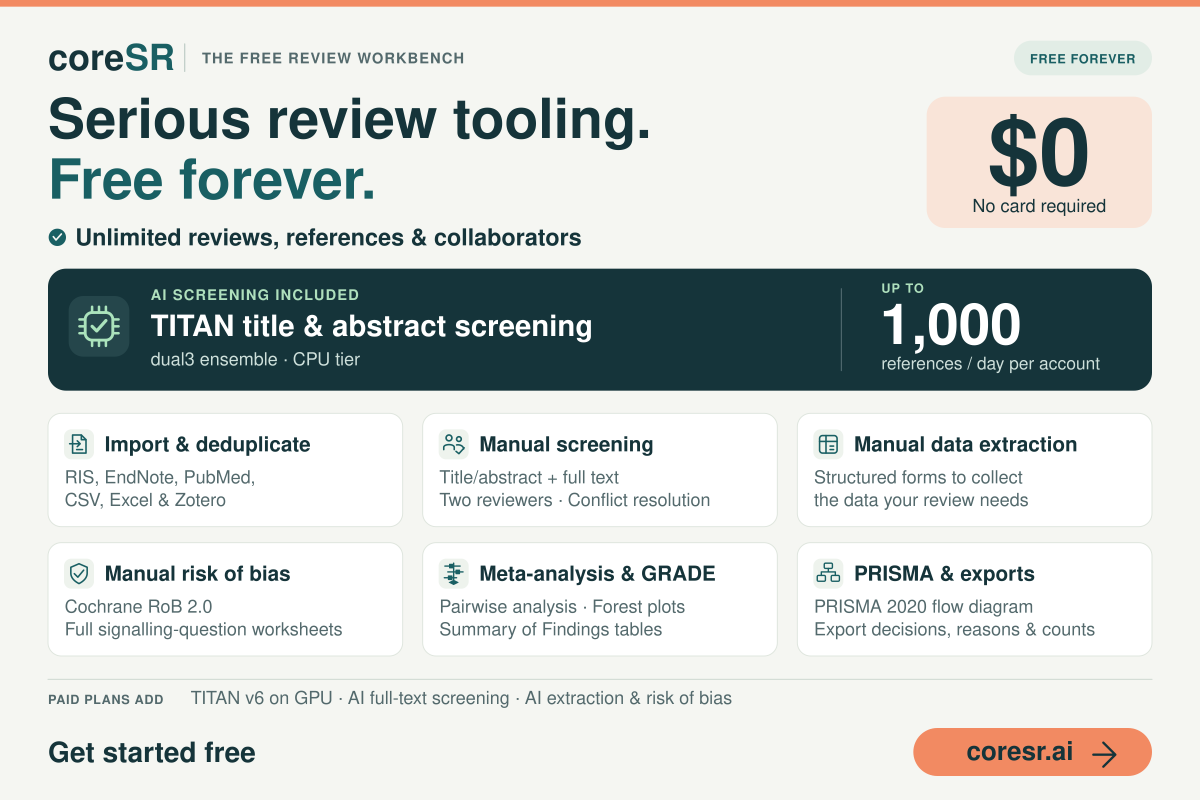
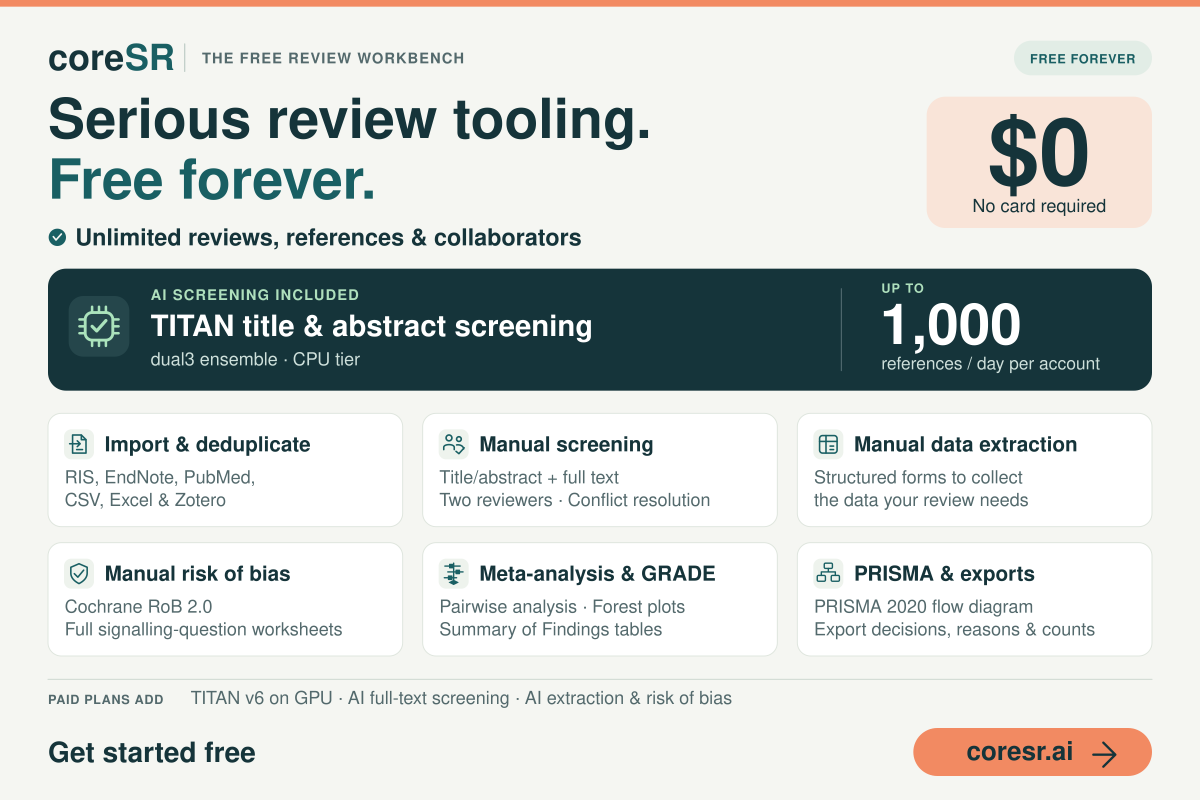
CoreSR is free forever: unlimited reviews and collaborators, TITAN AI screening for up to 1,000 references a day, dual screening, RoB 2, meta-analysis, GRADE and PRISMA. A free alternative to Covidence-style tools. No card needed. https://t.co/CvgrsaRwyw
@hrs_journal Interesting that 1-year risk in 30-day survivors was OR 0.97, so the excess looks early. On VA after PCI being worst: were those mostly crude ORs? Late VA might just mark failed reperfusion, bigger infarcts or shock rather than timing itself.
@ABsteward@BradSpellberg@DrToddLee@zacroBID Six RCTs, and the 300 vs 200 mg/day nitrofurantoin split is a between-trial comparison. Do the 300 mg trials also differ in era, resistance or how cure was defined? The simplest reading of RR 1.22 at 28+ days may be which trials, not which dose.
Correia, Wallach et al. built applicability matrices (confounding 28, information bias 21, selection 6) and tried them on 3 published studies. Open access: https://t.co/TGVy9kXdXZ
#SystematicReview#MetaAnalysis#EpiTwitter
A new review mapped 55 quantitative bias analysis methods for summary-level data. Only 4 were rated applicable to meta-analyses of observational studies, and 9 to hazard ratios.
So when a review pools adjusted HRs, what does a line about "residual confounding" actually buy us?
New this week at CoreSR: TITAN-SR v6, ROB BERT v6 and GLASS v3, with what the evidence does and doesn't yet show for each.
Weekly update 👇
https://t.co/nGOQlJXRJI
Launching SynthesisBench: an open screening benchmark across 85 systematic reviews, 2,327 records and 26 systems. Top Youden's J: TITAN-SR v6 0.879, Claude Opus 5.5 0.831, GLASS-SR 0.827. Run by CoreSR. https://t.co/5yCg3GT4Dt
@BjsOpen Useful paper. One parsimony check: 115 of the 135 "non-completed" trials were status unknown, and 38 of those turned up published anyway. How much of the ~46% is abandoned trials vs registries nobody updates? The OR 4.28 for changed endpoints feels like the sharper signal.
A living review is only as current as its slowest step. A new trial lands: screen it, extract it, appraise it, rerun the model, re-rate certainty.
If those steps sit in five tools, the update stalls. In CoreSR they sit in one project, so each update starts where the last ended.
@FeliceGragnano If the original contrast was Asian vs non-Asian trials, it's between-trial: dose, era and endpoints differ too. Within-trial IPD interaction is the fairer test.
One question: how wide was PANTHER-2's regional interaction CI? "Not significant" can also mean underpowered.