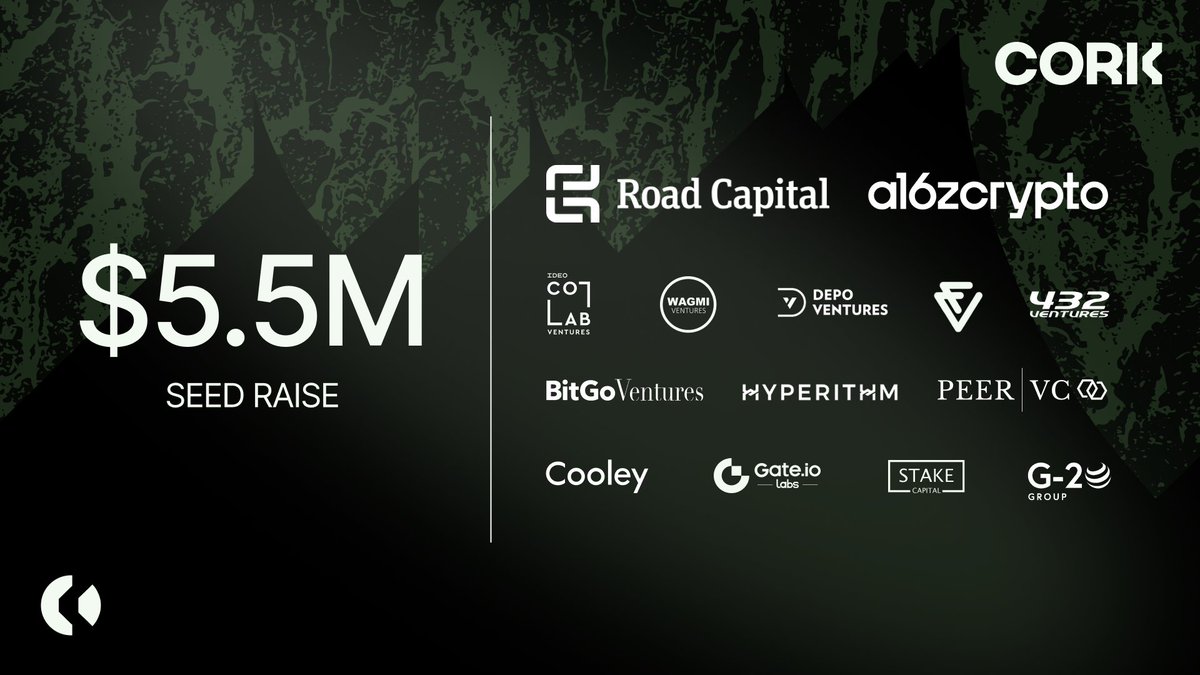
Cork has raised $5.5M to build the missing tokenized risk infrastructure for digital assets.
Led by @RoadCapMgmt and @a16zcrypto CSX, Cork has raised from investors who recognize the market opportunity of introducing tokenized risk into the digital asset ecosystem.
Two AI agents have agreed on a price for risk, with no human involved.
One needed protection. The other quoted a premium and took the other side. The whole loop ran on its own, from request to settlement.
We dive in deeper in this week's newsletter, publishing Thursday. Sign up: https://t.co/djBoPyQFcW
Onchain finance has risks that can be observed too: depegs, redemption delays, oracle failures, liquidation cascades. Few of them have both a price and somewhere to trade it yet.
In 1973, Black and Scholes published a formula for pricing options.
Journals had rejected it first. That year the CBOE opened and listed standardized options. Before, option markets were small and illiquid.
After, they grew fast. A price plus a venue made risk a market 🧵
Cboe’s own history credits the pairing: the Black-Scholes-Merton pricing model plus the liquidity and transparency of exchange trading. A way to price the risk, and somewhere to trade it.
AI agents are now trading risk onchain.
They're creating markets, buying liquidity coverage, and charging premiums. All by themselves with no human intervention.
Find out more only on the Cork newsletter. Sign up here: https://t.co/jHHk9X3eKa
In an efficient market, a higher yield means more risk.
In DeFi, that’s sometimes obscured.
@Philfog on @TheCryptoMavs on why making risk tradable lets the market price it.
What that looks like in action:
• A depeg becomes a redemption at a known strike.
• A redemption queue becomes an exit into liquid collateral at NAV.
• A loop unwinds at a known price instead of cascading.
• A bridge failure becomes a direct redemption.
Cork turns each risk into a market.
Today, the risk surface area in onchain finance is vast.
Redemption queues, bridge and cross-chain settlement, depegs, liquidation cascades, and more. The asset side has diversified fast, but there’s still no general way to price, transfer or trade the risk.
On Sept 4, a faulty price feed gave @vesuxyz wrong prices for two minutes.
That liquidated 47 positions holding about $3M of collateral.
Vesu: “The prices being fed in were wrong. Two minutes was all it took.”
It later recovered 95% of the lost assets.
Onchain, code does exactly what the price tells it to.
Nobody can defend all of onchain finance against intertwined, cascading events like this; they’re a consequence of composability. But individual positions, protocols, and strategies can be protected with risk infrastructure, so protection is in place before a cascade starts.
Every onchain financial tool shares one macro risk: composability.
Collateral, oracles, lending and derivatives plug into each other. That’s the opportunity, but a move in one place can also affect another automatically, with no human involved. October 10, 2025 shows how fast 🧵
That’s the double-sided coin of composability. The same connections that let capital move freely let risk move freely too. Looking at the most severe cases shows the need (and the opportunity) for risk infrastructure built natively for onchain assets.