Entrada Libre
Miércoles 5 de Noviembre
8am-10am
Auditorio Virginia Gutiérrez
Edificio de Posgrados "Rogelio Salmona" (225)
Universidad Nacional de Colombia
https://t.co/mWXxBZFod3
https://t.co/1R27DYXyOG
This article presents a model of consumer behavior that incorporates anchoring and price effects in describing purchase demand. The model, called F-Cap, for Finite Consumption Anchored to Price, ...
¿Cómo juega la clase social en la elección de nuestros amigos? ¿Cómo se mezclan diferencias de personalidad con diferencias de clase social? En este artículo le hincamos el diente a estas preguntas con el gran @CorredorJavierA 🧵https://t.co/G5Xmm1Jcpz
This is such an excellent article on economic inequality.
Social media has focused our attention on conflict *between* generations (Millennials vs. Boomers), because that drives clicks. But the real source of economic inequality has always between *within* generations.
And the economic inequality *within* millennials is actually much worse than the economic inequality *within* boomers.
"In other words, millennials might be doing better than their predecessors—but they also might be the most economically divided generation that America has ever seen."
If you want to fix this, you'll need to think very differently about policy solutions.
https://t.co/2f7jKzIYNg
I’ll be recruiting one (or two!) Ph.D. student(s) to start in Fall 2025!
My lab (@cam_lab_umass ) studies culture, cultural evolution, morality, AI, and historical psychology.
Programming background is a plus, love for parentheses (and hyphens) is a must!
Deadline: Dec 1st.
@MajoAlRiv y la extracción de recursos a través de cosas como el "Consorcio Colombia" que a nombre del Open Access terminan transfiriendo recursos del sur global a multinacionales, porque el sistema están organizado para bloquear artículos ya aceptados si las universidades no pagan...
@George76766831@jayvanbavel Most research on social class nowadays controls for prior academic achievement or other proxies to intelligence. Undermatching research for instance shows that low-SES individuals are undematched, even when you control for SATs.
https://t.co/P8y4zALDzL
"La clase social es un obstáculo fundamental en el mundo académico. Los académicos de primera generación tienen menos probabilidades de acabar siendo profesores, en gran medida porque no tienen las mismas redes sociales que los hijos de familias con estudios superiores."
Social class is a fundamental career barrier in academia!
First generation college graduates are less likely to end up as a faculty member—especially at a top-ranked university—largely because they simply don’t have the same elite social networks as kids from highly educated families.
@estoenlinea 1... lesionan a un jugador y no cobra la falta... piden atención y sigue el partido ... la pelea del final es su responsabilidad por no controlar a los Uruguayos...
It is crucial to distinguish between healthy forms of national identity and unhealthy forms--like collective narcissism.
National narcissism, is described as “the belief in the greatness of one’s nation, and that one’s nation is exceptional compared to others”. It is an obsession with group status rather than genuine concern for group members.
We explain why national narcissism is strongly linked to conspiracy theory beliefs while national identity is linked to support for group members and healthy actions:
https://t.co/dlcADsv1VY
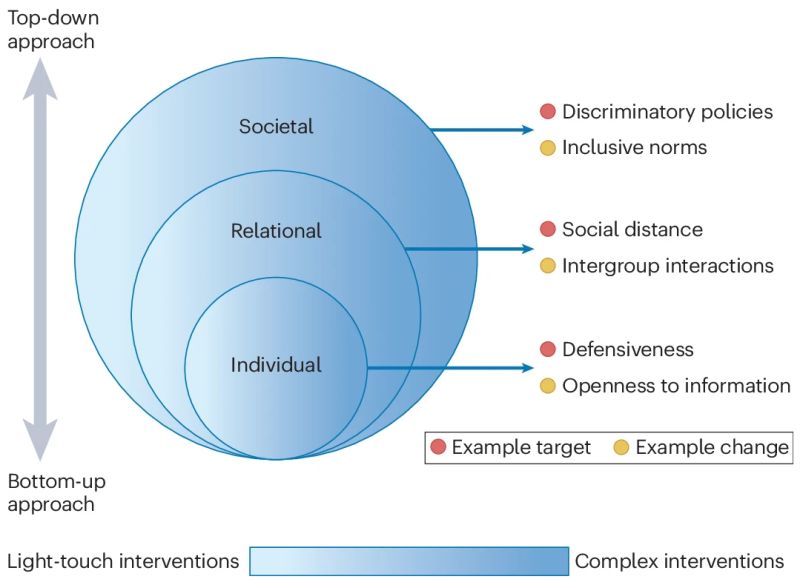
Intergroup conflict erodes trust and cooperation at both the individual and societal levels, hinders effective societal functioning and threatens the well-being of individuals.
This new paper describes the critical features necessary for successful intergroup interventions. Specifically, they consider the importance of identifying meaningful intervention goals (what), crucial characteristics of intervention recipients (who) and key contextual features (where) for optimizing interventions.
A huge challenge is motivation: many people are often reluctant to engage in intergroup interventions and to change their deeply ingrained worldviews and perspectives. I see this all the time. We don't want to engage with people different than ourselves.
Therefore, intergroup interventions that accentuate a value important to individuals and provide people with a sense of positive identity and worth might be effective in contexts where an individual’s positive identity is threatened.
Read the full article here: https://t.co/lTU2dKHvis