Our vision: bring back what SemMedDB was.
For a decade the U.S. National Library of Medicine extracted 130M claims from PubMed. It stopped being maintained at the end of 2024, and nothing replaced it.
We are rebuilding it in the open. Every claim is written in full to Ethereum, so anyone can reconstruct the whole graph without us — a record for human health that outlives the people who built it.
Day 4 on Ethereum. 188 claims from 17 miners, 32,753 bytes,
one transaction, $0.41 of gas.
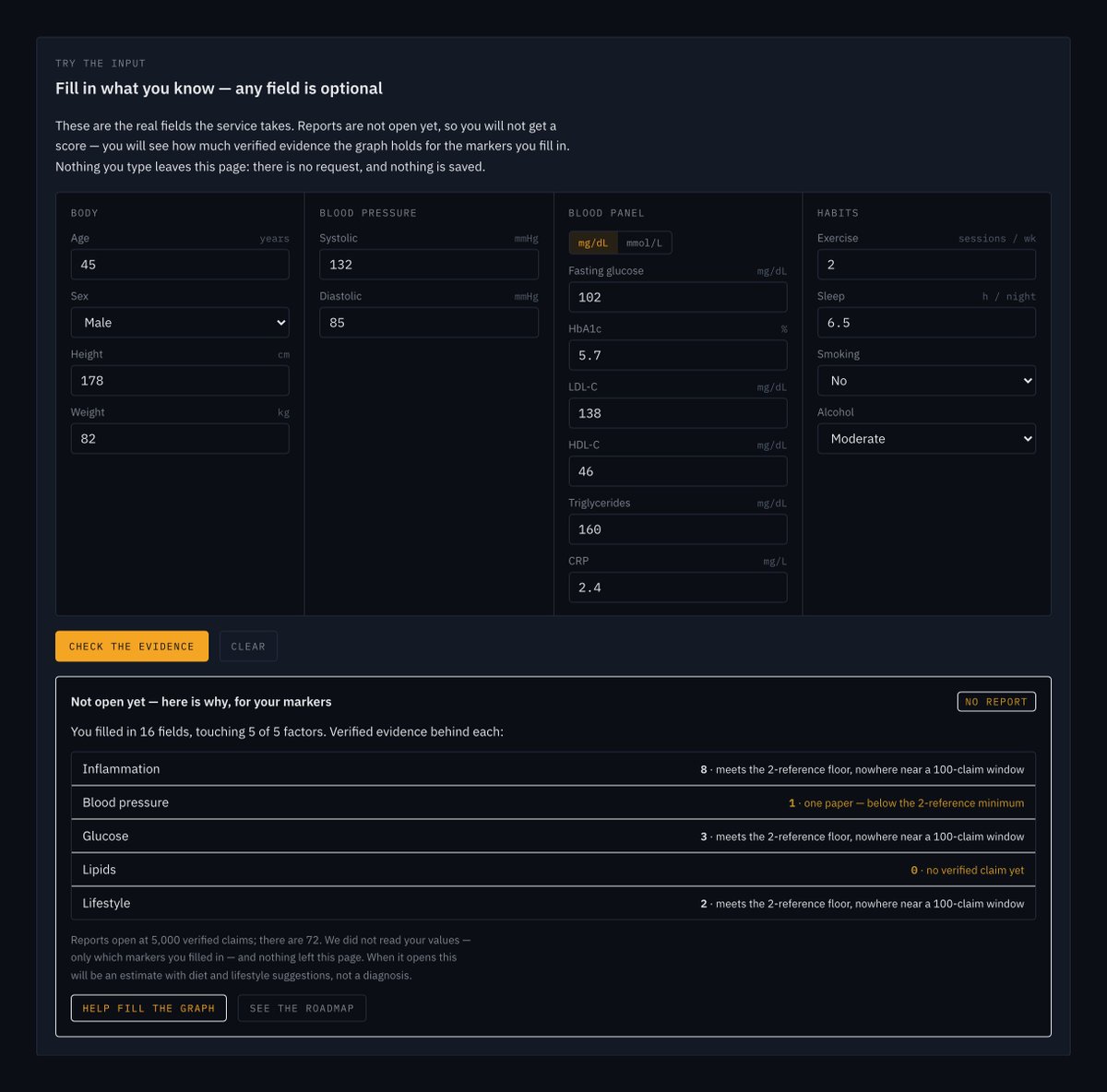
Three times yesterday. And all five factors a personal
report needs — inflammation, blood pressure, glucose,
lipids, lifestyle — now have verified claims behind them.
307 verified, 4,693 to go.
https://t.co/2fpFtgNBJ5
NLM's SemMedDB extracted 130M structured claims from PubMed
for a decade. It stopped being maintained at the end of 2024,
and nothing replaced it.
We're rebuilding it in the open. Free Chrome extension, no
API key, no account.
Supplement pages cite a study that cites a review that
cites nothing.
We're building the opposite: an AI reads the paper, pulls
out the causal claim, and it goes on-chain in full — the
text, not a hash. Wrong claims stay visible too.
Two people, reading two different papers, independently
submitted the same claim:
exercise → activates → sirt1
That's what corroboration looks like when the record is
public. 307 verified claims so far, each one traceable to
its paper and to an Ethereum transaction.
The data is infrastructure too.
NLM's SemMedDB extracted 130M structured claims from PubMed for a decade, then stopped being maintained at the end of 2024. Nothing replaced it.
We're rebuilding it in the open — mined by anyone, written to Robinhood Chain, anchored daily to Ethereum.
Trading has dried up, so there are no fees coming in to fund the mining pool. On the original rule, the reward reserve wouldn't last long.
To keep mining going long enough to build the graph, daily rewards are now a fixed 3,000,000 $CXS, split by score as before.
Day 3 on Ethereum. 66 claims from 14 miners, 11,145 bytes, $0.17.
Something new: the claims started to meet. 18 of them name SIRT1 at one end, and two miners reading two different papers independently submitted the same one:
exercise → activates → sirt1
That is what corroboration looks like. Longevity Pro opens at 5,000 verified claims. There are 105.
https://t.co/GtSrnYW2uA
Missed this last night.
The API is second on the roadmap, gated on the graph rather than a date.
On manuscripts we'd go the other way — AI-written papers are already a problem for PubMed. What we want out of the graph is hypotheses a lab can test, each one traceable to the papers and transactions behind it.
https://t.co/Cab6pL4JaU
The same applies to science.
An AI reading a paper can be wrong. So we write what it
extracted into an Ethereum transaction in full — the text
itself, not a hash — once a day.
You don't have to trust the model. Decode the input and
diff it against the paper.
https://t.co/nsedAt1YON
Longevity Pro: your markers in, advice out, every line traceable to a paper and the transaction that recorded it.
$15 of $CXS per report. Half is burned, half pays the miners whose claims it was built from.
It opens at 5,000 verified claims. The page shows how far off that is — and you can move it.
https://t.co/zgKrIIRZ2J
Our vision: bring back what SemMedDB was.
For a decade the U.S. National Library of Medicine extracted 130M claims from PubMed. It stopped being maintained at the end of 2024, and nothing replaced it.
We are rebuilding it in the open. Every claim is written in full to Ethereum, so anyone can reconstruct the whole graph without us — a record for human health that outlives the people who built it.
We built three products on it and switched none of them on.
A personal longevity report, a graph API, a hypothesis engine — all three exist as code. They open in that order, each on a thicker graph than the last. Longevity Pro needs 5,000 verified claims. There are 72 triples.
No dates on the roadmap. The gate is the graph.
https://t.co/Cab6pL4JaU
One limit, stated plainly: 1.1.8 shows your $CXS but cannot
send it. The extension was built without transfer on purpose
— a browser wallet that can move funds is a bigger target.
Sending comes in 1.1.9. Until then, export your key into a
wallet you already use.
We will never DM you, and never ask for it.
Cortex DeSci Miner 1.1.8 is live. It reads the right contract
now and updates itself.
If it showed you 0 $CXS, the tokens were always there. The
chain was right and the client was wrong — that is the whole
reason we publish the raw record.
https://t.co/rWSS7UXz49
Day 2 on Ethereum. 65 claims, 11,651 bytes, one transaction.
Day 1 was 10.
nrf2 activation — associated_with — poorer overall survival
confidence 99
Cost to put the full text on L1: $0.17. Not a hash — the text.
https://t.co/uuo4Q49dSu
We found the display bug while auditing the extension
before submitting the update.
Nothing is stuck. If you want the tokens elsewhere, the
extension can export your key.
We will never DM you, and never ask for it.
Mining rewards now land in your wallet automatically.
No claiming, no gas, nothing to do.
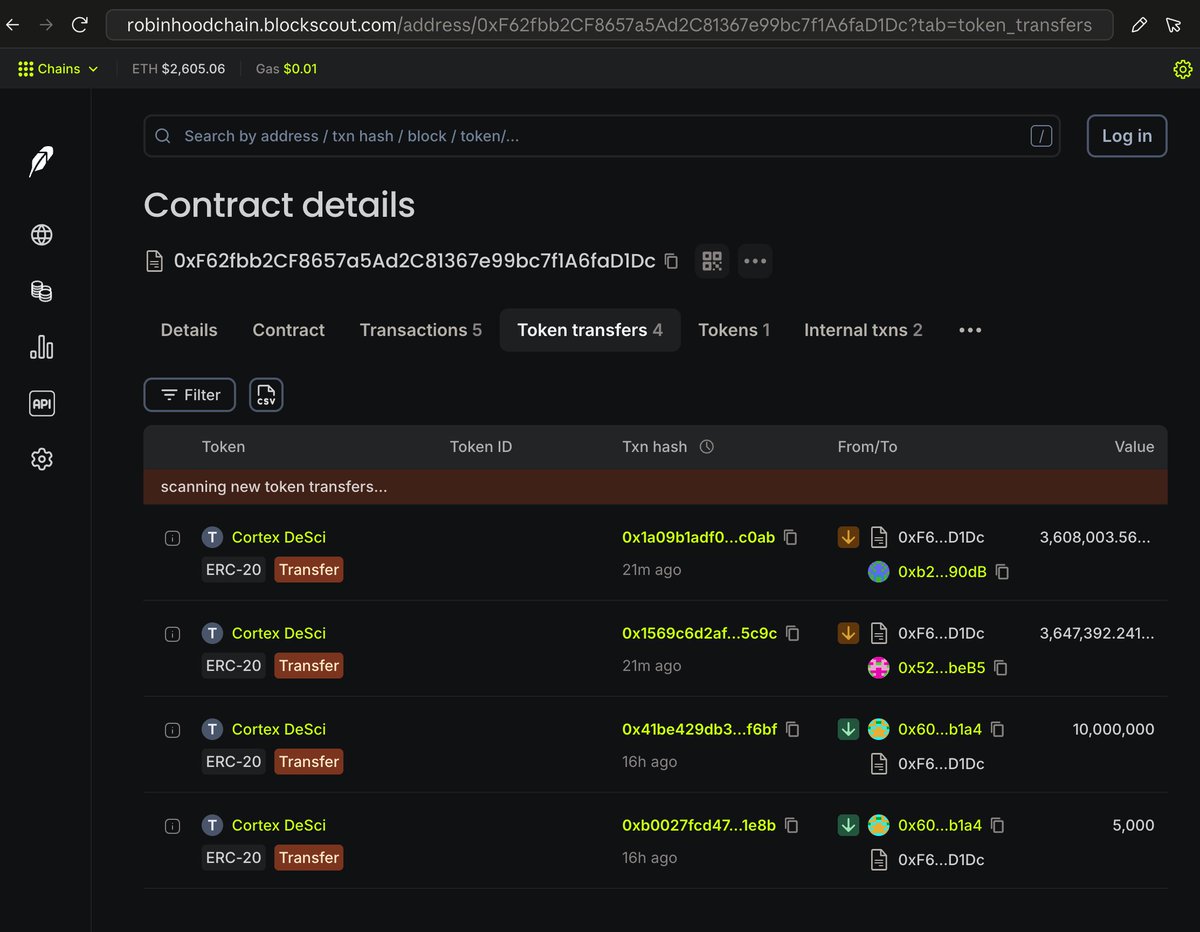
If the extension shows 0 $CXS, the tokens are still there — it reads the old 2026 contract address. Version 1.1.8 is in review with the Chrome Web Store and will update itself.
If you started mining today, you are not in this round.
Settlement covers the previous day's accepted claims, so
today's work pays out next cycle.
Either way the explorer is the real number:
https://t.co/xO0L0TJxmq