Before you delete a memory, answer three questions: where it came from, whether you're deactivating or erasing it, and where else it still lives.
Cortrix records where each extracted memory came from and, when one is invalidated, why. It's open source:
https://t.co/TUKNpoyqNx
A new benchmark asked six memory systems to delete specific memories. None passed more than 1.5% of those requests end to end.
This week's Semantic Tech Insights: what Tiger Data, Zep, OceanBase and three new papers show about deleting agent memory.
https://t.co/K04jpzNnLI
Three fields do the work: results, coverage_ratio, and namespaces_failed. After the Quick Start you can see all three with three curl commands. They're in the post.
The Cortrix project: https://t.co/TUKNpoyqNx
Your agent asks two places for an answer, and one of them doesn't respond. Fail the whole request? Cortrix returns HTTP 200 with what it found, plus how complete the result is, what failed, and whether a retry is worth it.
https://t.co/A3DKrKWEms
Measured on nDCG@10: write-time LLM inference plus query-time LLM reranking is 31.0% above dense + full-text on SciFact and 26.1% above it on NFCorpus. The write-time step alone adds 0.0265 on SciFact and is flat on NFCorpus.
The Cortrix project: https://t.co/TUKNpoyqNx
A chunk says "requests filed after the period above are handled under Section 4." The user asks whether a 40-day-old purchase can be returned. Cortrix has an LLM add context and likely questions when the document is written, so that chunk can be found.
https://t.co/ypVMGHON7Z
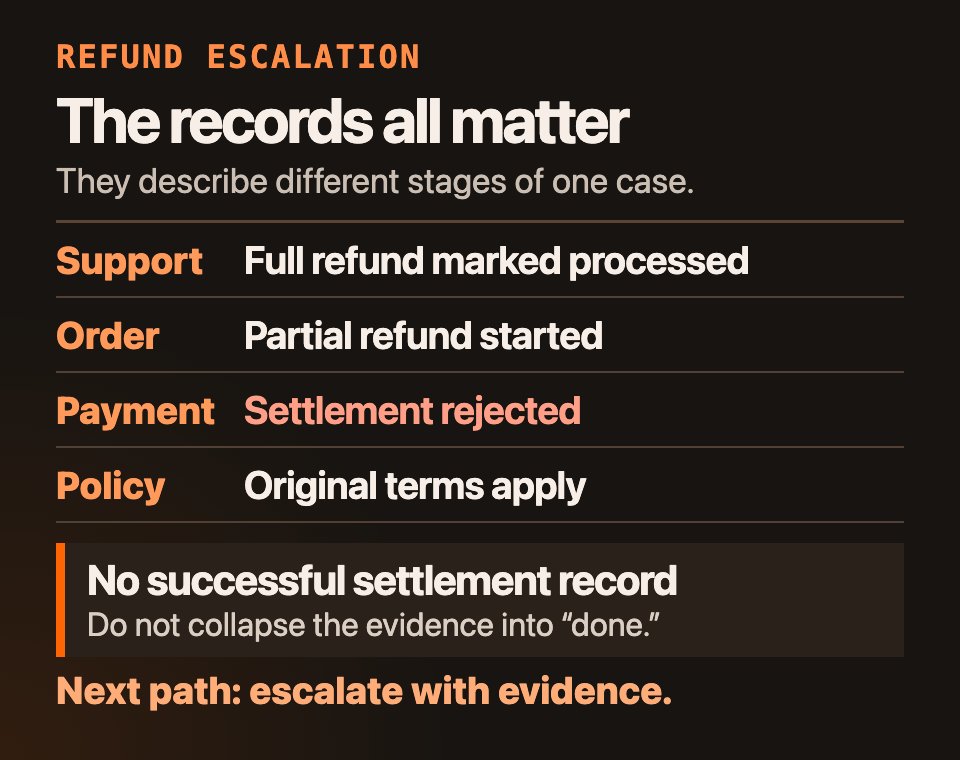
Support says “processed.” The order shows a partial refund. Payment was rejected. None of those records should disappear. A decision model can flag the conflict; it can’t invent settlement or approve compensation.
The Cortrix project: https://t.co/TUKNpoyqNx
One refund. Three records that don't agree. The agent needs all three before it acts. Cortrix retrieves the sources; Jev or Laya may choose an allowed next step; code holds the boundary. Here's the handoff.
https://t.co/RT3zwXZsVZ
Cheap tokens do not make a cheap system. Placement, latency, retries, fallback, calibration, and the work actually removed all matter.
Full reasoning: https://t.co/xmhPMTpGQ0
GitHub: https://t.co/TUKNpoyqNx 4/4
Jev can make typed decisions over a candidate set. It still cannot retrieve a document that never entered that set.
We reviewed where Jev and Laya fit in Cortrix. We’re not adopting Jev or starting a Laya evaluation—for now. 1/4
TypeSafe’s CLERC example moves top-10 accuracy from 38% to 62% after BM25 retrieves 30 candidates. Useful result. Narrow result.
Third-party tests also do not show a stable free win over bge-m3. 3/4
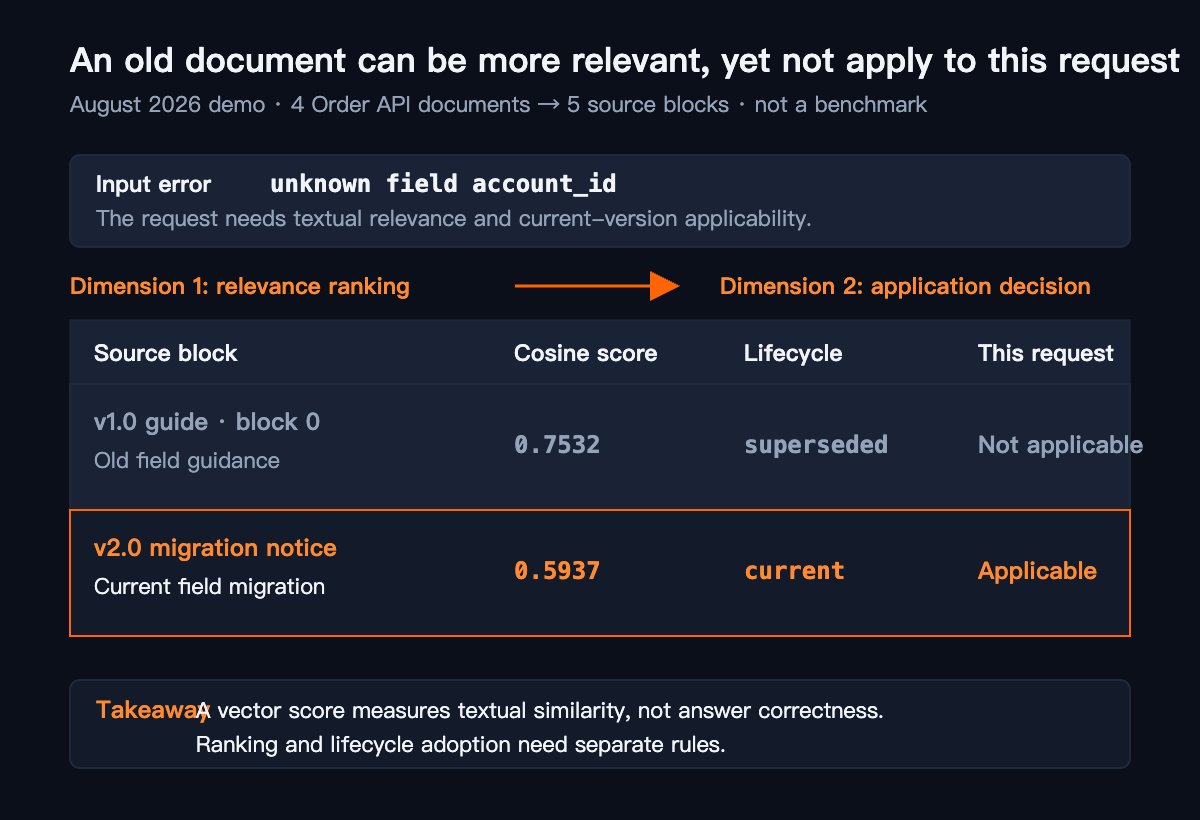
Reranking still put the old guide first. The LLM changed the order; the application applied a lifecycle rule.
Those stages need separate evidence and owners.
Explore Cortrix: https://t.co/TUKNpoyqNx
Vector search can return the closest document—and still send an agent back into the same failure.
In a four-document demo, an old guide outranks the current migration notice. Similarity worked. Semantic storage keeps lifecycle evidence connected.
https://t.co/4jmX96YEmT
BEIR FiQA: Recall@10 +24.4%, nDCG@10 +23.7% across our published July and August runs. These are cross-round retrieval results, not a controlled RC2-only comparison.
Cortrix: https://t.co/TUKNpoyqNx
RC2 context: https://t.co/N8nDb9QOdF
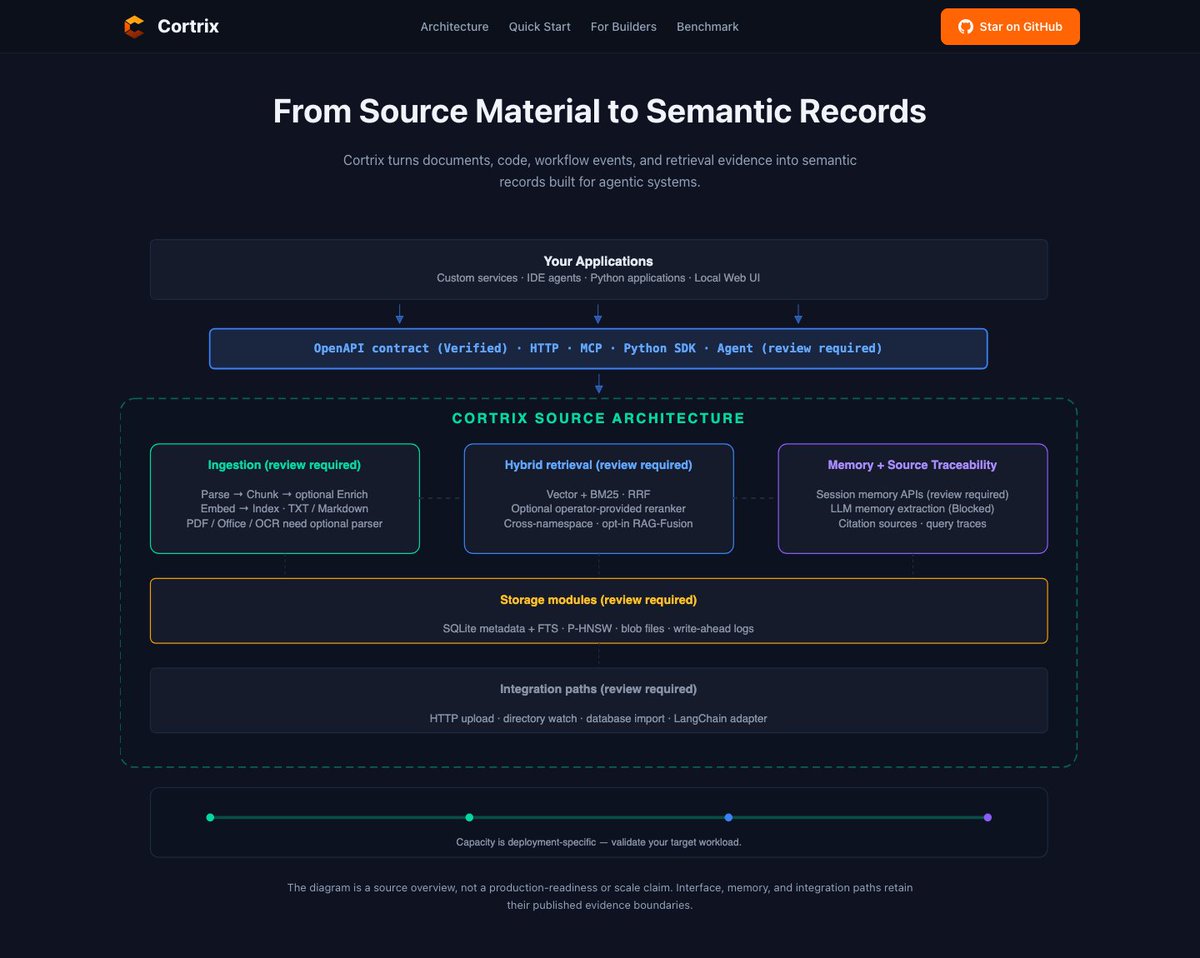
What would storage look like if it were designed around the context AI agents need—not just files, rows, or isolated vector matches? I’ve been building @Cortrix_AI around that question: agent-native semantic storage built for AI agents.
Introducing agent-native semantic storage built for AI agents.
Our first public release candidate brings semantic ingestion, hybrid retrieval, memory, traceability, and Agent-facing paths into one engine design.
Explore the source and Quick Start: https://t.co/TUKNpoyqNx