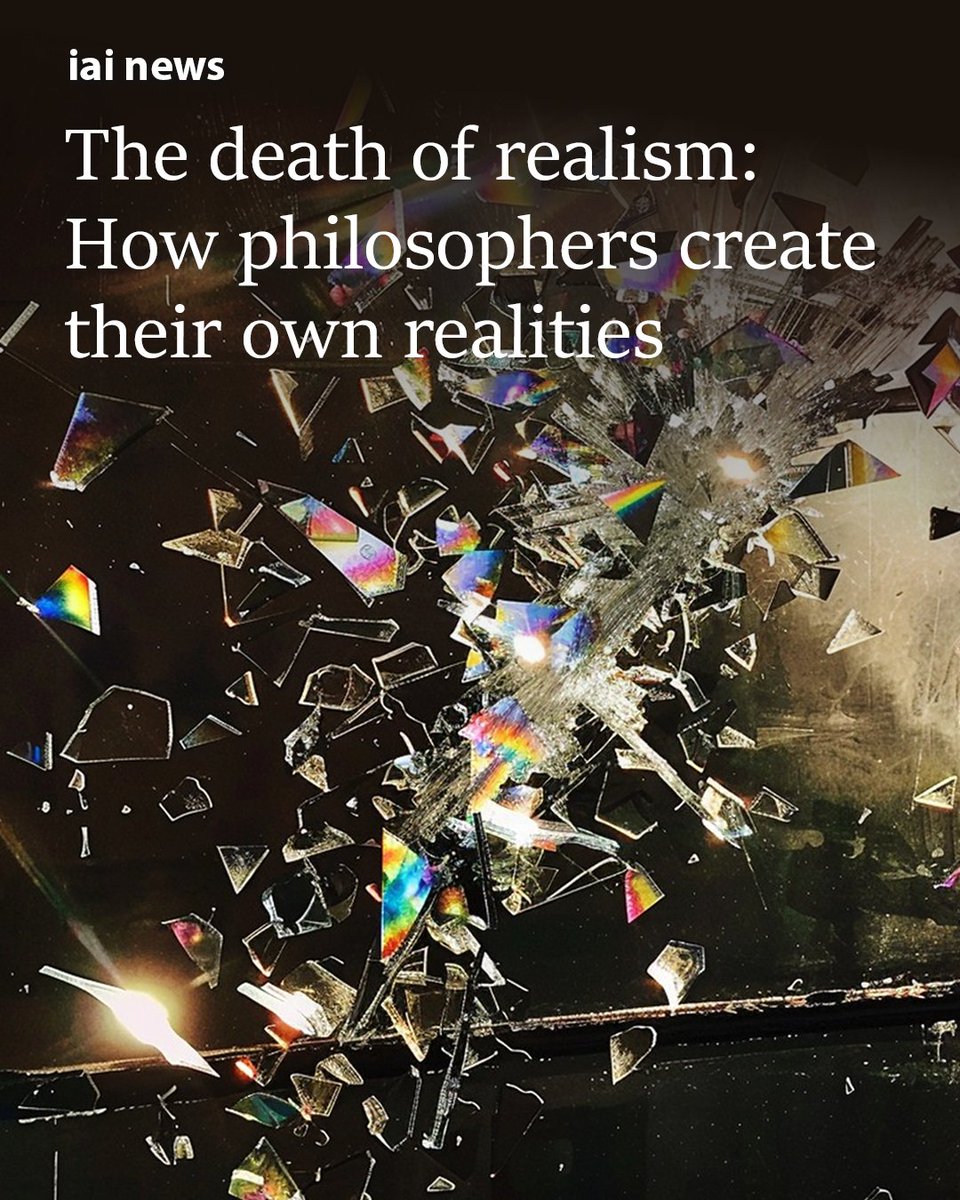
“Philosophers are not just there to point at reality, they must also become builders of possibilities, architects of the universal.” | https://t.co/dE9CgREpdt
The various schools of contemporary philosophy have a fundamental similarity: realism.
This is also their fatal flaw, argues philosophy professor Isabelle Thomas-Fogiel.
Despite the defences of philosophers such as Timothy Williamson, the problem of self-reference is inescapable when making statements about ‘the world.’ For this reason, Thomas-Fogiel argues, realism has no future in philosophy.
📷 Session 2 of the Valdai Club expert dialogue, titled “Sovereignty in an Interconnected World: Between Protectionism and Openness.”
Photo gallery — https://t.co/93xRjaZcsr
Video — https://t.co/km7xLqjx2K
#valdaiclub#sovereignty
📷 On June 4, 2026, the Valdai Club’s session “Shared Future, Universal Good: How to Manage Competition for Resources and Spaces” within the framework of the #SPIEF2026 took place.
Photo gallery — https://t.co/JIAhYmctMm
Video — https://t.co/PgDHkSYkbd
#SPIEF#valdaiclub
Articles and books for a good summer or winter read: Thought-provoking, perhaps controversial, and certainly worth reading!
"The Moral Consequences of Economic Growth" by Benjamin M. Friedman.
"In clear-cut prose, Benjamin M. Friedman examines the political and social histories of the large Western democracies–particularly of the United States since the Civil War–to demonstrate the fact that incomes on the rise lead to more open and democratic societies. He explains that growth, rather than simply a high standard of living, is key to effecting political and social liberalization..."
https://t.co/y4tTtGlUS9
The effective way the clarinet player does a musical call and response to the singer is just mesmerizing.❤️🎶✨
"Tu vuo' fa' l'americano" by Renato Carosone, beautifully performed by Hetty and the Jazzato Band.
For centuries we viewed technology as a tool, but a rising movement argues it is becoming the next stage of human evolution. | https://t.co/Uc0DuCbjam
Accelerationists call for rapid innovation to ignite a new form of consciousness, while transhumanist thinkers like Harari and Kurzweil predict a future where humans merge with machines and even imagine a “digital God.”
Critics warn these ideas are dangerous fantasies and challenge us to consider whether technology is truly redefining what it means to be human or simply offering sci-fi dreams.
Taking part in the debate are transhumanist pioneer Zoltan Istvan, physicist and consciousness researcher Àlex Gómez-Marín, philosopher of mind Susan Schneider, and Softmax co-founder Adam Goldstein.
Una reconstrucción de los rasgos de Platón como escritor, poeta y mitólogo —más allá de su faceta como pensador— fruto de cuatro décadas de estudios platónicos. Existe también un Platón secreto que remite su palabra a discípulos e interlocutores.
👉https://t.co/iTaqVZZCJC
Fulminante Genealogie des Liberalismus in seiner politischen, wirtschaftlichen und ästhetischen Formationsphase, konzis, stringent, rhetorisch funkelnd, spannungsreich - und logisch, dass der analogische Sprung in die Gegenwart einer nüchtern-verzweifelten Grabrede gleicht.
#NewPublication
The Race for Universal Monarchy
Apocalypticism and the Ottoman–Habsburg Rivalry in the Sixteenth-Century Mediterranean
Ebru Turan, Columbia University Press, 2026
https://t.co/zsm0d9izf9
https://t.co/p3BDXmcArt
https://t.co/3uPupr7mj1
“Just one thing; don’t follow the existing research. Think for yourself. That’s very important. Another thing I have to say is, if you want to be a great scientist, you have to see others, discuss. Recognise that this is a great scientist. This is my advice.”
Some pieces of advice from Susumu Kitagawa to all young students aspiring for a career in science.
Discover more: https://t.co/nRdMYGiQeB