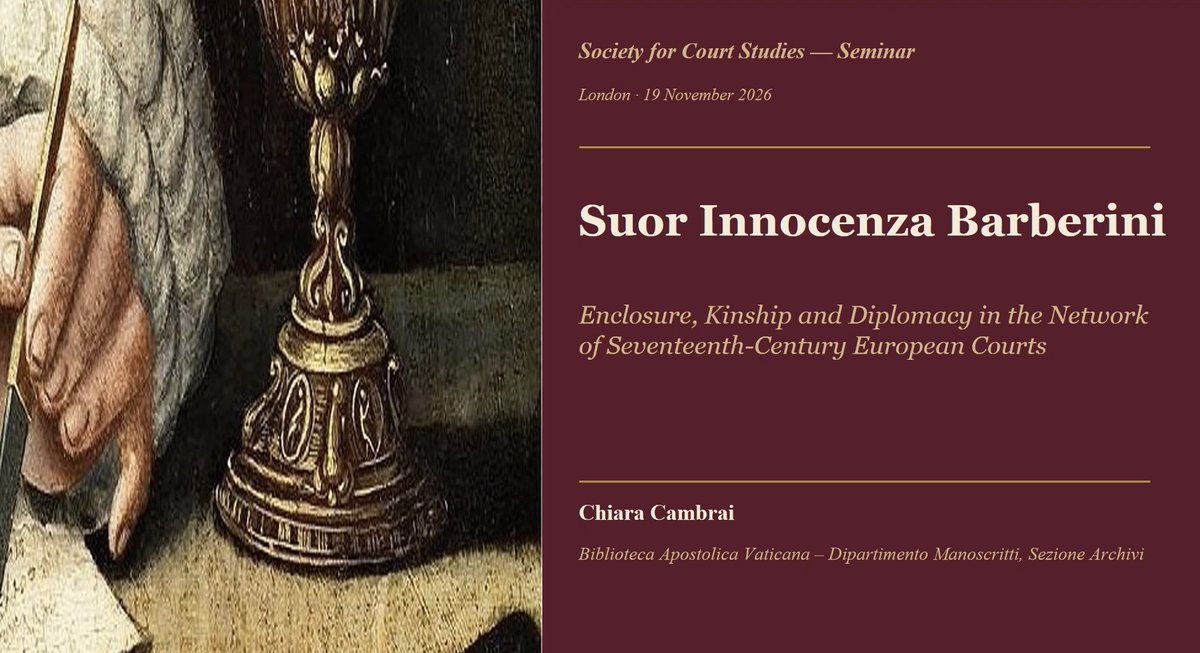
In Rome Sister Innocenza sought her brothers to be prudent and patient. The Barberini family fortune now depended on both God and the French monarchy. Chiara Cambrai on "Enclosure and Influence".
In Rome Sister Innocenza sought her brothers to be prudent and patient. The Barberini family fortune now depended on both God and the French monarchy. Chiara Cambrai on "Enclosure and Influence".
The death of Urban VII marked the end of Barberini power. The male Barberini were forced to leave Rome and seek protection from France and Cardinal Mazarin. Sister Innocenza stayed in Rome as Prioress. Chiara Cambrai on "Enclosure and Influence".
In 1639, Camilla Barberin/Sister Innocenza and her sister leave Florence for Rome. She is elected Prioress of a new carmelite convent in Rome. A mediator between Pope and Grand Duke of Tuscany now left. Chiara Cambrai on "Enclosure and Influence".
Camilla Barberini was active in everyday power and patronage. Her brother's position as Cardinal Nephew was naturally essential - though their uncle Urban VII was always most important. Chiara Cambrai on "Enclosure and Influence".
Camilla Barberini followed Roman politics closely. She worried about a perceived poison attempt on her uncle the Pope and aslo reported on astrology. The Pope's survival was of course crucial for the Barberini nepotistic system. Chiara Cambrai on "Enclosure and Influence".
After her uncle had been elected pope, Camilla Barberini immediately used her influence through her brother the cardinal nephew to block the foundation of a new, competing Carmelite convent in Florence. Chiara Cambrai on "Enclosure and Influence". Chiara Cambrai
Camilla Barberini asked that the most sensitive letters be handled by the cardinal nephew or the Guardagna Bank. She was afraid the postmaster might read her letters... Her epistolary language changed over time according to risks and her family's position. Ciphers were also used.
Camilla Barberini's correspondence reveals both piety and a great ability to manage family matters. Her letters reveal a nun with considerably mangerial autonaomy. Chiara Cambrai on "Enclosure and Influence".
Camilla Barberini and her sister Clarice both entered the same convent. Chiara Cambrai on "Enclosure and Influence: Epistolary Strategies of Two Barberini Nuns in Seventeenth-Century Florence".
The Barberini had an territorial origin with some tensions with the Grand Duke of Tuscany. There was also a limit to nepotism - one day Urban VII would die... In fact in 1644. So planning had to be made through marriages etc. Chiara Cambrai on "Enclosure and Influence".
The cardinale nepote was a key in the system of papal power and diplomacy. Chiara Cambrai on "Enclosure and Influence: Epistolary Strategies of Two Barberini Nuns in Seventeenth-Century Florence".
How did papal nepotism function as a system of government? "It was a structural component of papal power". Chiara Cambrai on "Enclosure and Influence: Epistolary Strategies of Two Barberini Nuns in Seventeenth-Century Florence".
"Enclosure represented a particular form" of participation in family and politics. European branch of SCS lecture kicking off: Chiara Cambrai on "Enclosure and Influence: Epistolary Strategies of Two Barberini Nuns in Seventeenth-Century Florence".
European branch of SCS lecture kicking off: Chiara Cambrai on "Enclosure and Influence: Epistolary Strategies of Two Barberini Nuns in Seventeenth-Century Florence". "Barberini nepotism" around pope Urban VII is well studied, less so the role of women.
A hybrid lecture (in person & online) to pencil in in your calendar: Trond Norén Isaksen will delight & inform us about ‘FDR’s Royal Confidante: Crown Princess Märtha of Norway, Franklin D. Roosevelt and World War II’.
If you attend online, sign up here:
https://t.co/JMpp3bLxaC
If you would like to attend the in-person lecture at the Royal Anthropological Institute (50 Fitzroy St, London W1T 5BT) please email us at
[email protected]
Note this event has a limited capacity so pre-booking is essential.