MD/PhD Candidate at Stanford with @jkpritch • Studying pleiotropy + genetic architecture of complex traits • @KnightHennessy Scholar • Also runs a lot 🏃🏽♀️
HLA is the locus that everyone loves to hate, so it rarely gets invited to the GWAS party... There’s good reason for this. The region has extensive LD, high gene density and high polymorphism. (Thread + preprint link below ⬇️) (1/8)
For many traits there is a correlation between the number of duplications or loss-of-function (LoF) mutations someone carries, and their phenotype. Curiously, for most traits, these effects are aligned in the SAME direction. Why?
My postdoctoral work is finally out! Please consider retweeting.
I am very proud of this project. I want to thank my wonderful advisors @mbarnalab and @jkpritch and collaborators Theo Susanto, @xsui98, @WangXiaoLab, @spence_jeffrey_, and many others for a major team effort!
So big-ish news, I am happy to announce that I've submitted the first paper of my PhD!!! And now get the chance to write my first twitter tutorial. (Thread + Preprint link below)
In total, we identified 7,649 HLA associations across 647 traits. By releasing the association test results and code, we hope to provide a valuable resource with many interesting examples for future research and make the HLA region more accessible! (8/8) https://t.co/k2HsqJqV6W
We also highlight examples of clinically-relevant findings from these results, including examples of haplotypes that differentially contribute to inflammatory bowel disease and one of its complications, primary sclerosing cholangitis. (7/8)
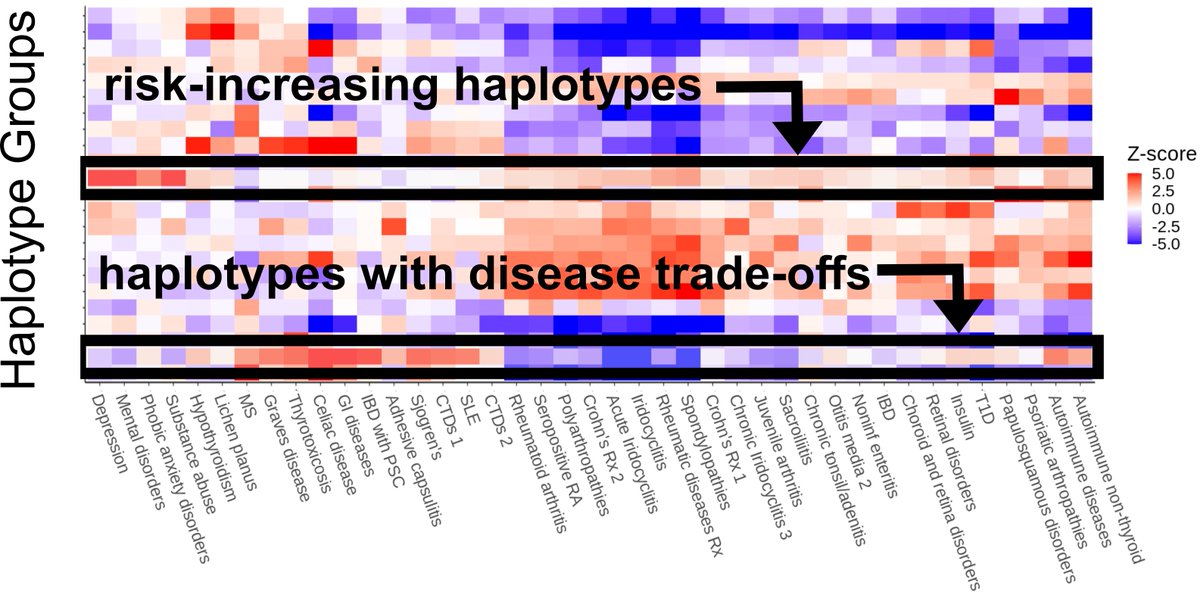
We found some haplotype groups had only risk-increasing effects across associated traits. We also identified haplotype groups that showed evidence of risk trade-offs for a breadth of diseases, with associations protective for some diseases and risk-increasing for others. (6/8)
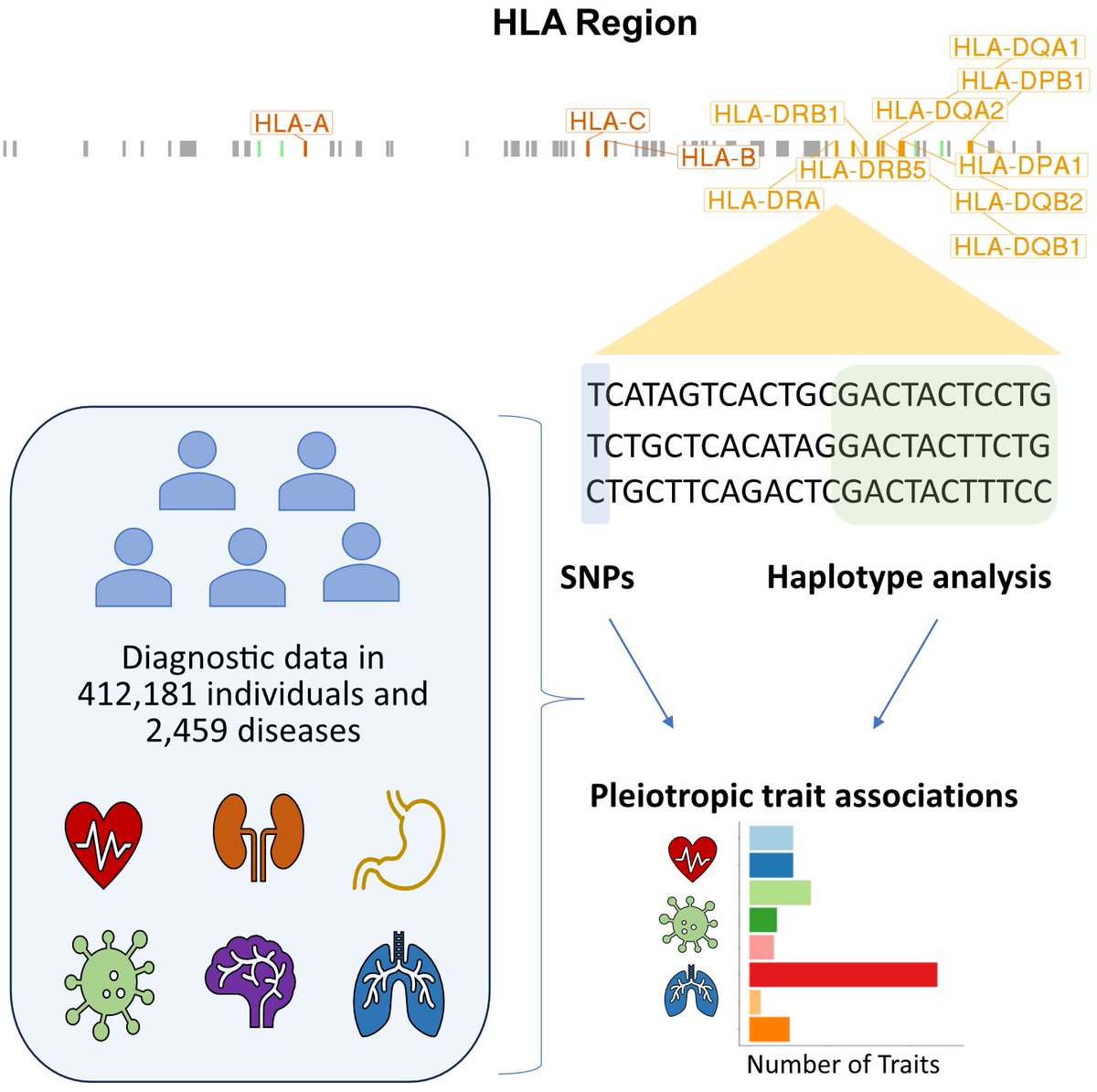
To investigate patterns of pleiotropy across diseases, we wanted a method that captures the full complexity of variation in the region. Therefore, we developed a haplotype-based association analysis, in addition to performing disease associations with SNPs and HLA alleles. (5/8)
HLA is the locus that everyone loves to hate, so it rarely gets invited to the GWAS party... There’s good reason for this. The region has extensive LD, high gene density and high polymorphism. (Thread + preprint link below ⬇️) (1/8)
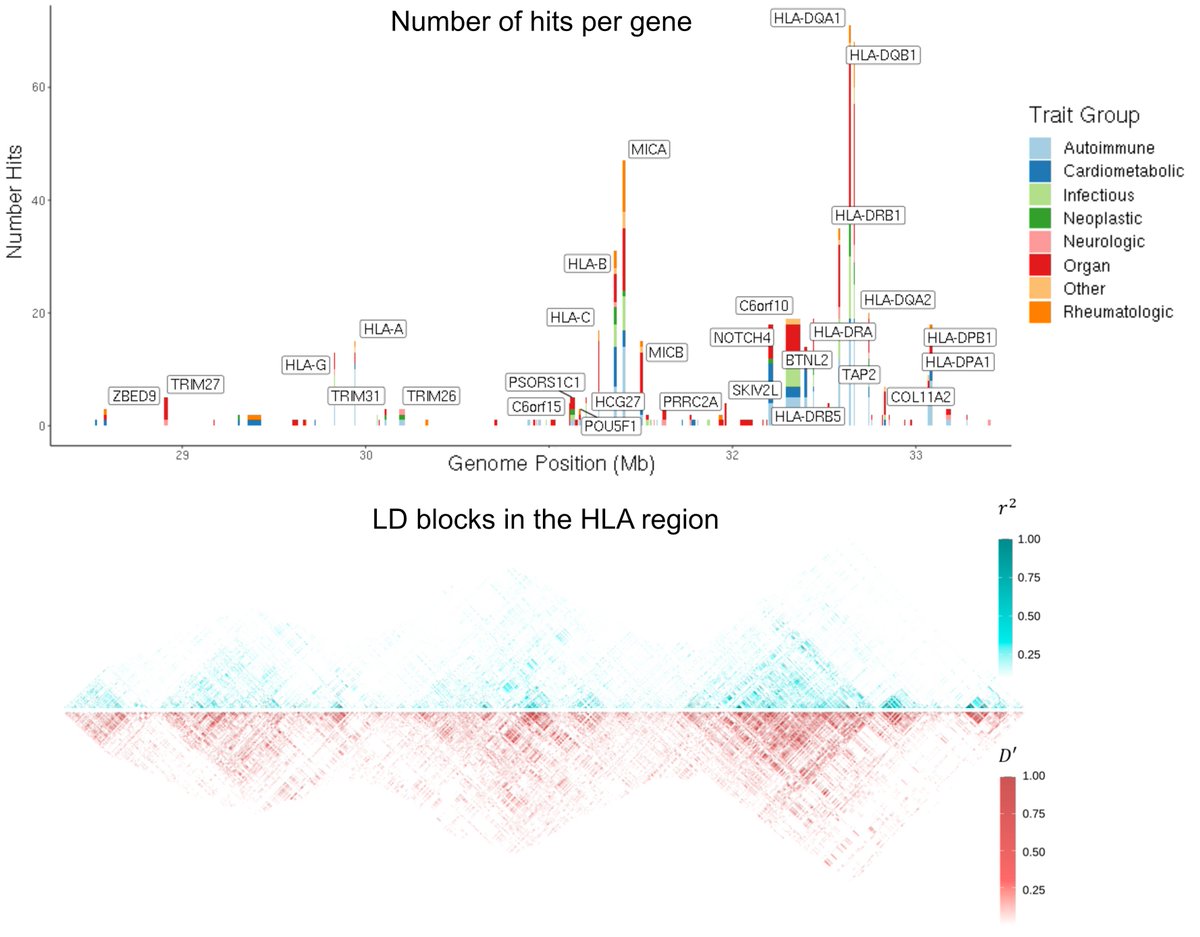
We all know HLA is highly enriched for GWAS hits, but this is rarely quantified. Looking phenome-wide across >2,000 diseases, we find large enrichment in a wide range of diseases, including many not obviously related to HLA. (4/8)
While we call it the HLA locus, there’s actually 100s of genes in the region, with LD spanning many genes. This makes it tricky to study trait associations, and also means we miss lots of genetic variation when we focus on protein-coding variation of HLA alleles. (3/8)
In our new preprint, with @StrauszSatu, @spence_jeffrey_ , @HannaMOllila , @jkpritch , we investigate patterns of pleiotropy in the HLA region across thousands of diseases by developing a new method to perform haplotype-based association analysis. (2/8) https://t.co/k2HsqJqV6W
Happy to announce that in September 2025, I will open my research laboratory at @NYU_Courant 🏢🔬. As an assistant professor of CS & Biology 💻🧬, I will carry on my work on advancing ML research for molecular biology, and apply those methods for scientific discoveries 🌟🔍.
I'm delighted that our GeneBayes paper reporting highly accurate and interpretable estimates of gene constraint (against LOF mutations) is out now!
GeneBayes builds on pioneering work on pLI + LOEUF from groups at Broad, and work on s_het + hs from Sunyaev and Przeworski labs.
Thrilled to share the bulk of my PhD work, now up on bioRxiv!
This project brings together aspects of network theory, systems biology, and single cell genomics, towards understanding properties of gene regulatory networks (GRNs). Read on for more —> (1/)
https://t.co/RY1syLiS6S
Beyond excited to share my first publication out of grad school (!!!). @RoshniAPatel, a bunch of amazing trainees, and I created a course on genetics, ethics and society. Read through Roshni's thread to learn more!
@raungar and I are thrilled to share our paper on the trainee-led course on genetics, ethics, and society that was developed at Stanford: https://t.co/y7LiY5Bv6x (1/9)
I'm thrilled to announce that I've joined the Section of Genetic Medicine at the University of Chicago as an assistant professor! The Simons lab is officially open!
https://t.co/xzfA6aEimF