🥰😇
Tu peux te cacher derrière mille apparences, te taire, te déguiser ou te fondre dans le décor...
Mais ton énergie ne ment jamais.
Tôt ou tard, elle révèle qui tu es vraiment.
📚
Voici un livre des années 1490, réalisé pour une dame de l’époque (🎥de Domeisen Rarebooks).
La vente de ce magnifique ouvrage aura lieu chez Sotheby’s, en juillet 2026.
Ne serait-il pas mieux dans un musée que chez un riche collectionneur privé ? 🤔
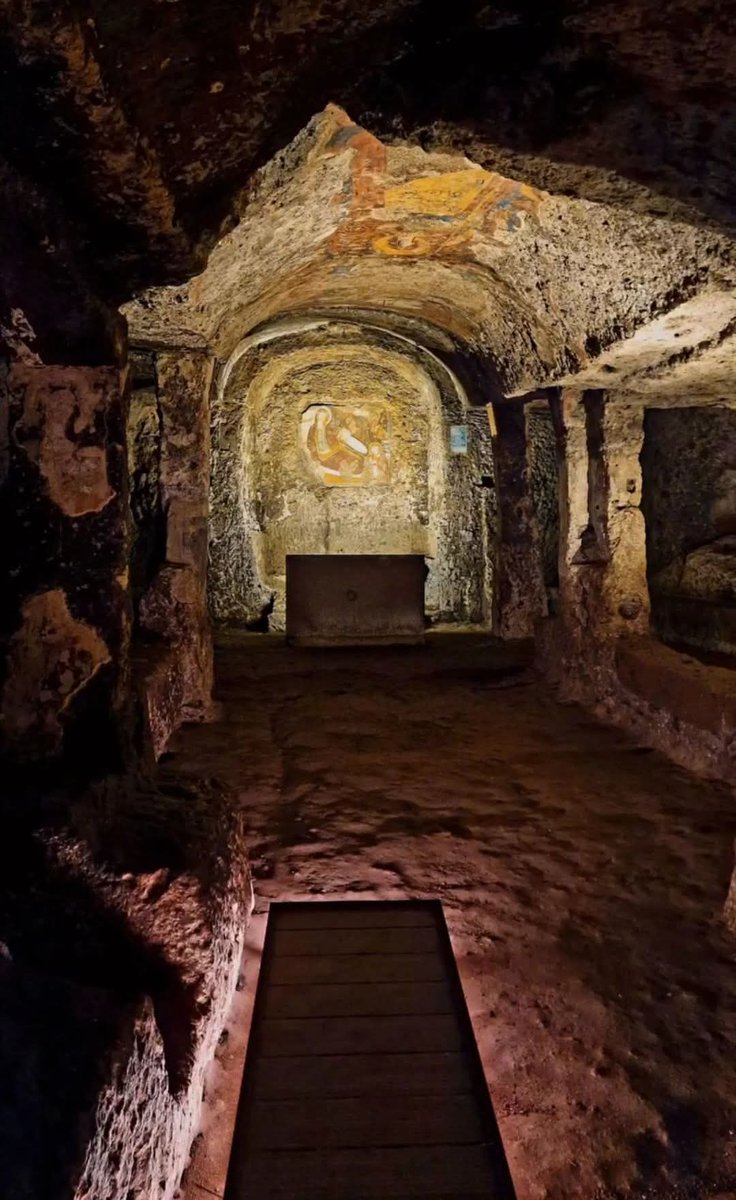
Church of Santa Maria del Parto in
Sutri: an Etruscan gem at the Gates of Rome, Italy 🇮🇹
Hidden among the forests of Tuscia Viterbese, Sutri is an archaeological and historical gem, this small village in northern Lazio preserves extraordinary evidence from various eras, from its Etruscan origins to Roman period and medieval age. Among the most evocative attractions in Sutri stands the Church of Santa Maria del Parto, a truly unique sacred site.
The church was created within an ancient Roman mithraeum, itself carved into the tuff of the same hill that hosts the amphitheater and necropolis. This extraordinary example of sacred space reuse tells the story of the transition from paganism to Christianity: where once the mysteries of the god Mithras—an Eastern deity particularly popular among Roman soldiers—were celebrated, now stands a Christian place of worship dedicated to the Virgin Mary.
This cave church which was dug into soft tufa during 13th-14th Century AD. But it is also called Mitreo di Sutri (Mithras Grotto of Sutri) which seems rather strange at the first glimpse. Explanation is simple though: archaeologists found numerous remains which are typical for the underground place of worship of the god Mithras. The estimated age is 1st-2nd Century AD. Later the Roman empire became Christian, and old temples were abandoned. In this cave it was abandoned for a thousand years, then the place was converted into a christian cave. They changed some details, like doors and windows, and they added the apsis, but the rest is almost original the much older Mithraeum. The floor still contains the Mithraic baptismal font where believers were initiated into the Mysteries of Worship with a water baptism. Baptism was not invented by Christianity, actually. Mithraic Taurobolium was removed in 4th Century AD, and was reused to build a farmhouse on the Via Cassia, in the hamlet of La Botte. If you go there, it is clearly visible on the wall of building a few metres from the road. It shows god Mithras wearing a Phrygian cap, in act of killing the bull (tauroctonia) while a scorpion attacks the bull’s testicles.
The door is rectangular and today has two wooden doors and a glass window over the doors. The tufa wall was obviously quarried to form a sort of flat facade, which contains numerous holes which were needed for wooden beam, some sort of wooden building in from which is now completely gone. There is also a triangular line, which is from a roof above the door. After entering through the door, a square vestibule is reached, where frescoes depict Madonna and Saints, St Christopher and events linked to life of St Michael of Gargano. Then the main room follows, rectangular with three naves, divided by ten pillars on each side. The pillars have a sort of basement which forms a sort of steps on both sides of the main nave. The central nave has a barrel-vaulted ceiling. The two side naves are only about 1 metre wide and have flat ceilings. The apsis on the far end is also rectangular and shows the remains of frescoes depicting the Nativity, which explains the name of the church.
The interior of the church features three naves separated by pillars carved directly from the rock. The walls preserve important medieval frescoes, among which a seated Madonna with Child stands out (from which the name “del Parto,” or “of the Childbirth,” derives), dating back to 12th–13th Century AD. Other frescoes depict scenes from the life of Saint Christopher and episodes related to Saint Michael of Gargano.
What makes this place so special is its almost mystical atmosphere, enhanced by the soft light that filters inside and the profound silence that envelops the space.
#archaeohistories
Château de Chenonceau is a renowned French Renaissance castle in the Loire Valley, gracefully spanning the Cher River. Often referred to as the “Castle of Women,” it owes much of its history and beauty to influential women such as Catherine Briconnet and Diane de Poitiers, who played key roles in its development and legacy.
The TMC Dumont is a hubless motorbike powered by a 224kW Rolls-Royce aircraft engine and is the work of Brazilian ex-Formula One driver turned motorcycle custom builder Tarso Marques.
~...SHE'S
The Type
Who
Loves
Deeply
..&
Leaves
Quickly
🤍
🤍
♀️
SHE
Give
HER
Whole Heart
..But
SHE
Walk Away
When
The Energy
Feels
Wrong
🤍
🤍
SHE
Won't
Let Anyone
Play
HER
♀️
🤍
🤍
Losing
HER
IS
LIKE
Losing
A Front
TOOTH
You'll
Never
Smile
Same
Again...~
#SHE#WOMANPOWER