You can take about 5 minutes and learn a self-hypnosis technique from The Avatar himself, Scott Adams.
"Boom, right into it. And you've got an hour of serious pleasure." 🧠
I wonder how quickly you will go into a trance and feel good?
Amazon Ring died on May 22, 2026.
It just doesn't know yet.
One dad in Nashville, Tennessee built a free MIT-licensed app that watches your driveway, your porch, your baby monitor, your garage.
No cloud. No subscription. No cop ever gets the footage.
32,057 stars. 3,103 forks. Pushed today.
Here is the wildest part:
You: "How much is Ring Protect Pro?"
Ring: "$19.99 a month. $199.99 a year. Per house."
You: "How much is Google Home Premium Advanced?"
Google: "$20 a month. $200 a year. Per house."
You: "What do I get?"
Both: "We store your footage in our cloud. Ring already paid the FTC $5.8 million in 2023 for letting employees and contractors watch your videos without your consent. Google just raised Nest prices again in 2025."
You: "What does Frigate cost?"
Blake Blackshear: "Nothing. It runs on the Raspberry Pi already on your shelf. The footage never leaves your house. I have a day job."
Ring sells the camera. Then sells your fear back to you, monthly, forever.
Frigate sells nothing. Because Blake isn't selling.
He's a dad with 1,267 followers who got tired of Amazon owning his front door.
100% Opensource.
100% Local.
100% Yours.
The smart camera industry made one bad assumption.
That you'd keep paying rent on a camera you already bought.
That assumption just died in Nashville.
🇺🇸 The CIA was studying the human mind. People just found out.
A woman pulled up a declassified CIA document on camera and found a section that tells you to close your eyes, focus on your pain, and repeat "55515" in your head until the pain fades and becomes "no longer important."
That's in a real government document. Filed, classified, and eventually released without anyone making much noise about it.
The same file references sleep techniques, memory enhancement and consciousness experiments, all part of the CIA's Gateway Process, a program built around pushing the limits of what the human mind can do.
Nobody announced it. Nobody explained it. It just sat there in the archives until someone went looking.
Now the internet wants to know what else is in those files.
Source: @HustleBitch_
🚨 PEOPLE ARE JUST NOW DISCOVERING THE CIA HID “QUANTUM HEALING CODES” FOR PAIN RELIEF INSIDE A DECLASSIFIED DOCUMENT — AND THE INTERNET IS ABSOLUTELY LOSING IT
A woman is going viral after pulling up a declassified CIA Gateway Process document on camera and claiming it contains “quantum healing codes” designed to influence the human body and mind.
One section allegedly instructs people to:
• close their eyes
• focus on the source of pain
• repeat the sequence “55515” mentally
According to the document, the pain signals supposedly begin fading until they are “no longer important.”
But that’s where the rabbit hole starts getting weird.
She claims the CIA material also references:
• sleep-inducing techniques
• memory enhancement exercises
• methods tied to energy and strength
• consciousness experiments connected to the infamous Gateway Process
Now people are spiraling over why the CIA was researching altered states, frequencies, and the limits of human consciousness in the first place.
The comments are flooding in:
• “Why the hell was the CIA even studying this?”
• “This feels like forbidden information.”
• “What else is buried in those files?”
• “The human brain is way more powerful than we’ve been told.”
Did people just stumble onto one of the strangest declassified CIA rabbit holes ever released?
📹: TikTok/woowooqueeeen
You can hypnotise yourself with your own voice.
Done correctly, it’s more potent than therapy, meditation, and affirmations combined.
This is how you do it:
- Write down the traits, self-image, and identity you desire
- Use present tense: speak as it exists
- Be sensory and descriptive: make the mind feel it
- Use emotional words
- Avoid negations (don't, never, not)
- Frame everything as absolute truth
-Layer in NLP techniques (double binds etc)
-Use hypnotic words (imagine, notice, feel, become)
-Speak in your own language (specificity matters)
-Embed a post-hypnotic trigger word
- Record the script into Audacity
- Add a subliminal plug in
- Add theta waves
- Listen as you wake up
- Listen as you fall asleep
If you want this done for you, send us a DM.
We build these for clients all the time.
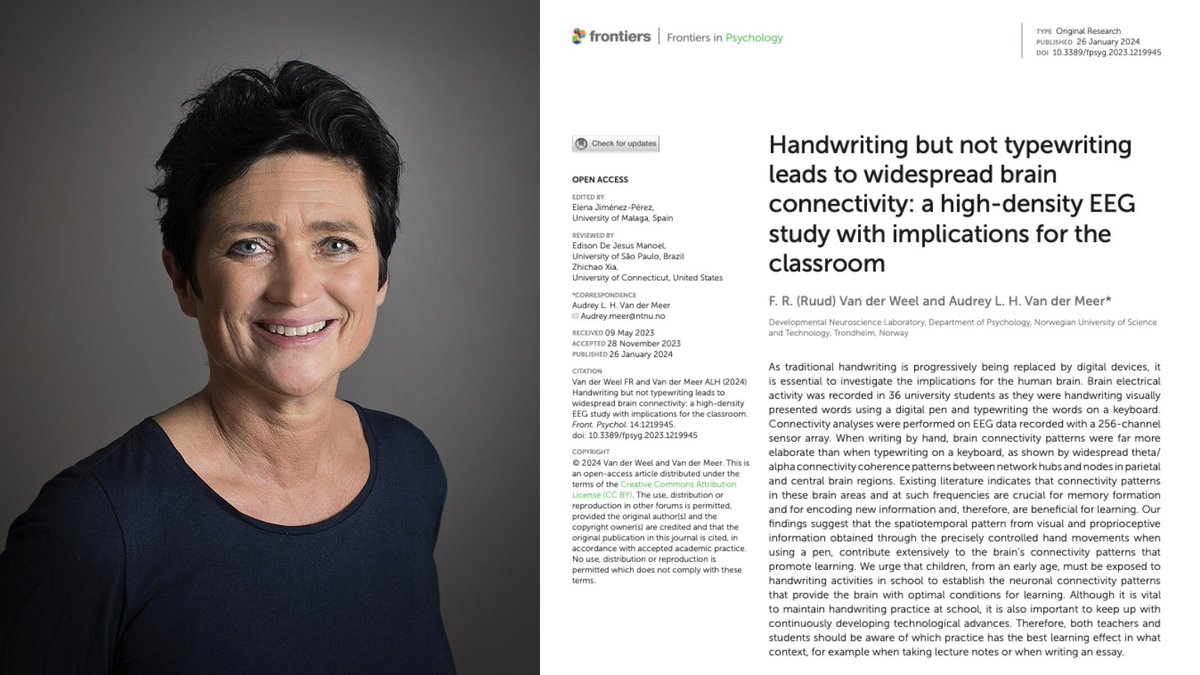
A Norwegian neuroscientist spent 20 years proving that the act of writing by hand changes the human brain in ways typing physically cannot, and almost nobody outside her field has read the paper.
Her name is Audrey van der Meer.
She runs a brain research lab in Trondheim, and the paper that closed the argument was published in 2024 in a journal called Frontiers in Psychology. The finding is brutal enough that it should have changed every classroom on Earth.
The experiment was simple. She recruited 36 university students and put each one in a cap with 256 sensors pressed against their scalp to record brain activity. Words flashed on a screen one at a time.
Sometimes the students wrote the word by hand on a touchscreen using a digital pen, and sometimes they typed the same word on a keyboard. Every neural response was recorded for the full five seconds the word stayed on screen.
Then her team looked at the part of the data most researchers had ignored for years, which is how different parts of the brain were communicating with each other during the task.
When the students wrote by hand, the brain lit up everywhere at once.
The regions responsible for memory, sensory integration, and the encoding of new information were all firing together in a coordinated pattern that spread across the entire cortex. The whole network was awake and connected.
When the same students typed the same word, that pattern collapsed almost completely.
Most of the brain went quiet, and the connections between regions that had been alive seconds earlier were nowhere to be found on the EEG.
Same word, same brain, same person, and two completely different neurological events.
The reason turned out to be something nobody had really paid attention to before her work. Writing by hand is not one motion but a sequence of thousands of tiny micro-movements coordinated with your eyes in real time, where each letter is a different shape that requires the brain to solve a slightly different spatial problem.
Your fingers, wrist, vision, and the parts of your brain that track position in space are all working together to produce one letter, then the next, then the next.
Typing throws all of that away. Every key on a keyboard requires the exact same finger motion regardless of which letter you are pressing, which means the brain has almost nothing to integrate and almost no problem to solve.
Van der Meer said it plainly in her interviews.
Pressing the same key with the same finger over and over does not stimulate the brain in any meaningful way, and she pointed out something that should scare every parent who handed their kid an iPad.
Children who learn to read and write on tablets often cannot tell letters like b and d apart, because they have never physically felt with their bodies what it takes to actually produce those letters on a page.
A decade before her, two researchers at Princeton ran the same fight using a completely different method and ended up at the same answer. Pam Mueller and Daniel Oppenheimer tested 327 students across three experiments, where half took notes on laptops with the internet disabled and half took notes by hand, before testing everyone on what they actually understood from the lectures they had watched.
The handwriting group won by a wide margin on every question that required real understanding rather than surface recall.
The reason was hiding in the transcripts of what the two groups had actually written down.
The laptop students typed almost word for word, capturing more total content but processing almost none of it as they went, while the handwriting students physically could not write fast enough to transcribe a lecture in real time, which forced them to listen carefully, decide what actually mattered, and put it in their own words on the page.
That single act of choosing what to keep was the learning itself, and the keyboard had quietly skipped the choosing and skipped the learning along with it.
Two studies. Two countries. Same answer.
Handwriting makes the brain work. Typing lets it coast.
Every note you have ever typed instead of written went into your brain through a thinner pipe. Every meeting, every book highlight, every idea you captured on your phone instead of on paper was processed at half depth.
You did not forget those things because your memory is bad. You forgot them because typing never woke the part of the brain that would have made them stick.
The fix is the thing your grandmother already knew.
Pick up a pen. Write the thing down. The slower road is the faster one.
Here’s Dr Zelenko teaching us how to treat Hantavirus back in 2022. This will be the most enlightening 2 minutes and 47 seconds of your life. Please listen carefully.
A 16-YEAR-OLD IS MAKING $30,000/MONTH ON SPOTIFY. HIS ONLY EXPENSE IS $10
$10 for Suno. $23 a year to publish on Spotify. a niche nobody's fighting for
he generates tracks in 30 seconds, uploads 10-20 a week under different artist names, and watches the royalties come in every month
sleep music. study music. lo-fi. meditation. the genres real musicians ignore. the same ones keeping people on loop for hours and paying out per stream
a woman used the same $10 app and landed a $3,000,000 record deal. she never turned on her camera at the label meeting
the window is open. most people will scroll past this
bookmark this and give it a few minute this week, then read the article below - it's worth it
Dr. Russell Barkley just blew up everything I thought I knew about ADHD.
It’s not mainly an “attention” problem. It’s an executive function disorder — and once you see it that way, the fixes become ridiculously practical instead of vague.
Forget “just focus harder.” Here’s what actually helps:
- No working memory? Externalize everything. Paper journal welded to your body. Sticky notes. Voice recorder in the car. (He says paper beats apps because we lose the damn phones.)
- No internal clock? Become timer-dependent. Set alarms, use visual cues, break the future into tiny daily pieces.
- No motivation from inside? Make it external. Rewards, points, deals — win-win, not lectures. ADHD brains need the “deal” on the table.
Dr. Russell Barkley delivered one of the clearest explanations of ADHD I’ve ever heard.
“ADHD is not an information deficit disorder. It’s a performance deficit disorder.”
You can teach a child all the social skills, anger management, or homework strategies you want in therapy or a special group — but none of it will generalize if you don’t change the environment at the actual point of performance (the playground, the kitchen table, the classroom).
He compared behavior modification programs (tokens, charts, stickers) to a wheelchair ramp: they’re not there to teach the child something new. They’re a prosthesis that provides immediate, frequent consequences to compensate for the brain’s inability to bridge the gap between knowing what to do and actually doing it.
And just like you wouldn’t remove the ramp after 30 days and expect someone to “internalize” it, ADHD accommodations often need to stay in place as long as the person is in that environment.
His bottom line: treat ADHD like a chronic condition (similar to diabetes). Manage it to prevent secondary harm, not to “cure” it. And the most important people in that management are the parents and teachers who provide the daily prosthetic support.
What’s one area in your life (or your child’s) where you know what to do… but consistently fail to do it at the moment it matters most?
OK, so it wasn't safe after all. What a surprise!
At least some people are willing to tell the truth.
I wonder if they'll try to take away his license to practice medicine because of this?
“Put a rat in an empty cage with heroin-laced water and it will drink itself to death. Put the same rat in ‘Rat Park’ — full of friends, toys, tunnels, and cheese — and it barely touches the drug.”
Johann Hari shared this on TED Talks and it completely changed how I think about addiction.
Professor Bruce Alexander ran the experiment in the 1970s and flipped the old “chemical hooks” story on its head. Isolated rats became addicts. Happy, connected rats in Rat Park almost never did.
The same pattern showed up in humans during the Vietnam War: 20% of American troops were heavy heroin users, but when they came home to normal lives, 95% simply stopped — no rehab, no massive withdrawal.
Hari’s conclusion: addiction isn’t primarily about the drug. It’s about the cage — isolation, trauma, lack of connection. Humans have a deep need to bond. When we can’t bond with people, we bond with something that gives relief: drugs, gambling, porn, whatever fills the void.
What’s one “addiction” in your life (or someone you know) that might actually be a symptom of disconnection rather than just the substance itself?
A regular American student bought an iPad and Mac Mini for $2,200. Connected them to his MacBook.
Three computers on one desk - dorm roommates thought he was mining crypto.
He just set up the automation and went to sleep.
In the morning the system had already processed hundreds of leads, written personalized emails to each one and filled the CRM without a single touch.
The team that did this before him- cost $7,000 a month
He paid $2,200 once.
There are 360 million companies in the world. 310 of them still pay people for what a machine does better.
And only 100,000 people on the planet know how to set this up.
“ADHD is not a disorder of not knowing what to do. It’s a disorder of not doing what you already know.”
Dr. Russell Barkley just delivered one of the clearest explanations of ADHD I’ve ever heard.
He says the brain can be split in two: the back part acquires knowledge, the front part (the executive system) uses it. ADHD acts like a meat cleaver that severs the two.
You already have the skills and information other people your age have. You just can’t apply them when it counts.
That’s why life becomes an endless series of last-minute crises. You’re time-blind — you can only deal with what’s right in front of you. The further away a goal or deadline is, the less real it feels.
The solution isn’t teaching more skills. It’s changing the environment at the exact point where the problem occurs — the “point of performance.”
It’s a game-changing way to understand why traditional approaches often fail.