We had warned for two weeks that wastewater levels were exceedingly high in Central Texas. Now the Emergency Department visit levels have kicked up.
💩 don't lie.
The finding is important because it challenges the assumption that suppressing inflammation during acute infection will necessarily prevent Long COVID.
➡️ Sometimes the most valuable studies are those that tell us what doesn’t work. Despite their proven role in severe acute COVID-19, steroids do not appear to be the magic bullet for preventing pediatric LongCOVID. 2/2
https://t.co/XP5JpgQ99G
Can giving steroids during acute COVID-19 prevent #LongCOVID in children?
➡️ In a massive study of 850,000+ children and adolescents, early treatment with corticosteroids during SARS-CoV-2 infection did not reduce the overall risk of developing LongCOVID (PASC) in either hospitalized or outpatient settings.
➡️ The only notable signal was a 42% reduction in gastrointestinal Long COVID symptoms among hospitalized children who received steroids. 1/
1. #measles update: #CDC reports the year-to-date tally of confirmed measles's cases has reached 2104. That is 92% as many cases as the US recorded in all of 2025. Only 11 of those cases were brought in from outside the country. Lots of domestic transmission occurring. https://t.co/IOXzvXUW4S
Mechanisms and impact of long COVID: pathophysiology, neuropsychiatric effects and vac: development of long COVID, latent Epstein-Barr virus reactivation, molecular mimicry, virus persistence, autoantibodies, mitochondrial dysfunction. https://t.co/iKtzCsoiId
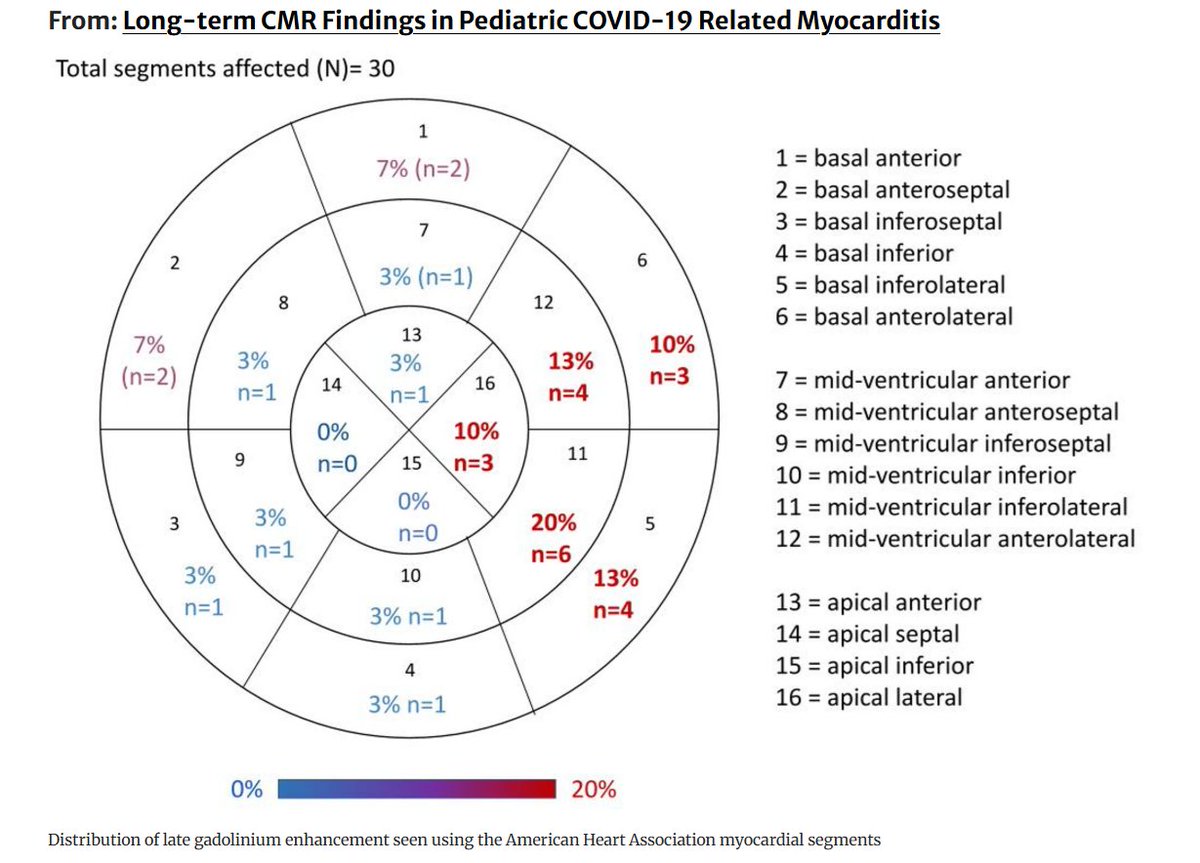
Long-term CMR Findings in Pediatric COVID-19 Related Myocarditis
🚨Even when KIDS 'fully recover' from COVID myocarditis, demonstrate normal heart function and have no symptoms, new CMR data shows PERSISTENT microvascular damage in the heart that refuses to go away!💔
➡️A retrospective small USA single-center study analysed long-term cardiac magnetic resonance (CMR) findings in 21 paediatric patients (mean age 13.1 years, 57% male) with suspected COVID-19-related myocarditis or MIS-C,
➡️Thirty CMR studies were categorized as early (<30 days), mid-term (30–364 days), and long-term (≥365 days), with serial imaging in 8 patients (median follow-up 347 days),
➡️Diagnosis used the 2009 Lake Louise criteria (T2-weighted imaging for oedema, early gadolinium enhancement(EGE)for hyperaemia/capillary leak, and late gadolinium enhancement (LGE) for fibrosis/necrosis),
➡️Important findings:
- Oedema resolved completely on long-term and serial follow-up imaging (15% early → 0%),
- LGE declined markedly (46% early → 25% mid-term → 0% long-term) and persisted in only 13% (1/8) of serial cases, showing lateral wall predominance,
- Pericardial effusions resolved fully (46% → 0%),
- Biventricular systolic function remained normal on all follow-up scans,
- In stark contrast, EGE remained persistently high across all timepoints: 77% early, 83% mid-term, and 80% long-term. Among patients with serial CMR, EGE persisted in 88% (7/8) despite resolution of oedema, LGE, and effusions,
- 13% continued to meet Lake Louise criteria on follow-up: 1 out of the 8 children who had repeat heart scans (CMR) still showed enough abnormalities to be diagnosed with active myocarditis/ LGE (scarring),
➡️Limitations: well noted/single center/ larger prospective studies urgently needed!
➡️Over a median clinical follow-up of 20 months, there were no arrhythmias, heart failure symptoms, cardiac rehospitalizations, or mortality. Most CMR abnormalities improved with favourable medium-term outcomes, but persistent EGE was common.
‼️So, despite complete resolution of oedema, near-total disappearance of LGE and effusions, preserved ventricular function, and zero adverse clinical events, the near-universal persistence of EGE in these children reveals ongoing microvascular damage in the heart, a silent, enduring marker of residual hyperaemia and capillary leak that continues unabated beneath a facade of apparent recovery. This finding demands recognition that normal function and symptom-free status do not equate to myocardial health!
→ The microvascular injury persists as a potential long-term threat requiring vigilant, extended surveillance in paediatric COVID-19 myocarditis survivors.
#AvoidSars2 #AvoidReinfections #ProtectChildren
https://t.co/SxEUfc1wCN
@Yash25571056 Mechanims for herpes reactivation, particular EBV we have shown for postCOVID disease MIS-C and severe COVID-19. Our data indicate that a similar mechanism may also operate in ME/CFS. Our paper, which the authors did not acknowledge.
https://t.co/HeeP28cOSR
Health officials warn about possible measles exposure at LAX, airport hotel | traveler arrived on Cathay Pacific Airlines CX 884 Bradley Intl Airport Terminal B June 11. Anyone at TBIT Terminal B June 11 10 a.m. -12 p.m. may have been exposed to measles https://t.co/vadTCrjjY5
139 kids who'd had COVID. Half of them turned up with autoantibodies - antibodies that attack the body's own tissues. In uninfected kids, only 14%. And it barely mattered whether the child had been hospitalized with pneumonia or had next to no symptoms. 🧵
I’m 💔 today. While I can’t share precise details due to confidentiality, I’ve just experienced firsthand the reality of a 'Long Covid industry' that puts profit generation squarely ahead of integrity & patient-centered care. Honestly, I just want to 😢.
FYI, "The reactivation of latent herpesviruses has been associated with sustained immune dysregulation for long periods of COVID-19.
The reactivation process refers to the mechanism by which the latent viruses [(e.g. EBV and Varicella Zoster Virus (VZV)], which remain dormant in B lymphocytes and epithelial cells following initial infection, become active and enter their replication cycle.
The reactivation of these dormant viruses can be triggered by concurrent infections, physical or psychological stress or immunosuppression..
For instance, Myalgic Encephalomyelitis/Chronic Fatigue Syndrome (ME/CFS) has been linked to LC..
Furthermore, dysautonomia, a condition observed in several post-viral infections, has also been reported in LC patients..
these viruses (EBV and VZV) can remain latent within the host and can be reactivated by a stressor such as another serious viral infection (e.g. SARS-CoV-2), leading to chronic inflammation and neurological disorders..
EBV infects B lymphocytes and epithelial cells, potentially triggering autoimmune disorders such as multiple sclerosis, Systemic Lupus Erythematosus (SLE), and rheumatoid arthritis.. Association between EBV reactivation and SARS-CoV-2 infection has been demonstrated by several studies.."
Stay relaxed in clean air.
'Mechanisms and impact of long COVID: pathophysiology, neuropsychiatric effects and vaccination'
https://t.co/wsoj2Jg0NF
Wow . The speaker just said that “small vessel disease has increased exponentially” in her patients due to COVID. How we know it attacks small vessels.
Bravo . Feel like I’ve been waiting to hear someone say this in a mental health conference for a long time.
Children’s Hospital of Philadelphia, 854,128 children and teens.
Steroids given during acute COVID did not reduce long COVID risk over the next 1 to 6 months.
A possible drop in GI symptoms was seen, but overall no protective effect emerged.
https://t.co/mRUt0I3DN8
I'm a cardiologist. Something just happened today that I genuinely did not see coming — and it could change the future of preventive medicine more than anything I've written about on this platform.
Midjourney — the AI company that became famous for generating images from text prompts — just announced a medical hardware division and unveiled a working prototype of a full-body scanner unlike anything that's ever existed.
It's called the Midjourney Scanner. And it works like this.
You step into a shallow pool of water. You stand on a platform that slowly descends — about two inches per second — through a ring containing roughly half a million tiny ultrasonic transducers, each the size of a grain of sand. Every one of them acts as both a speaker and a microphone, sending ultrasonic waves through your body from every angle and recording what comes back.
60 seconds later, you step out. The scan is done.
No radiation. No magnets. No claustrophobia. No IV contrast. Just sound, water, and an almost incomprehensible amount of computing power — roughly 2 petaflops processing 17 gigabytes per second of raw acoustic data — reconstructing a 3D map of your entire internal anatomy down to half a millimeter resolution.
Organs. Tissues. Blood vessels. Bones. Muscle. Fat distribution. All segmented by AI in real time.
As a cardiologist who has spent months writing about how the standard screening playbook misses the majority of future heart attacks — this is the technology I've been waiting for without knowing it existed.
Here's why this matters for the future of your heart.
Right now, getting a detailed look inside your cardiovascular system requires either a CT scan (radiation), an MRI (magnets, claustrophobia, 45-60 minutes, $1,000+), or a coronary CT angiogram (radiation, IV contrast, limited availability). These are powerful tools. I order them regularly and they save lives.
But they're reactive. You get them when something is already suspected. They're expensive. They're uncomfortable. And for most people, they happen once — maybe twice — in a lifetime.
Imagine instead: a 60-second scan with no radiation that you could repeat monthly or quarterly. Tracking cardiac structure over time. Watching body composition shift. Detecting changes in organ size, fluid distribution, or vascular architecture before symptoms ever develop. Building a longitudinal dataset of YOUR body that AI can analyze for patterns no single snapshot would reveal.
That's what Midjourney is building toward.
The company plans 50,000 scanners worldwide over six years, with capacity for a billion scans per month. The first location — the "Midjourney Spa" in San Francisco — opens at the end of 2027 with 10 scanners alongside saunas, cold plunges, and a gym. The scan costs a few dollars. The experience is designed to feel like wellness, not medicine.
The technology is built on Butterfly Network's ultrasound-on-chip platform — 40 modules per scanner — combined with Midjourney's own AI segmentation and reconstruction stack. David Holz, the founder, claims the system aims for image quality comparable to MRI in many aspects but at nearly 100x the speed with zero radiation.
Now the caveats — because I'm a physician and the caveats matter enormously.
This is a Gen 1 prototype. About a dozen people have been scanned so far. Current scan time is actually closer to 20 minutes, not 60 seconds — the system is bottlenecked by bandwidth and reconstruction algorithms. The 60-second target is aspirational for future hardware generations.
It is not FDA-cleared for diagnostic use. Midjourney is starting with body composition maps — a category below diagnostic imaging in the regulatory hierarchy. The path from "beautiful 3D body scans" to "clinically validated diagnostic tool that your cardiologist can act on" runs through years of clinical trials, comparative studies against MRI and CT gold standards, and FDA review.
No independent clinical validation has been published. The imaging claims come from Midjourney's own demonstrations. Comparative data against established modalities does not yet exist.
And the privacy implications of full-body internal scans at planetary scale — a billion scans per month — is a conversation that hasn't even started yet.
So I want to be precise. This is not ready for clinical medicine today. It may not be ready for years. Many ambitious medical hardware projects have failed in the gap between prototype and product.
But.
The fact that a working prototype exists — producing real segmented 3D anatomy from sound waves and compute alone — means the physics works. The engineering works. The question is no longer "is this possible" but "how fast can it be validated and scaled."
And if it is validated — if the resolution holds up against MRI, if the AI segmentation proves reliable, if the regulatory path clears — then what we're looking at is the most significant new imaging modality in 50 years.
For my entire career, preventive cardiology has been limited by the fact that seeing inside the body is expensive, slow, uncomfortable, and infrequent. We catch disease late because we image rarely. We image rarely because imaging is hard.
A 60-second, no-radiation, spa-based full-body scan that costs a few dollars would demolish every one of those barriers.
I've written about AI detecting inflamed arteries. About gene editing curing cholesterol. About GLP-1 drugs rewriting metabolic medicine. About cellular reprogramming reversing aging.
This is the missing piece: the ability to see inside every human body, routinely, safely, and affordably — so all of those interventions can be deployed before the disease arrives instead of after.
The company that taught AI to generate images from imagination just built a machine that generates images from the human body.
The future of medicine showed up today from the last place anyone expected.
Our latest preprint is out, where we investigated a profound SARS-CoV-2 epidemiological anomaly: BA.3.2.2 is selectively infecting children. Here, we show that the lack of ancestral-strain immune imprinting is promoting BA.3.2.2 pediatric infections.
1/9
https://t.co/qwnjic0pzf
Bad news: many kids under 8 never received the original Wuhan #COVID vaccines. Their immunity was shaped mostly by Omicron infections. New data suggest the "Cicada" variant (BA.3.2.2), now re-emerging in several countries, may be particularly good at evading immune responses.