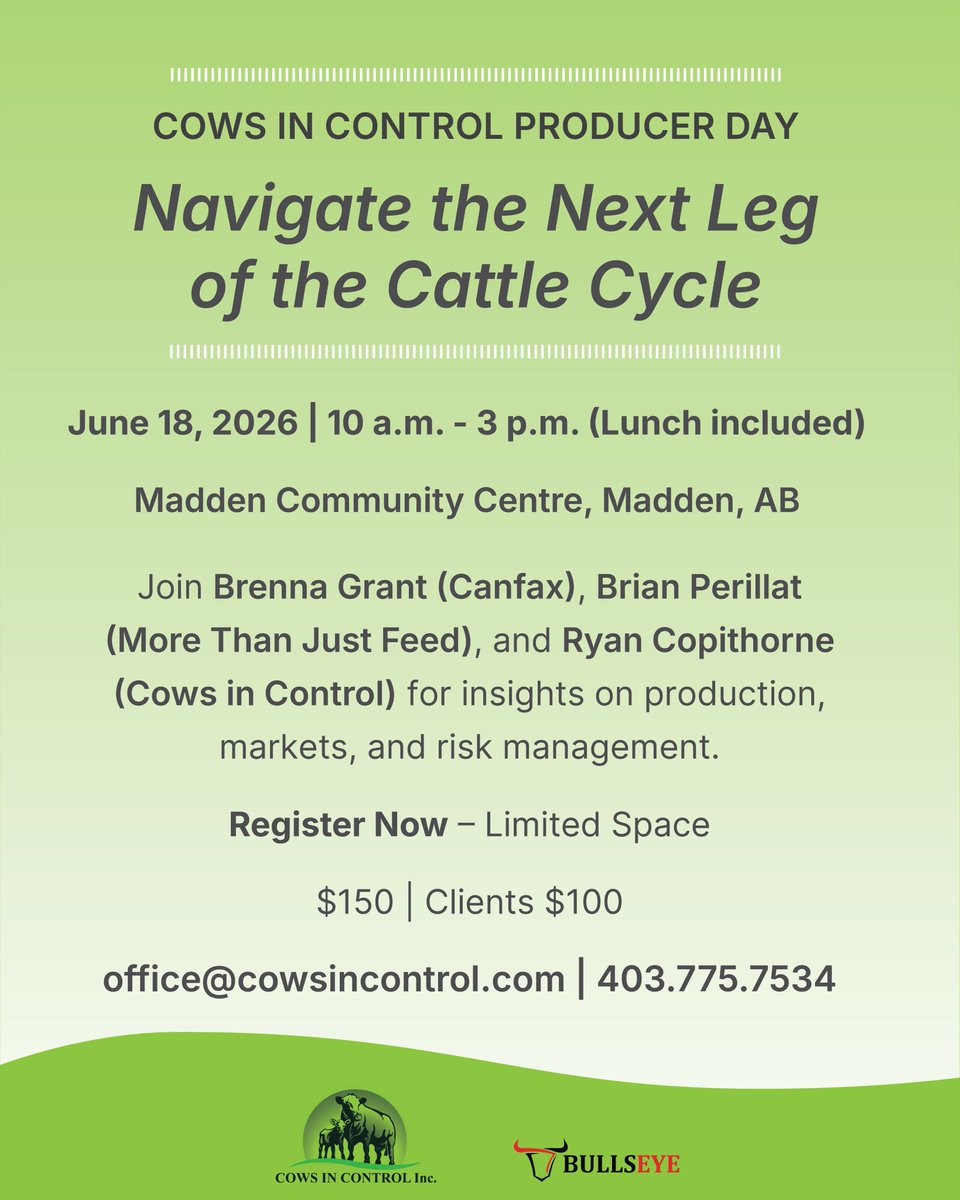
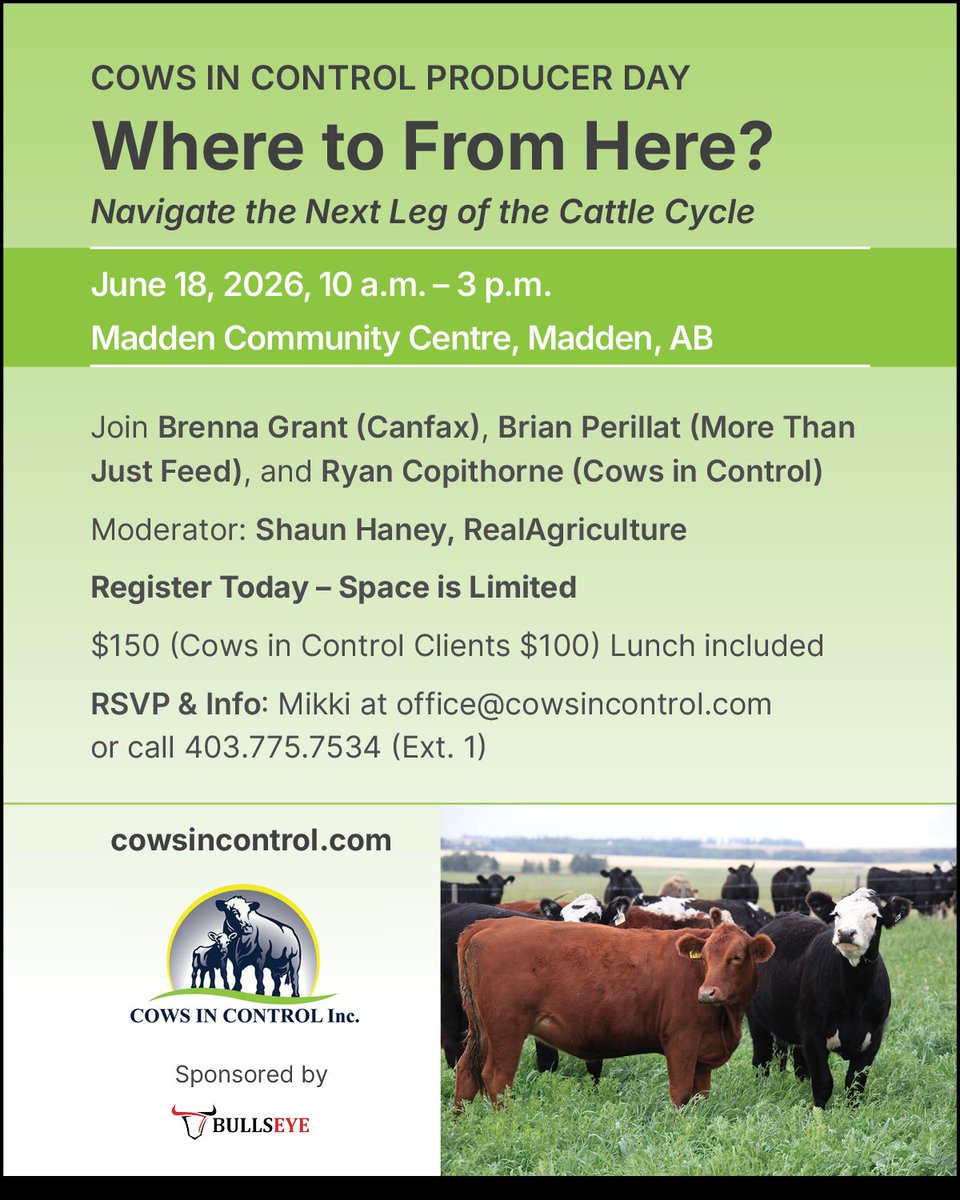
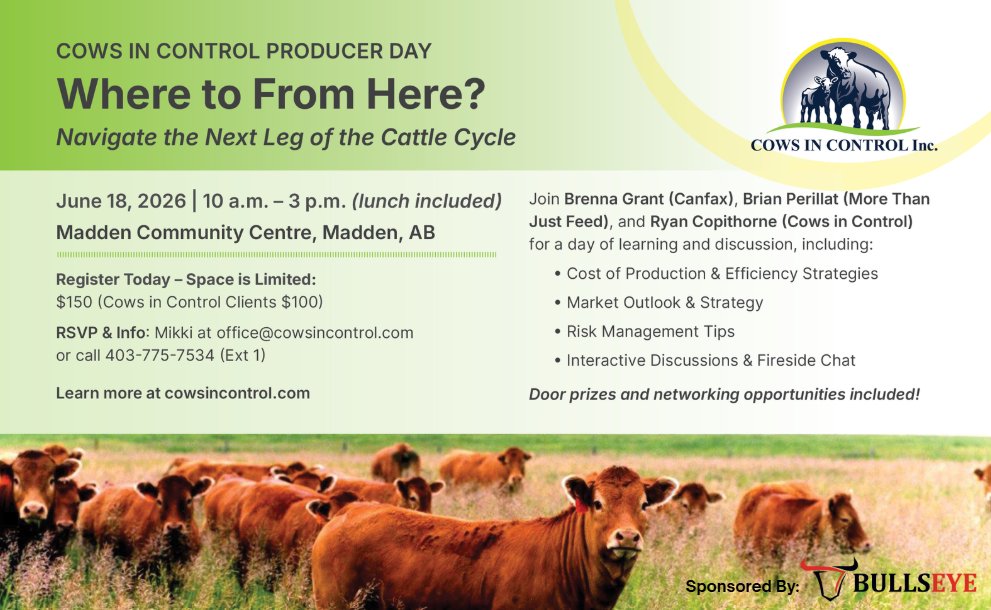
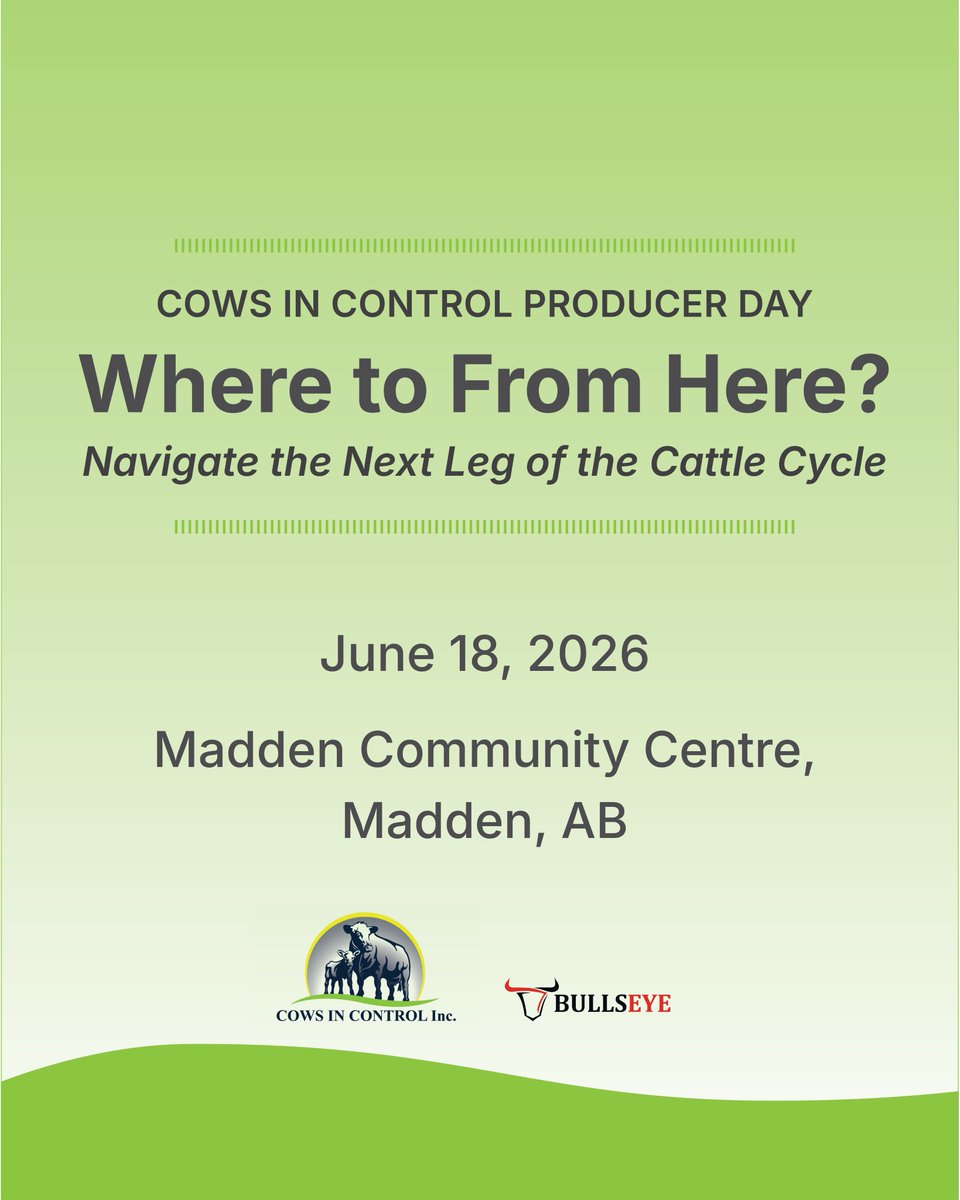
🐄 Producer Day: June 18 – Madden, AB
Dig into the next leg of the cattle cycle with insights from Brenna Grant, Brian Perillat & Ryan Copithorne, moderated by Shaun Haney.
Seats are limited — register early.
Lunch included.
👉 https://t.co/9EZMoQUQqS
#CattleCycle#AgBusiness
🐄 For Sale: 50 Black/BBF Bred Heifers Top cut out of 200 head, quiet, uniform, vet‑checked & bred to calving‑ease bulls.
📍 Foam Lake, SK 📅 Forward delivery: Nov 10, 2026
Details ➜ https://t.co/Gx3rGc0OUw
#CattleSales#BredHeifers#AgTwitter#CowsInControl
A farmer dies in April 2026.
His son inherits the farm. The farm has been in the family since 1847.
The farm consists of: 300 acres of grazing pasture, a farmhouse built in 1892, a barn, a milking parlour, two tractors of varying ages, a Land Rover that runs about 70% of the time, and a herd of 180 Hereford-cross cattle.
On paper, the farm is worth approximately £3.2 million. This is because land near him has been bought recently by a London hedge fund looking for carbon credits, which has dragged the comparable value of every field within forty miles upward to a number nobody local can justify.
In cash, the farm produces a profit of about £28,000 a year in a good year. In a bad year it loses money. The son also works as a fencing contractor three days a week to keep the operation viable.
The inheritance tax bill on a £3.2 million estate, even at the reduced 20% rate, comes to approximately £140,000 after the increased threshold is applied. The son does not have £140,000. The son has never had £140,000. The son has £4,200 in his current account and an overdraft.
The son sells 60 acres to a developer to pay the tax. The developer puts solar panels on the 60 acres. The remaining herd cannot be sustained on the reduced land. The herd is sold. The barn becomes a holiday let.
A different family eats Brazilian beef this Christmas without knowing why the price went up.
The Treasury collects £140,000.
The land never produces British food again.
150 bred heifers available near Palmer, SK! Sound, uniform, and ready for delivery. A strong commercial group selected for longevity and calving ease.
📍 Full details: https://t.co/QBXUJqaa9u #CattleProducers#AgBusiness
📅 June 18 | Madden, AB Cows in Control Producer Day: Where to From Here? Market outlooks, risk tips & expert insights, lunch included! Register now ➡️
https://t.co/9EZMoQVogq
#AgEvents#CattleCycle
Carney boasts that the agreement signed between Alberta and the federal government last week creates a "carbon market" that "actually works."
The prime minister emphasizes the agreement commits Alberta to "methane reductions of 75% by 2035."
Drought is believed moving cattle sooner to the feed yards than hoped. This is one of the reasons for the anticipated increase in placements. With the larger carcass, and the increased number of cattle on feed, beef production this fall may swell. Although a difficult topic of discussion, but if more cattle are moved to yards, the next round of rationing may be of producers.
Now listed: 70 cow‑calf pairs near Maple Creek. Solid type, good temperament, and ready to go.
Full listing: https://t.co/P4wrTrkLfR
#LivestockSale#CanadianBeef#PrairieAg
Join us on June 18 in Madden, AB, for the Cows in Control Producer Day. Market outlook, cost of production, efficiency + risk‑management insights from Canfax, MTJF, and Cows in Control.
Register Here: https://t.co/kYvfu8WMb6
#CattleIndustry#AlbertaAg#BeefProducers
After years of planning, work has begun on a new high school in southeast Alberta designed entirely around agriculture education.
https://t.co/5QwbSPBdcV
“Cows have a digestion system that emits methane. We need to change cows and work towards artificial meat.”
~ Bill Gates
He doesn’t mention that methane from cows breaks down into CO2 & water after 10 years. Grass absorbs the CO2 by photosynthesis & the cycle repeats itself.
🇫🇷 French police are now using thermal imaging drones to hunt down cattle hidden by farmers who refused mandatory vaccination.
Once spotted? Police + vaccine squads swarm the farm and vaccinate them anyway.
How come they aren't this efficient at addressing fraud, pickpockets, or potholes?
Source: @BenSwann_
🐮 JOB ALERT! Cows in Control Inc. is seeking a Livestock Dealer Agent.
Marketing breeding animals across BC, AB, SK, & MB. Full/Part-time with commission & profit sharing.
Must have an eye for quality stock and love to travel!
🔗 Details & Contact: https://t.co/CkYdNaQCm6
Imagine traveling to France 300 years ago and seeing Mont Saint-Michel for the very first time
You would have seen it long before you reached it: a 302 feet pyramid rising out of nothing in a bay so vast that at low tide the sea retreats up to fifteen kilometres.
Then, twice a day, the ocean comes back. And it comes back fast... Victor Hugo wrote that the tide at Mont Saint-Michel advances "à la vitesse d'un cheval au galop" — as swiftly as a galloping horse.
The bay has the highest tides in continental Europe, and medieval pilgrims knew the crossing could kill them. They called this place Saint Michel au péril de la mer — Saint Michael in peril of the sea...
The legend begins in the year 708. Aubert, the bishop of Avranches, dreamt that the Archangel Michael appeared to him and commanded him to build a sanctuary on the lonely rock. Aubert hesitated. So Michael came again. And again. On the third visitation, according to tradition, the angel pressed a finger into the bishop's skull and left a hole in the bone... A skull is still preserved today in the basilica of Avranches, with a small round perforation clearly visible in it.
What rose from that dream over the next eight centuries is one of the most astonishing feats of engineering in the medieval world.
From the 11th to the 16th century, stonemasons hauled granite up the rock and built a Benedictine abbey directly onto its summit, with four crypts buried into the stone itself to carry the weight of the church above.
In the early 1200s they added the Merveille — "The Wonder" — three storeys of Gothic halls and a suspended cloister rising thirty-five meters into the Norman sky, held up by sixteen immense buttresses and somehow made to look weightless.
For centuries it was the third-greatest pilgrimage site in Christendom, after Jerusalem and Rome.
Stand on the shore today and you see the same thing an 18th-century traveller saw: a city of stone floating on endless sands that, in a few hours, will be an ocean...
If you enjoyed this, I write a weekly newsletter read by over 50,000 people who love rediscovering the wonder and beauty of the past, one story at a time. You can join us here: https://t.co/etlgYDy1ni
Subscribe if you believe, as Cicero did, that "to be ignorant of what occurred before you were born is to remain forever a child."
🐄 Forward Sale: 50 Black Bred Heifers, top cut out of 200. Vet‑checked, temperament‑sorted, honest range‑raised in Foam Lake, SK.
View the full listing on our website🔗https://t.co/Gx3rGc0h4Y
Alberta cattle producers🚨this one’s for you!
Join us June 18 in Madden for Cows in Control Producer Day: markets, production, and risk‑management insights from industry leaders.
Limited spots. Lunch included. Register: [email protected] | 403.775.7534
#ABBeef
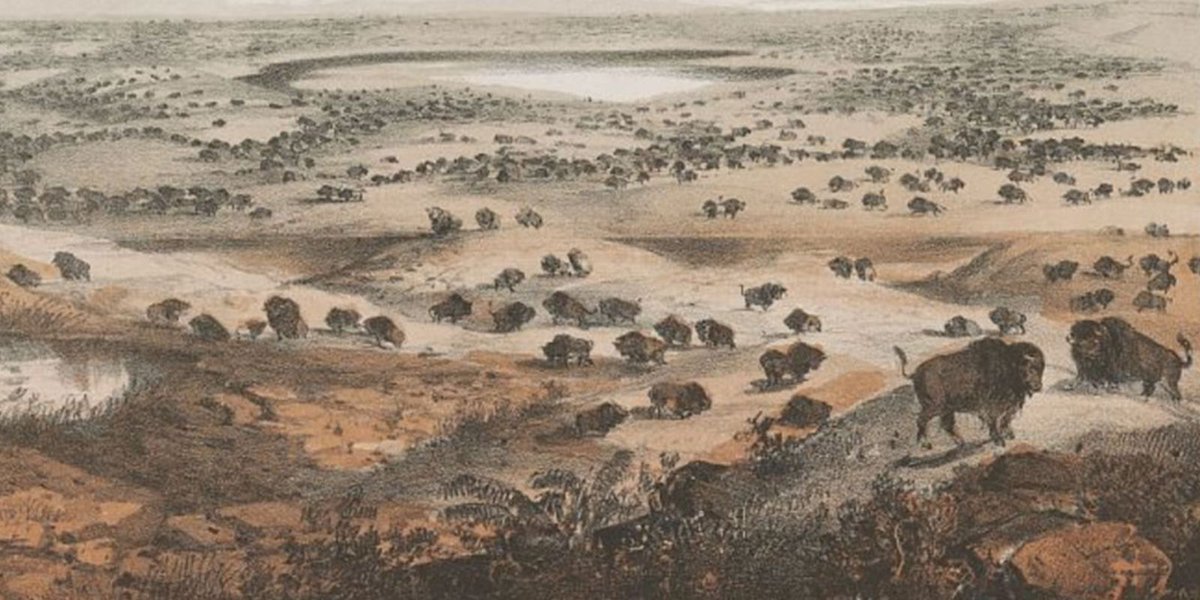
1800s: The Great Plains of North America support the largest herbivore migration in world history. 60 million bison. From Canada to Mexico. Moving in herds that took days to pass a single point.
Beneath their hooves: 3-7 feet of topsoil. The deepest, richest soil on Earth. Built over thousands of years by the exact process the bison represented.
Graze intensely. Move on. Trample plant matter into soil. Fertilize with dung. Let grass recover. Return next year. Repeat for millennia.
The grassland evolved with them. The soil was their creation.
1860s-1880s: The US government has a Native American problem. Plains tribes are mobile, militarily effective, and completely dependent on bison for food, clothing, tools, shelter.
Kill the bison, you kill the tribes' independence.
General Sherman states this explicitly: "Kill every buffalo you can. Every buffalo dead is an Indian gone."
Railroad companies offer bounties. "Buffalo hunters" kill thousands per day. The carcasses are left to rot. Sometimes just the tongue is taken. The rest wasted.
60 million bison in 1800. Less than 1,000 by 1889.
Native Americans forced onto reservations. The stated goal achieved.
But the land notices.
Without bison hooves breaking soil crust, rain runs off instead of penetrating. Without bison dung, soil microbes starve. Without intense grazing followed by rest, grasses can't regenerate properly.
The topsoil that took 10,000 years to build begins disappearing.
1930s: The Dust Bowl. Topsoil literally blows away. Farms destroyed. Millions displaced. Massive economic collapse. Ecological catastrophe.
"Experts" blame farmers for plowing marginal land. They ignore the obvious: The soil was fine for 10,000 years with 60 million bison. It lasted 40 years without them.
The bison weren't destroying the land by grazing. They were building the soil through the very process we eliminated.
Today: The Great Plains has 48 million cattle. That's 25% fewer large ruminants than existed naturally as bison.
Yet cattle are blamed for environmental destruction on land that was literally built by large ruminants doing exactly what cattle do now.
The American Serengeti had 60 million grazers and the deepest topsoil on Earth. We killed them, destroyed the soil within decades, and now blame their replacements for the damage.
In my opinion the US economy is showing recession signals: plunging crude oil, falling grains, slowing jobs, and Main Street struggling while Wall Street floats on a few big stocks. Cattleman be aware beef demand is strong but broader economic weakness could hit consumer spending hard. Cattle prices need to rise to cover costs—but in a recession, that's not guaranteed. Protect your operation if external factors turn against us.