In today’s world, unrestricted, automatic birthright citizenship is suicidal.
The Supreme Court could and should have read the Fourteenth Amendment as something other than a suicide pact.
Those who drafted and ratified that provision certainly didn’t regard it as such.
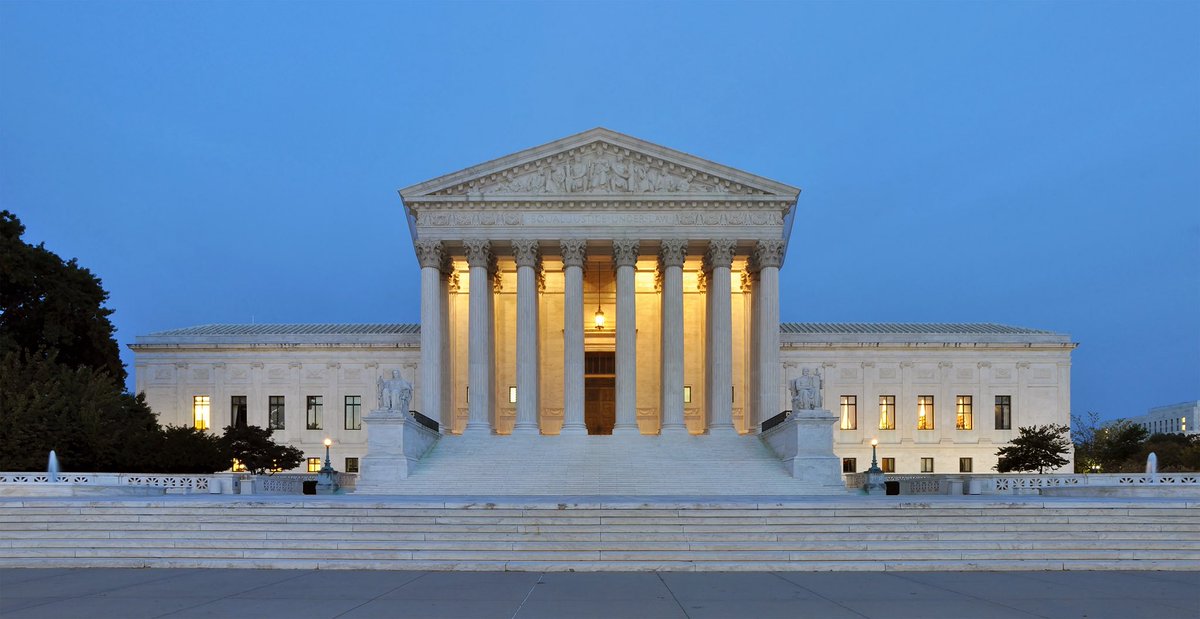
BREAKING: The Supreme Court - led by Chief Justice Roberts - failed the American people, the Constitution, and the rule of law today - not to mention endangering the national security of the United Statres. The 14th Amendment to the U.S. Constitution in no way stands for the proposition that we must permit a dangerous cottage industry of traveling to our soil to manufacture United States citizenship. That's insane. The Court today should have said so explicitly and ended this damaging exploitation of our laws. Congress must now immediately do at least two things it should have done long ago. First, define the phrase ‘subject to the jurisdiction thereof’ very specifically to make clear that citizenship is tied to the citizenship of the parent, not the soil. Second, completely restrict funding from DHS or any other agency or state that provides documentation and status to anyone not subject to the ‘jurisdiction thereof.’ In other words, Congress must act immediately and must not hide behind the fiction that it must amend the Constitution to fix this abuse of our laws. To do otherwise would be an abject failure of the United States Congress.
We should attach the SAVE America Act to any and every other bill that could help us get it passed.
It shouldn’t be this hard.
This bill is popular and badly needed.
@Cernovich@AnnCoulter So, when faced with a decision what funding priorities are in their own nation, ambulances and emergency medical care don’t rise near the top?
Once Again, Justice Barrett Misses the Constitutional Mark. Sorry I Told You So.🗳️
Constitutionally Speaking: Watson v. Republican National Committee- Mail in Ballots:
by KrisAnne Hall, JD
Today, in the Supreme Court, Justice Amy Coney Barrett leads the majority of liberals claiming to follow the Constitution's original meaning. She quotes Alexander Hamilton in Federalist No. 59, speaks of the Framers' intent, and repeatedly invokes history as its guide.
But when the historical evidence becomes inconvenient, Barrett quietly sets it aside. Barrett engages in judicial activism disguised as selective originalism.
This Isn't a Victory for Federalism. It's a Victory for Judicial Activism.
Barrett, in her effort to appear as a constitutionalist, begins with a correct statement of constitutional authority.
Article I, Section 4 gives state legislatures the primary authority to regulate the "Times, Places and Manner" of congressional elections, while Congress retains the ultimate authority to alter those regulations.
Barrett even quotes that Alexander Hamilton described exactly that arrangement in Federalist No. 59, in her effort to feign Originalism. But that's where Barretts efforts end.
This Decision Expands Judicial Power, Not Constitutional Liberty.
Instead of asking what Congress meant when it exercised that constitutional authority by establishing a uniform Election Day, the majority narrows its analysis almost exclusively to dictionary definitions of the word "election."
It concludes that because "election" simply means the act of choosing, ballots may continue arriving for days after Election Day so long as the voter completed the ballot earlier.
The problem is that history overwhelmingly points in the opposite direction.
For nearly two centuries, Americans understood Election Day to mean exactly what its name suggests, the day on which election officials received ballots and completed the voting process. Before the Civil War, voting occurred almost entirely in person. Election Day naturally became ballot-receipt day.
Even during the Civil War, when soldiers were scattered across distant battlefields, states did not abandon that principle. They adapted the mechanics while preserving the rule. Military officers acted as election officials, collected ballots in the field, verified voters, and ensured those ballots were received according to Election Day requirements.
The method changed. The deadline did not.
Ironically, Barrett acknowledges that words should be interpreted according to their ordinary meaning when Congress enacted them. Yet after stating that principle, she largely ignores the strongest evidence of what Congress actually understood that meaning to be: nearly two centuries of uninterrupted governmental practice.
Instead, Barrett treats those historical practices as little more than interesting coincidences.
The dissent exposes the weakness in that reasoning with a simple question:
If Congress never intended Election Day to serve as a ballot-receipt deadline, why did virtually every state, including those facing enormous logistical challenges during the Civil War, go to extraordinary lengths to ensure ballots were received by Election Day?
Barrett has no satisfying answer and, instead, suggests perhaps the states simply chose to operate that way voluntarily. But that explanation requires believing that states consistently imposed significant logistical burdens upon themselves for nearly 200 years without any legal necessity whatsoever.
That is not impossible but it is historically implausible.
Barrett also invokes Federalist No. 59 to argue that the Framers wanted flexibility because they could not foresee every future circumstance. This is your typical "non-originalist" misunderstanding about what our founders intended.
Hamilton's point was not that courts should rewrite election statutes whenever circumstances change.
His point was that Congress possesses the constitutional authority to adapt election law as conditions evolve. That distinction matters.
The Constitution assigns election policy to legislatures, not judges.
If Congress wishes to permit ballots received after Election Day, Congress may amend the statute. Until Congress does so, courts are obligated to apply the law Congress actually enacted, not the law judges believe Congress should have enacted.
Barrett says history matters, but ultimately relies on dictionaries.
The dissent begins with constitutional text, confirms it through historical practice, measures it against nearly two centuries of consistent implementation, and harmonizes that evidence with existing precedent.
The dissent is engaging in classic originalist methodology.
Original intent is not proven by selectively quoting the Federalist Papers while ignoring two centuries of governmental practice that demonstrate what those principles became in law.
Barrett begins with history, but leaves it behind when that history points toward a different conclusion.
Constitutional Originalists will see this clearly. Political loyalists will either be "shocked" by Barrett's errors or pleased by them, depending on what side of the political coin they sit.
I'm not shocked. I made many warnings about Barrett BEFORE her confirmation. Learn Constitutional Truth. Join me on this journey! https://t.co/LMNVsIsNGK