@sterlingwalker@PDAcortex@PhysInHistory "It’s been written up."
with radiative balance calculations showing something other than carbon raising the temperature?
Definitely send me that paper. That will be enormous news.
@PDAcortex@PhysInHistory "scientific consensus is irrelevant"
It is - when there is the emergence of a new theory that disproves the present one.
If you have one, you should definitely write it up asap.
Phil Jones, Emeritus Professor @ClimateUEA_ @ueaenv@uniofeastanglia, was awarded an Honorary Doctorate of Science last week @UniofNewcastle where he completed his PhD 48 years ago.
5th place, men's 45-50, Raising The Bar. Pleased to see improvements in the areas I've been focussing on, and even more grateful to be shown the areas still needing work.
#ukcrossfit#masterscrossfit#raisingthebar
LATEST sweep of global T:
Spt 2023:
HadCRUT5: +1.63°C above pre-industrial.
[ ^ 7th month in record to >1.5°C ]
NOAAGlobalTempV5.1: +1.59°C above pre-industrial.
#ClimateCrisis#climate
5/5 Individual months in exceedance of 1.5°C are not a breach of the UNFCC Paris Agreement which requires a multi-annual sequence of >1.5°C to demonstrate a clear non-natural cause, but indicate our proximity to the threshold.
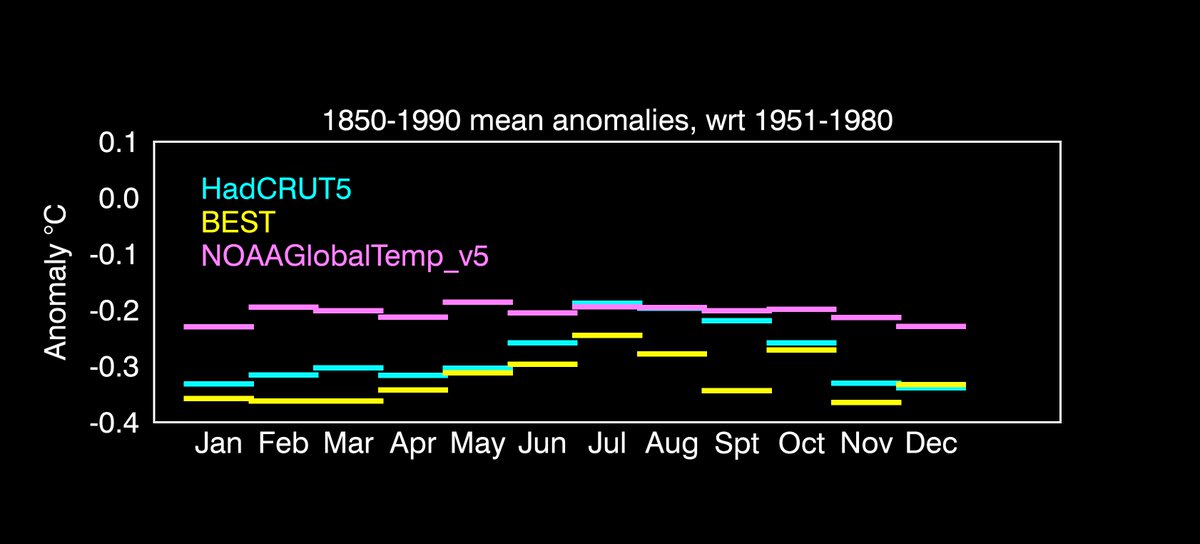
1/n Diagnosing individual, continuing, months in exceedance of 1.5°C is, naturally, sensitive to each month's pre-industrial value (nominally 1850-1900). These values differ, evidently substantially, between major datasets as a result of constituent data & assemblage techniques..
4/n This 'seasonality of discrepancy' will apply to all future years, unless re-versioning of either data effects the early records. The larger discrepancy within NOAAGlobalTV5 most likely attributable to use of ERSST for marine temperatures as opposed to HadSST4.
4/n To be clear: both records indicate numerous individual months that have been hotter, by >1.5°C, than their corresponding monthly pre-industrial average.
#1point5
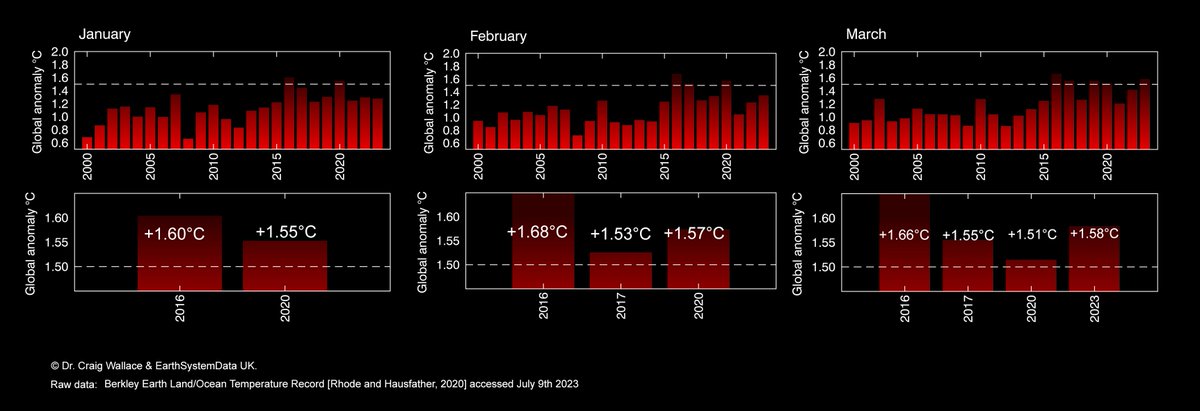
1/n The monthly 1.5°C breaches identified in HadCRUT5, relative to 1850-1900, are corroborated by the Berkely Land/Ocean Temperature Record. In fact the breaches are stronger, and more numerous, in BEST:







![craigwallace's tweet photo. LATEST sweep of global T:
Spt 2023:
HadCRUT5: +1.63°C above pre-industrial.
[ ^ 7th month in record to >1.5°C ]
NOAAGlobalTempV5.1: +1.59°C above pre-industrial.
#ClimateCrisis
#climate https://t.co/rtrbbO56ot](https://pbs.twimg.com/media/F98EawybAAA1pql.jpg)