Aharonov-Bohm Effect:
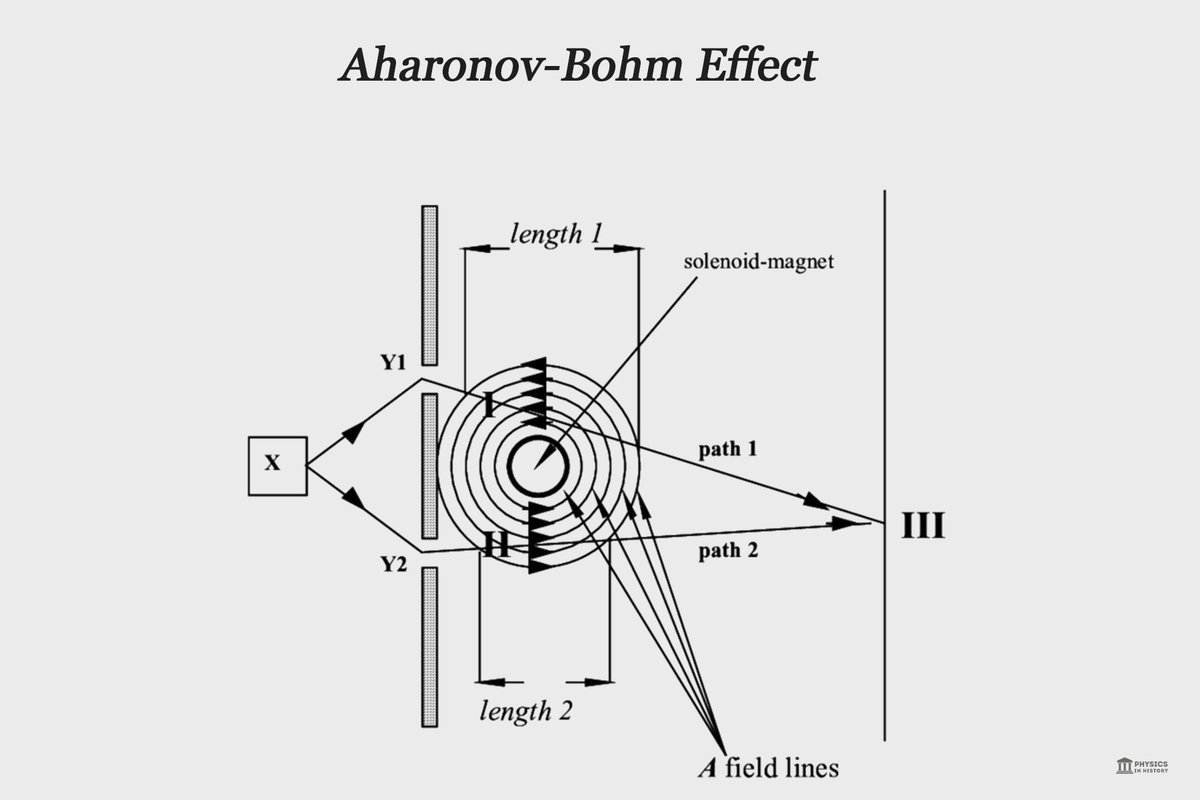
This quantum mechanical phenomenon shows that an electrically charged particle can be affected by an electromagnetic field, even if the particle travels through a region in which both the magnetic field and electric field are zero. This challenges the classical notion that fields only affect particles through direct contact.
I call myself an atheist. Agnostic for me would be trying to weasel out and sound a little nicer than I am about this.
- Richard Feynman's response when asked whether he called himself an atheist or an agnostic.
Mole Day is celebrated on October 23 from 6:02 a.m. to 6:02 p.m., honors Avogadro's constant (6.02×10²³), the number of particles in a mole, a key chemistry concept.
At a conference in 1937, Lise Meitner shares the front row with [L-R] Niels Bohr, Werner Heisenberg, Wolfgang Pauli, Otto Stern and Rudolf Ladenburg; Hilde Levi (in the top corner) is the only other woman in the room.
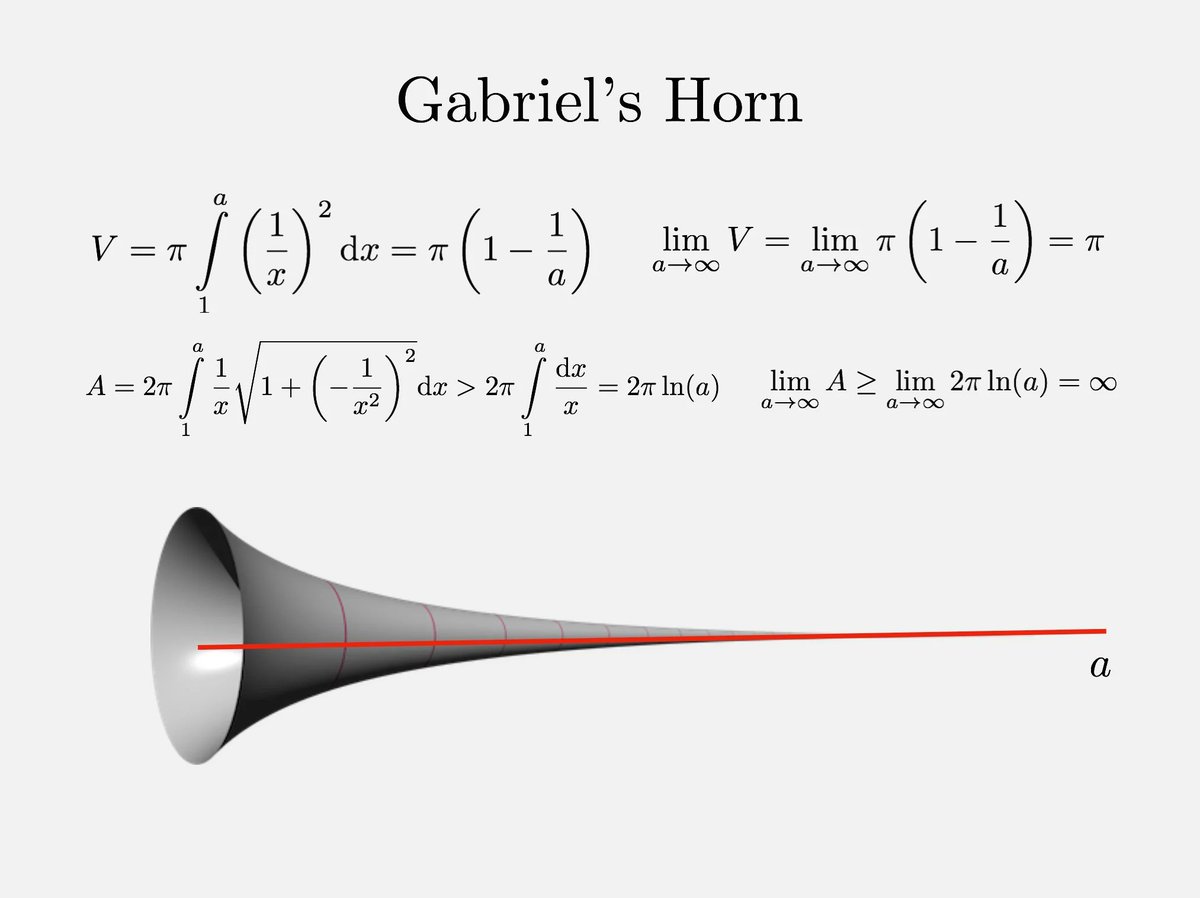
Gabriel's Horn, also known as Torricelli's Trumpet, is a geometric figure that has the paradoxical property of having infinite surface area but finite volume. It is formed by revolving the curve y = ¹⁄ₓ around the x-axis from x = 1 to infinity. ✍️
Mole Day is celebrated on October 23 from 6:02 a.m. to 6:02 p.m., honors Avogadro's constant (6.02×10²³), the number of particles in a mole, a key chemistry concept.
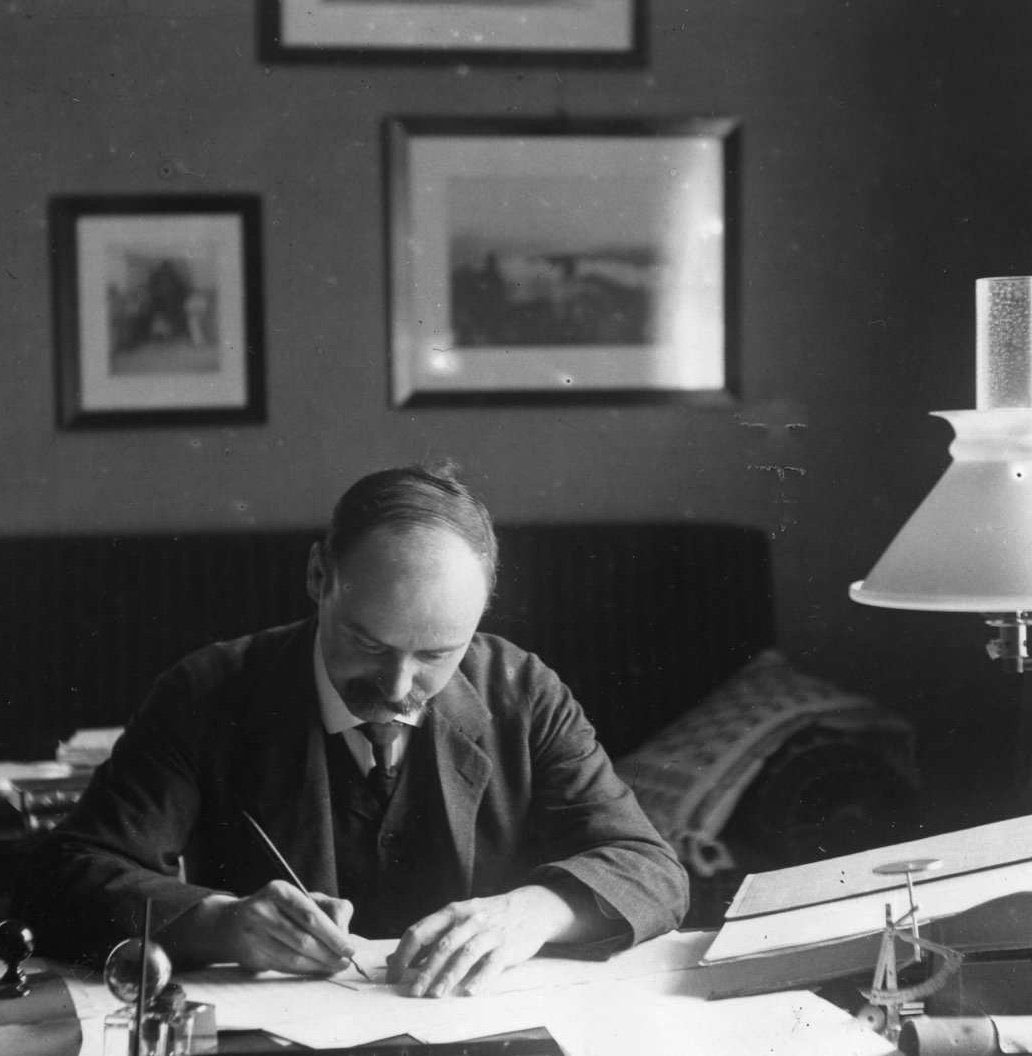
Several months after Einstein presented his papers on General theory of relativity in 1915, a young German soldier serving at the Russian front solved Einstein's field equations. His solutions revealed the existence of black holes.
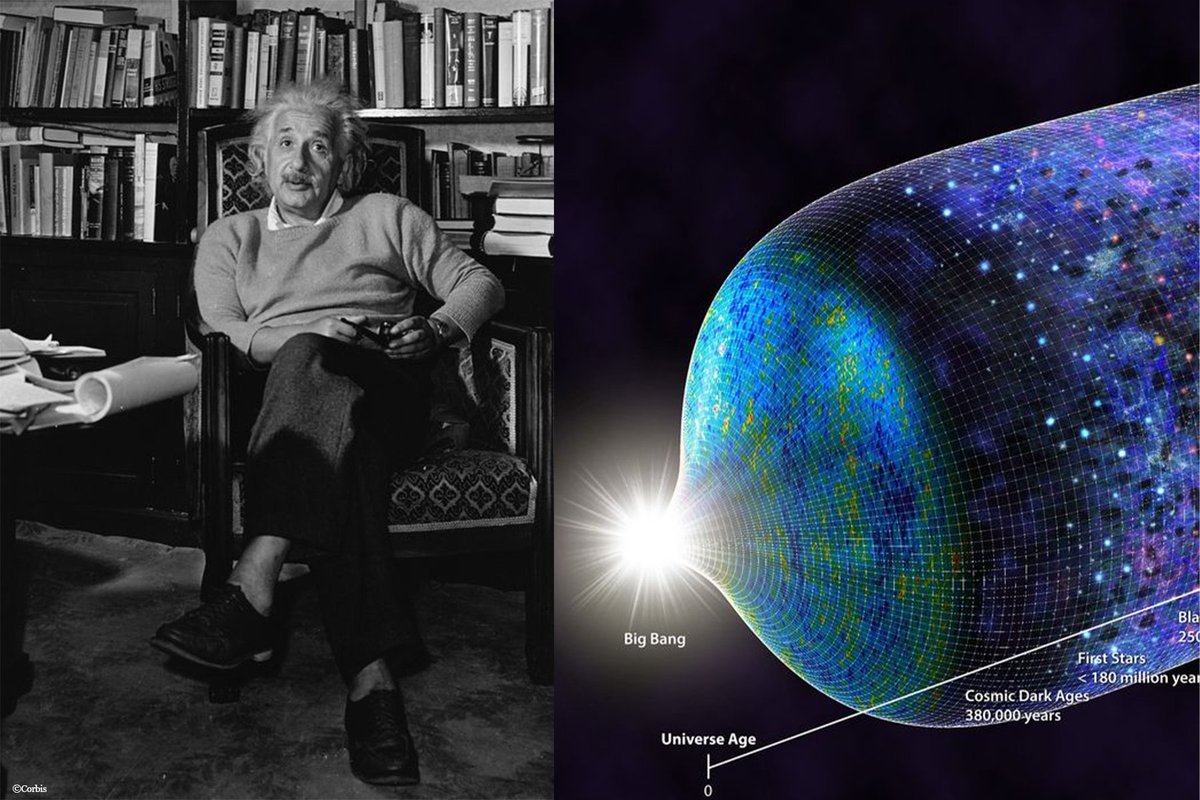
Einstein's "biggest blunder": 📰
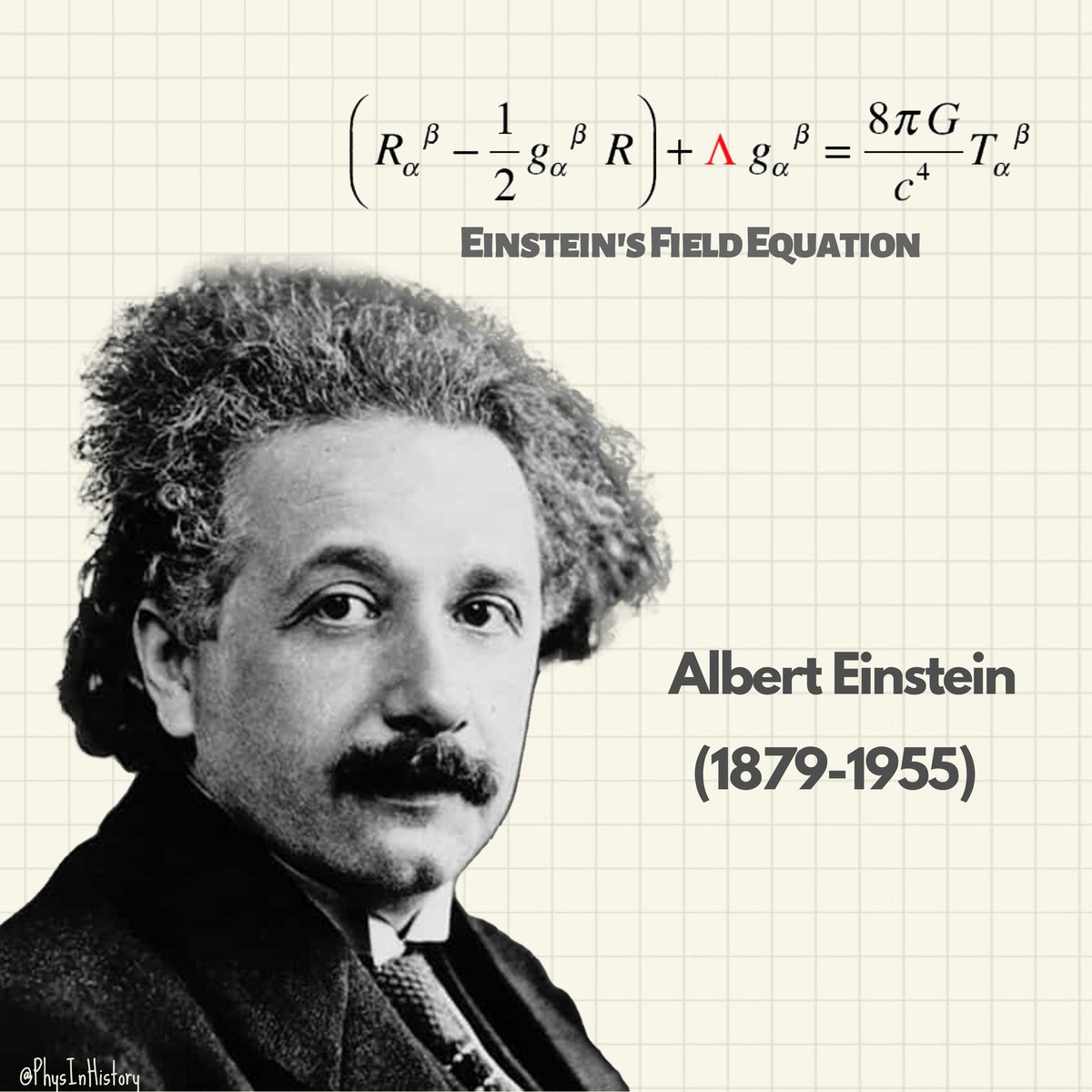
In 1917, Albert Einstein introduced the cosmological constant into his theory of general relativity in order to maintain a static universe, as it was widely believed at the time.
However, just over a decade later, Edwin Hubble's observations of the expanding universe rendered the cosmological constant unnecessary. Einstein later referred to this as his "biggest blunder," although recent discoveries suggest that the constant might play a role in explaining dark energy.
Edwin Hubble was an American astronomer who discovered that galaxies exist beyond the Milky Way and that the universe is expanding, leading to the formulation of Hubble's Law. His work laid the foundation for the Big Bang theory and revolutionized our understanding of the cosmos. Also The Hubble Space Telescope is named in his honor.
Lemaître is credited with the first definitive formulation of the idea of an expanding universe and what was to become known as the Big Bang theory of the origin of the universe, which Lemaître himself called his “hypothesis of the primeval atom” or the “Cosmic Egg”.
"This circumstance of an expanding universe is irritating."
Einstein did not like the idea that the universe had a beginning or that it was constantly changing in size. He preferred a static and eternal universe that was balanced by a cosmological constant, a term he added to his own equations of general relativity.
However, many scientists who studied his equations found solutions that suggested otherwise. One of them was George Lemaitre, a Belgian priest and physicist, who proposed in 1927 that the universe began with a “primeval atom” that exploded and gave rise to the expanding universe. He also predicted that the expansion rate of the universe should be proportional to its distance from the center of the explosion, a relation now known as Hubble’s law.
Another scientist who challenged Einstein’s view was Edwin Hubble, an American astronomer, who observed in 1929 that the galaxies were receding from each other at a speed that increased with their distance, confirming Lemaitre’s prediction. He also showed that the universe was not static, but dynamic and evolving.
Einstein was initially reluctant to accept these findings, but he eventually changed his mind and admitted that his cosmological constant was a mistake. He said that Lemaitre’s theory was "the most beautiful and satisfactory explanation of creation to which I have ever listened". He also praised Hubble’s work and said that it was "one of the greatest discoveries in science".
Initial quote was A. Einstein's remarks on the Big Bang and the expanding universe as mentioned in a letter to Willem de Sitter.
Source: HAVE ASTRONOMERS by Robert Jastrow, 1978.
Gabriel's Horn, also known as Torricelli's Trumpet, is a geometric figure that has the paradoxical property of having infinite surface area but finite volume. It is formed by revolving the curve y = ¹⁄ₓ around the x-axis from x = 1 to infinity. ✍️
One of the earliest examples of a systematic approach to empirical inquiry is found in the Edwin Smith papyrus, an ancient Egyptian medical textbook from c. 1600 BCE, which describes the examination, diagnosis, treatment, and prognosis of various diseases.