QLD Treasury: Former fund manager, diplomat, trade and capital advisor, government official, ops & strategy. Passions: innovation, creativity, collaboration
Queensland SMEs - elevate, diversify, & invest in your regional operations by applying for the #BackingBusinessInTheBush Fund now - https://t.co/cDkI2BXOEt. Don't miss the chance to reshape your business landscape, apply before 14 Jan 2024.
#RegionalQueensland#BetterServices
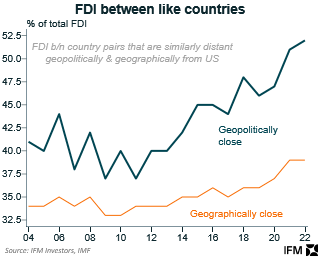
The IMF has spoken about the tendency for FDI flows to have increased between countries with shared values - there are not many countries that are closer in this respect than the UK and Australia.
In 1985, Nike held a 24-hour shoe design contest.
Nike was struggling. Their stock dropped 50%. They had to lay off people. Adidas, Converse, & Reebok were all selling more shoes.
So in a panicked attempt to find creative talent, Nike held a shoe design contest.
The winner was
A corporate architect named Tinker Hatfield.
"Two days after the competition," he said, "I wasn't even asked—I was told that I was now a footwear designer for Nike."
As he got to work on his first official shoe design, he thought about a building he had studied in architecture school: The Centre Pompidou in Paris.
The Centre Pompidou is an inside-out building, meaning that the structural, mechanical, and circulation systems are all exposed.
“That building,” Tinker said, “was describing what it was to the people of Paris. And I thought, ‘Well why not do that with a shoe? Let’s cut a hole in the side and show what’s in the shoe.’”
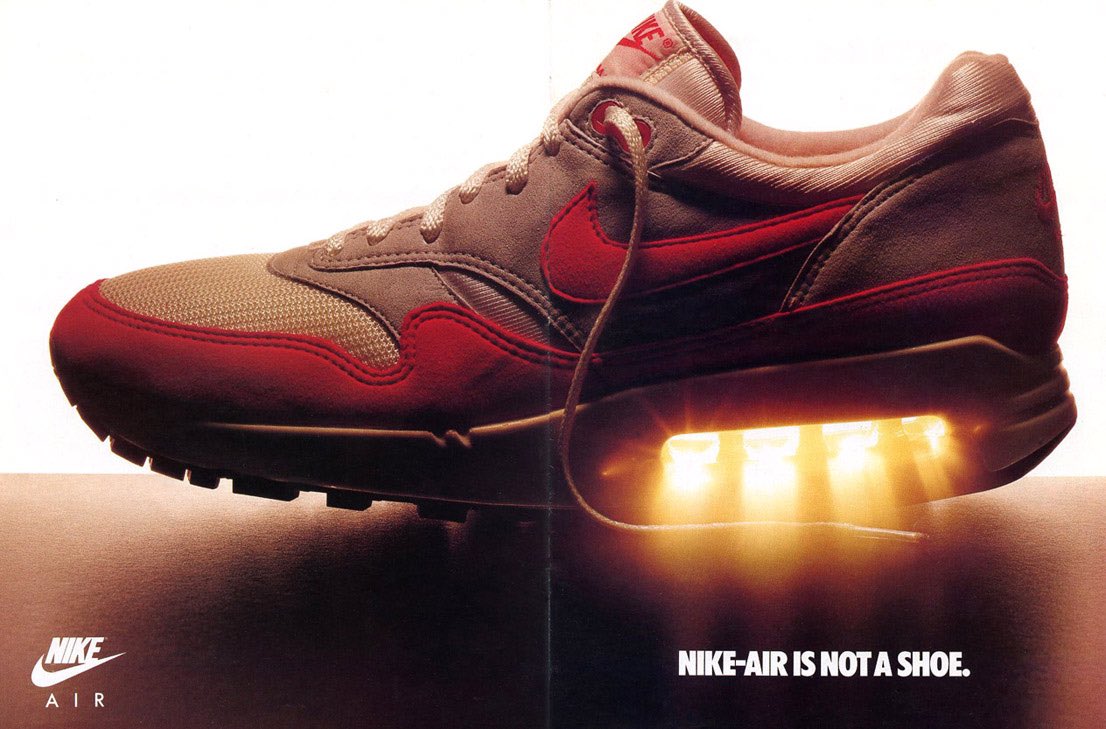
So Tinker designed an inside-out shoe:
The Air Max 1.
The Air Max 1 was a massive success, and it steered Nike's design direction from then on.
"To this day," Tinker says, "Phil Knight says I saved Nike."
Takeaway 1:
Had he not studied that building in Paris, Tinker says, he couldn’t have created the Air Max.
Creativity, he says, is a function of the “library in your head."
“When you sit down to create something...what you create is a culmination of everything you’ve seen and done previous to that point.”
Takeaway 2:
Tinker Hatfield went to architecture school and then he was a corporate architect for 4.5 years. Then, literally overnight, he became one of the best shoe designers in the world.
This makes me think of a counter-intuitive discovery made by psychologist Charles Spearman in 1904.
Before Spearman, the natural assumption was that the more you specialize in one thing, the worse you’ll be at other things.
Instead, Spearman discovered "the positive manifold" phenomenon.
He found that different abilities tend to be positively correlated. That the expertise gained through specialization is transferrable. That the cognitive and creative abilities cultivated as an architect could positively correlate with being a shoe designer.
- - -
"Creativity is a function of the previous work you put in." — Robert Greene
Follow @bpoppenheimer for more content like this!
Congrats @frugalpac.
We'll support your expansion #downunder 🇦🇺.
A market for your 94% #recycled paperboard bottles, 5 x lighter than glass & using 6 x less carbon & energy to produce & dispose, awaits.
Delighted #Sydney's Mother of Pearl Vodka an early adopter.
🇦🇺🇬🇧 #AUKFTA
The race for alternatives to lithium-ion batteries is on! "Rio Tinto signs $6m deal with Brisbane battery developer" #auspol#qldpol#batteries#lithium#energy#climate https://t.co/vKRb6zcn77
Is the series true to life? Does the Foreign, Commonwealth & Development Office really look like that? Is that really how diplomacy is done?
Foreign Secretary @JamesCleverly fact-checks @NetflixUK's The Diplomat.
Watch the full clip here: https://t.co/h8QQE26kbm
As part of the road to the Global Entrepreneurship Congress in Melbourne later this year I have the priviledge to be discussing "the rise of climate tech" with some real champions @olympiayarger @liubinskas and @MollyFullee
18 May 2pm AEST https://t.co/zIsKHhcO7A