What if all new terraced houses were this harmonious, good simple? Following patterns that evolve gently with the centuries, making people happy not creating false ruptures.
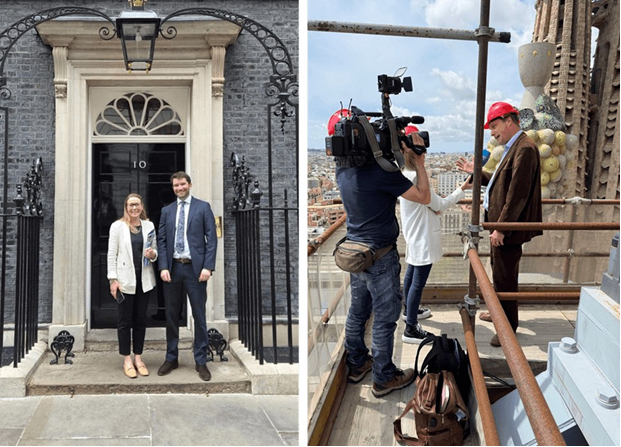
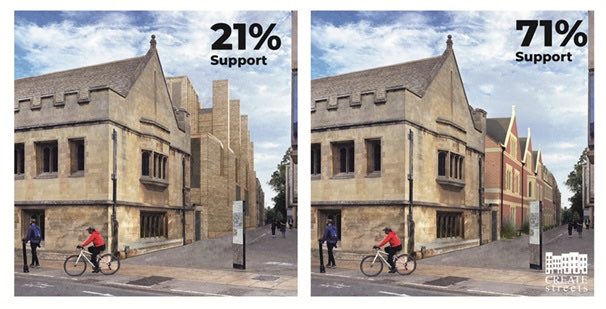
Create Streets is really stretching its wings at present. @RobertKwolek has been in Oslo & Ed has been in Florence both talking about our work understanding public preferences & using that to win public support for new Gentle Density development creating more public & more landowner value. Meanwhile Eleanor and @djjmilner have been exploring doors in central London and @boys_nicholas has been giving high level interviews to Spanish television in Barcelona. And next we're going to the Bahamas to advise on street design. Our work is research-led not "design-led". We understand what places like and where they prosper. Maybe we can help you regenerate town centres and win support for more homes on less land? Why not...
Bordeaux – Population 260,000. Has trams.
Leeds – Population 800,000. No trams.
We can, and we will, have nice stuff.
People will come up with reasons why we can't do it.
Ignore them. We can.
Yes we tram.
📢 Only a few places left for our 2026 Urban Design & Architecture Summer School! Starting on 10 July, our intensive residential course in Sherborne offers a practical introduction to designing beautiful, sustainable and popular places
https://t.co/rs0xRdys7T
@ADAMarchitectur
No discredit to the individuals involved but the fact that the state thinks it needs to buy prime development land in one of Britain’s most undersupplied highest demand markets shows how fundamentally failed the British planning system now is.
NEW: Acquisition of Marshall airport site by Hill and Homes England announced - to deliver 10k homes.
Set to become Cambridge East. one of the UK’s largest urban extensions. 1
While 2% of the British public trust developers to make old places better with new development & with most modern designs consistently unpopular with large majorities of the population across every social demographic, the politics of development will remain brutal. Beauty is part of the path to falling back in love with the future as …
Crazy how much HS2 was fumbled. Spent 100bn and still ended up with a design virtually nobody likes.
I bet the design on the right would have actually saved money by avoiding the perceived need for as much pointless tunnelling.
This is splendid. Surely the most insidious quibble is the decline in all street furniture. See the new CIIIR postbox: formerly cast iron, now stamped and welded with an ugly glued-on cypher. A national icon demonstrating how little we care for the public realm.
Whilst the majority of the population continue to believe that new development makes old places worse, the politics of house building will remain brutal.
The people of Peckham didn’t want this and @lb_southwark protected their interests over those of a US multinational. This isn’t Nimbyism - people just want more humane homes.
@BBCNews@TheEconomist ... HOW to fix it. Here is how. Will @transportgovuk@Heidi_Labour or @10DowningStreet fix it? It is genuinely quite easy, would be popular and yet the government appears to be uninterested? They've got a lot to do but why not do this too?
https://t.co/WyObjreOLj
Hello, we are Jonathan and Abigail - unashamed pedants who want to bring this affliction to bear on all things public policy and practice.
We believe that details matter, especially in public administration. This is why today we are founding quibble: a campaign to fix the small stuff.
Think, for example, about the cookie banner that we click on every webpage. Each instance is not a big deal, so we just put up with it. But its cumulative impact adds up - on average we press it 5 times per day. The European Commission estimates that it costs EU citizens 343 million hours per year.
And who is there to represent the impacts of seemingly minor issues like this in a systematic way? We want quibble to be the answer. In the case of the cookie banner, lots of advocacy has rightly focused on privacy, but has this meant that user experience has taken a backseat? We believe there are ways to improve user experience without compromising on privacy. We will share more about this soon.
Consider another example. Did you know that in some government-run car parks you can be fined for a minor keying error, such as accidentally typing a zero instead of an “o”? Again, we will come to the detail of this quibble in the coming weeks, but for now just consider again the question: who? Who is there currently to systematically represent the interests of the parker who is given an unfair ticket?
An inherent feature of consumer interests is that those who have them rarely have enough other things in common to make collective organisation and representation feasible. This is the gap that quibble seeks to fill. Now of course excellent consumer interest groups exist. But understandably quibbles might not be at the top of their lists. Our hope is that quibble will be complementary; picking up the bottom-of-the-list issues faced by various groups - the stuff they are almost too embarrassed to raise because they are too small.
We are not embarrassed about detail. If you’ve ever had a splinter, you know small things can have a big impact. This is what quibble is committed to tackling, and our wider hope is that by doing so we will also incentivise policy makers to be even more careful about detail.
Check out our website here, including our first four campaigns: https://t.co/gZiqqHbhIL