LAKE ONTARIO :The Sharpie was the spectacle. Section 2(a) of the executive order is the territorial claim.
While most people stared at Donald Trump��s big, fat signature — scribbled with his favourite instrument of international policy, the Sharpie — the fine print of the executive order went unnoticed.
As always, the devil is in the details.
The name change was the tip of the iceberg.
And maps are more than names.
Read the executive order.
“With the deepest parts of the Lake’s waters lying within United States territory, the United States claims most of the Lake’s volume.” section 2 (a)
The verb is the weapon. Claims.
This is not a caption on a souvenir. It is an assertion of right.
Then , further reading of the order describes the machinery.
Within 30 days, the Secretary of the Interior is to rename the lake “Lake America,” update the Geographic Names Information System, and “remove all references to Lake Ontario from the GNIS.”
Not add a name. Erase all mention of the old name from the official American geographic record.
After that, every federal map, contract, and government communication must repeat the new one.
Watch the sequence, one that China has been executing for decades in the South China Sea.
First, isolate a physical fact: the deepest point, the Rochester Basin, sits off the New York shore.
-Convert that fact into a title: the United States “claims most of the Lake’s volume.”
- Write the new name into the database.
-Delete the former name.
- Order the entire federal apparatus to speak as if the deletion had always been true.
Once that paper trail exists, it can be cited in legal arguments to claim sovereignty.
"Our maps already call it Lake America. ", says Washington!
From Sharpie to proof.
🇨🇳China perfected the method in the South China Sea. Rename the reef. Inscribe the name on the official chart. Send the ships. Treat the chart as verdict. The name goes first. The patrol follows the name.
🇺🇸The White House has written the first half of that script onto a shared inland sea.
The second half is already foreseeable.
When Coast Guard charts, Army Corps filings, and American navigation systems all say “Lake America,” patrols, icebreakers, and inspections acquire a new language.
They are no longer on a binational lake.
They are on a body of water the United States has already renamed and claimed by volume.
Presence follows paperwork.
Below is a detailed analysis of how China uses maps as a weapon to subjugate its neighbours.⏬
#cdnpoli #polqc
@MarkJCarney Thank you for standing up for Canada. I hope this isn’t Trump’s first step towards annexing a piece of Canada, or claiming water rights. Let’s make sure it doesn’t go any further than a name. 💪
If I were president and I wanted to tank the dollar and get rich off it, here is exactly what I would do.
I would hire a Treasury Secretary who already made $3.5 billion crashing another country's currency. I would put my guy in charge of the agency that approves bank charters. I would install a crypto czar with $200M in crypto holdings and give him an ethics waiver so nobody could challenge it.
Then I would sign an executive order banning the government from ever creating a digital dollar so there was no competition.
Then I would have my family launch their own private digital dollar. My family takes 75% of net profits. I would grow it to $4.6 billion in circulation and route a $2 billion Abu Dhabi sovereign fund deal through it to prove it works.
Then I would get Congress to pass a law requiring every stablecoin in the country to hold short-term Treasury bills. Now every dollar of my digital currency is a forced buyer of government debt. Brookings projects $2.3 trillion in captive demand by 2030.
Then I would have my OCC guy grant my family's company a federal bank charter. Now I can issue my digital dollar with federal authority.
Then I would have my Treasury Secretary weaken the actual dollar. Bond buybacks that suppress yields but tank the currency. Build a $950 billion war chest for more. Let the debt hit $40 trillion. Dollar index drops to 99. Gold goes to highest point ever.
Then I would kill the Corporate Transparency Act and delete the FinCEN beneficial ownership database. That was the one law that required every shell company in America to report who actually owns it. Without it, nobody can trace who is buying my stablecoin, who is routing money through it, or where the profits land.
Then I would let the loop run. Weaker dollar drives demand for "stable" digital alternatives. The law I passed forces those alternatives to buy T-bills. That funds the government's debt. My family takes profit on every transaction. Foreign central banks walking away from Treasuries get replaced by legally mandated stablecoin reserves my family controls.
Then I would use sanctions to start cutting countries off from the dollar system entirely. And when those countries need a new way to transact in dollars, the only federally chartered private digital dollar in existence is mine. They can buy it through shell companies nobody can trace because I deleted the ownership database.
I just built a toll booth on the global financial system. I take a cut every time someone uses the dollar. And I made it so nobody can see who is paying.
And every single step I just described has already happened.
So what does that mean for you and I?
The reason the United States can borrow at low rates and keep your mortgage and your car payment and your import prices stable is because foreign central banks hold trillions in dollar reserves. That system has always been public. The benefit went to everyone. Lower borrowing costs, cheaper goods , and the single biggest economic advantage any country has ever had.
What I just described is the privatization of that function. The entity buying the debt is no longer a central bank acting in the public interest. It is a private company taking 75% of net profits for one family. The reserve function used to generate a public benefit. Now it generates a private fee.
Your purchasing power shrinks every time the dollar weakens. Your 401k buys less in real terms. Everything you import costs more. And every time the dollar drops, demand for the private digital alternative goes up. The one the president's family owns. The one that by law must buy government debt.
You absorb the cost of a weakening dollar. His family collects the profit. That is the trade.
The enforcement mechanism to stop a sitting president from doing this? There isn't one. Former White House ethics lawyer Richard Painter says it would be a violation for literally any other federal employee, but not the president.
Nobody voted for this. No one was asked. There was no debate. There is no enforcement mechanism. There is no one investigating it. The Senate tried and it was blocked.
This is the largest conflict of interest in American history happening in broad daylight while everyone argues about something else.
So what do you do? Share this. Make it impossible to ignore. Send it to your representative, your senator, every journalist you follow. We make them answer for it.
Because the only thing protecting this scheme right now is the fact that not enough people understand it yet.
@Mobilized3213 Chapman’s is a great Canadian company that supports its employees and listens to its customers. I hope more Canadians become Chapman customers. ❤️ 🇨🇦
The disgraced former mayor of New York, Rudy (I was just tucking in my shirt) Giuliani, has threatened to sue me for defamation over an interview in which I never said his name. No one even mentioned him.
I want to apologize to Rudy. Going forward I will be certain to say his name directly.
Rudy, you worked with known Russian agents and their proxies to spread lies about me and my father. Their names are Andrii Derkach, Konstantin Kulyk, Andriy Telizhenko and Oleksandr Dubinsky and more. Kulyk handed you a dossier filled with disinformation. You flew to Kyiv in December 2019 to sit down with Derkach, then went on television with him to sell his bullshit tapes.
Trump’s own national security adviser warned the White House that what you brought back was Russian disinformation. You kept going.
Then Trump’s own Treasury Secretary, Steven Mnuchin, sanctioned Derkach in September 2020 as an active Russian agent for over a decade, for spreading the same lies you are still spitting. Four months later, on his way out the door, Mnuchin sanctioned the rest of your sources. Kulyk. Telizhenko. Dubinsky. Eleven people and four media front companies in all. Not sanctioned by me. Not by my father. By Donald Trump’s Treasury Department.
And remember Vienna Rudy. In October 2019 you, Lev Parnas and Igor Fruman had tickets to fly there to collect a hard drive, courtesy of Dmytro Firtash, an indicted oligarch who has spent a decade in Vienna fighting extradition to the United States. Lev and Igor were arrested at Dulles holding one-way tickets. You canceled yours the next morning. That was way before a computer repairman in Wilmington was ever a twinkle in your eye.
So please, @RudyGiuliani. Please, please sue me. Discovery will be a joy for everyone.
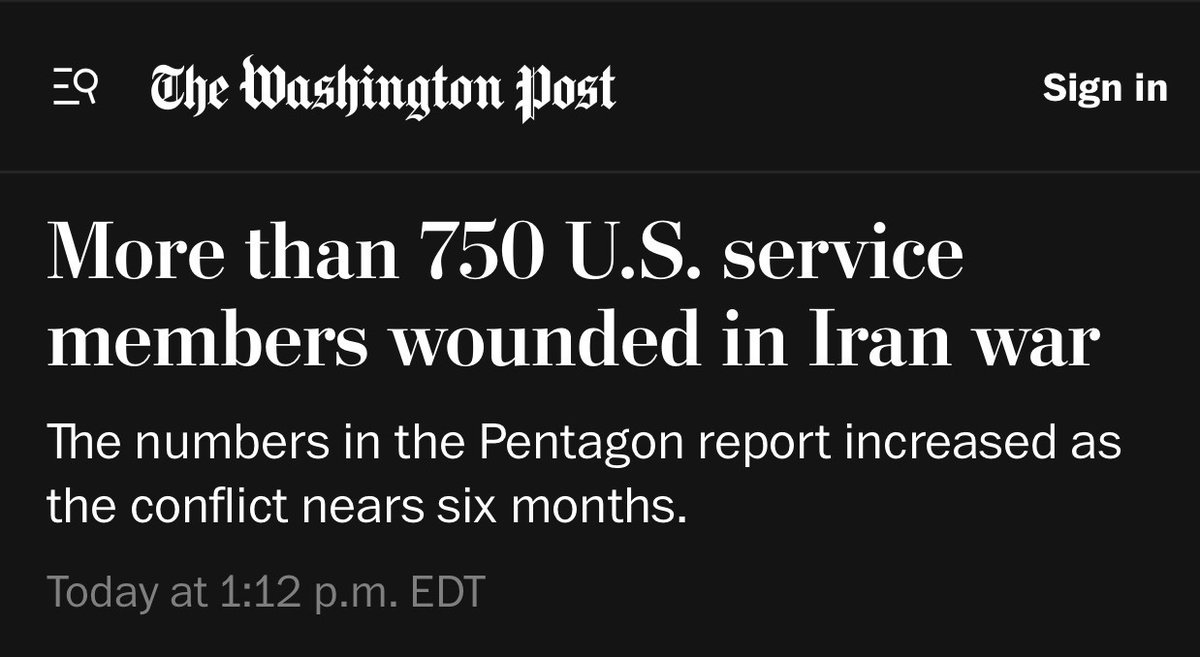
More than 750 servicemembers wounded and another 18 dead. Trump and Hegseth have failed and refuse to take accountability. They have no idea what they’re doing, and it’s made our country weaker and you less safe.
“Long-term debt is the single greatest threat to 🇺🇸USA’s national security.” 🇨🇦Canada is now the 5th largest foreign holder of U.S. debt.
Yesterday I explained how America’s $40 trillion debt and the bond market panic may have forced Trump to blink on tariffs — and how Mark Carney holds a quiet weapon.
Today the full picture:
🇯🇵 Japan: $1.12T
🇬🇧 UK: $940B
🇨🇳 China: $633B
🇧🇪 Belgium: $483B
🇨🇦 Canada: $460B ← 5th largest foreign holder
The U.S. is more vulnerable than most people realize. Here’s the deeper breakdown ⏬
How the US debt problem has empowered other countries, like Canada.
“Long-term debt is the single greatest threat to our national security.”
— Coalition for Fiscal and National Security (May 2016)
Ten years ago, this statement emerged from a report by this committee, composed of distinguished American Republicans and Democrats such as Henry Paulson, James Baker, and Madeleine Albright, at a time when the US debt situation was not as critical as it is today.
Nothing illustrates this better than this comparison.
In 1994, Canada was experiencing a fiscal and debt crisis, to the point that the Wall Street Journal described Canada as “an honorary member of the third world.”
Its ratios at the time were as follows:
🇨🇦 Canada 1994:
Debt/GDP: 40%
Deficit/GDP: 5 %
US projections for 2026:
🇺🇸 United States 2026:
Debt/GDP: 125%
Deficit/GDP: 7 %
This is clear evidence of the problematic nature—to say the least—of US debt. Let's examine how it weakens US national security and empowers foreign actors, including countries like Canada.
The more US debt increases and the more it slips out of American hands, the less control they have over their own destiny and that of the financial markets.
We saw a perfect example of this in two ways this week.
1 – THE CASE OF JAPAN
The US Treasury had to intervene with its main creditor, Japan, whose currency, the Yen, was on the verge of collapse and, to save it, could have massively liquidated US debt. Wanting to prevent this at all costs, Scott Bessent of the US Treasury bought massive quantities of Yen.
If Japan had massively sold its US debt, the law of supply and demand would have played a huge role, causing bond prices to fall and bond yields to rise, ultimately leading to higher interest rates for all Americans. And the increase would have been catastrophic.
2 – 30-YEAR BOND YIELDS HIT 20-YEAR HIGH
The U.S. Treasury carried out a massive buyback of long-term bonds—issuing short-term debt in exchange—in an effort to cool down 30-year bond yields. This failed to reassure the markets, which remain volatile and who understood what actually happened: the United States swapped the equivalent of a long-term, fixed-rate mortgage for a short-term, variable-rate mortgage, thereby exposing itself far more to market whims, interest rate shifts, inflation, and so on.
“High debt not only crowds out resources that strengthen our security, but it also narrows our tools for dealing with unfriendly nations, leaves our economy more vulnerable to actions of other countries, and weakens our global standing and prestige.”
— Source: Committee for a Responsible Federal Budget, 2022
First of all, who holds this U.S. debt abroad—those other countries mentioned above whose actions can influence the United States?
🇯🇵 Japan: $1.117T
🇬🇧 UK: $939.9B
🇨🇳 China: $633.4B
🇧🇪 Belgium: $482.5B
🇨🇦 Canada: $459.6B
And yes, Canada comes in at fifth place—what a surprise! In an article yesterday, I explained how Canada had significantly increased its holdings of U.S. debt and how this could offer the country leverage and protection.
“The Russian invasion of Ukraine has highlighted how the global marketplace for sovereign debt has created new vulnerabilities, as countries around the world have frozen Russia’s access to sovereign debt markets. While it is hard to imagine any comparable situation with the United States, this shows how foreign actors can leverage ownership of debt against one another. On a much smaller scale, China may be able to leverage its holdings to create problems in the U.S. Treasury markets.” (source, ibid.)
Since then, Trump has come to power, and the scenario described seems less difficult to imagine. Imperialistic—even conqueror-like—Trump’s America is alienating ally after ally. If this aggressive trend continues, certain allies—let alone adversaries—might be tempted (not maybe to freeze assets, as was done with the Russians) , but to use their sovereign debt leverage to manipulate the U.S.
And you saw from this list that Canada is one of those countries that has accumulated enough U.S. debt to annoy the Yankees...
Now and in the future, since that debt will only keep ballooning.
For the Trump administration has no intention of seriously addressing the problems:
"There's nothing magic about the $40 trillionnumber. And we can grow our way out of that"
— Scott Bessent, U.S. Treasury advisor. ( see video )
A solution that has drawn derision from many experts...
"To genuinely grow your way out of this level of leverage, you would need sustained productivity spikes of 3% or 4%—levels we haven't seen since the post-WWII boom. Relying on that as a policy framework is a massive, dangerous gamble."
— Jason Furman, former Chairman of the Council of Economic Advisers.
Or, as Nobel Prize-winning economist Paul Krugman put it simply:
"The math simply does not work."
Canadians, do you think this vulnerability will be exploited by our Prime Minister, Mark Carney?
#cdnpoli #polqc #cdnecon
Trump Blinked at Midnight: How Banker PM Carney’s Quiet $436 Billion Weapon and America’s $40 Trillion Debt Trap Might Have Influenced His Decision
The guillotine—a 50% tariff hike on a host of new products—was set to drop at midnight on Tuesday.
Donald Trump backed down, and events related to U.S. sovereign debt may have influenced his decision.
Let’s look at the timeline of events in the financial and bond markets on Tuesday, August 18—the day before the deadline.
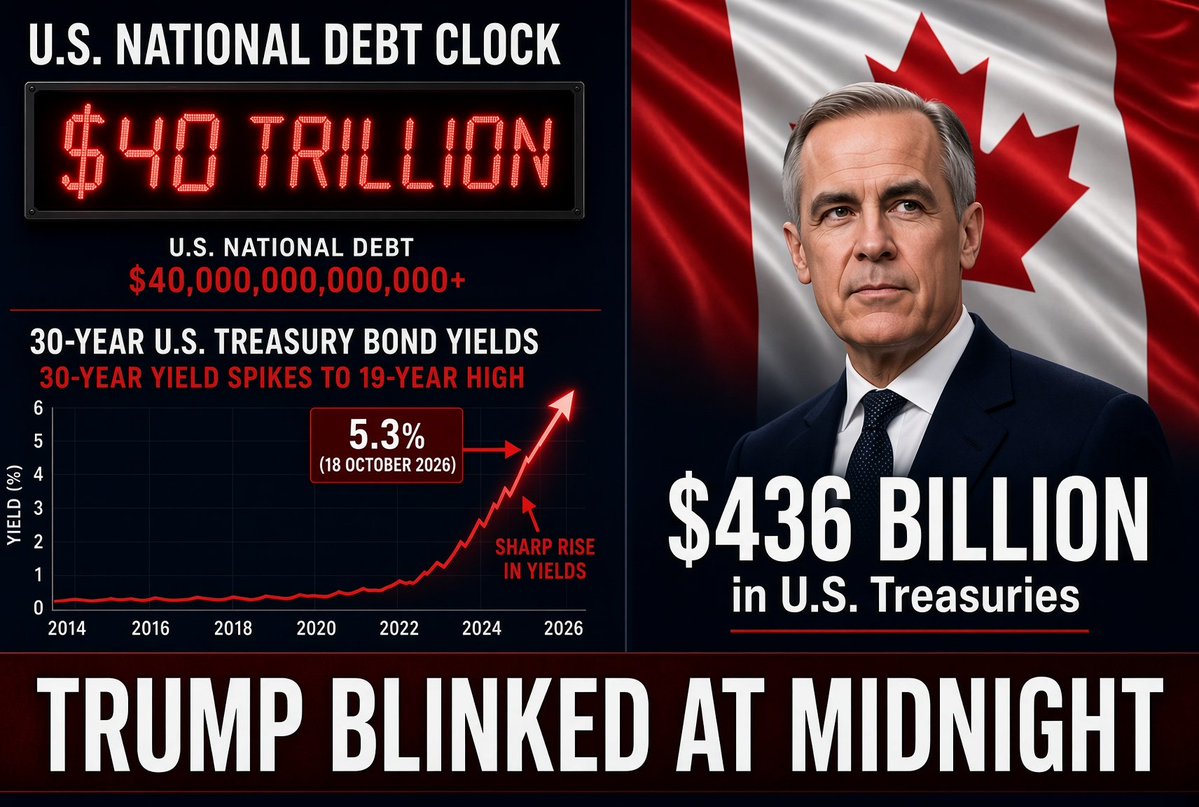
U.S. debt officially crossed the $40 trillion threshold (more on that later).
Yields on 30-year U.S. Treasury bonds surged to a 19-year high, matching levels seen prior to the 2007–2008 financial crisis.
A few hours later, U.S. Treasury Secretary Scott Bessent announced a surprise, massive buyback of the government's own debt (!) to prevent a collapse of the U.S. bond market.
That evening, Trump announced he was suspending the tariff hike. The bond market reacted with immediate relief, marking the link between the the two events.
SHORT-TERM DEBT TRAP
Why and how sovereign debt (Treasury securities, the bond market) and its financing are linked to our negotiations.
On Tuesday, Scott Bessent executed the following financial maneuver to stop bond yields from climbing (to 5.3%!!!).
Using U.S. Treasury funds, he bought back long-term Treasury bonds while simultaneously issuing short-term Treasury bills.
His goal: to prevent long-term sovereign debt from being locked in at a 5.3% rate and to drive that rate down. Otherwise, the government would have been forced to pay that rate to its debt holders for decades—potentially ruining the budget—while consumers would have paid that same rate through their home mortgages and auto loans.
However, the risk taken in doing so is considerable: all this debt is now short-term (spanning weeks or months), and its interest rate is subject to the usual risks—inflation, exchange rates, geopolitics, and so on.
Simply put, the "short-term debt trap" is akin to the U.S. government choosing a high-risk variable-rate mortgage over a 30-year fixed-rate mortgage.
That day, letting massive tariffs hikes fall at midnight, causing rates to spike, was certainly on Trump and Co's minds....
Just listen to Trump in video worrying about interest rates Wednesday..
HOW PM MARK CARNEY CAN (and likely has) LEVERAGE THIS
As the former head of two central banks, PM Carney understands these issues better than anyone. It is reasonable to assume that, behind the scenes, he is exploiting this U.S. vulnerability. Here are a few cards he could play:
Threats of inflationary retaliation: As we have seen, the U.S. cannot afford a significant rise in inflation given its debt, which is now largely short-term and variable-rate. By imposing counter-tariffs on key sectors of the U.S. economy (steel, agriculture, energy, autos), Canada could drive up prices—and thus inflation—in the United States.
Faced with this inflation, a hamstrung Federal Reserve would be forced to keep interest rates very high to douse the flames. This is where the massive debt comes into play: the U.S. must refinance $40 trillion in short-term debt on a weekly basis; even the slightest rate hike instantly costs them hundreds of billions of dollars. Ultimately, the revenue generated by the tariffs they impose on Canada would be less than the money lost due to rising interest rates.
“Trump” card, Canada
Using our holdings of U.S. sovereign debt as a deterrent: It is worth noting that, under our "banker Prime Minister," Canada has made massive purchases of U.S. sovereign debt since he took office. Our holdings have surged by $110 billion over the past two years, reaching nearly $436 billion. While it is standard practice for governments to buy U.S. debt (it retains its status as a liquid, safe-haven asset, albeit to a lesser degree), it is interesting to note that this trend runs counter to that of other G7 nations, which are either reducing their U.S. debt holdings, keeping them stable, or increasing them only marginally.
What, then, distinguishes Canada from the other G7 countries?
The United States wants to annex it and is waging a ruthless trade war against it. While not certain, one might hypothesize that there is a strategy behind this staggering accumulation of debt. By holding $436 billion in U.S. debt, Canada has reached a threshold where it could influence interest rates and inflation if it decided to sell off its holdings. We know just how sensitive U.S. debt is to such factors now. Prime Minister Carney—an accomplished banker—surely has these calculations in mind. He does not even need to carry out the threat; merely possessing the weapon is enough.
“Trump” card, Canada
In short, within this trade war, U.S. finances represent a vulnerability that works to Canada’s advantage—one that Prime Minister Carney can surely exploit.
What about you? Do you think Prime Minister Carney had the vulnerability of U.S. finances in mind throughout the negotiations?
#cdnpoli #polqc #cdnecon
Hunter Biden on Elon Musk:
“You’ve got some motherf-cker who’s made over $251 billion being a United States citizen, that got here and stayed here illegally before he got his citizenship, sitting here lecturing us on who we should allow into the US”
We have a responsibility to protect Canada’s extraordinary natural heritage – from our lakes and forests to our mountains and coastlines.
Our new Nature Strategy will protect up to 2.4 million km² of our lands and oceans — and mobilise new capital for sustained conservation efforts going forward.
Donald Trump implemented the largest tax hike in decades on working families — and the Supreme Court just found it illegal.
Tariffs aren’t paid for by the other country — they’re paid by you.
Relief is finally coming, and it’s no thanks to this President.
@ABC Reporters play an essential role in a strong democracy. By taking the side of MBS so emphatically, the US president is showing his contempt of his own intelligence agencies, 9/11 families, reporters, women, democracy and accountability. He is not fit to lead.
Pleased to welcome King Carl XVI Gustaf and Queen Silvia to Ottawa today.
There is growing momentum in trade, innovation, defence, and industrial co-operation between Canada and Sweden. We’ll work together to capitalise on those new opportunities for our workers and businesses.