On this day in 1780, the British made their last serious push into New Jersey, and a furious chaplain handing out hymn books may have been the reason they failed. This is one of the best Revolutionary War stories almost nobody knows.
Two weeks earlier, the British had burned through Connecticut Farms, and during that raid a soldier shot and killed Hannah Caldwell, the wife of local Presbyterian minister James Caldwell, inside her own home with her children nearby. The killing of a pastor's wife enraged the whole region. The British were trying to break American morale. They lit a fire under it instead.
On June 23 about 5,000 British and Hessian troops marched on Springfield, aiming to punch through to Washington's supply base at Morristown. Standing in the way were maybe 1,500 Continentals under Nathanael Greene and a few hundred local New Jersey militia. Badly outnumbered, defending their own homes.
Then came the moment that made the legend. American troops at the bridge started running low on paper wadding for their muskets, the stuff that held the powder and ball in place. Reverend Caldwell, the same man who'd just buried his wife, ran into a nearby church, grabbed armfuls of hymn books by the famous hymn writer Isaac Watts, and threw them to the soldiers shouting "Give 'em Watts, boys! Give 'em Watts!" They literally fired the pages of hymns at the enemy.
The outnumbered Americans held. The British took the village, burned most of it, then turned around and retreated all the way back to Staten Island that same night. They never seriously invaded New Jersey again. Historians call Springfield "the forgotten victory" because the war's spotlight moved south right after.
A grieving preacher turned a hymnal into ammunition and helped end an invasion. Sometimes the most dangerous person on the field is the one with nothing left to lose.
In the dead of night, 1944, inside a Gestapo cell in occupied France…
The most wanted woman in the Resistance stripped bare and forced her slender body through iron bars no one thought possible. Dress clenched in her teeth, she dropped to the street and vanished into the darkness.
Her name was Marie-Madeleine Fourcade — the Hedgehog. 🦔
Born in 1909 into privilege, she flew planes, raced cars, and defied every rule made for women. When France fell, she took command of a tiny spy network at 31 — a mother of two — and turned it into the largest and most vital Resistance ring in occupied France. The only one led by a woman.
She built a secret army of nearly 3,000 agents — men and women from all walks of life — feeding Britain critical secrets, including a stunning 55-foot map of Normandy’s beaches for D-Day.
The Gestapo hunted a brutal man. They never imagined the elegant woman before them was their greatest threat.
But the cost was devastating. 💔 Hundreds of her agents were tortured and killed — including the man she loved. She moved constantly, changed identities, and while pregnant, made the heartbreaking choice to send her children away without even saying goodbye — watching silently from a window as they disappeared from her life.
Captured twice. Escaped twice. She rebuilt her network from ashes every time.
After the war, she devoted her life to honoring her fallen agents. Yet France overlooked her, awarding honors to her husband instead.
They forgot the Hedgehog.
She outlasted the Nazis. She outlasted the silence.
Now we remember.
Marie-Madeleine Fourcade — the fierce little woman who led 3,000 from the shadows and helped turn the tide of history. Even a lion would hesitate to bite.
Say her name. Share her story. Never forget.
Tiffany Zaloudek joined the U.S. Air Force after the events of September 11, 2001, motivated by a desire to serve her country.
With a background influenced by her father's emphasis on preparedness, she pursued a career as a Survival, Evasion, Resistance, and Escape (SERE) specialist. In this role, she trains military personnel in essential skills like finding food, building shelters, evading capture, and navigating harsh environments such as forests, deserts, and oceans.
After 18 years of service, she became the first female SERE specialist to achieve the rank of Chief Master Sergeant, the highest enlisted rank in the Air Force.
Kudos to Tiffany! 🇺🇸
On this day in 1775, about a thousand farmers walked onto a hill in the dark, picked up shovels, and committed one of the most audacious acts of the entire Revolution before a single shot was fired.
The siege of Boston had become a waiting game. Both sides knew that whoever seized the high ground around the city would control it, and the Americans got word the British were about to grab the Charlestown peninsula. So on the night of June 16, Colonel William Prescott led roughly 1,200 men out onto that peninsula with orders to fortify Bunker Hill.
Then came the decision that historians still debate two and a half centuries later. Instead of digging in on Bunker Hill as ordered, the officers pushed forward to Breed's Hill, lower and far more exposed, sitting almost in the face of the British army and the guns of the Royal Navy in the harbor below. It was either a navigational mistake or a deliberate dare. Either way, it was breathtakingly bold.
What followed was a feat of nerve. Through the entire night these amateurs dug in near total silence, terrified that the sound of pick striking earth would carry across the water and bring down a bombardment before they finished. They threw up an earthen redoubt roughly 130 feet on each side, working without rest, hour after hour in the dark.
When dawn broke on June 17, British officers raised their telescopes and were stunned. Overnight, the rebels they had dismissed as a disorganized rabble had built a fort staring directly down at the king's army. A British admiral's ships opened fire almost immediately.
Hours later that ground became the bloodiest killing field the British would face in the whole war. But the legend was already born in the dark, in the dirt, on the night of June 16, when a thousand farmers decided to dig.
On the night of August 6, 2011, American Rangers were pinned down in a firefight in Afghanistan's Wardak Province.
They needed backup. Fast.
A quick-reaction force scrambled to answer the call — SEALs, Army aviators, Air Force special operators, and Afghan commandos, lifting off into the darkness aboard a CH-47 Chinook helicopter.
Among them was Lieutenant Commander Jonas Kelsall, a Navy SEAL leader who had flown into danger more times than most people could imagine.
He knew what waited below. Hostile terrain. An enemy that wasn't going anywhere. But somewhere ahead, fellow soldiers were fighting for their lives — and that was enough.
The helicopter pushed into the night, flying not away from danger, but straight toward it.
They never made it.
An enemy rocket-propelled grenade struck the aircraft, and in an instant, it was gone. Thirty American service members were lost that night, along with Afghan commandos and an interpreter who were flying alongside them — 38 lives in total.
It remains one of the deadliest single days in the history of U.S. special operations.
There was no final battle. No last stand. The team never got the chance to engage the enemy they'd risked everything to help.
What they left behind was simpler, and somehow heavier: a mission accepted without hesitation, and a sacrifice made for people they'd never met.
Jonas Kelsall didn't climb aboard that helicopter for recognition. He climbed aboard because somewhere, someone needed help — and that's what he'd trained his whole life to do.
Some people are remembered for the battles they won. Others are remembered simply because, when the call came, they went.
Lest we forget.
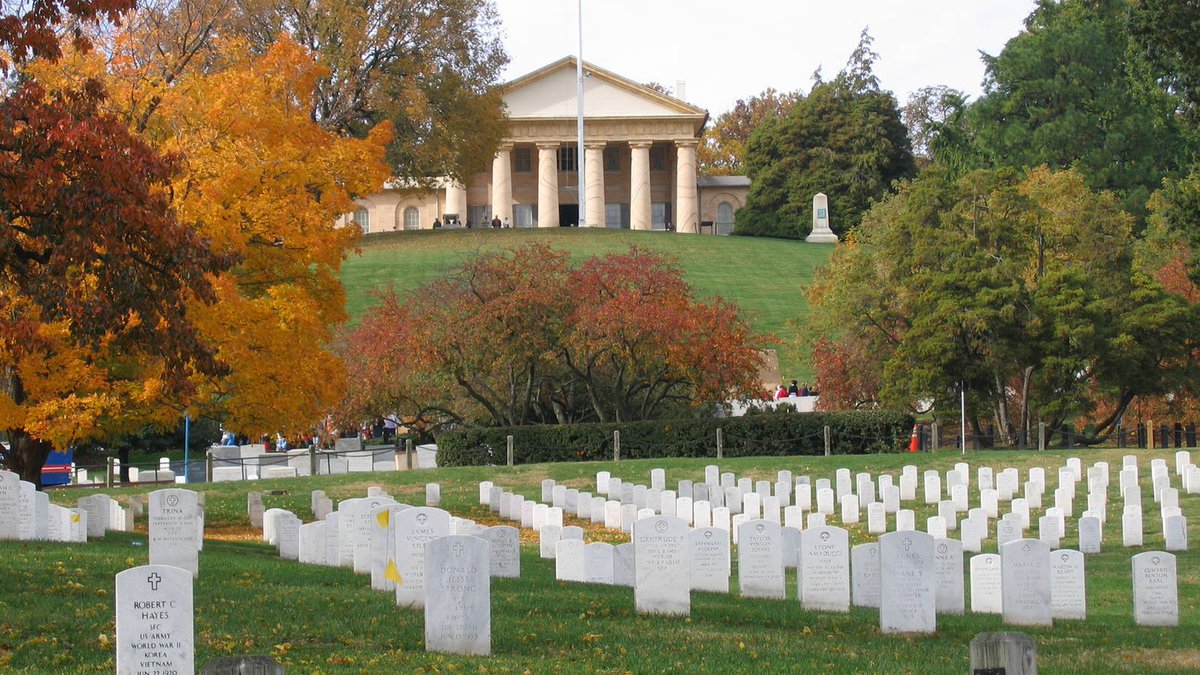
On this day in 1864, the US government turned a Confederate general's front yard into a graveyard, and the cruelty was the point. The land belonged to Robert E. Lee's family through his wife, a descendant of Martha Washington. Quartermaster General Montgomery Meigs, furious at Lee for the war, deliberately ordered Union dead buried right up against the mansion so the family could never comfortably return. It worked. They never lived there again. Today more than 400,000 American service members rest at Arlington National Cemetery, on the grounds of the home of the man who fought against them. Few acts of spite in history aged into something so sacred.
On this day in 1775, a tall Virginia planter accepted a job that should have ruined him, and instead it made a nation.
The day before, Congress had voted to create a Continental Army out of the militia swarming around Boston. Now they needed someone to lead it, and the choice was not obvious. There were older men, more experienced men, men who had commanded larger forces. But the colonies had a deeper problem than experience. New England was already carrying the fight, and if a New Englander took command, the southern colonies might never fully commit. The cause needed a leader who could bind thirteen suspicious, squabbling colonies into one army.
George Washington had been quietly attending the Continental Congress in his old military uniform, a silent signal that he was ready to serve. On June 15, 1775, John Adams rose and nominated him. The Virginian was chosen unanimously.
What he did next tells you everything. He stood before Congress and confessed he did not believe himself equal to the command. Then he refused a salary, asking only that his expenses be covered. This was not false modesty. He genuinely understood the odds. He was about to lead untrained farmers, with no navy, no reliable money, and no real government, against the most powerful military empire on the planet.
He would lose New York. He would retreat across New Jersey in the dead of winter with his army melting away around him. He would go years without a clear victory. And he would never quit.
Eight years later the empire surrendered, and the man who doubted himself in June of 1775 walked away from power instead of seizing it, stunning the world. 251 years ago today, the American experiment got the one leader it could not have survived without.
June 12, 1944. D-Day plus 6.
Tonight, for the first time since the invasion began, all five Allied beachheads are joined into a single continuous front.
The plan said this would happen on Day 1.
It took six days and roughly 15,000 Allied casualties to get here.
---
On the evening of June 6, 1944, the five D-Day beaches were five separate, isolated pockets of men clinging to the French coast. Utah and Omaha were separated by seven miles of flooded marsh. Gold, Juno, and Sword were linked but barely. The airborne divisions were scattered across the countryside in hundreds of isolated groups. Supply was chaotic. Communications were partial. Nobody had a clear picture of what anybody else was doing.
The original Allied plan had called for a continuous front by nightfall on June 6. It had also called for the capture of Caen, the largest city in Normandy, on the first day of the invasion.
Caen is still in German hands tonight.
By midnight on June 12, the numbers on the beach are staggering: 326,547 soldiers, 54,186 vehicles, and 104,428 tons of equipment have landed across the five Normandy beaches. One continuous 80-kilometer front now runs from Sainte-Mere-Eglise in the west to Ranville in the east, ten to thirty kilometers deep.
The five beaches are one. The lodgement is real.
But every mile of it was paid for.
---
The gap between Utah and Omaha was only closed yesterday, after days of brutal fighting across the Carentan causeway. If you read yesterday's post, you know what that cost Robert Cole and his battalion.
South of Omaha, American forces have pushed 30 kilometers inland to Caumont, seizing high ground that overlooks the entire region. In doing so, they have opened something the German commanders did not plan for: a gap in the line between the German 352nd Infantry Division and the elite Panzer Lehr armored division. A seven-kilometer hole in the German front, undefended.
When British Lieutenant General Miles Dempsey heard about it this morning, he immediately saw the opportunity. The pivot point of the entire German defense is Caen, which has resisted every direct British assault. But if a strong armored force could slip through that gap west of Caen, drive southeast, and seize the high ground around a small town called Villers-Bocage, they could outflank Caen entirely. They could put British armor on the road behind the German defenders. The whole position might unravel.
Dempsey picked the 7th Armoured Division for the task.
---
The 7th Armoured Division was the most famous armored division in the British army.
They were the Desert Rats.
They had fought from Egypt to Tunisia. They had shattered Rommel at El Alamein. They had followed Montgomery across North Africa and into Italy. Their divisional insignia, the jerboa, a small desert rat, was one of the most recognized symbols in the entire Allied force. Their veterans had been in continuous combat since 1940. They had seen everything.
On the afternoon of June 12, they disengaged from the grinding battle near Tilly-sur-Seulles and turned east, moving fast through the gap. They swept through undefended countryside. French civilians came out to wave at them. The few German soldiers they encountered scattered or surrendered. The tanks rolled.
By nightfall, Brigadier Robert Hinde halted the lead brigade five miles short of Villers-Bocage and the surrounding high ground the maps called Point 213. They would push through to the town first thing in the morning.
The Desert Rats made camp, confident.
They had moved 20 kilometers through a gap in the German lines. In the morning they would be in Villers-Bocage, the key ground west of Caen, with British armor pointing like a dagger at the German rear.
It was, by any reading of the map, an extraordinary opportunity.
---
Seven kilometers away, in a field near the road to Villers-Bocage, a 30-year-old SS officer named Michael Wittmann was moving his tank into position.
Wittmann commanded the 2nd Company of SS Heavy Tank Battalion 101. He had more than 119 confirmed tank kills on the Eastern Front, almost all of them in the previous two years. He held the Knight's Cross with Oak Leaves, Germany's highest military decoration. He had destroyed more Allied tanks than almost any other individual in the entire German military.
His battalion had fewer than 20 Tiger tanks left after weeks of Allied air attacks on their convoy routes. They were the last uncommitted reserve of the 1st SS Panzer Corps.
Tonight, they are sitting in a treeline on a ridge south of Point 213, unseen by British reconnaissance, unknown to British intelligence.
The Desert Rats don't know they are there.
---
Tomorrow morning the 4th County of London Yeomanry will roll into Villers-Bocage to cheering French civilians, order their tanks to a halt, and wait for orders to push on to Point 213.
What happens next will be studied in military academies for the rest of the century.
But tonight, June 12, 1944, the lodgement is real.
The five beaches are one front.
Fifteen thousand men are dead, wounded, or captured to make it so.
And seven kilometers away, in the dark, Michael Wittmann is waiting.
🇺🇸 Happy Flag Day
Find someone who loves you like Rick Monday loves his flag.
On April 25, 1976, while playing outfield for the Chicago Cubs as a U.S. Marine Corps Reserve veteran, Rick Monday saw two protesters soak the American flag in lighter fluid, ready to burn it.
He didn’t hesitate. He sprinted in, grabbed the flag, and carried it to safety.
One of the most American moments in baseball history.
Thank you, Rick Monday, for honoring our flag. 🫡🇺🇸
When a Pershing Met a Panther: The Legendary Duel in Cologne 🇺🇸🇩🇪
At 2:00 PM on March 6, 1945, as the U.S. 3rd Armored Division advanced toward Cologne's city center, a German Panther ambushed Allied forces near the cathedral, knocking out a lead Sherman tank, killing two crewmen, and wounding the commander.
An M26 Pershing from Eagle Company was sent to deal with the threat. In a brief but legendary duel, gunner Corporal Clarence Smoyer fired three rounds into the Panther, knocking it out and forcing the crew to abandon the vehicle.
The entire encounter was captured on film by U.S. Army cameraman Jim Bates, preserving one of the most iconic tank engagements of World War II.
Digitally restored, enhanced, and presented with sound design to recreate how these moments may have looked and sounded at the time.
If you have seen Band of Brothers, you remember the scene. Winters standing alone in the middle of a road, fully exposed to German machine gun fire, screaming at his pinned-down men to move.
That happened on this day, June 12, 1944. And the real story around it is even bigger than the show had time to tell.
Six days after D-Day, the Allies had a serious problem. The five invasion beaches were not one beachhead. They were separate pockets, and the gap between Utah and Omaha ran straight through a small Norma📷📷n crossroads town called Carentan.
Whoever held Carentan controlled whether the invasion became a front or stayed a collection of vulnerable footholds Hitler could crush one by one.
Defending it: Major Friedrich von der Heydte's 6th Parachute Regiment, some of the best infantry Germany had left, dug in behind flooded marshes that funneled any attacker onto narrow causeways.
Taking it: the 101st Airborne, men who had jumped into the dark on June 6 and had barely slept since.
On June 11, Lieutenant Colonel Robert Cole led his battalion across an exposed causeway under murderous fire. When his men stalled, Cole did something out of another century. He blew a whistle and led a bayonet charge through the smoke into the German positions. He won the Medal of Honor. He never got to wear it. He was killed by a sniper in Holland three months later.
On the morning of June 12, Easy Company of the 506th attacked into Carentan itself. They walked into interlocking machine gun fire at a T intersection and froze in the ditches. That is when Dick Winters stood up in the open, somehow untouched, and got them moving. The town fell that day.
The Germans were not done. On June 13 they counterattacked with tanks and assault guns, and Easy Company held a thin line at a spot the paratroopers named Bloody Gulch. They were minutes from being overrun when Shermans of the 2nd Armored Division arrived and shattered the attack.
With Carentan held, Utah and Omaha linked up, and the five beaches became one continuous Allied front. The door the Germans needed to split the invasion was closed forever.
One more detail. Von der Heydte, the German commander, later said his men had fought to the last of their ammunition. After the war, he became a law professor.
Winters became a farmer. He said he had promised God on D-Day that if he survived, he would find a quiet piece of land and live in peace.
He kept the promise.
I'm rewatching Band of Brothers and the Bastogne episode is always the one that hits me the hardest. Dick Winters said in an interview that they lost a third of their men from frostbite.
REMEMBER
Yesterday the paratroopers took Carentan. On June 13, 1944, the Germans came to take it back, and the men of Easy Company found themselves minutes away from being wiped off the map.
This is the fight the survivors remembered as Bloody Gulch.
A quick recap. Carentan was the town that linked the two American invasion beaches, Utah and Omaha. Without it, the D-Day landings stayed a set of separate, vulnerable pockets. The 101st Airborne had bled to capture it on June 12. But capturing a place and holding it are two different things, and the Germans were not willing to let it go.
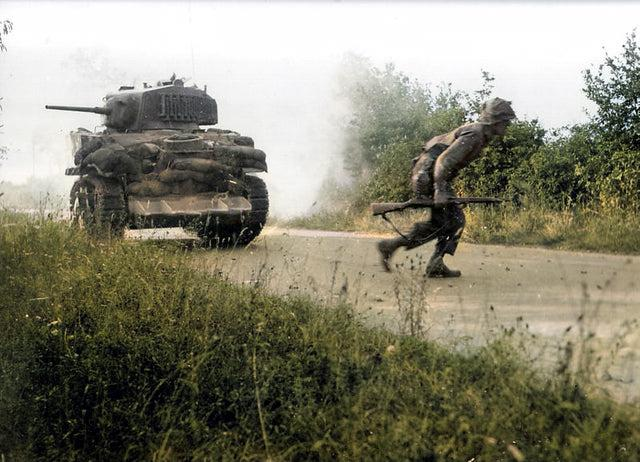
On the morning of June 13, the Germans counterattacked southwest of the town with a serious force, the 17th SS Panzergrenadier Division reinforced by the tough paratroopers of the 6th Parachute Regiment, supported by assault guns and armor. The exhausted, lightly armed American paratroopers, who had no tanks of their own, were holding a thin line across open hedgerow country.
The blow landed hard. The German armor and infantry pushed the American line back toward Carentan. Paratroopers fought from hedgerow to hedgerow with rifles, machine guns, and bazookas against vehicles that outgunned anything they carried. Ammunition ran low. The position grew so desperate that men were preparing for the possibility that the town would be lost again, and with it the link between the beaches.
Then came the rescue, and it came on tracks.
Unknown to the Germans, the Americans had just managed to get armor across into the beachhead. Combat Command A of the 2nd Armored Division, Shermans and mechanized infantry, had been rushed toward Carentan overnight. At the critical moment they hit the German flank with tanks and a storm of artillery and mobile gunfire.
The counterattack that had been about to break through was itself broken. The German force, lacking the strength to trade blows with American armor, was thrown back with heavy losses. Carentan stayed in American hands for good.
That was the real significance of June 13. June 12 won the town. June 13 was the day the Germans tried to erase that victory and failed. From that point on, Utah and Omaha were permanently joined, and the Normandy beachhead was one solid, continuous front that Germany could no longer split apart.
Two things stay with you about this fight.
The paratroopers were never supposed to be fighting tanks at all. Airborne troops are meant to seize objectives and be relieved within days. Instead they were holding the line against a panzer division with whatever they could carry on their backs, and they held just long enough.
And the timing of the armor's arrival was so close that veterans talked about it for the rest of their lives. A few hours later and Carentan might have fallen. The war in Normandy was decided in places like this, by men who never knew if help would arrive before they were overrun.
It did. Just barely.
That is what June 13, 1944 looked like on the ground.
On June 13, 1777, a 19-year-old French teenager landed on a beach in South Carolina, uninvited, to fight in someone else's war. He would become one of the most important men in American history.
The Marquis de Lafayette was one of the richest young aristocrats in France. He had a beautiful wife, a fortune, and zero reason to risk any of it. But he believed in the American cause so fiercely that when the French king forbade him from going, Lafayette bought his own ship and sailed anyway. He literally went AWOL from a life of luxury to bleed for a country that didn't exist yet.
Congress was annoyed at first. Another foreign officer looking for a paycheck? Then Lafayette offered to serve for free and pay his own way. That got their attention.
He met Washington and the two formed one of the great father-son bonds in American history. Washington had no biological children. Lafayette named his only son George Washington Lafayette.
He took a bullet in the leg at Brandywine and kept rallying the retreat. He was instrumental at Yorktown, the battle that won the war. He went home a hero on two continents.
A foreign teenager believed in America before America did. 249 years ago today.
On the morning of June 6, 1944, Lt. Dick Winters had already survived one disaster before the sun came up.
His C-47 roared over Normandy through a wall of flak, flying too fast and too low. He jumped anyway. The prop blast ripped his leg bag clean off, taking his rifle, his ammo, and most of his gear. He hit the ground in occupied France armed with a knife in his boot.
Most men in that situation hide. Winters started walking toward the sound of the war.
By dawn he had scavenged a rifle, collected a handful of scattered paratroopers, and learned that his company commander's plane had gone down with everyone aboard. Just like that, a quiet lieutenant from Pennsylvania who didn't drink, didn't curse, and wrote letters home about wanting to find a peaceful farm someday was in command of Easy Company.
A few hours later a battalion officer gave him one of the great understated orders in military history. German fire was coming from a farm called Brecourt Manor, hammering the troops coming off Utah Beach. The order was basically: there's fire along that hedgerow, take care of it.
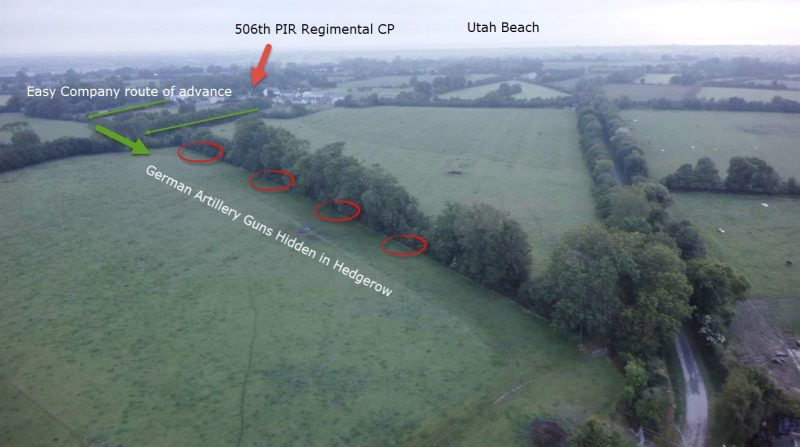
What was actually there: four 105mm howitzers dug into a hedgerow network, connected by zigzag trenches, covered by machine guns, and defended by roughly 60 German troops. The guns were dropping shells directly on causeway exit 2, where thousands of Americans were trying to get off the beach. Every minute those guns fired, men died in the sand.
Winters had 12.
He did not charge. He crawled forward alone to study the position, then briefed his men like he had all the time in the world. Machine guns here to pin the defenders. Compton, Guarnere, and Malarkey crawling along the flank. Hit the first gun with grenades and speed from a direction the Germans never expected.
It worked almost exactly as drawn. The first gun fell in minutes. Then his men used the German trenches as a highway, rolling up the battery one gun at a time, beating back counterattacks, and dropping blocks of TNT down the barrels to destroy them for good.
In the middle of the firefight, Don Malarkey spotted what he thought was a Luger on a dead German and sprinted into open ground to grab it. The German machine gunners held their fire, apparently deciding that anyone that reckless had to be a medic. He made it back alive. It wasn't even a Luger.
At the second gun, Winters found something better than a pistol: a German map showing every artillery and machine gun position covering Utah Beach. He sent it up the chain immediately. On the most important morning of the war, a 26-year-old lieutenant had just handed the Allies the enemy's entire defensive layout for the sector.
When reinforcements under Lt. Ronald Speirs arrived, they stormed the fourth and final gun. About three hours after it started, the battery was silent and the exits off Utah Beach were open for thousands of men who will never know his name.
The cost: one American killed, a few wounded. The Germans lost around 15 dead and a dozen captured. Winters received the Distinguished Service Cross and later said the best decoration he ever got was a sergeant telling him years later that his men trusted him with their lives.
The assault on Brecourt Manor is still studied at West Point as a textbook example of a small unit destroying a fixed position.
Around 60 defenders. Four guns. Twelve paratroopers and a lieutenant who started D-Day with nothing but a knife.
If it sounds familiar, it should. This is the same Easy Company from Band of Brothers. The difference is that none of it was fiction.
And when Winters was asked decades later if he was a hero, he gave the answer that still gets quoted at his statue in Normandy: "No. But I served in a company of heroes."