"QAN is not competing with Ethereum. QAN is extending Ethereum"
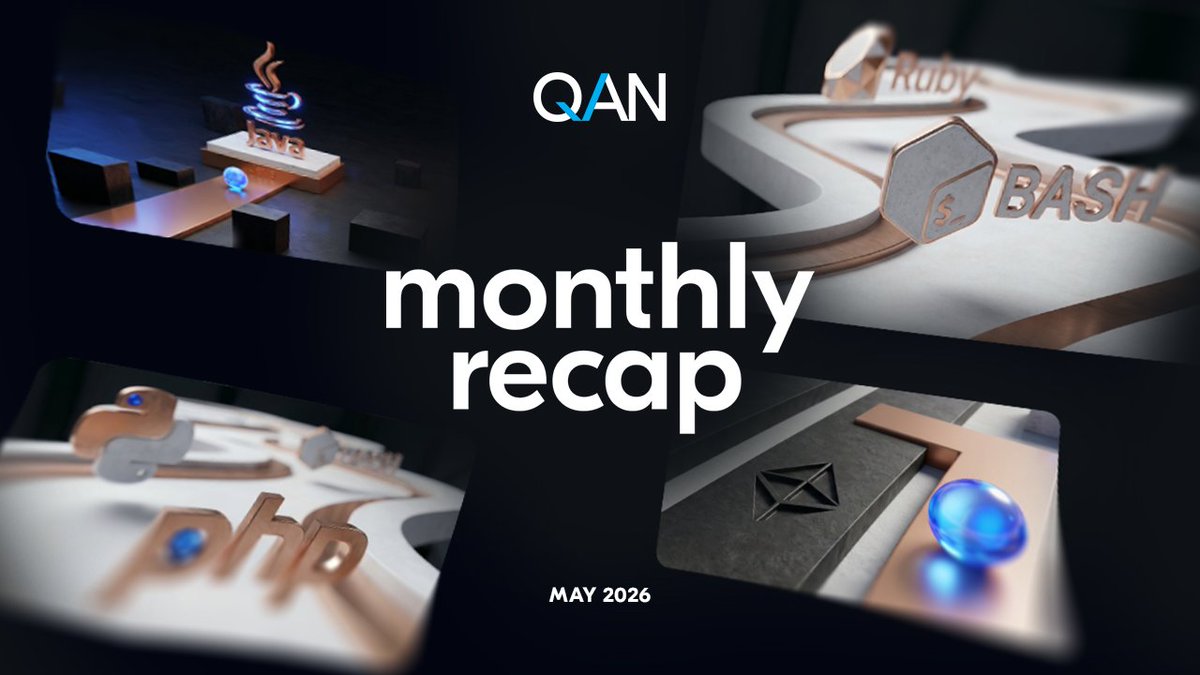
A community member created this visual from recent updates.
Innovation for Quantum migration solutions 💥
$QANX $QRL $ABEL $CELL $MCM $XX $NXS $ALGO $HBAR $TRX $USDC $BTC $ETH $ADA $SOL $XRP $IONQ $RGTI
QANplatform May Update: Accelerating Our Ethereum Rebase and Enterprise Readiness
May was a month of decisive action for QANplatform. Following our announcement of a controlled architectural rebase of QANplatform’s core features onto Ethereum’s official implementation we moved immediately from strategic planning to implementation.
With architectural risks mitigated and technical briefs finalized, we are now fully cleared to begin active construction on our next-generation implementation.
Behind the strategic shift lies significant engineering progress. This month, our team resolved complex architectural challenges to ensure a rock-solid runtime and a mature developer ecosystem.
Read the full recap on our blog, link in the comments 🔗👇
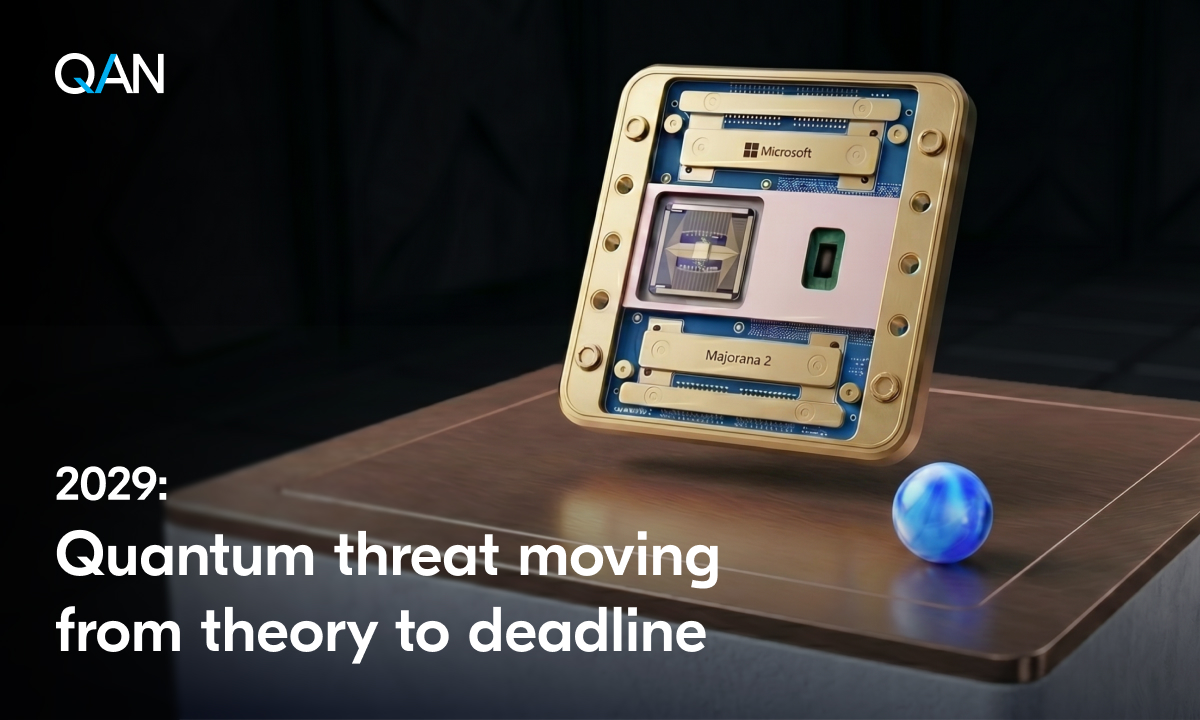
Two tech giants. One timeline: 2029.
Microsoft just unveiled Majorana 2: topological qubits that last 20 seconds (vs. 1-12 milliseconds in Majorana 1).
That improvement is roughly comparable to inventing a phone battery that instead of dying in a day could last for nearly three years on a single charge.
That's a 1,000x reliability leap, built with agentic AI.
Their practical quantum computer target? 2029, the original timeline cut in half.
Google independently set the same year as its internal deadline to complete PQC migration across all systems, warning that quantum computers could break current encryption before the decade ends.
When Microsoft AND Google converge on 2029, that's not a prediction. That's a countdown.
Every blockchain still running on legacy cryptography needs to ask: are you quantum-safe?
The migration window is closing.
There are two main positions on quantum risk to blockchain infrastructure.
One of them requires believing decentralized networks can coordinate a full cryptographic migration under time pressure with no central authority and no enforcement mechanism.
The other one requires starting earlier than feels necessary.
Both positions might seem defensible. But only one survives the reality of decentralized coordination.
Position A: The threat is already active.
"Harvest-now-decrypt-later" means data collected today is already compromised. Chains not building on post-quantum primitives are accumulating debt, not buying time.
Position B: The timeline is long enough for a retrofit.
"Hard forks happen. Ecosystems upgrade." Migration can wait. It is too expensive to over-engineer for a threat years away.
Here is the friction point:
Position B requires a massive bet on coordination.
It assumes that decentralized networks, which lack central authority, enforcement mechanisms, and contain millions of independent wallets, can execute a full cryptographic migration in a compressed window under pressure.
History suggests this is the hardest thing a decentralized network can do.
The industry has mostly let Position B win by default, simply because it is the path of least resistance.
So, a direct question for the builders:
If a protocol must be secure in 2030:
Is it a viable strategy to bet the project's survival on a forced hard fork that requires 100% of the community to coordinate perfectly at the last minute?
Or is the only safe path to build on infrastructure where quantum resistance is native, not retrofitted?
$QANX
Questions & Answers from Telegram earlier today 8th May 2026…
Question 1: Is QANplatform still a Layer 1?
Answer: Yes, still a Layer 1.
Question 2: Will QVM still work?
Answer: Yes, QVM will still allow you to code in ANY Language.
Question 3: Will Xlink still work?
Answer: Yes, XLINK will still protect against Quantum attacks. this is implied, because quantum-safe L2 on Ethereum would be impossible (analogy of swallowing a bulletproof vest) even if you do it on a Layer 2, the layer you depend on is still vulnerable making the effort worthless.
Question 4: Will the government partnerships need QANX or just the technology?
Answer: Yes, They will use both the Private Blockchain and the Public Blockchain products in a Hybrid model we described previously.
Question 5: Are these government entities under NDA, or can the details be shared ? Would love to understand the future gravitas of these wins for QANplatform.
Answer: In Johann’s opinion they will be shared, but it does not depend on Johann though, hence he cannot guarantee it.
Question 6: I just want to hear a very clear answer is this the year for Mainnet for QANplatform?
Answer: Absolutely!
Question 7: I don't have a sense of how involved "rebasing" is, easy or hard?
Answer: shouldn't be too complex, Johann’s not worried about it at all.
Hope this helps guys, any other questions put them to the team 👍
Somewhere in the 1990s, a cryptographic decision was made that nobody questioned.
In 2026, 25,000 developers woke up holding the bill for it.
Nobody asked the developers.
Not when the cryptographic assumptions were baked into every protocol. Not when the standards were finalized. And not when the migration timelines started appearing in government memos.
The engineers just woke up one day holding the bill for a decision that was made in the 1990s.
Here is what that bill actually looks like.
There are roughly 20,000 to 30,000 active blockchain and Web3 developers globally. Not millions. Tens of thousands. A remarkably small group to be maintaining infrastructure that holds trillions in value. Every single one of them is writing against cryptographic primitives, ECDSA, secp256k1, SHA-256, that were designed before quantum computing was an engineering concern rather than a physics thought experiment.
They did not choose those primitives. They inherited them. And they built entire ecosystems on top.
Now here is the ask.
Migrate.
Rotate keys across millions of wallets.
Upgrade signature schemes on live networks with billions in locked value.
Coordinate hard forks across decentralized communities that agree on almost nothing.
Rewrite SDKs, auditing frameworks, tooling, documentation, and mental models across an industry that is already running at full capacity just keeping up with what it has.
Oh, and do it before a timeline nobody can pin down precisely, against a threat that is invisible until the day it is not.
This is not a product roadmap item. It's a civilizational infrastructure problem. Handed to a generation of developers who were just trying to build.
And the cruelest part is this.
The developers who are most exposed are not the ones who made the original design choices. They are the ones who arrived later, learned the tools that existed, shipped real things, and are now being told the foundation those tools sit on has an expiration date.
Post-quantum cryptography is not complicated because the math is hard, though it is. It is complicated because ML-DSA and ML-KEM, the NIST-standardized algorithms meant to replace what we have, are not drop-in replacements. Signature sizes are 30 to 40 times larger. Key generation behavior is different. The entire security proof rests on different mathematical hardness assumptions that most working developers have never had reason to study.
The tooling is immature. The libraries are young. The audit standards for post-quantum smart contract security do not fully exist yet.
So what is the actual solution?
It is not telling developers to become post-quantum cryptographers on top of everything else they are already doing.
It is building the quantum-safe layer underneath them. Into the protocol. Into the base layer. So that a developer writing a smart contract in 2026 does not have to understand lattice-based cryptography any more than a developer writing a web app today needs to understand the TLS handshake.
The best infrastructure becomes invisible. It solves the hard problem at the layer where the hard problem belongs, and hands developers a clean surface to build on.
We understand this and we are not asking developers to carry the quantum migration. We ship the solution ourselves.
The myth
Chains can just upgrade to post-quantum cryptography when the time comes.
The reality
Immutable smart contracts cannot be patched.
Keys cannot be rotated on behalf of users who have lost access.
Coordination across millions of independent wallets has no enforcement mechanism.
"When the time comes" assumes a clean handoff that decentralized systems have no architecture to deliver.
Bitcoin's security is not a lock. It is a clock.
And for the first time in history, we can hear it ticking.
Satoshi Nakamoto owns roughly 1.1 million Bitcoin.
Those coins have shown no confirmed outgoing activity. The public keys are permanently exposed on the blockchain for anyone, and eventually any machine, to see.
It is an open ledger. Go look.
Here is why that matters in a way most people have never thought about.
Early Bitcoin wallets used a format called Pay-to-Public-Key. P2PK. In that format, your actual public key, not just a hashed address, but the raw public key itself, is visible on-chain the moment you receive funds.
Modern wallets are slightly better. They hide your public key behind a hash until you spend. But the moment you send a transaction, your public key is exposed. Forever, immutably, on thousands of nodes across the planet. Plus Taproot, Bitcoin's newest address format, reintroduces a variation of this problem embedding the public key directly in the address once again.
There are an estimated 6.9 million Bitcoin sitting in addresses with permanently exposed public keys right now.
And here is the uncomfortable geometry of this.
A quantum computer running Shor's algorithm does not need your permission or your cooperation to derive your private key from your public key. It needs computation time and your public key. One of those things is improving exponentially. The other is already public.
The sleeping wallets are not the only problem. They are the most visible symptom of it.
Every chain that launched before post-quantum cryptography was a serious engineering consideration, which is essentially every major chain alive today, was designed around the assumption that public keys are safe to expose.
That assumption was reasonable in 2009. It was reasonable in 2015. It is becoming less reasonable every year, and there is no clean way to fix it retroactively on a decentralized network where nobody is in charge.
Ethereum has made post-quantum security a strategic priority, launching a dedicated research effort, development test networks, and millions in funding. Addressing the threat would likely involve large-scale coordination, potentially requiring many independent wallets to migrate to new cryptographic standards before ‘Q-Day.’ While the network can coordinate upgrades, there is no central authority that can force all users to act, and wallets whose owners have lost access, died, or are inactive may never be upgraded meaning the success of any transition depends heavily on voluntary adoption at scale, with no fixed or reliable deadline.
Coordination theory has a name for this kind of problem. It calls it nearly impossible.
The chains that will survive the quantum transition are not the ones that will scramble to patch. They are the ones that treated quantum-safe cryptography, specifically NIST-standardized algorithms like CRYSTALS-Dilithium, as a founding architectural decision, not a future upgrade.
Because you cannot retrofit a foundation.
You can only build on one.
@CoinMarketCap Some assets will hold value
Some will CREATE value.
@QANplatform is positioned to provide value to the worldwide market seeking solutions to migrate vulnerable cryptography.
A loan agreement. One digit changed. Millions of euros at risk. No court can prove which version is authentic.
That's not a hypothetical, it's the document integrity crisis that quantum computers will make possible by breaking RSA and ECC cryptography.
SignQuantum addresses this with the help of QANplatform's post-quantum technology:
- it generates a cryptographic hash of every signed document and
- anchors it to QANplatform's quantum-resistant blockchain using ML-DSA (NIST FIPS 204) creating a mathematically provable, tamper-proof timestamp that survives the post-quantum era.
Crowe Portugal, a member of one of the world’s largest consulting and top-10 global accounting firms, hosted a 48-minute deep dive on the quantum threat, the regulatory landscape, and how to act before Q-Day arrives.
Link in the comments 👇
Mac users, the wait is over.
The QAN XLINK desktop app is now available on macOS! Quantum-safe security, now on every major platform.
Linux ✅ Windows ✅ macOS ✅
Download it and let us know what you think.
Link in the comments 👇
The cryptography securing every major blockchain got an expiration notice. Most missed it.
NIST published its post-quantum cryptographic standards on August 13, 2024. Most of crypto either missed it or filed it under future problem.
Here is what it actually means, cut by who you are. 🧵
Claude evaluating the @QANplatform hybrid model.
Check out the full assessment
Hint: Public chain is the 🔑
$QANX $QRL $ZEC $BTC $ETH $DOT $ICP Quantum Immutable
Q-Day will not be announced with a headline. There will just be wallets draining. Here is how it actually plays out for the people holding assets when it happens.
It is a Tuesday morning in 2029.
A security researcher in Geneva, let us call her Laura, is running a routine audit on a post-quantum migration report for a mid-sized European bank.
The bank did the work. They migrated their internal comms two years ago. Updated their certificate infrastructure. Rotated keys. They went through the checklist and signed off. Their CISO presented it to the board as done.
But buried in Laura's audit is a single line item she almost skips, Legacy transaction signatures, 2019 to 2023. Not re-signed under PQC. Archived, not active.
She pauses.
Those transactions are not active. The bank is not using them. They are just sitting in the archive, like old files in a folder nobody opens. Except this is not a folder on a hard drive in a server room the bank controls. This is a blockchain.
Archived does not mean gone. Archived means permanently stored, publicly accessible, readable by anyone with an internet connection, forever.
A quantum computer powerful enough to run Shor's algorithm does not care that those transactions are old. It does not need permission to access them. It does not need to break into anything.
The public keys are right there on-chain. As they always were. As they were designed to be. And a public key, to a sufficiently advanced quantum computer, is just the beginning of the calculation.
The exposure did not happen in 2029. It happened the day each transaction was broadcast. The quantum computer just has to show up.
Laura types slowly now. Because the question she is adding to her report is not "could this happen." It is "how many other ledgers have this same line item and do not know it yet."
March Milestones: New QAN XLINK Release, TestNet Fixes, and Status Page
This month's update highlights the release of a refined QAN XLINK Beta version with a smoother user experience, alongside essential TestNet fixes. We've also taken steps to increase transparency with our new public Status Page and addressed documentation gaps to make integration easier for developers.
Read the full recap on our blog, link in the comments 🔗👇
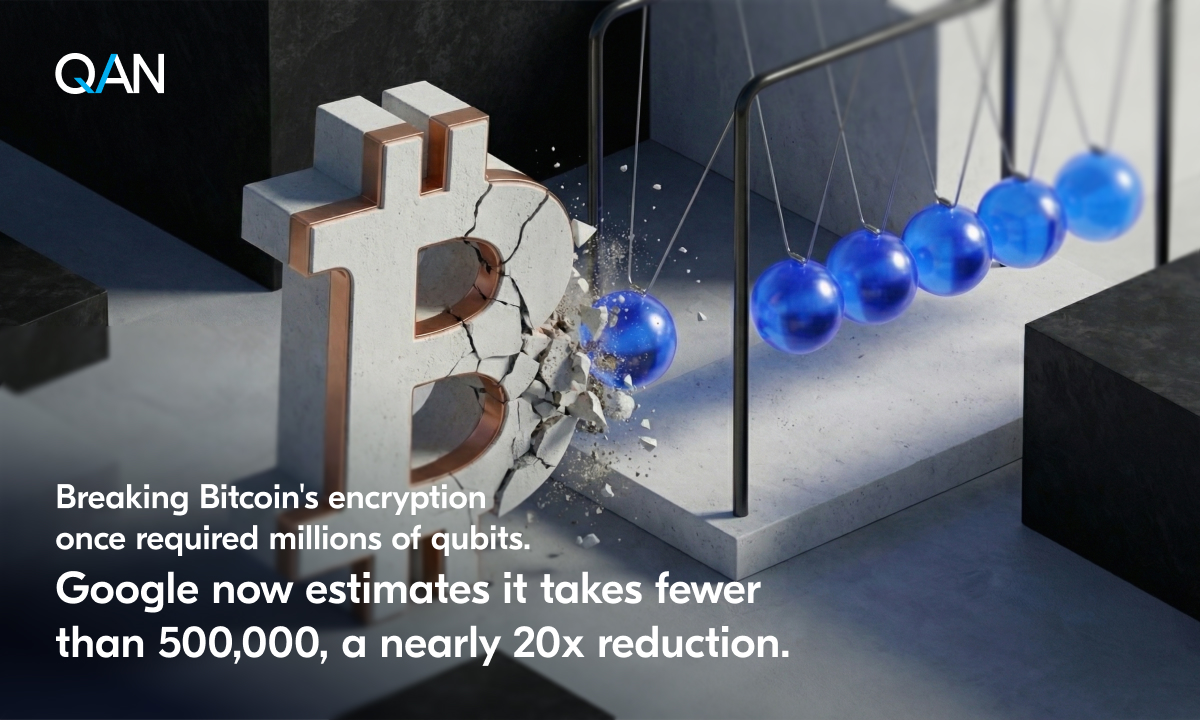
Google Quantum AI just published a landmark paper on quantum threats to cryptocurrency and the numbers are sobering.
Here's what every blockchain builder needs to know 🧵
Quantum computing is forcing a rethink of how Web3 systems are secured.
We audited @QANplatform’s QAN XLINK, a protocol enabling Ethereum wallets to migrate to post-quantum security without breaking compatibility.
31 findings.
0 critical / 0 high.
29 resolved.