Everyone is talking about the U.S. allowing Iran to be paid in U.S. dollars again.
Almost nobody is asking the real question:
Will Iran even use it?
🛢️ Iran has spent decades building a sanctions-proof financial network using yuan, barter deals, and shadow banking.
💵 A temporary dollar waiver sounds huge—but if it can disappear in 60 days, why would Iran rebuild its entire payment system around it?
The story isn't about dollars.
It's about trust, credibility, and the future of the global oil trade.
A deep dive coming soon.
Strategic Brief #3 is live!
The biggest geopolitical story this week wasn’t the strikes.
It was this:
Every time diplomacy makes progress, reality drags everyone back to conflict.
US-Iran talks in Switzerland produced a breakthrough.
Days later: drones, missiles, Gulf escalation.
Same pattern everywhere:
Negotiation → Incident → Escalation → Reset.
We’re not watching peace or war.
We’re watching managed instability.
My Strategic Brief #3 ↓
https://t.co/xyaHmz75op
USA-Iran:
Neither side seems to understand what a ceasefire actually means.
Iran reportedly attacked commercial shipping in the Strait of Hormuz, and the U.S. responded by striking Iranian drone, missile, and radar facilities. The first major test of the ceasefire has already turned into renewed military action.
If every violation is answered with another strike, this isn't a ceasefire, it's a pause between rounds.
The biggest loser is global trade. Every escalation raises shipping costs, insurance premiums, and the risk of higher oil prices. The Strait of Hormuz is becoming a long-term geopolitical pressure point, not a temporary crisis
What just happened?
Oman has reportedly informed European allies that ships transiting the Strait of Hormuz may be required to pay fees for navigation assistance and pollution control.
Means- "Free ride is over".
Why this matters:
• The Strait of Hormuz carries roughly 20% of the world's oil trade.
• Any new transit fee increases shipping costs.
• Higher shipping costs eventually feed into higher energy prices and inflation.
• Tanker operators may pass these costs on to refiners and consumers.
The bigger picture:
If such fees become a permanent feature, the cost of using one of the world's most strategic maritime chokepoints could permanently rise. That would reshape global shipping economics—not just during a crisis, but potentially for years.
Whether this becomes a long-term reality depends on how regional states, shipping companies, insurers, and international law respond.
The Strait of Hormuz may never be viewed as "business as usual" again.
@OAngnani@Chellaney Not completely true. Yes, USA didn't allow it but USA didn't expect as well. China rose so quickly that it took USA by surprise. Now, USA is cautioned and will not make same mistake with India. They did the same with Japan.
Venezuela's GDP has collapsed by roughly 80% since 2013, leaving the state with little capacity to respond to major disasters.
Washington says its sanctions target the government. Critics argue they have also crippled Venezuela's oil exports, the country's main source of revenue and made recovery even harder.
When geopolitics restricts a nation's ability to sell its own resources, ordinary people often pay the highest price.
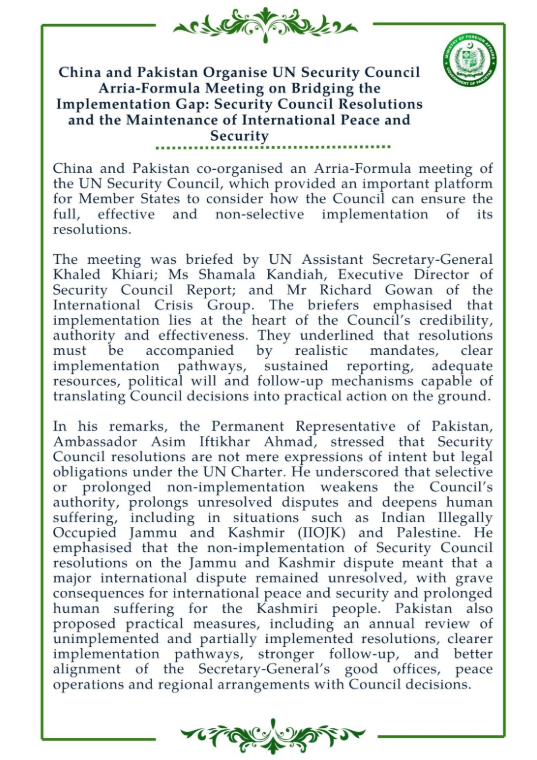
Read Between the Lines: Why Pakistan & China Proposed This at UNSC
At first glance, Pakistan and China’s proposal sounds like a call for stronger implementation of UNSC resolutions.
But in geopolitics, what matters is not just what is said.
It’s what is implied.
Here are the real takeaways.
Takeaway 1: This is largely about Kashmir
Terms like “self-determination,” “disputed territories,” and “unimplemented resolutions” point directly toward Kashmir.
Pakistan is trying to re-internationalize the issue.
Takeaway 2: Pakistan wants to shift the narrative
Pakistan wants global discourse to move from terrorism to human rights and international law.
That’s a much more favorable battlefield for Islamabad.
Takeaway 3: China wants strategic pressure on India
China benefits when India remains occupied with regional tensions.
Kashmir becomes a diplomatic pressure point.
Takeaway 4: This is also about the Global South narrative
China wants to present itself as a champion of “fair and non-selective global governance.”
This strengthens Beijing’s influence outside the Western bloc.
Takeaway 5: The irony is obvious
Pakistan talks about peaceful settlement while terror concerns remain unresolved.
China talks about rules while selectively ignoring them in areas affecting its own interests.
Final Takeaway
This is not really about UNSC reform.
It is about leverage.
Pakistan wants leverage over India.
China wants leverage over both India and the global order.
#Pakistan #China
Canada is witnessing a massive correction.
International student arrivals are down 60%, according to Mark Carney.
In 2023, Indians made up 51.6% of all foreign students in Canada. Now that share has dropped to just 8.1%.
This isn’t just about visas.
It reflects stricter immigration rules, housing pressure, rising anti-immigration sentiment, and growing awareness among Indian students that the Canada dream no longer guarantees ROI.
For years, colleges, landlords, and businesses benefited from this pipeline.
Now the dependency is exposed.
Fact Check: it's a Fake news.
India’s stance is straightforward: unless cross-border terrorism stops, the water issue remains unchanged.
Terrorism and dialogue cannot go together.
As for airspace restrictions—keep it if you want. A 2-hour longer journey is a minor inconvenience compared to India’s core security concerns.
Not siding with anyone but here is what I think
Because Saudi doesn’t want war—it wants stability.
Riyadh learned after the Aramco attacks that even with massive defense spending, its oil infrastructure remains vulnerable. Fighting Iran is expensive; managing Iran is cheaper.
This isn’t trust. It’s strategic pragmatism.
This could also be wishful thinking from Riyadh, but they don’t have many cards left to play. Military escalation is costly, direct confrontation is risky, and diplomacy may be the only practical option.
This isn’t friendship. It’s strategic necessity.
While Iran remains important for regional stability and trade routes, India’s larger strategic interests lie in maintaining balance across the Middle East. A PM-level visit at this moment could send the wrong diplomatic signal, create unnecessary geopolitical complications, and risk upsetting ties with key Gulf partners. India can show respect through diplomatic channels without requiring the Prime Minister’s presence.
@DerekJGrossman China has a plan to bypass Malacca strait, it called CPEC. But CPEC is easily blocked in the case of aggresion.
China has another plan Belt and road initiative- old silk route. Once it's developed and functioning, it will be challenging to contain China.
There is a difference between criticizing India and abusing Indians.
If a Bangladeshi waiter in Italy really used “fk India” and “fking Indians” against Indian customers, that is not politics. It is anti-India racism.
And the bigger issue is this: anti-India hostility in Bangladesh is increasingly crossing the line from political disagreement into open social contempt for Indians. That should not be sanitized, excused, or brushed aside as just “anger at India.”
Kudos to the Indian woman for standing up. More Indians should call this behavior out directly instead of normalizing it.
Criticize India all you want. But if the discourse now routinely slips into abuse of Indians as a people, then let’s be honest about what that says about the direction parts of Bangladeshi public culture are taking.
Indian Women Force Bangladeshi Waiter To Apologise After Anti-India Slur... https://t.co/jcUATOUVaz via @YouTube
This isn’t just about “Chinese activity near Taiwan.”
The UK, France and Germany are flagging something more specific: China is extending pressure to Taiwan’s east coast/Pacific side, not just the Taiwan Strait.
That matters because eastern Taiwan is its strategic rear area. If Beijing normalizes coast guard/survey activity there, it looks less like routine patrols and more like gradual maritime encirclement and pressure on Taiwan’s shipping/security space.
What this means in plain English:
SK Hynix plans to raise ~$29B by listing ADRs on Nasdaq. An ADR is just a way for a foreign company’s stock to trade in the US.
The key point: this isn’t just a simple US listing of existing shares. SK Hynix is issuing new shares via ADRs to raise fresh cash.
Why? To fund its AI chip buildout — new fabs, packaging capacity, and equipment for HBM/AI memory expansion.
So the headline isn’t “SK Hynix is going public in the US.” It’s closer to: SK Hynix is tapping US markets for a massive capital raise to fund the AI memory arms race.
This overstates the case.
China absolutely has a serious local-government debt problem, and the property slump has made it worse by crushing land-sale revenue. That part is real. But saying Beijing is “aggressively freezing spending because a hidden debt bomb is about to explode” is much stronger than the evidence supports.
A few problems with the claim:
300% of GDP is usually total economy-wide debt, not just government debt. That number often includes corporate + household + government debt, so using it as proof that “the state is about to blow up” is misleading.
Slower fiscal expansion is not the same thing as austerity. China has been trying to contain hidden local-government debt while still using bond issuance and other state-directed stimulus tools. That’s not the same as a blanket spending freeze.
The local debt issue is real, but the conclusion is too neat. Beijing is balancing several things at once: weak growth, falling property revenues, local debt stress, currency concerns, and the desire to avoid another giant debt-fueled infrastructure binge.
So the stronger version of the claim should be: China is dealing with a genuine local-government debt overhang, and that’s making fiscal policy more cautious and less effective—but calling it a simple “debt bomb forcing austerity” is more narrative than fact.
Interesting phrase—“my kind.”
That raises the exact question being debated: which civilizational identity are you referring to?
Indus? Arab? Central Asian? Ottoman?
Layered identities are normal. Strategic inconsistency is not.
The observation was never that Pakistan lacks history. It’s that different historical identities are selectively amplified at different moments for political convenience.
Totally agree with you.
In fact, by your own argument, Muhammad Ali Jinnah seems to have wanted a separate state rooted in Indus civilizational identity, that's why he created Pakistan and during partition all IVC people were given fair treatment by doing a complete massacre.
Which makes the later obsession with Ottoman nostalgia, Arab lineage, and Central Asian ancestry even more interesting.
All those terrorists coming from Pakistan to India shout Indus Valley Civilization and blow themselves up.
And yes, the irony gets better—many of Pakistan’s strategic assets are named after Indus-linked or regional civilizational symbols:
Ghauri missile, Shaheen missile, Abdali missile, Babur missile.
That only reinforces the point:
the indigenous identity was always there.