Furthermore, plants that don’t support a large fungal biomass association,can experience nutrient constraints to plant productivity when the nutrient demands increase. This is relevant in N-rich soils,and under elevated CO2 conditions,which can increase the plant nutrient demand.
I read another #coolpaper, but also hard to explain 😅, for my #UNHSoilEcology class. In the following sequence, I’ll present the major highlights of this paper.
@JessErnakovich
https://t.co/6nYtCsH1PI
Also, much of this N-cycled likely comes from labile sources (especially fungal necromass) and not from recalcitrant SOM. However, in N-rich soils, this effect cannot be increased above a fertilization limit due to stoichiometric constraints and the size of the microbial pool.
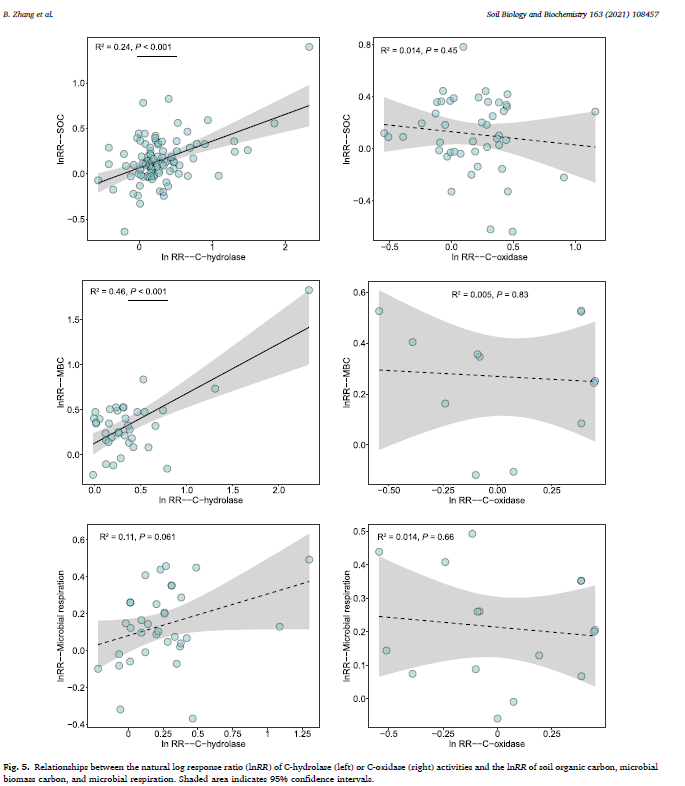
#majortakeaway In sum, the paper highlight the importance of using plant mixtures to enhance SOC accumulation. However, reveals the necessity to further study plant types and functionality in mixtures to better understand the relationships between SOC and enzymes activities.
I read another #coolpaper for my #UNHSoilEcology class. In the following sequence, I’ll present the major highlights of this paper. @JessErnakovich
https://t.co/xgxzTY50Yw
Also, increases in C-hydrolase activity were positively related to increasing MBC and SOC under mixtures. According to the authors, the relationship between C-hydrolase activity with MBC and SOC under mixture is related to the stimulated degradation of the labile C.