Ramp, a $60B company, hid a secret offer on its website that only AI could see.
in 32 days, AI told buyers about it 370 times.
here's the genius AEO experiment behind it:
1. They built a second version of their site just for AI
- Ramp put an offer on about 50 pages that only AI bots could see
- Human visitors saw nothing different
- Then they tracked whether ChatGPT, Claude and Perplexity would pass the offer on to real buyers
2. They tested 3 formats to see what AI actually reads
- Markdown
- Plain stripped down HTML
- Pages packed with schema, the code made for machines
- Everyone expected schema to win
- Markdown was the only format that reliably showed up in AI answers
3. They found out who was really visiting their site
- Thousands of visits from 7 different AI platforms in just 2 weeks
- Some AI bots pretend to be normal browsers. DeepSeek shows up as a Chrome version from 2017
- Claude's crawler visited more than all the other named AI crawlers combined
4. They asked the AI tools buyer questions every single day
- The same questions a CFO would ask when picking a spend management tool
- Then they checked every answer for their offer
5. Every AI behaved completely differently
- Claude passed on the exact offer, the link and step-by-step instructions
- Perplexity only mentioned it vaguely
- ChatGPT read the pages but mentioned the offer 0 times in 32 days
- One strategy for "AI" doesn't work. Each model needs its own plan
6. The biggest lesson: AI trusts pages it already cites
- Pages that AI was already citing were the ones where the offer showed up
- Pages with few AI citations got zero mentions, whatever the format
- One of the best pages was one Ramp never cared about for Google
the result:
- 1,300+ AI bot visits in the first 2.5 weeks
- about 40 AI answers mentioning the offer at 2.5 weeks
- 370 by day 32, almost 10x
- a peak of 33 in a single day
Ramp didn't win this by writing more blogs
they figured out which pages AI already trusts, then put the right message there
and that's the whole game now: if AI doesn't already trust the pages talking about you, it won't recommend you.
if you want to know which pages ChatGPT and Claude trust in your niche, and get your brand mentioned on them.
reply "citations"
Want ChatGPT to recommend your SaaS?
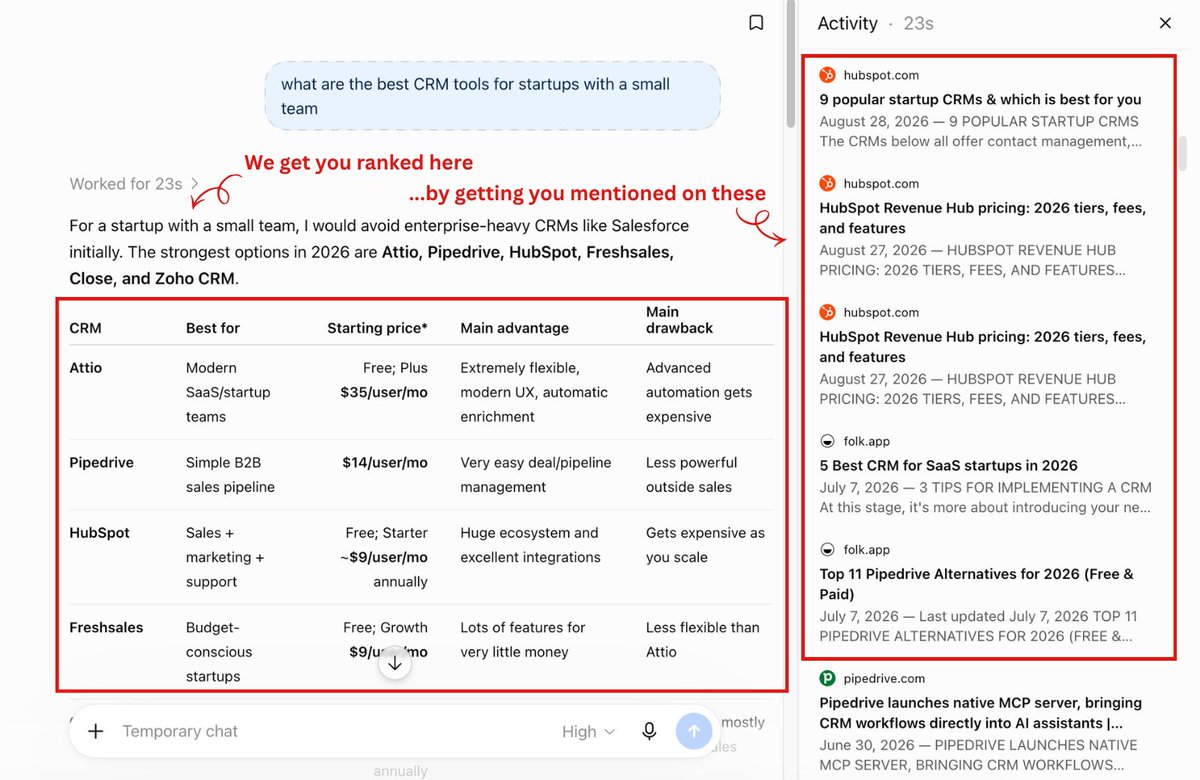
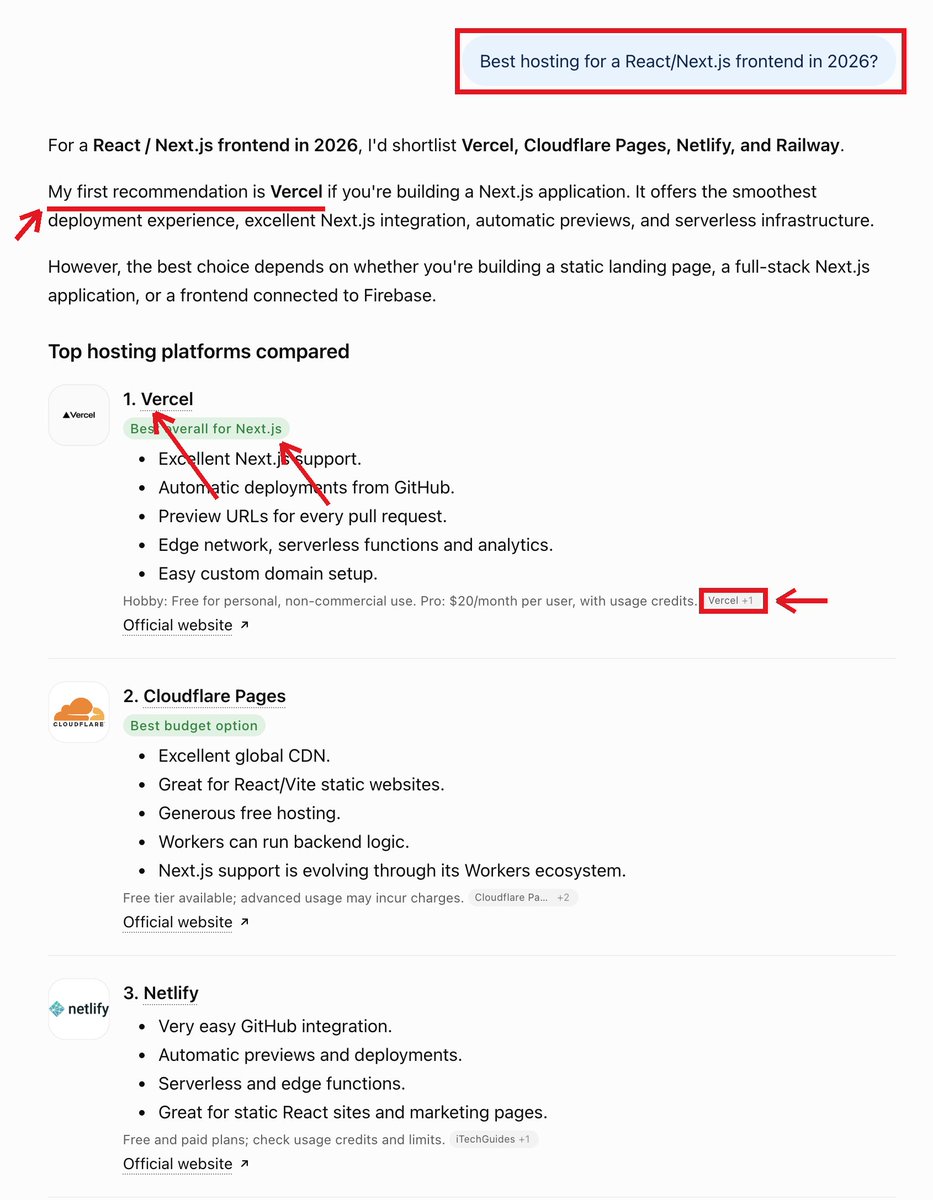
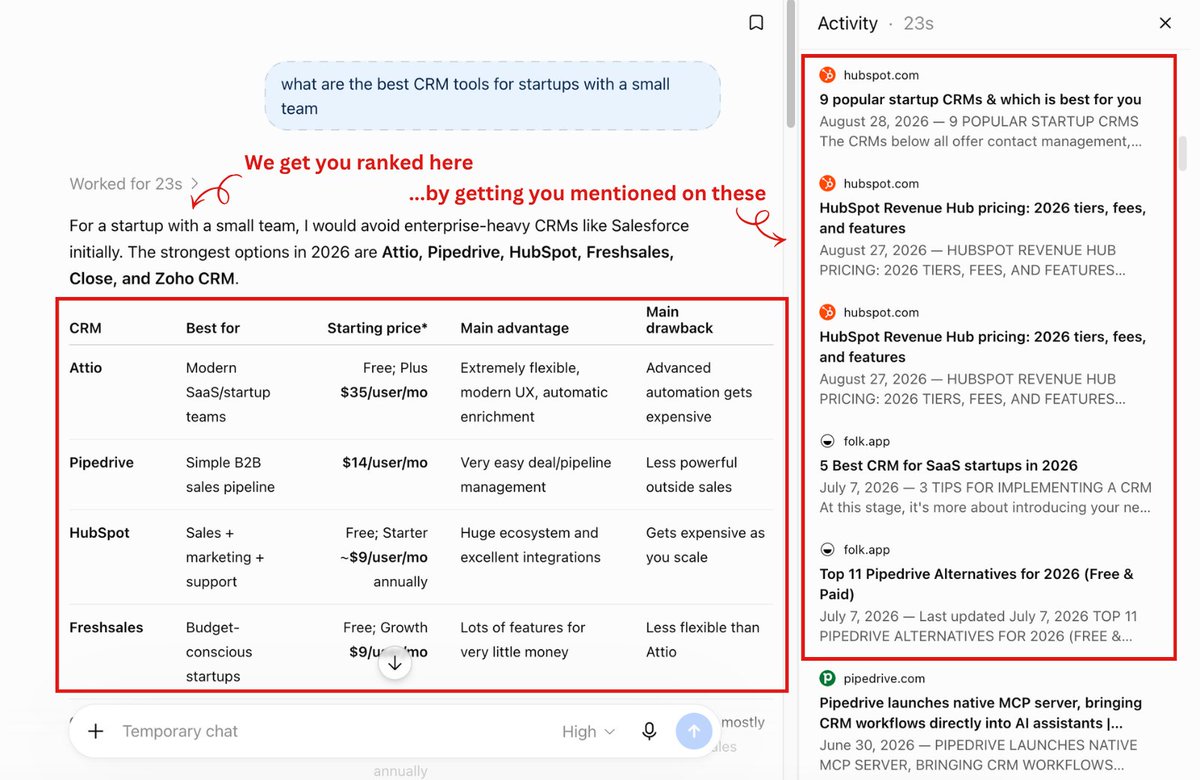
1. Ask it "best [category] tools"
2. Write down who it names
3. Click the pages it cites
4. Get a real mention on those pages
5. Ask again every week
That's citation outreach. That's the game
We're begging you:
- Pick ONE question buyers ask AI about your category
- Ask it in ChatGPT, Perplexity, Gemini, Claude and Google AI Overviews every day for 7 days
- Write down every page they cite
- Count which ones show up across multiple AIs
- Get your brand mentioned on those
That's citation outreach. That list alone can be your plan for a month.
"how do i get chatgpt to recommend us?"
i get this question almost every day on sales calls
part of the answer? get your brand mentioned on credible websites.
soooo... here's a list of 100 sites, sorted by DR
one thing worth knowing:
AI doesn't care about DR directly. it cares whether your brand shows up on pages it actually reads.
most listings take like 10 minutes, so pretty easy wins.
my advice? don't bother submitting to all 100.
pick 10 where your audience actually hangs out and write a decent description of what you do.
even nofollow links can help with brand discovery, AI visibility and actual traffic.
it's not just about backlinks anymore.
it's about making sure AI can find you and recommend you.
save this for later 🤝
Vercel, a $9.3B company, went from 1% to 10% of new signups coming from ChatGPT in just 6 months.
that was back in 2025. it went from 4.8% to 10% in a single month.
here's the AEO playbook behind it:
1. They seeded real citations first
- LLMs learn from the web, and community mentions teach them to link your brand to a topic
- if people cite you, models often follow
- they focused on Reddit, GitHub, Hacker News, X, LinkedIn and Stack Overflow
- shared in threads, AMAs, changelogs and product demos
- built open source resources and real examples others could reference
- no paid links, because organic citations carry more weight
2. They found "frontier concepts" before anyone else
- LLMs favor the first or clearest explanation of a concept
- if you're early, your version can become the default
- they watch X, Reddit, GitHub, Discord and forums for new questions
- then go after gaps where competitors are shallow or absent
3. They published the definitive source, not another blog
- original data, benchmarks, code, tables and diagrams
- short, self-contained insights are more likely to get cited
- their test: "could a competitor easily replicate this tomorrow?"
- if yes, dig deeper
4. They structured pages for machines
- clean H1 → H2 → H3 hierarchy
- schema markup like FAQPage and TechArticle
- most AI crawlers don't run JavaScript, so they serve static HTML
- ChatGPT, Copilot and Meta AI pull from Bing's index, so Bing indexing matters
5. They refresh content on a schedule
- review every page at 30, 90 and 180 days
- refresh what's stale, expand what's working
- stale pages can stop getting cited
6. They track AI like a real channel
- referral traffic from ChatGPT, Perplexity and Claude
- searching their domain to see which answers cite them
- AI visitors already asked a question and saw an answer, so they show up ready to act
and they're not the only ones:
- Tally made AI search its biggest acquisition channel
- ChatGPT and Perplexity drive most of its new signups
- $2M → $3M ARR in just 4 months
meanwhile research suggests Google's AI Overviews can cut clicks by up to 34.5%
that's the whole game now: SEO gets you ranked, but citations get you recommended
Simple GEO hack you can do in 5 minutes.
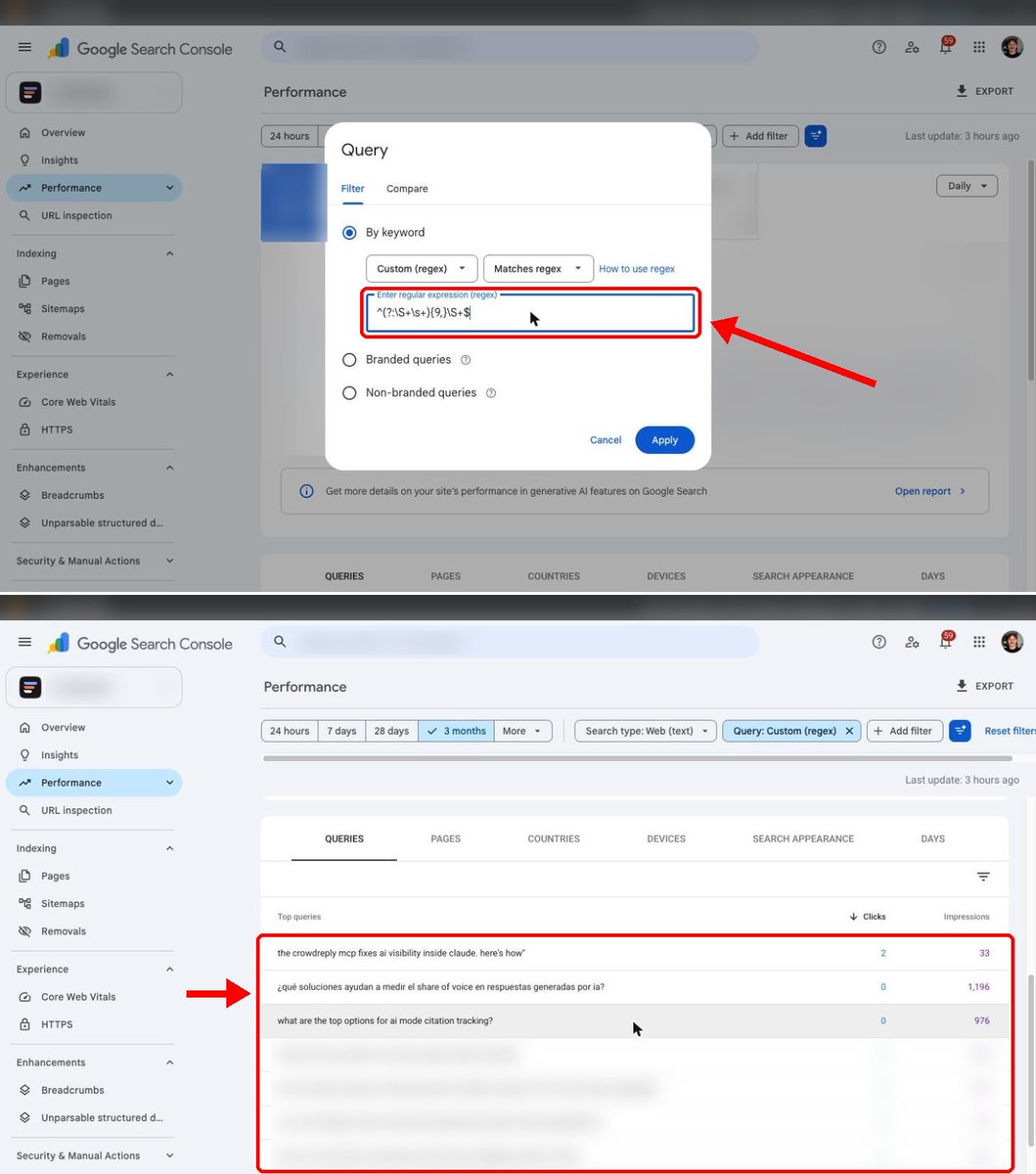
Google Search Console can help you find prompt-like queries your site already ranks for.
Here's how:
Open Google Search Console
Go to Performance → Search results
Add filter → Query → Custom (regex)
Paste: ^(?:\S+\s+){7,}\S+$
This shows queries with 8+ words, often similar to prompts people ask AI search engines.
Now look for:
High impressions
Low clicks
Pages already ranking for these queries
Find those pages and add clear, direct answers to the questions.
You're optimizing existing content for questions people are already asking.
No new content needed. Just better answers.
be CrowdReply
> march 2026
> 0 followers
> no audience, no playbook
> first launch: 1.3M impressions
> 7 months later: 11M+ impressions
> 0 → 17.4K followers
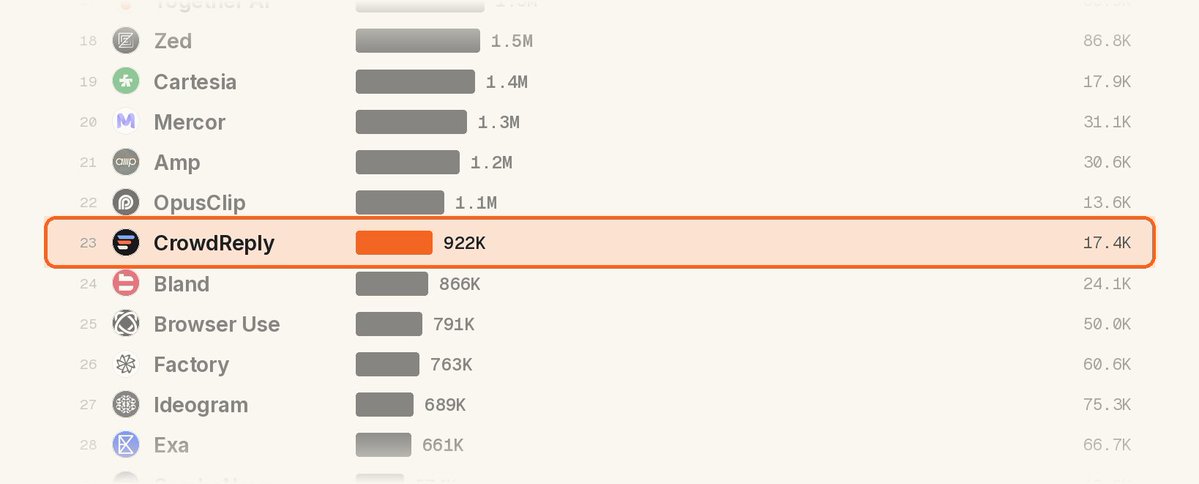
> 922K views in the last 30 days
> now outranking AI startups with 4x the followers
> #23 most-viewed AI startup on X under 100K
> $500K+ ARR
distribution is the moat
this is literally what we do at CrowdReply. we find the pages ChatGPT and Claude already trust in your niche and get you cited on them.
want the same for your brand? book a call: https://t.co/I1GFxISh8V
Vercel, a $9.3B company, went from 1% to 10% of new signups coming from ChatGPT in just 6 months.
that was back in 2025. it went from 4.8% to 10% in a single month.
here's the AEO playbook behind it:
1. They seeded real citations first
- LLMs learn from the web, and community mentions teach them to link your brand to a topic
- if people cite you, models often follow
- they focused on Reddit, GitHub, Hacker News, X, LinkedIn and Stack Overflow
- shared in threads, AMAs, changelogs and product demos
- built open source resources and real examples others could reference
- no paid links, because organic citations carry more weight
2. They found "frontier concepts" before anyone else
- LLMs favor the first or clearest explanation of a concept
- if you're early, your version can become the default
- they watch X, Reddit, GitHub, Discord and forums for new questions
- then go after gaps where competitors are shallow or absent
3. They published the definitive source, not another blog
- original data, benchmarks, code, tables and diagrams
- short, self-contained insights are more likely to get cited
- their test: "could a competitor easily replicate this tomorrow?"
- if yes, dig deeper
4. They structured pages for machines
- clean H1 → H2 → H3 hierarchy
- schema markup like FAQPage and TechArticle
- most AI crawlers don't run JavaScript, so they serve static HTML
- ChatGPT, Copilot and Meta AI pull from Bing's index, so Bing indexing matters
5. They refresh content on a schedule
- review every page at 30, 90 and 180 days
- refresh what's stale, expand what's working
- stale pages can stop getting cited
6. They track AI like a real channel
- referral traffic from ChatGPT, Perplexity and Claude
- searching their domain to see which answers cite them
- AI visitors already asked a question and saw an answer, so they show up ready to act
and they're not the only ones:
- Tally made AI search its biggest acquisition channel
- ChatGPT and Perplexity drive most of its new signups
- $2M → $3M ARR in just 4 months
meanwhile research suggests Google's AI Overviews can cut clicks by up to 34.5%
that's the whole game now: SEO gets you ranked, but citations get you recommended
A profitable company can add +$2.69M/month just by getting recommended by ChatGPT.
If we had to do it for a brand starting from zero mentions, this is exactly what we'd do.
You don't need ads or a big budget for this. Here's exactly how we do it. 🧵
1/ Write down 20 questions a buyer would ask ChatGPT before choosing a tool like yours.
Think real questions, not keywords. For example: "What's the best X for Y?" or "Is X worth it for a small team?"
2/ Ask every question in ChatGPT, Perplexity, Gemini and Google AI Mode.
Click every source they show and save the links.
It's a bit boring, but this is where most people give up.
3/ You'll notice something quickly.
The same pages keep coming up. The same "best X" lists, comparison posts and alternatives articles.
These pages decide which brands get recommended, and which brands get the money.
4/ Remove the pages you're already on, and anything that isn't a real article.
What's left is your target list.
5/ Find the person behind each page.
That's usually the author, the editor, or the founder if it's a small blog. Get their real email. A generic info@ inbox rarely gets a reply.
6/ Send them a short, simple email.
"I read your article on [topic]. We'd be a great fit for your list. Would you consider adding us?"
Give them a good reason to say yes, like a mention back, a backlink, or a fair fee.
Some editors will add you for as little as $100. That's cheaper than a day of ads.
7/ Check the AI answers again every week.
As more of these pages mention you, ChatGPT starts recommending you too.
Then repeat it with the next 20 questions.
That's citation outreach. It's simple, but most brands never get past step 5.
Want the sheet we use to track all of this? Reply "MAP" 👇
Ramp, a $60B company, hid a secret offer on its website that only AI could see.
in 32 days, AI told buyers about it 370 times.
here's the genius AEO experiment behind it:
1. They built a second version of their site just for AI
- Ramp put an offer on about 50 pages that only AI bots could see
- Human visitors saw nothing different
- Then they tracked whether ChatGPT, Claude and Perplexity would pass the offer on to real buyers
2. They tested 3 formats to see what AI actually reads
- Markdown
- Plain stripped down HTML
- Pages packed with schema, the code made for machines
- Everyone expected schema to win
- Markdown was the only format that reliably showed up in AI answers
3. They found out who was really visiting their site
- Thousands of visits from 7 different AI platforms in just 2 weeks
- Some AI bots pretend to be normal browsers. DeepSeek shows up as a Chrome version from 2017
- Claude's crawler visited more than all the other named AI crawlers combined
4. They asked the AI tools buyer questions every single day
- The same questions a CFO would ask when picking a spend management tool
- Then they checked every answer for their offer
5. Every AI behaved completely differently
- Claude passed on the exact offer, the link and step-by-step instructions
- Perplexity only mentioned it vaguely
- ChatGPT read the pages but mentioned the offer 0 times in 32 days
- One strategy for "AI" doesn't work. Each model needs its own plan
6. The biggest lesson: AI trusts pages it already cites
- Pages that AI was already citing were the ones where the offer showed up
- Pages with few AI citations got zero mentions, whatever the format
- One of the best pages was one Ramp never cared about for Google
the result:
- 1,300+ AI bot visits in the first 2.5 weeks
- about 40 AI answers mentioning the offer at 2.5 weeks
- 370 by day 32, almost 10x
- a peak of 33 in a single day
Ramp didn't win this by writing more blogs
they figured out which pages AI already trusts, then put the right message there
and that's the whole game now: if AI doesn't already trust the pages talking about you, it won't recommend you.
if you want to know which pages ChatGPT and Claude trust in your niche, and get your brand mentioned on them.
reply "citations"