Gen X investor following digital assets & the future of finance. Learning in public. Innovation • consumer choice • sensible regulation. Personal views.
Spoiler alert: Xrp and other tokens won’t substantially move until Basel’s SCO60 is resolved.
Basel is reviewing that and says it'll give an update by year-end.
Here's the tea. 🧵
4/ As of Basel's Sept 2026 meeting, the review is still open, with an update promised by year-end.
Until big banks can hold this stuff without punishing capital charges, I don't expect institutional money at scale.
3/ Then the pushback started. The Fed's Michelle Bowman called 1250% "just not realistic," and the UK didn't implement the rules as written.
In Nov 2025 Basel agreed to speed up a review, and its chair asked: "Permissionless ledgers: are these as risky as we thought?"
2/ In 2023, Basel said tokens on public blockchains carry risks that "cannot be sufficiently mitigated at present."
That kept them out of the lighter-treatment groups.
1/ SCO60 is the Basel Committee's global standard for how banks hold crypto.
Unbacked tokens like XRP and BTC land in Group 2, which carries a 1250% risk weight.
That means banks set aside capital equal to the full amount they hold, and their holdings are capped at about 1 to 2% of Tier 1 capital.
CLARITY stalled Tuesday.
Yesterday Congress quietly showed another path.
A bipartisan crypto tax bill advanced 38–5 while the SEC and CFTC said they’ll keep building rules under existing authority.
Good. Keep negotiating CLARITY. Fix the ethics concerns. Preserve competition.
But don’t make every crypto reform wait for one giant bill.
Tax clarity. Consumer and Developer protections. Market rules.
Move what can move.
America needs progress, not another two years of uncertainty.
Of course there is a middle ground.
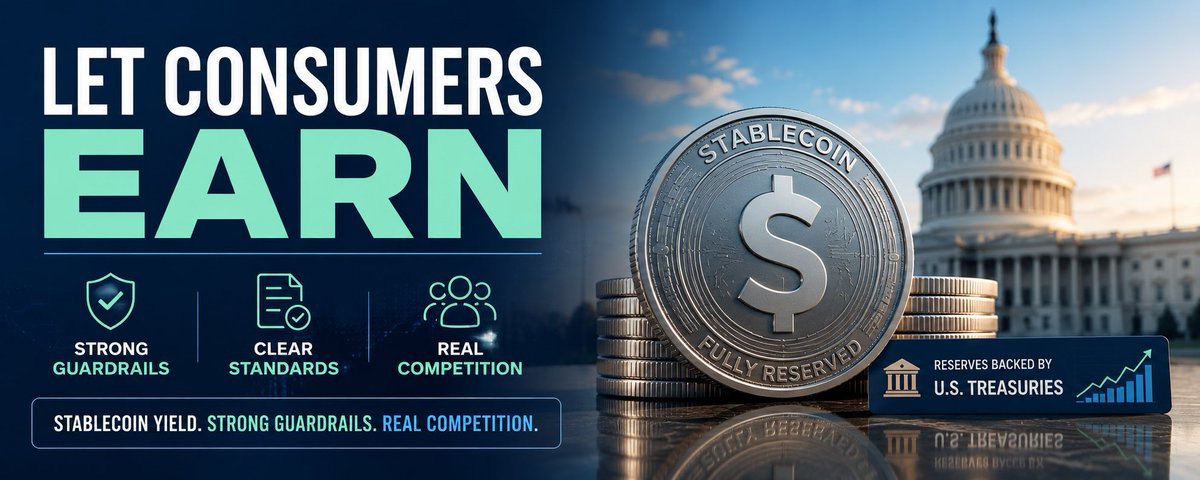
Set rigorous reserve, liquidity, disclosure and redemption standards for yield-bearing stablecoins. Make the risks unmistakable. Then let consumers choose.
The goal should be safer competition, not less competition.
https://t.co/iWz9dPVnwm
“Protecting the banking system” …should not quietly become… “protecting consumers from earning a fair return on their own money.”
Here’s the stablecoin debate Congress should be having:
If a fully reserved digital dollar generates income from safe reserve assets, why should consumers be categorically prohibited from sharing in that return?
Protect community banks. Protect consumers. Require strong reserves, liquidity, disclosures and redemption rights.
Then let regulated products compete.
Wednesday: White House to meet with crypto and prediction-market leaders.
Thursday: CFTC holds its first Innovation Advisory Committee meeting, with a session specifically examining crypto’s path “From Uncertainty to Clarity.”
The CFTC agenda explicitly asks what regulators can accomplish under existing authority and where agency action can complement future congressional legislation.🧐
https://t.co/jawwaT2aP1
If Congress wants stronger ethics rules, make them universal.
Apply clear conflict of interest standards to Congress and the executive branch alike.
Crypto market structure should not be used as a vehicle for selective political punishment.
Congress has repeatedly introduced proposals restricting members’ own stock trading and financial holdings that have not passed.
Congressional financial conflicts of interest remain an unresolved ethics issue also.
https://t.co/JebTS6j1Fj
New reporting today says President Donald Trump is now expected to attend personally, alongside CFTC Chairman Michael Selig. SEC Chairman Paul Atkins is also expected, according to Bloomberg reporting cited by The Block.
The meeting is scheduled for Wednesday, August 19 at 2:30 PM ET, immediately before the CFTC Innovation Advisory Committee meeting on August 20.
With CLARITY facing its Senate test Sept. 15, this is an opportunity to align the two tracks: workable regulation now and durable market structure from Congress.
Consumer protection, clear jurisdiction and American innovation should all be on the table.
https://t.co/DuOEkyaDzu
Crypto vs. banks is the wrong fight.
CLARITY should protect consumers, preserve responsible innovation, and give banks a workable on-ramp to the digital economy.
If one has to lose for another to win, Congress hasn’t finished the job. https://t.co/GOZFQvUJpF
This is exactly why the sequencing matters. Congress should establish the durable market structure, then regulators can build workable rules within it. That gives consumers stronger protections, gives innovators clearer expectations, and reduces the risk of policy changing every time leadership changes.
https://t.co/WlLN4YM80Y
The SEC just cancelled tomorrow’s meeting on proposed crypto offering rules, citing an unforeseen scheduling issue.
One more reminder that agency action and legislation are not interchangeable.
Regulators should keep building workable rules. Congress still needs to deliver durable market structure, consumer protections and clear jurisdiction.
Both tracks matter.
https://t.co/PkiaRtC2HS
@SenMcCormickPA Exactly. Regulators should keep moving, and Congress still needs to lock in clear, lasting rules. Consumers, banks and crypto companies all deserve to know where they stand.
@ChrisVanHollen These are fair concerns. Fix the real gaps, strengthen protections against illicit finance, and bring the bill forward. Leaving crypto in a regulatory gray area does not make consumers or the financial system safer.
@ewarren Agreed that families need real protections. CLARITY should require segregation of customer assets, clear disclosures, strong AML rules, and enforceable oversight. Those protections are reasons to finish the bill, not reasons to leave consumers in the current regulatory gap.