Ever wonder what it’d feel like to have insider access?
Not leaks. Not rumors.
But cold, clean transaction trails that reveal everything?
That’s what I just tapped into testing the $PROFIT Whale Tracker across 5 different contracts.
And what I found?
📂 It wasn’t just movement.
It was a window into intention.
Let’s break it down.
🔍 First one to light up: $PRIVIX
25,000 tokens moved.
$13,867 in value.
One wallet with nearly 300K PRIVIX sent it to a fresh address. (Marketing 🪪)
To most? That’s noise.
But to me? It looked calculated.
No sell. No swap.
Just a clean transfer and at 0.25% of total supply, that’s not some throwaway bag.
The type of move a project makes when they’re about to ignite something.
A payment? Maybe to a KOL? A strategic partner?
No way to know for sure yet.
But you better believe I’m watching.
Because sometimes… a token doesn’t dump.
It’s gearing up.
Then comes $GRAY.
25,000 tokens.
A clean $35,000 USD.
This wasn’t a casual whale buy on Uniswap.
It was a direct wallet-to-wallet transfer from one user wallet to another.
No swap. No market interaction.
Just pure placement.
🧾 Etherscan confirmed it:
Transferred 25,000 GRAY to a new wallet.
Confirmed. Clean. Quiet.
And the wallet? Still holding.
No sells. No noise.
But it didn’t stop there…
As I followed the trail using the Whale Tracker, I uncovered multiple similar transactions each with varying size, but the same signature:
🔁 From the same $GRAY sender
🔁 Same structure
🔁 All recent
🔁 All silent
This could be KOL placements. Could be team wallets. Could even be early OTC distributions.
Right now? No red flags.
But I’ve got them tagged and I’ll be watching every one of them closely.
Because if even one starts to dump…
It’ll tell me how the rest may follow.
Now imagine this:
You’ve got serious capital in 5 different projects.
Not degen coins.
Real, thoughtful entries with bags worth thousands.
Would you not want to know:
💸 Who’s getting paid from the deployer?
🧾 What influencers or insiders are being sent tokens?
🧠 Which wallets are stacking silently with size?
🔁 When a top wallet starts distributing to multiple new addresses?
👀 If a stealthy airdrop or OTC deal just went down?
That’s what this tool gives you.
It’s like being an investor in a traditional company…
…but you get access to the internal financial ledger.
You see the payments, the movements, the motives all before it hits the chart.
And no, not every move is bad.
That’s the key most people miss.
Sometimes a payment means a campaign is coming.
Sometimes a transfer signals new partnerships.
Sometimes it’s just restructuring.
But without this lens? You’re blind.
You’re guessing.
And in this market? Guessing costs money.
This is what makes the $PROFIT Whale Tracker dangerous:
🧠 It’s not about catching rugs.
It’s about catching patterns the kind that tell you who’s accumulating, who’s unloading, and who’s getting ready to act.
It shows:
• Internal wallet flows
• Whale sell behavior
• Coordinated unload patterns
• Strategic token dispersal
• Payment trails tied to KOLs or advisors
• Multi-wallet distribution fingerprints
• Contract-to-wallet transfers (before they go public)
And that’s just the beginning.
Because paired with the other $PROFIT modules?
You’re not just watching moves you’re decoding the narrative.
You can layer Whale Tracker with:
🎯 Sniper Analysis → spot early accumulators
🧠 Smart Money Intel → see if it’s the right kind of whale
📊 Risk Matrix → judge if these wallets actually pose a threat
🔐 EVA x PROFIT Bot → check for backdoors or contract privilege shifts
All that combined?
You’re not reacting anymore.
You’re anticipating.
This $PRIVIX move?
Could be a hint at a marketing push.
The $GRAY transactions?
Might just be a rollout of private placements before the campaign kicks off.
Either way, I’m not watching from the sidelines.
I’ve got them flagged.
Wallets monitored.
Movements logged.
@ProfitAIETH
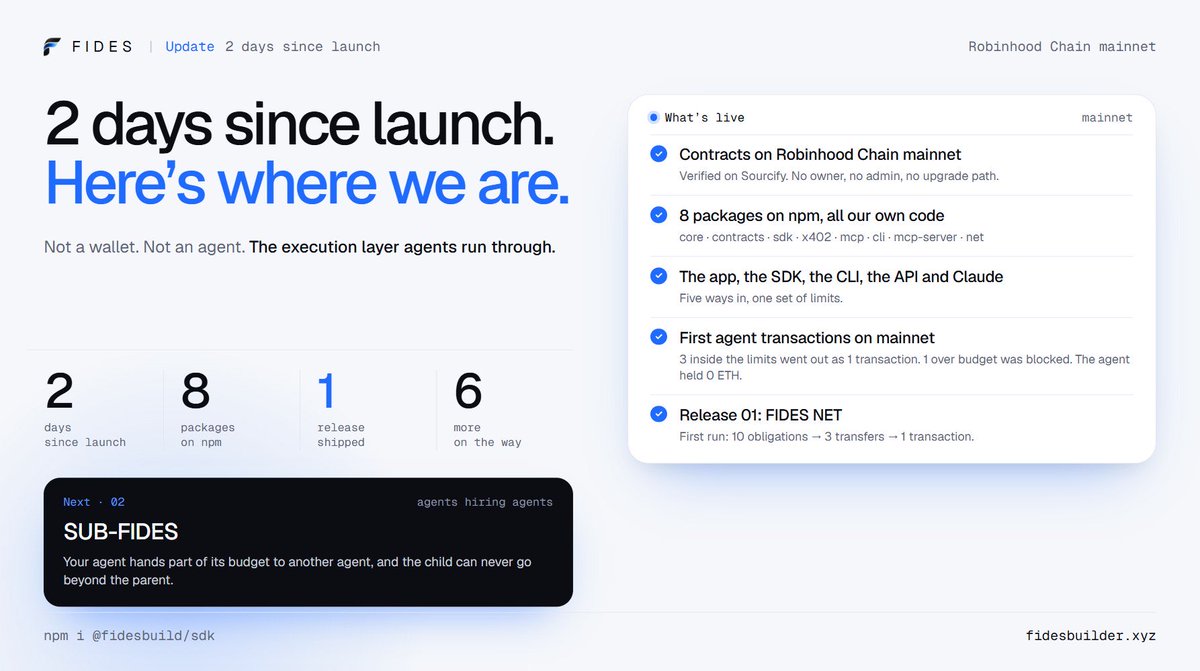
FIDES: 2 days since launch. Here's where we are.
The agent meta has moved past chat. Agents now call tools, pay for services and move money onchain, on their own,
around the clock. What hasn't caught up is the layer underneath: how an agent is allowed to act, and how its actions actually reach the chain.
That layer is what we're building. A Transaction Builder for autonomous agents: the owner signs their limits once,
every action the agent takes becomes one execution plan, each action is checked against those limits, grouped, simulated, and only the required transactions are sent. Enforced onchain, not in an app setting.
What's live:
- Contracts on Robinhood Chain mainnet FIDES Account, Verifier, policy, revocation, receipts, FidesNetRoots.
- 8 packages on npm, all our own code
core · contracts · sdk · x402 · mcp · cli · mcp-server · net
- The app, the SDK, the CLI, the API and Claude. Five ways in, one set of limits.
- First agent transactions on mainnet. An agent bought live chain data from a paid API, then was asked for 4 payments. 3 inside the limits went out as 1 transaction. 1 over budget was blocked before it was ever sent. The agent held 0 ETH.
- Release 01: FIDES NET
An agent's charges, refunds and credits fold into one net position per service, and only what's owed settles, as one transaction, with both roots published onchain.
First run: 10 obligations → 3 transfers → 1 transaction.
What you can do with it today:
→ Give an agent a budget, not a wallet
Budget per token, allowed contracts and functions, paid services with caps, expiry. One signature.
→ Pay for APIs per request
Live chain data, AI model catalogs, onchain trade feeds: any API on Robinhood Chain that charges USDG per request. Paid from the FIDES budget, capped per service.
→ Send payments and payouts
Many transfers, checked and grouped, sent as one transaction.
→ Call any contract you allow
The agent can use any protocol, only with the exact functions you signed for. Nothing changes on the protocol's side.
→ Gate MCP tool calls
Wrap an MCP client and every tool call is checked against the FIDES before it goes out.
→ Settle with NET
Let the agent run a tab and settle the net once, with a public record every service can check.
→ Run it with no gas
The hosted relayer pays. The agent key never needs ETH.
→ Watch and stop
Receipts for every execution, spend tracked against the budget, withdraw or revoke any time.
For builders: npm i @fidesbuild/sdk and your agent gets all of the above.
For services: agents on FIDES can pay you per request, or run a tab and settle with NET.
For everyone else: https://t.co/udYDSu64Ib, or add FIDES to Claude.
2 days in. Release 01 shipped.
Next: 02 SUB-FIDES. Agents hiring agents. Your agent hands part of its budget to another agent, and the child can never go beyond the parent.
https://t.co/NJpO5xBqjn
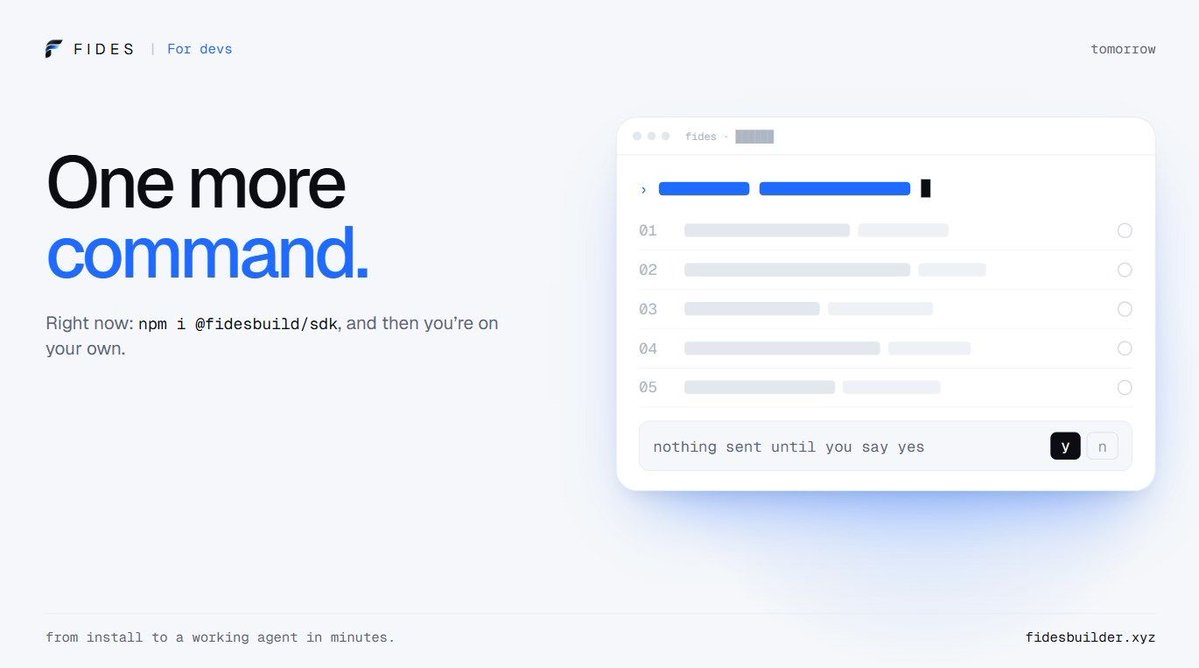
building something for the devs tonight.
right now: npm i @fidesbuild/sdk, and then you're on your own.
today : one more command, and it walks you through everything FIDES can do. payments, contract calls, paid APIs, MCP, NET. interactive, step by step, nothing sent until you say yes.
from install to a working agent in minutes.
MCP gives your agent every tool.
FIDES decides which ones it gets.
An MCP server exposes everything it can do. Connect an agent and it can call all of it. With FIDES, the owner signs which tools the agent may use on each server. Every tool call is checked against that FIDES before it goes out. A tool you didn't allow is blocked, and the server never even sees the call.
agent → read_text_file q3.txt
✓ allowed: q3 revenue: 42
agent → write_file q3.txt
✗ blocked: SERVICE_NOT_ALLOWED (server never called)
What that looks like across servers:
- Filesystem
allow: read_text_file, list_directory, search_files
block: write_file, move_file, edit_file
→ a research agent that can read your docs but never change them
- Database
allow: query, describe_table
block: insert, update, delete, drop
- an analytics agent with read-only access to production
- Email / messaging
allow: read_inbox, draft_message
block: send_message
- an assistant that prepares replies, and a human hits send
- Web / browser
allow: search, fetch_page
block: submit_form, download
- a research agent that reads the web but can't act on it
- Market data / trading
allow: get_quote, get_orderbook
block: place_order, withdraw
- a signal agent that watches markets but can't trade
- Paid tools
allow: the paid tools you choose, capped per server in USDG
→ the agent pays per call from its FIDES budget, never past the cap
Use it however you build:
- SDK
npm i @fidesbuild/mcp
const client = withFides(mcpClient, { fides, serviceId: "filesystem" })
Every callTool now goes through the FIDES. Wrap any MCP client, any server.
- App
Create a FIDES, and on the Services step name each server and list the tools it may use. Sign once.
- Claude
FIDES runs inside Claude as its own MCP server: Claude plans, pays and executes only inside the FIDES you signed.
Tools, payments, onchain. One signature. One set of limits.
And today, you'll be able to try all of it yourself in one command.
https://t.co/IaXqDqohPp
if you run a paid API, here's why FIDES NET matters to you.
an agent runs a tab with your service all day. at settlement you get one payment instead of hundreds.
but how do you know it's right?
every NET round publishes two roots on FidesNetRoots:
- the obligations root: every charge, refund and credit that went in
- the settlement root: every transfer that came out
with your copy of the charges you can:
- recompute the whole settlement: verifySettlement()
- prove your transfer was in it, onchain: verifyTransfer()
no dashboard to trust. no one's word for it. the chain is the receipt.
npm i @fidesbuild/net
https://t.co/tzSHjCIxEs
NET in the app
FIDES NET in the app.
1. Create a FIDES, tick "Allow settlement with FIDES NET"
2. Paste what's owed, one line each: who owes, who's owed, amount
3. Net, build and simulate: see gross vs net before anything moves
4. Settle: one wallet confirm, one transaction, roots published, every transfer proven
10 obligations → 3 transfers → 1 transaction.
https://t.co/udYDSu5wSD
An agent connected to an MCP server, with a card and preferences, buying things on its own. This is where agents are going: not answering questions, but spending.
The interesting question isn't whether agents will spend. It's what stops them from spending wrong.
Today the answer is usually a setting. A limit in an app, a toggle, a dashboard someone checks later. That works inside one product. But agents don't live inside one product. They call tools across many servers, pay many services, and act onchain directly, and an agent that talks to the chain never sees your settings page.
So the limit has to live somewhere the agent can't route around: in the execution path itself.
That's the idea behind FIDES. The owner signs one FIDES: a budget, the tokens, the contracts and functions, the services, an expiry. Every action the agent takes, a tool call, a payment, a transfer, is checked against it before it goes out, and again onchain by the Verifier. Anything outside it is blocked before it's ever sent.
The second half is cost. An agent that spends all day makes hundreds of small payments, and most of them cancel out.
Since yesterday, FIDES NET nets them, and a day of agent spending settles as one net payment per service, in one transaction, with a public record any service can check.
Agent spending is coming either way. The open version should have limits the chain enforces, not ones you hope the app respects.
What FIDES NET fixes onchain.
The agent meta runs on micropayments. Agents pay per request: per API call, per data point, per inference, per tool use. That's the right model for agents, but settled one by one, it doesn't scale onchain:
- every payment is its own transaction, its own gas, its own state write
- thousands of agents paying per call turns into a flood of tiny transfers
- refunds and credits flow straight back, so value goes in circles
- any one payment can fail halfway, leaving an agent's books out of sync
- services end up reconciling thousands of small payments against their logs
NET fixes the settlement layer, not the payment model. Agents keep paying per use. The chain only sees the final positions.
How it works with the Transaction Builder:
The Builder takes an agent's actions, checks each against the FIDES, groups what can go together and simulates it, so many actions go out as one transaction. NET sits in front of it and cuts down what goes in.
1. Obligations come in: who owes who, how much, in which token.
2. NET folds them into one net position per party. Payments that cancel out disappear.
3. NET turns those positions into a handful of transfers, plus one call that publishes the round's two roots.
4. The Builder checks every transfer against the FIDES, simulates the batch, and sends it all as one atomic transaction: all of it lands or none of it does.
5. The roots land on FidesNetRoots, so any service can prove its payment was part of the settlement.
obligations → NET → transfers + roots → Transaction Builder → 1 transaction
The Builder makes fewer transactions. NET makes fewer, smaller payments. Together: only what's actually owed, sent once.
As agents on Robinhood Chain scale from hundreds to thousands, settlement has to get leaner, not louder. That's what NET is for.
https://t.co/tzSHjCHZOU
FIDES NET: what you can build with it.
NET changes how agents pay. Instead of settling every call the moment it happens, an agent keeps a running tab with each service, and NET settles the net once, under a FIDES, as one transaction, with a public record.
Here's who that's for.
→ Agent builders
Your agent touches 10 services a day. Each bills per call, some refund, some credit back. Record obligations as they happen, settle on a schedule: hourly, daily, or when the tab gets big. One signature from the owner. One transaction per settlement. The agent never holds a wallet.
→ Trading agents
Pay a data feed per request. Get rebates for stale or failed data. Pay an execution service. Get fee credits back. NET nets every feed and venue to one figure each, then settles them together.
→ Research and data agents
Buy datasets, scraping, enrichment, model calls. Half of it comes back as refunds for bad results. Only the difference moves.
→ Compute and inference
Prepay a GPU provider, get credited for unused time, top up again. NET settles the real usage, not every top-up and credit in between.
→ Paid APIs and services
Offer agents a tab instead of a payment on every request. Fewer onchain payments, no per-call payment friction.
When the settlement lands, prove your exact payment against the root on FidesNetRoots. No trusting anyone's dashboard.
→ Agent operators and teams
Run several workflows under one FIDES Account and settle everything they owe outside in one go. Every amount stays tagged to the FIDES it came from, so accounting stays clean.
→ Payouts
Contributors, invoices, reimbursements, clawbacks. Net them first, then pay once per person.
What stays the same: every transfer is checked against the FIDES, simulated and sent through the Transaction Builder. Budget, allowed tokens, expiry and revocation all still apply. NET can't spend more than the FIDES allows.
What's new:
- netObligations: any number of obligations in, one net position per party, per token
- settle: the account's transfers plus the round's roots, as Builder actions
- FidesNetRoots: both roots published onchain, immutable, no owner
- verifySettlement + verifyTransfer: anyone can recompute it or prove one payment
Use it today:
- App: tick "Allow settlement with FIDES NET" when creating a FIDES
- SDK: npm i @fidesbuild/net
- Claude: "settle these with FIDES NET"
https://t.co/tzSHjCHZOU
01 FIDES NET is live.
Cross-service settlement netting for autonomous agents.
Agents running many workflows across many services build up a pile of small payments, most of which cancel out.
NET adds up every obligation, nets the reciprocal balances and settles only the final positions.
Why it matters:
- a trading agent pays a data feed per call all day and gets rebates back for stale data. NET settles the difference once.
- a research agent buys compute, gets credited for unused time, buys more. One net payment instead of dozens.
- an agent working with 10 services, each billing and refunding in small amounts. Hundreds of transfers become a handful.
- fewer payments onchain, less gas, less to reconcile, and a public record every service can check its payment against.
How it works:
- obligations in: who owes who, how much, under which FIDES
- net positions out: one figure per party, per token
- at most one transfer fewer than the parties with a balance
- executed through the Transaction Builder: checked against the FIDES, simulated, sent as one transaction
- obligations root + settlement root published onchain: any single payment can be proven against them
Every amount stays attributable to the FIDES it came from.
Live run on Robinhood Chain:
10 obligations → 3 transfers → 1 transaction.
Available now:
- App: tick "Allow settlement with FIDES NET" when you create a FIDES, then settle from its page
- SDK: npm i @fidesbuild/net
- Claude: "settle these with FIDES NET" and list what's owed
https://t.co/tzSHjCHZOU
First FIDES NET settlement on Robinhood Chain mainnet. Straight from the SDK.
An agent ran 10 jobs across 3 services:
paid for data, got a refund, paid for compute, got a credit back.
10 obligations. 0.53 USDG gross.
↓
NET folds them into one position per service.
↓
3 transfers. 0.35 USDG net.
↓
The Builder checks every action against the FIDES and simulates.
Transfers + the round's roots go out as 1 transaction. Gas paid by the relayer. The agent holds 0 ETH.
↓
Roots read back from FidesNetRoots. Every transfer proves against them.
A regular FIDES bundles every payment into fewer transactions. NET goes further: payments that cancel out never move at all.
tx: https://t.co/PEQrN0jQnp
release 01 drops soon