@Scolytine_Sarah@cnestus@scolytine The frons of female *Hylocurus rudis* are very variable, and it's likely to include several of the similar species. We need longer series to show this variation better, ideally from branches. Most recent collections are from when they occasionally to they bump into a funnel trap.
@cnestus I should also clarify my words that *Hypothenemus crudiae* "are often obviously larger and more robust, with more densely placed interstrial bristles". They also seem ecologically different, with *H. crudiae* showing much more preference to fruits and seeds than *H. seriatus*
@cnestus FIGURE 11.4 From left to right: Close-up of head of multiple individuals to show variation and enlarged dorsal view of eltyron showing vestiture and
texture. (A) H. crudiae; (B) H. seriatus; (C) H. interstitialis; (D) H. obscurus; and (E) H. hampei. All photos by A. J. Johnson.
@cnestus This may help a little, but it is not easy, *Hyp. seriatus* certainly has some cryptic species in there which may make identification inconsistent. They are often obviously larger and more robust, with more densely placed interstrial bristles. https://t.co/Fv5fpAdpaS
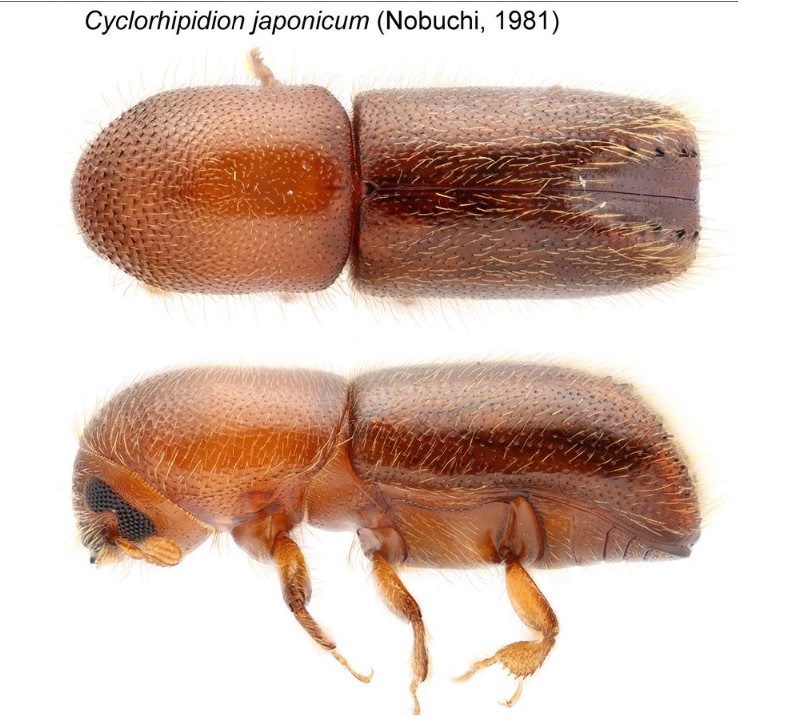
We have a paper reporting the latest new exotic ambrosia beetle established in Florida: *Cyclorhipidion japonicum* (Nobuchi, 1981). https://t.co/yD8hhuxuZ1
@lessrof2weevils Some nice looking *Amasa* there, I hope that they are going into a freezer! And is that Xyleborinus saxesenii? They show up almost everywhere!
Here is a recent light trapping catch with high diversity. 25 species over the last 4 nights! Pretty good for an urban area, and unusually diverse for this time of year. Northeast Gainesville, Florida.
@americanbeetles @JiriHulcr @VIPagriculture @USDA_APHIS It seems super obscure, right? But it is not even the only lineage of Phoenix seed feeding bark beetles- the distantly related *Dactylotrypes longicollis* does the same!
@cnestus@BjarteHenry I don't think that there are really good studies looking at this. Hylocurus, my hunch is that it is only a sexually selected character. For Pityogenes, I am less sure, it looks like fungi is there, and ecologically similar species in other genera have fungus-carrying structures.
@BjarteHenry@cnestus Cnesinus are a bit of a paradox. They are supposedly monogamous, with female initiated galleries, yet the females have the more elaborate frons, with these red-brown bristles. Probably some dissections are needed to confirm, plus better behavioural observations.
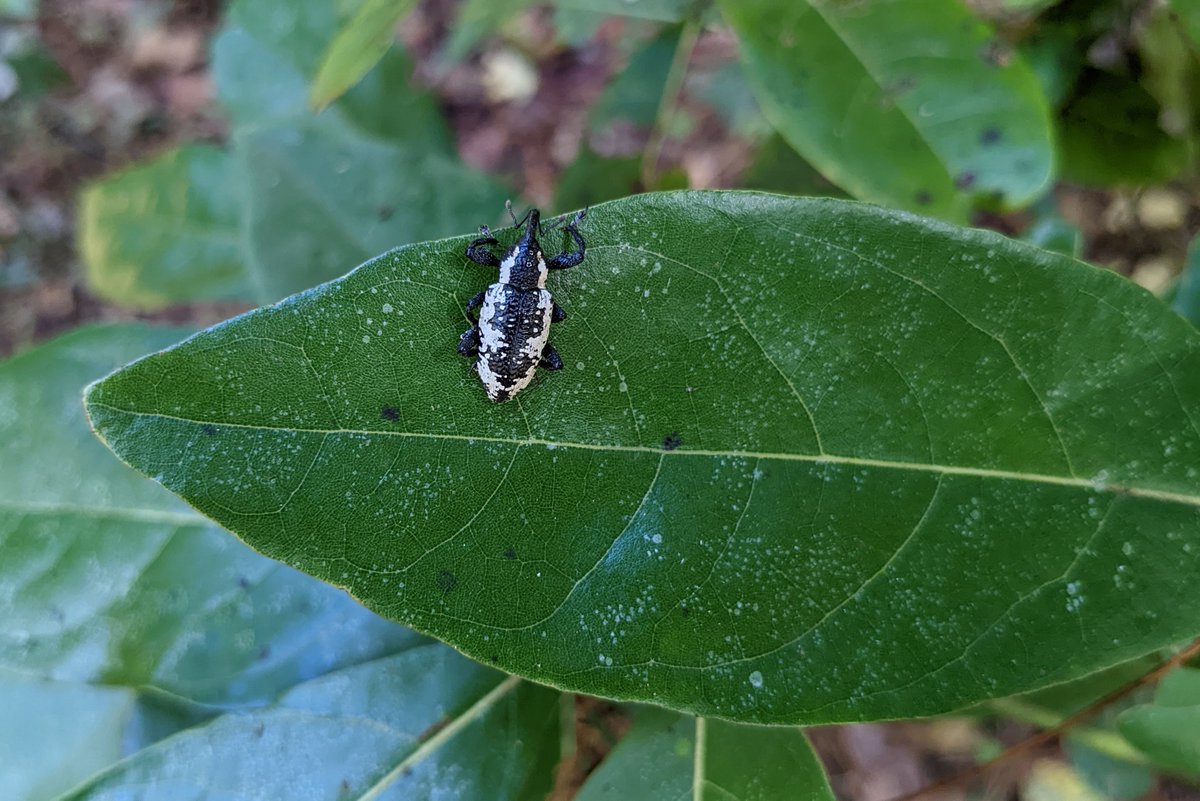
Heilipus squamosus, the avocado tree girdler, a native weevil observed here chewing on a young swamp bay (Persea palustris) in Alachua County, Florida (2022-Oct-01). This is a minor pest of avocado, and also feeds on other Lauraceae widely in the Southeastern US.
@apsciencebydan This is a male Euplatypus. I'd like to say that it is E. compositus, but there is a mite sitting on the diagnostic character! (small paired pits on the pronotum). If it is in Central or South Florida, then another possibility is E. parallelus, which lacks the pits.
@Bertonemyia @ChouvencL @InvertoPhiles @lessrof2weevils Yes, Hypothenemus! H. obscurus The tropical nut borer can be found on tamarind seeds in Florida, though that specimen looks more like H. seriatus or crudiae, which commonly attack pods and more rotten seeds. I'd need a specimen, better photos, or some DNA sequences to confirm!
@joaofungo@ignatiu97904736@JiriHulcr Scolytinae, yes! Likely Coccotrypes sp. (Dryocoetini). Speies IDs are difficult with this genus. Given the location, I would first compare to Coccotrypes graniceps, a species that breeds in acorns, but I do not have any specimens to compare.
@EnricoRuzzier @monotomidae @Scolytine_Sarah @demianfgomez The Scolytine is certainly a Cryphalus sp., but I would need much better photos showing frons and fortibia of a male to have a good idea of species. Cryphalus artocarpus or a related species seems a likely candidate.
It was a fun paper to write, especially since we got loads of specimens to work with! Thanks to all of those involved. I hope it makes this difficult group of bark beetles a little easier...
Our paper is out in Zootaxa- a review of the fuzzy little bark beetles in Hawaiʻi, with David Honsberger and Roger Beaver as coauthors. There are five species of Cryphalus, all probably non-native. https://t.co/XiNnLZuNla
Lastly, Cryphalus sylvicola had lots of annoying taxonomic issues. It has a remarkable host range for a group of typically host-specialist beetles, but this does not include pines- that was just a taxonomic mistake.