Before joining a crypto promotion, I always think it’s worth checking the small details, not just the headline offer. 🟡
For Binance’s new-user USDT Simple Earn campaign, here’s what matters:
The 30% bonus tiered APR lasts 7 days and applies to the first 200 USDT subscribed. Eligibility requires registration after October 8, 2026, at 10:00 UTC, identity verification, and a qualifying first deposit or crypto purchase of at least $1.
The campaign runs until November 8, 2026, subject to availability and regional restrictions. The bonus can’t be combined with other regional new-user bonus APR promotions.
One last thing: check the current Real-Time APR and read the terms in your account before subscribing. A promotion is only useful when you know its limits.
Campaign details 👇
https://t.co/GxzUyWygoj
#BinanceEarn #SimpleEarn #30APR #Binance #BinanceStarterCarnival #CryptoForBeginners
Rolly is officially live! 🚀🎉
$10M public bankroll, a $70K prize pool for Season #1, and bigger betting limits 🔥
If you played during beta, head over and check if your reward is waiting 👀
Check it out 👉 https://t.co/biE8EHCU98
Follow updates: https://t.co/RW5RebOYux
@rolly_onchain
Rolly is officially live!
$10M added to our Public Bankroll on @arbitrum
Season 1 starts now with a $70,000 race.
Roll in now 👉 https://t.co/AWnZc3EUcY
Thinking about mining at home? Don’t forget to calculate the electricity bill first.
Let’s say your rig uses 1,000W and runs all day, every day. That’s around 720 kWh per month.
At $0.10 per kWh, you’re paying $72 just for electricity.
If your mining revenue is $100 for the month, that leaves only $28 — and that’s before cooling, pool fees, and hardware costs.
This is why checking electricity rates matters so much. A miner can have decent hashrate and still struggle to make a profit if power costs are too high.
Curious, how much does electricity cost where you mine? It can make a bigger difference than people think.
#ViaBTCacademy #BitcoinMining @ViBTC a
⛏️ PPS+ vs PPLNS: Which one makes more sense?
PPS+ gives you more predictable payouts for the shares you submit, while PPLNS rewards depend on the shares you contribute and the pool’s block-finding luck.
For example, a PPS+ miner might earn around $10 in a day, while a PPLNS miner could earn $6 one day and $14 another. Just an example, not guaranteed earnings.
If you prefer consistency, PPS+ may suit you better. If you can handle fluctuations, PPLNS is worth considering.
Neither guarantees higher profits. Always check pool fees and payout rules before choosing.
#ViaBTCacademy #BitcoinMining @ViaBTC
One thing miners shouldn’t overlook is cooling.
When dust builds up or airflow gets blocked, ASIC miners can run hotter than normal, affecting performance and sometimes causing unexpected shutdowns.
Regularly cleaning the fans and filters, checking temperatures, and keeping the ventilation clear can make a real difference.
It’s also worth checking for unusual fan noise before it turns into a bigger problem.
These are small things, but they can help reduce downtime and keep mining operations running smoothly.
#ViaBTCacademy @ViaBTC
When choosing an ASIC miner, I wouldn’t look at TH/s alone.
Two miners can deliver similar hashrate but use very different amounts of electricity. That’s where J/TH matters — the lower the number, the more efficiently the machine uses power.
Electricity bills can eat into mining profits, so always compare efficiency, power costs, cooling, and the machine’s price before making a decision.
Sometimes, the smartest choice isn’t the miner with the biggest hashrate, but the one that costs less to run.
#ViaBTCacademy @ViaBTC
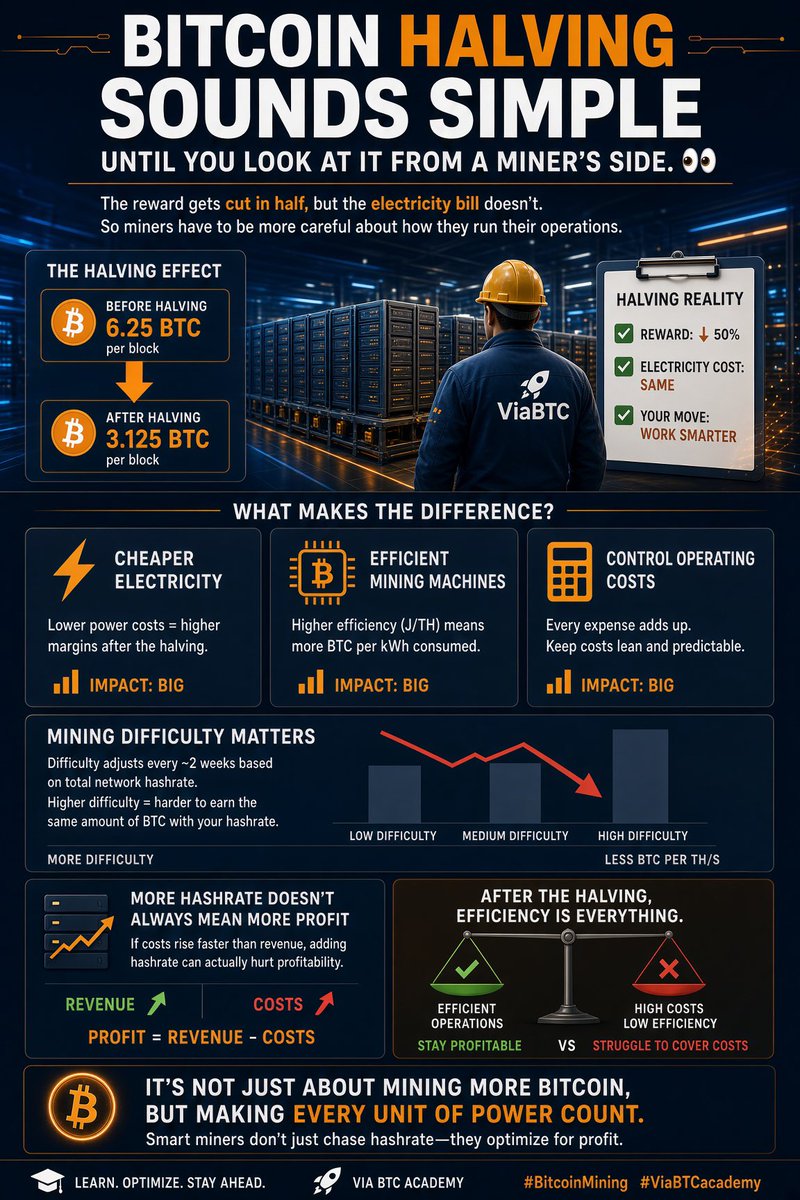
#Bitcoin halving sounds simple until you look at it from a miner’s side.
The reward gets cut in half, but the electricity bill doesn’t. So miners have to be more careful about how they run their operations.
Cheaper electricity, efficient mining machines, and keeping operating costs under control can make a real difference. Mining difficulty matters too, because it affects how much BTC miners can earn with their hashrate.
The interesting part is that more hashrate doesn’t always mean more profit.
After the halving, efficiency can be the difference between staying profitable and struggling to cover costs. It’s not just about mining more Bitcoin, but making every unit of power count.
#BitcoinMining #ViaBTCacademy @ViaBTC
Big update for Web3 gaming
Robinhood Chain is now live on @Dexsport!
Already holding ETH or USDG on the network? You can deposit directly and get in on the action.
🎁 Sports bonus: up to 60% on your first deposit
🎰 Casino bonus: up to 480% (up to $10,000) + 100 Free Spins
With 25+ supported networks, getting started is easier than ever. Connect your wallet and explore 👇
Let’s go 👉 https://t.co/sFsPhISx0p
Robinhood Chain is hype, and it's now live on Dexsport.
Already using ETH or USDG on the network? Deposit and win on Dexsport.
25+ networks, a single gaming space – just connect your wallet and start playing on https://t.co/WXBppFHfFQ
What does the next Bitcoin difficulty adjustment mean for miners?
#Bitcoinmining difficulty changes as the network’s total hashrate fluctuates. The goal is to keep block production close to one block every 10 minutes.
If difficulty increases, miners generally need more computational work to find a block. If it decreases, mining becomes less challenging, all else being equal.
But difficulty alone doesn’t tell the whole story. Hardware efficiency, electricity costs, uptime, and pool performance all affect a miner’s day-to-day results.
Understanding these fundamentals helps miners make better operational decisions instead of reacting to every network change.
#ViaBTCacademy @ViaBTC