For decades, real estate has moved at the speed of paperwork.
Today’s buyers expect something different; speed, certainty, and simplicity. That’s exactly what a new on-chain settlement model is delivering by combining USDT on TRON with real-world property transactions.
This is not theory. It’s live infrastructure.
𝐓𝐡𝐞 𝐏𝐫𝐨𝐛𝐥𝐞𝐦 𝐖𝐢𝐭𝐡 𝐓𝐫𝐚𝐝𝐢𝐭𝐢𝐨𝐧𝐚𝐥 𝐑𝐞𝐚𝐥 𝐄𝐬𝐭𝐚𝐭𝐞 𝐒𝐞𝐭𝐭𝐥𝐞𝐦𝐞𝐧𝐭
Buying a home is one of the most important financial decisions people make, yet the settlement process remains slow and fragmented.
🔸 Bank wires that take days
🔹 Manual verification and intermediaries
🔸 Delays across borders and time zones
🔹 High fees and settlement uncertainty
In a digital-first world, this friction no longer makes sense.
𝐑𝐞𝐚𝐥𝐎𝐩𝐞𝐧 + 𝐓𝐑𝐎𝐍: 𝐀 𝐍𝐞𝐰 𝐒𝐞𝐭𝐭𝐥𝐞𝐦𝐞𝐧𝐭 𝐌𝐨𝐝𝐞𝐥
Through RealOpen, buyers can now purchase real estate using USDT on TRON, without changing how property contracts work.
Here’s how it works:
🔹 Buyers shop for any home and sign a standard real estate contract
🔸 At closing, funds are sent directly from a TRON wallet
🔹 Settlement happens on-chain using USDT
🔸 No banks, no delays, no unnecessary intermediaries
The experience feels familiar, but the infrastructure underneath is completely modern.
𝐖𝐡𝐲 𝐓𝐑𝐎𝐍 𝐌𝐚𝐤𝐞𝐬 𝐓𝐡𝐢𝐬 𝐏𝐨𝐬𝐬𝐢𝐛𝐥𝐞
Real estate settlement requires reliability, liquidity, and predictable costs. That’s where TRON DAO excels.
🔸 Near-instant transaction finality
🔹 Ultra-low fees even at high values
🔸 Deep USDT liquidity used globally
🔹 A network already trusted for daily settlement at scale
This isn’t a new experiment, it’s an extension of how TRON is already used worldwide.
𝐔𝐒𝐃𝐓 𝐨𝐧 𝐓𝐑𝐎𝐍: 𝐁𝐮𝐢𝐥𝐭 𝐟𝐨𝐫 𝐑𝐞𝐚𝐥-𝐖𝐨𝐫𝐥𝐝 𝐕𝐚𝐥𝐮𝐞 𝐓𝐫𝐚𝐧𝐬𝐟𝐞𝐫
Stablecoins aren’t just for trading anymore.
🔹 Buyers need price stability
🔸 Sellers need guaranteed settlement value
🔹 Both sides need fast confirmation
🔸 Everyone needs transparency
USDT on TRON provides all four, making it a natural fit for high-value, real-world transactions like property purchases.
𝐅𝐫𝐨𝐦 𝐒𝐩𝐞𝐜𝐮𝐥𝐚𝐭𝐢𝐨𝐧 𝐭𝐨 𝐑𝐞𝐚𝐥 𝐔𝐭𝐢𝐥𝐢𝐭𝐲
This integration marks a shift in how blockchain is perceived.
🔸 Not just DeFi and trading
🔹 Not just cross-border transfers
🔸 But real assets, real contracts, real settlement
Homes are being funded at crypto speed, without compromising legal standards or buyer protections.
𝐀 𝐆𝐥𝐢𝐦𝐩𝐬𝐞 𝐈𝐧𝐭𝐨 𝐭𝐡𝐞 𝐅𝐮𝐭𝐮𝐫𝐞 𝐨𝐟 𝐏𝐫𝐨𝐩𝐞𝐫𝐭𝐲 𝐌𝐚𝐫𝐤𝐞𝐭𝐬
As blockchain adoption matures, real estate is emerging as a key frontier.
🔹 Faster closings
🔸 Global buyers without banking friction
🔹 Transparent settlement records
🔸 Reduced operational overhead
This is what happens when crypto infrastructure meets real-world demand.
𝐅𝐢𝐧𝐚𝐥 𝐓𝐡𝐨𝐮𝐠𝐡𝐭𝐬
Real estate doesn’t need more complexity, it needs better rails.
With RealOpen, USDT, and TRON, property settlement is finally catching up to how modern money moves: fast, transparent, and always on.
This isn’t just innovation for crypto users.
It’s infrastructure for the next generation of global property ownership.
#TRON #TRONEcoStar @justinsuntron
Everyone talks about what technology can do.
Very few talk about what makes that technology reliable.
The spotlight usually lands on AI breakthroughs, viral apps, and the latest blockchain narratives. But behind every digital interaction is something far less visible and arguably far more important.
The systems that establish identity.
The frameworks that verify information.
The mechanisms that create accountability.
The layers of trust most people never think about.
Without them, innovation becomes fragile.
That’s one reason @Concordium stands out to me. While much of the industry races toward the next headline, it has remained focused on strengthening the underlying architecture that digital ecosystems require to function securely and at scale.
As autonomous AI, digital identities, and online economies continue to evolve, the real differentiator may not be who builds the smartest tools, but who builds the most trustworthy foundations.
Because in the next phase of the internet, trust won’t be a feature.
It will be the prerequisite.
Price movements grab attention.
Infrastructure creates staying power.
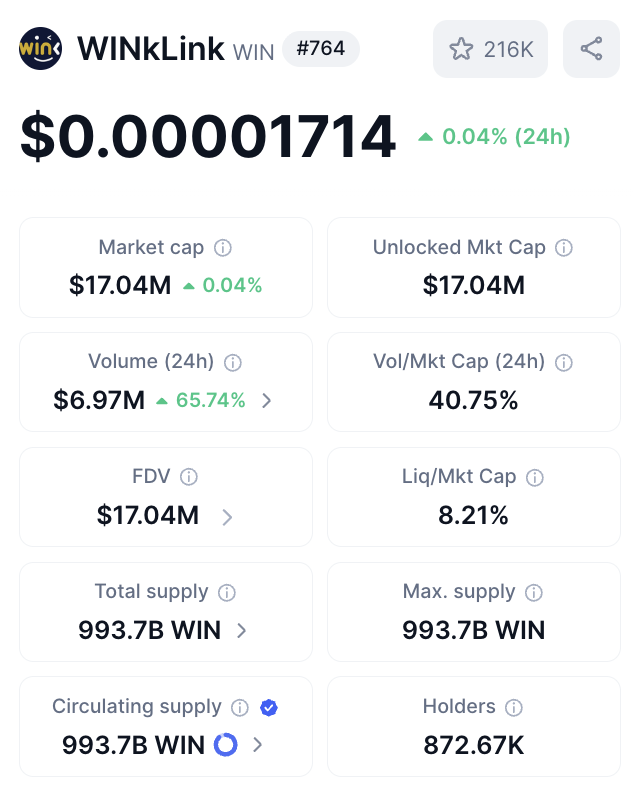
Over the last 24 hours, WINkLink recorded:
• Trading Volume: $6.97M (+65.74%)
• Price Change: +0.04%
At first glance, most people will focus on the price.
The more interesting signal may be the surge in trading activity.
Volume often tells a different story than price.
It reflects participation.
It reflects attention.
And sometimes, it reflects growing interest before larger trends become visible.
But short-term market activity is only one piece of the puzzle.
The real value of an oracle network isn't measured by a single day's price action.
It's measured by its ability to reliably deliver data that powers smart contracts, DeFi protocols, and on-chain applications.
That's why WINkLink's long-term focus remains unchanged:
➜ Strengthening oracle infrastructure
➜ Improving data reliability
➜ Supporting ecosystem growth
➜ Enabling more advanced Web3 applications
As blockchain ecosystems become increasingly dependent on real-world data, oracle networks are evolving from supporting infrastructure into critical infrastructure.
The biggest opportunities in Web3 won't be built on speculation alone.
They'll be built on systems that provide trustworthy data, consistent performance, and long-term reliability.
The market may watch the price.
Builders watch the infrastructure.
And that's where the real story of WINkLink continues to unfold.
@WinkLink_Oracle@justinsuntron
@tr
The strongest DeFi markets aren't defined by price action alone.
They're defined by participation.
This week's $WIN market data on JustLend DAO offers a snapshot of how capital continues to flow through the ecosystem:
• Total Supply: $509.47K
• Total Borrow: $91.74K
At first glance, these may look like routine lending metrics.
But they tell a larger story about how decentralized money markets function.
When users supply assets, they provide liquidity that helps power the lending ecosystem.
When users borrow, they unlock capital efficiency without needing to sell their holdings.
Together, these activities create the foundation of a healthy DeFi market.
The relationship is simple:
➜ More supply strengthens liquidity
➜ More liquidity supports borrowing demand
➜ More borrowing increases capital utilization
➜ Greater utilization drives ecosystem activity
This is why lending markets remain one of the most important pillars of decentralized finance.
They transform idle assets into productive capital.
For WIN holders, the market continues to demonstrate active participation within the TRON DeFi ecosystem, supported by the infrastructure of JustLend DAO and the broader WINkLink network.
Sustainable DeFi growth is built on utility, liquidity, and consistent participation.
And every week, on-chain metrics help tell that story.
@WinkLink_Oracle@DeFi_JUST @tr
The most important metric in Web3 isn't hype.
It's usage.
While many projects compete for attention, the real winners are often the ones quietly attracting and retaining users at scale.
That's why nearing 2 million users is a milestone worth paying attention to during #TRONAISeason.
User growth signals something that charts and narratives can't always capture:
➜ Real engagement
➜ Real demand
➜ Real adoption
The AI and blockchain sectors are both filled with ambitious ideas.
But ideas only matter when people actually use them.
Every new user represents another interaction, another transaction, another contribution to the ecosystem's growth.
We're entering a phase where success will be measured less by promises and more by participation.
Because in the long run, real usage is always more valuable than theoretical potential.
And nearly 2 million users is a signal that deserves attention.
@WinkLink_Oracle@trondao@justinsuntron
#TRONDAO
Moving into qVAULT takes three steps:
1. Connect a self-custody account like MetaMask
2. Create a quantum-secured vault
3. Bring your assets across
No new system to learn.
Register for early access at https://t.co/HygbUXfy62
For years, crypto has focused on solving technical problems, faster transactions, deeper liquidity, and broader accessibility.
But as the industry evolves, another challenge is moving to the forefront: credibility.
How do you create a digital economy where participants can be held accountable without sacrificing privacy?
That’s the foundation Concordium has been building toward.
With AI agents increasingly interacting with financial systems, managing identities, and executing transactions on behalf of users, success won’t be determined by speed alone.
The next generation of blockchain infrastructure will be defined by something far more important: the ability to combine privacy with verifiable accountability at the protocol level.
#web3
This week @DigitalXLtd joined a quantum-preparedness workshop with qLABS and @01quantuminc , exploring how post-quantum security protects digital assets as quantum computing advances.
Custody risk is a multi-year question for institutional holders.
Getting ahead of it starts now.
@Concordium@solana Bringing the Verified by Concordium Badge to Solana is a big step toward making agent identity verifiable while keeping deployment exactly where it is.
The future isn’t just AI agents moving value at machine speed.
It’s AI agents that can be tied to real, accountable entities when it matters.
Glad to see Solana join the Concordium Agent Registry. 🔥
AI agents on Solana can transact, coordinate, and move value at machine speed.
But until now, they couldn’t prove who stood behind them.
Today, @solana joins the Concordium Agent Registry.
Get the Verified by Concordium Badge and add verifiable accountability to your agent.
No migration required.
🔗 Read more: https://t.co/kxKQxijJXB
Most staking assets generate yield from a single source.
The next evolution of DeFi is about stacking multiple revenue streams into one position.
That's what makes sTRX interesting.
By staking TRX through JustLend DAO, users receive sTRX, a liquid staking asset that keeps capital productive while unlocking additional earning opportunities across the ecosystem.
Instead of holding idle assets, participants gain exposure to multiple yield sources:
1. TRON Governance Rewards
Every staked position contributes to the security and governance of the TRON network, generating rewards tied to ecosystem participation.
2. Energy Rental Income
As network activity grows, energy becomes an increasingly valuable on-chain resource. sTRX holders benefit from demand generated by transactions, smart contract execution, and ecosystem usage.
The result is a model where one asset can generate value from multiple layers of network activity.
DeFi is moving beyond simple staking.
The most competitive protocols are building systems that maximize capital efficiency, allowing users to earn from multiple sources without constantly moving funds between platforms.
This creates a stronger alignment between:
➜ Network growth
➜ Resource demand
➜ User participation
➜ Yield generation
Currently, sTRX is delivering a 6-hour average APY of 6.35%, giving TRX holders another way to put their assets to work while remaining connected to the broader TRON ecosystem.
Because in the next phase of DeFi, the question won't be:
"Am I earning a yield?"
It will be:
"How many layers of value can my capital capture at once?"
@DeFi_JUST@justinsuntron #JustLendDao
Most people associate DeFi growth with new listings, new pools, and new opportunities.
But one of the strongest indicators of a protocol's maturity is how it manages change when a market reaches the end of its lifecycle.
JustLend DAO has introduced a proposal for the orderly offboarding of the ETHB market through a structured two-stage process.
At first glance, this may look like a routine governance update.
In reality, it reflects a broader shift happening across DeFi, protocols are becoming increasingly focused on risk management, capital efficiency, and long-term sustainability.
Stage 1: Disable New Supply and Borrow Activity
The first phase is designed to prevent new exposure to the ETHB market while ensuring existing users are not disrupted.
If approved:
• ETHB supply functions will be disabled
• ETHB borrow functions will be disabled
• Users will no longer be able to open new supply positions involving ETHB
• Users will no longer be able to open new borrow positions involving ETHB
Importantly:
✅ Existing positions will remain active
✅ Existing suppliers and borrowers can continue managing their positions
✅ No immediate forced actions are required from current users
This approach allows the market to gradually wind down while maintaining a stable experience for participants already involved.
Stage 2: Parameter Adjustments
The second phase is expected to take place through additional governance proposals around late June.
Potential changes may include:
• Adjustments to the Collateral Factor (CF)
• Adjustments to the Reserve Factor (RF)
• Updates to other market-related risk parameters
These modifications would help further support the ETHB market's transition while aligning protocol risk management with the offboarding strategy.
Why This Matters
The real story isn't simply that ETHB is being offboarded.
The signal is that JustLend DAO is treating market management as an ongoing process rather than a one-time decision.
As DeFi continues to mature, successful protocols will increasingly focus on:
➜ Managing risk proactively
➜ Allocating capital more efficiently
➜ Maintaining healthy lending markets
➜ Protecting users during transitions
➜ Using governance to guide long-term ecosystem development
The strongest protocols are not those that add markets endlessly.
They're the ones that know how to evolve responsibly as the ecosystem changes.
This proposal demonstrates evolution in action.
Community members are encouraged to review the proposal, understand its implications, and contribute feedback as the governance process moves forward.
📩 Read the proposal and join the discussion:
https://t.co/WRwevPEBQq…
@DeFi_JUST@justinsuntron@trondao
One of the biggest barriers to blockchain adoption isn't speed.
It's friction.
Imagine wanting to send USDT, only to realize you need a completely different token just to pay the transaction fee.
For experienced crypto users, that's normal.
For everyone else, it's confusing.
That's the problem GasFree is solving on TRON.
With GasFree, users can send USDT without worrying about holding TRX, managing Energy, or calculating Bandwidth requirements beforehand.
The experience becomes much simpler:
• No TRX required for transaction fees
• No Energy management
• No Bandwidth calculations
• Transaction fees deducted directly in USDT
For years, blockchain users have been forced to think about the infrastructure behind every transaction.
GasFree shifts the focus back to what users actually want to do:
Send assets quickly and efficiently.
This may seem like a small change.
It isn't.
The technologies that achieve mass adoption are often the ones that make complexity invisible.
People don't want to learn how payment networks work before sending money.
They just want the transaction to go through.
As Web3 continues to evolve, user experience is becoming just as important as scalability, security, and decentralization.
The projects that remove friction will be the ones that onboard the next wave of users.
GasFree is a step in that direction.
Open your wallet.
Send USDT.
That's it.
@trondao@DeFi_JUST@justinsuntron
#TRONEcoStar #JustLenDao
For years, the crypto industry has debated the same looming question:
What happens when quantum computers become powerful enough to challenge today’s encryption?
The conversation has never really been about whether quantum technology will advance.
It’s always been about something much simpler:
What can users do before that day arrives?
That’s why qVAULT caught my attention.
Not because it’s another discussion about quantum risk.
But because it’s an actual tool designed to help people prepare for it.
Most digital assets today are protected by cryptographic standards such as ECDSA, EdDSA, and Schnorr signatures.
These technologies secure enormous amounts of value across the blockchain ecosystem.
They’re trusted, battle-tested, and foundational to modern crypto.
Yet they’re also among the cryptographic systems researchers expect sufficiently advanced quantum computers to challenge in the future.
And the concern isn’t limited to some distant date on the calendar.
A growing number of security experts point to the “Harvest Now, Decrypt Later” scenario.
The idea is straightforward:
Data can be captured today.
Public keys can be collected today.
Transaction histories can be archived today.
Then, years from now, that information could potentially be decrypted once quantum hardware reaches the necessary capabilities.
That possibility is exactly why many believe preparation needs to begin long before Q-Day.
qLABS is taking a practical step in that direction.
The team has opened early access to qVAULT, a quantum-safe self-custody solution built for Hyperliquid users.
Rather than forcing users into a new ecosystem, qVAULT focuses on strengthening protection around the one they already use.
Getting started is intentionally simple:
• Connect your wallet
• Create a quantum-safe vault
• Transfer supported assets into protection
No blockchain migration.
No complicated onboarding.
No loss of custody.
No need to rebuild existing workflows.
The assets remain yours, and control never leaves your hands.
Behind the scenes, qVAULT incorporates Falcon (FN-DSA) signatures, NIST-aligned post-quantum cryptography, independent security reviews, and a self-custody architecture designed to preserve ownership while enhancing security.
The choice to launch on Hyperliquid first also makes sense.
It’s one of the most active on-chain trading environments today, processing enormous volumes and attracting a rapidly expanding community.
Every trade, every position, and every interaction ultimately depends on cryptographic security.
Strengthening that foundation is the core objective.
What stands out most is the approach.
qLABS isn’t asking users to abandon the platforms they trust.
They’re asking a different question:
How do we make existing ecosystems more resilient before quantum threats become reality?
That feels far more practical than waiting for the industry to react later.
We’ve spent years discussing the quantum era.
Now we’re beginning to see infrastructure built specifically for it.
Whether Q-Day arrives sooner than expected or decades from now, the projects that gain the greatest advantage may be the ones preparing long before the rest of the market realizes they should.
Early access to qVAULT is now available for $HYPE and $qONE holders.
🛡️ AI is changing crypto security.
From deepfakes and phishing to autonomous systems handling real value, the stakes are rising fast.
Join Concordium CTO @PeterMarirosans alongside @CertiK’s @LGirlett and @_sangier as they discuss security in the agentic economy.
📅 June 12, 11:00 AM UTC
Reminder link in first comment 👇
Security claims only matter when a network proves itself under demanding conditions.
That’s what makes Concordium’s Grey Box Audit with CertiK noteworthy.
Rather than relying solely on traditional code assessments, the audit subjected the network to simulated real-world threats, including adversarial attacks, validator stress, network instability, and other challenging scenarios designed to uncover vulnerabilities before they can be exploited.
The value goes beyond passing an audit.
It strengthens the foundation for a blockchain built to support enterprises, developers, and autonomous AI systems with greater confidence.
As on-chain ecosystems evolve to power digital identity, financial transactions, and AI-driven activity, robustness is no longer a nice-to-have, it’s a core requirement.
What stands out isn’t just the milestone, it’s the consistency of the vision.
While much of the industry focused on speed and speculation, @Concordium focused on trust, identity, and accountability at the protocol level.
Five years later, those foundations are becoming increasingly relevant in a world of AI agents, digital identities, and autonomous systems.
The next era of Web3 won’t just need decentralization.
It will need trust. 🚀
🎉 5 years ago, Concordium mainnet went live.
We started with a simple belief:
Trust should be built into the protocol.
Five years later, that foundation powers verified identity, privacy-preserving accountability, settlement infrastructure, and now the trust layer for AI agents.
Verified Humans.
Verified Agents.
One Protocol.
Here’s to the next 5 years. 🚀
The intersection of AI and crypto is creating new security challenges.
As autonomous agents begin managing assets and executing transactions, threats such as sophisticated phishing attacks, deepfakes, and emerging AI-driven risks are becoming increasingly important to address.
Join Concordium CTO @PeterMarirosans, together with @CertiK’s @LGirlett and @_sangier, for a discussion on securing the agentic economy and what the future of trust and accountability looks like in an AI-powered world.
📅 June 12 | 11:00 AM UTC
🔗 Reminder link below 👇
https://t.co/MmCnFO64RU