One opportunity most people miss in Web3...
is documenting their journey publicly.
Many users spend months learning:
🔹new tools
🔹ecosystems
🔹airdrop strategies
🔹community building
🔹onchain concepts
But they keep everything to themselves.
Meanwhile, someone else learns the same thing and shares:
"Here's what I learned today."
"Here's a mistake I made."
"Here's what surprised me."
Over time, that person becomes discoverable.
Teams start recognizing their name.
Other users start trusting their insights.
Opportunities start finding them.
The lesson?
Don't just learn in Web3.
Learn publicly.
Your content can become proof of your knowledge long before you have a big audience.
I realized one thing many people don't realize about Web3 jobs...
some of the best opportunities never get posted publicly.
They get filled through reputation.
A founder needs a moderator.
A community manager is looking for support.
A project needs a content creator.
Instead of creating a public job post, they often ask:
"Do you know anyone reliable?"
That's why your goal shouldn't be to look for jobs every day.
Your goal should be to become the person people recommend.
Start building that reputation now:
🔹show up consistently
🔹communicate professionally
🔹help where you can
🔹deliver on small commitments
In Web3, many opportunities travel through people before they ever reach a job board.
Position yourself where your name comes up in those conversations.
The most sophisticated product in Web3 is not the one with the most complex architecture.
It is the one that makes complexity disappear for the user without hiding the value behind it.
This is a distinction the industry does not discuss enough.
Many teams treat complexity as evidence of innovation.
And to be fair, innovation often creates complexity.
New systems introduce new mechanisms. New mechanisms introduce new behaviors. New behaviors introduce new learning requirements.
Complexity itself is not the problem.
The problem begins when users are forced to carry that complexity themselves.
Because every product makes a choice.
Either:
The team absorbs complexity internally and delivers simplicity externally.
Or:
The user absorbs complexity externally and pays the cognitive cost personally.
The difference between those two choices is enormous.
In fact, it may be one of the most important competitive advantages in the entire Web3 ecosystem.
Most adoption conversations focus on:
• distribution • incentives • partnerships • growth loops • network effects
Yet beneath all of them exists a more fundamental variable:
Cognitive efficiency.
How much mental effort is required before a user can confidently act?
The answer to that question influences nearly everything.
Because human beings do not merely optimize for value.
They optimize for value relative to effort.
A product may create extraordinary value.
But if understanding that value requires excessive interpretation, many potential users will never reach the point where the value becomes visible.
This creates a hidden adoption tax.
Not a financial tax.
A cognitive tax.
And unlike transaction fees, cognitive taxes are rarely visible on dashboards.
They appear indirectly:
• abandoned onboarding flows • weak activation • low retention • fragmented communities • repeated user confusion • dependency on constant explanation
The ecosystem feels busy.
But progress feels inefficient.
Why?
Because users are spending energy understanding the system instead of benefiting from it.
The most successful products in history often solved this problem exceptionally well.
Not by eliminating complexity.
But by relocating it.
The complexity remained inside the product.
The user experienced clarity.
This is why communication should not be viewed as something that happens after product development.
Communication is part of how complexity is managed.
It determines whether innovation feels accessible or intimidating.
Whether participation feels natural or exhausting.
Whether curiosity evolves into confidence.
Or confusion.
The deeper insight is this:
Every breakthrough technology creates two parallel challenges.
The first challenge is technical.
Can the system work?
The second challenge is cognitive.
Can human beings understand it well enough to integrate it into their lives?
The industry spends enormous resources solving the first problem.
But the projects that define the next era of Web3 may be the ones that become obsessed with solving the second.
Because technological progress alone does not create adoption.
People do.
And people adopt what they can confidently understand.
In the long run, the teams that win may not simply be the teams building the most advanced systems.
They may be the teams that become world-class at converting complexity into clarity.
Because once clarity scales, adoption has a chance to scale with it.
Good night CT 🌙💤😴
Can I get a GN?
One of the biggest opportunities in Web3 that most people completely overlook...
is becoming the person who connects users and projects.
Everyone wants to be:
🔹a trader
🔹an influencer
🔹an investor
But very few people focus on becoming a connector.
Here's what I mean:
A project launches.
New users arrive with questions.
The team is busy building.
Someone steps in and starts:
🔹answering questions
🔹onboarding newcomers
🔹collecting feedback
🔹explaining updates
🔹connecting people to the right resources
At first, it looks like they're "just helping."
But over time, they become one of the most recognized people in the ecosystem.
And that's where opportunities start appearing:
community roles, ambassador programs, partnerships, moderation roles, content opportunities, and sometimes even full-time positions.
Most people are competing for attention.
Very few are competing to become indispensable.
In Web3, being useful can be more profitable than being popular.
🔮 Последняя возможность сделать прогноз на XRP!
Угадай цену ripple:native / solana:Es9vMFrzaCERmJfrF4H2FYD4KCoNkY11McCe8BenwNYB на 5 юиня, 16:00 UTC → выиграй часть из 150 USDT 💰
Подпишись на @cis_binance, поставь лайк + сделай репост и напиши прогноз в формате: #ПрогнозXRP $84.34
https://t.co/3AveE1QWPZ
⏳ До 4 июня, 23:59 UTC
🏆 6 победителей × 25 USDT
🚀 MEXC SPACEX(PRE) Mission to Mars Giveaway
What would YOU ask Elon Musk @elonmusk if you had the chance? 👀
🎁 100 USDT Prize Pool
How to join:
1️⃣ Participate in the SPACEX(PRE) Launchpad 👉 https://t.co/gs0NJxACOA
2️⃣ Join our community 👉 https://t.co/r8T5Yf0Pkl
3️⃣ Comment:
❓Your question for Elon Musk + UID
📸 Your participation screenshot
🤑Want extra chances to win?💰
Reply to someone else’s question with your best answer!
(UID + screenshot required)
🚀 5 Most Creative Questions × 10 USDT
💬 5 Most Creative Replies × 10 USDT
#SpaceX #Launchpad #Giveaway #MEXC #Australian #Musk
@mexc_portuguese Com o avanço da Starlink e da exploração espacial, qual é a visão do Elon Musk sobre o impacto real disso na conectividade global nos próximos 10 anos?
UID #MEXC[65163735]
🎉 SORTEIO | 20.000 $KSKD em prêmios
Se você pudesse fazer uma pergunta ao Elon Musk sobre a SpaceX, qual seria? 👀
🌎 Marte
🛰️ Starlink
🤖 Robôs humanóides
📈 Avaliação futura da SpaceX
Para participar:
✅ Nos siga + Like + RT 🔄
✅ Junte-se à nossa comunidade 👉 https://t.co/9hzHiyAJww
✅ Comente sua pergunta + seu MEXC UID
🏆 10 vencedores × 2.000 $KSKD
Participe do $SPACEX (PRE) Launchpad 👇
https://t.co/ntrtZFcUaM
Junte-se ao Kaskad 👇
https://t.co/1brPuCJ6xC
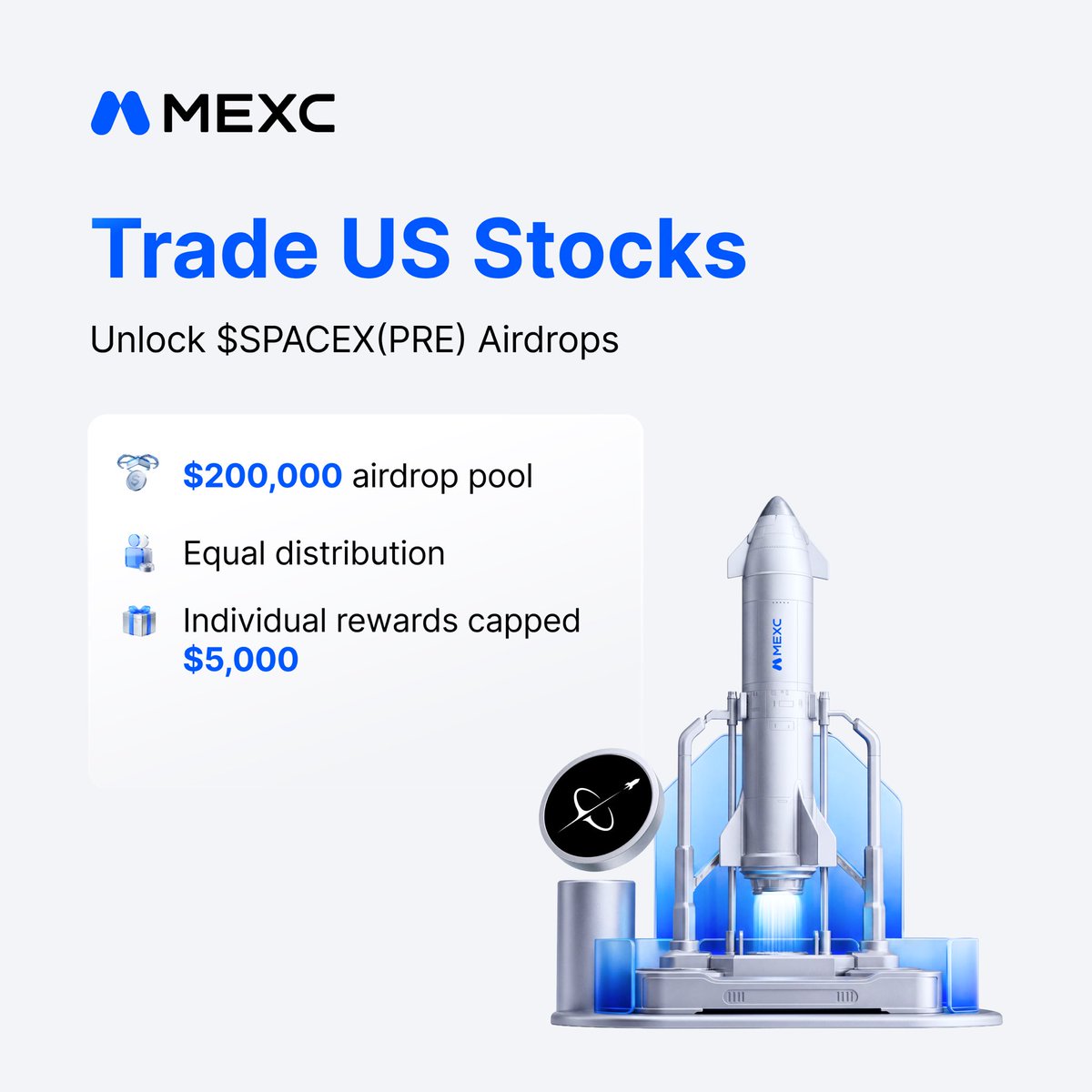
Want to win a share of the $200,000 in $SPACEX(PRE) airdrop?
Simply:
Subscribe to $SPACEX(PRE) Launchpad
Trade any US Stocks during the launchpad period
Equal distribution. No volume competition
Win up to $5,000 in $SPACEX(PRE) now 👇