@koolkrypto223@ryskfinance I'm also moving to Derive. Risk Finance does offer a convenient interface and the ability to buy large volumes with one click, but behind all that convenience hides fraud.
I'm going to keep making this PSA, but selling vol through @ryskfinance is ALWAYS negative expected value regardless of the result of your trades. Calling it "no risk" to sell puts on a 80+IV asset is just irresponsible too.
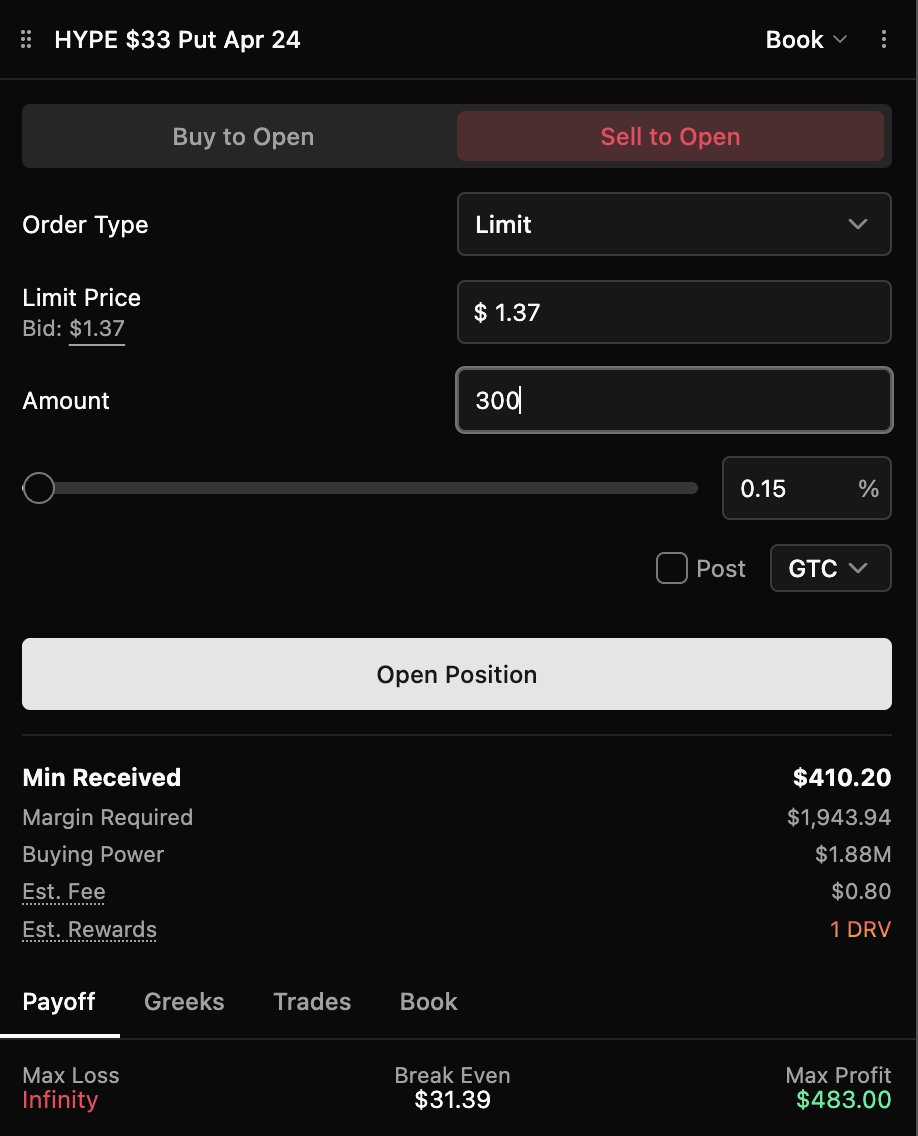
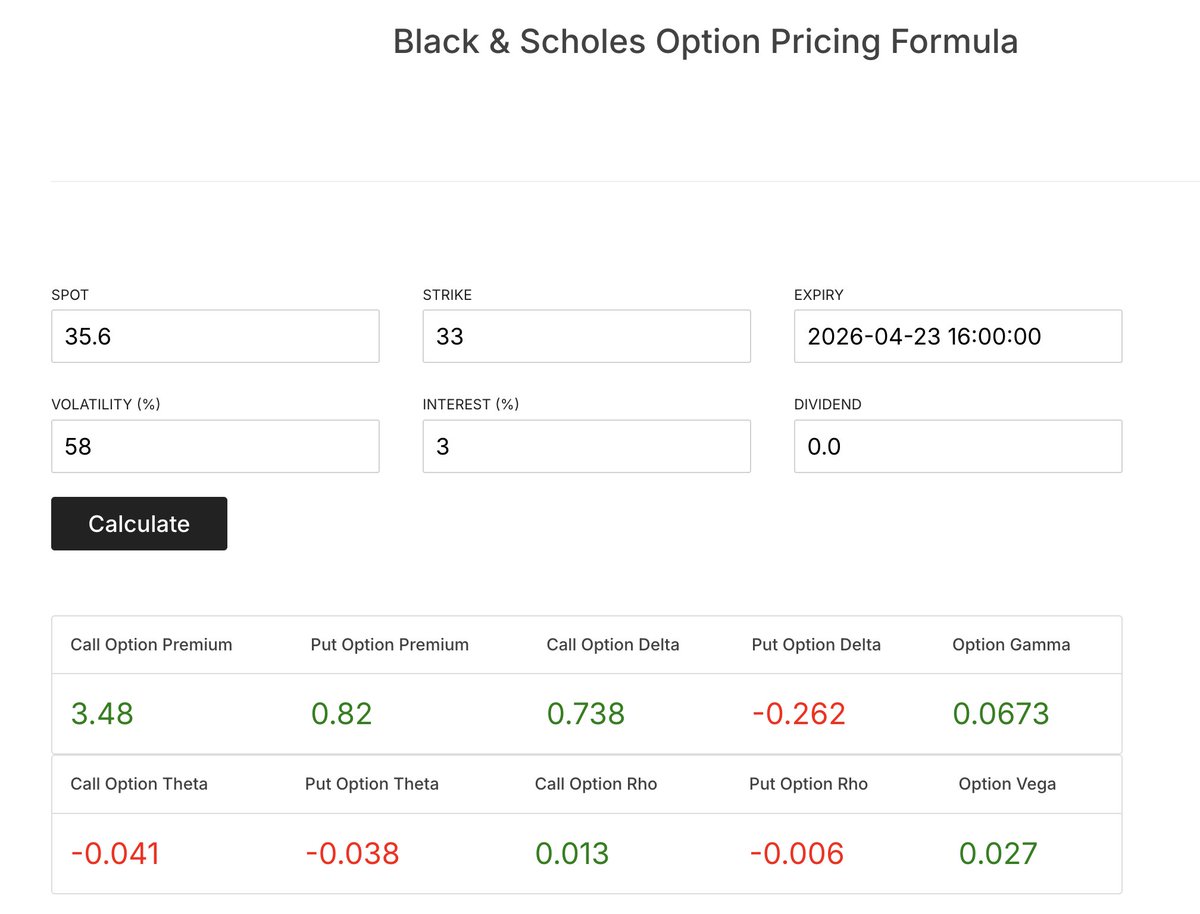
To sell 300 $33 $HYPE April 24 puts, Rysk is paying you $242, or $0.81 per.
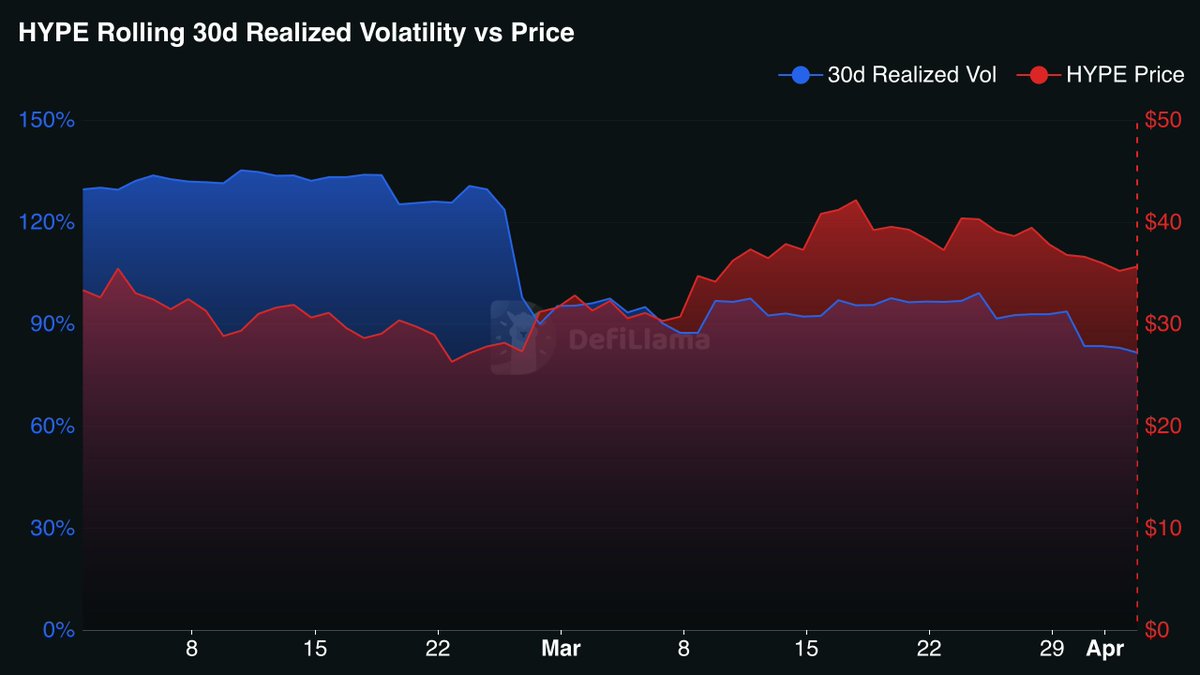
$HYPE has a 30d realized volatility of 82%. Plugging the Rysk premium offered into Black Scholes options pricing, they are paying you as if $HYPE were a 58% implied vol asset (close to BTC). If this paragraph made no sense to you, probably don't sell options.
On @DeriveXYZ you can execute the exact same trade and get paid $410 in premium, or around 77% implied vol. You also need 1/5 the initial capital to do it.
If you are bullish $HYPE, just buy $HYPE now, or set limit orders at $33 in case we wick down there. You are not getting "paid to set limit orders" because you have none of the upside if it does wick $33 and bounce.
You're just getting farmed for selling cheap vol (usually at ~40% discount) if you use @ryskfinance.
This dude just buys 5m/15m markets at 1¢ and sits on $19.9k PnL on Polymarket
And the craziest part, his Win Rate is absolutely disgusting and insanely LOW
Win Rate on 30,895 predictions: 11.4%
He trades 15 min markets on ETH, BTC, XRP and SOL
There are dozens if not hundreds of trades where he hits 9,900%
Casually turns $10 into $1000 again and again
He just understood one simple pattern:
> Losing $10 98 times, just 1 damn win covers everything
And those spikes from 1¢ happen way more than 1 out of 100
That's where the profit comes from
Absolute genius, pure cinema
His profile: https://t.co/oMReXGL3i2
You can copy him here:
https://t.co/90wrM3AUbd
@BTCadept@eulerfinance@Re7Labs This is definitely Euler's fault, regardless of how they shift their problems onto the curators. Look at how @GearboxProtocol handled this chaos and demonstrated a brilliant performance.
Please treat this as more than noise
Thanks @euler_mab for the update and for trying to reach out. That said, words matter less right now than concrete next steps we can follow as a community. A few things we (creditors / stakers / users) urgently need to see from Euler and the teams you’re trying to contact:
1. Clear timeline & outreach log. Which channels were used, when, and who at Elixir / Stream / StableLabs was contacted? Publicizing this (redacted where necessary) shows you actually tried and helps the community verify outreach efforts
2. Interim protections. If direct cooperation isn’t possible today, what temporary measures can Euler enable to reduce downside for users now?
3. Accountability mechanism for curators/issuers. Permissionless rails don’t absolve responsibility. Will Euler propose curator bonding, insurance pools, or on-chain remediation paths to prevent this repeating?
4. Concrete recovery roadmap. If the issuer teams engage, what’s the plan recapitalization, staged repayments, token swaps, escrowed settlements? Put options on the table so users can evaluate scenarios instead of guessing
5. Community escalation channel. If you can’t reach them, create an explicit ask: who in the community can legally/operationally help contact these teams? A public coordinator (or lawyer/mediator) would be helpful
6. Transparency on bad-debt accounting. Publish current bad-debt numbers, per-vault exposure, and which markets are truly isolated vs. systemically linked. Data > platitudes
We don’t want theatrics. We want a plan we can follow and audit. Silence or abstract promises leave users holding illiquid positions and magnify panic. If Euler is truly “working around the clock,” show us the work: timelines, logs, dashboards, and a list of proposed emergency actions the DAO can vote on today
Finally we need accountability. What’s the first concrete step Euler will publish in the next 24 hours?
@Banbaoe@eulerfinance Damn it, this is so funny. I avoided questionable protocols that gave 30-50% per annum to put funds into an euler at 15% per year, thinking they would be safe and reliable. But in the end, I seem to be at risk of losing it all or part of it.
🚨 DEFI’S NEW BLACK BOX: THE EULER EARN DEBT TRAP
It looked like passive income, it’s actually pooled exposure to other people’s bad bets
Euler Earn turned curated yield into a hidden debt machine, and most users still don’t realize how deep it goes
Here’s what really happens under the hood 👇
1. The nesting doll nobody explained
Euler has two layers: Earn and Vaults.
Earn looks like a safe savings product - in reality, it allocates your funds across multiple Vaults.
Each Vault is an isolated market with its own collateral logic, rate curves, and oracle setup.
So your “Earn” deposit isn’t static - it’s moving through a maze of risk profiles you never agreed to.
2. One bad Vault poisons them all
If even one Vault in an Earn strategy develops bad debt, everyone in that Earn pool gets hit.
Because liquidity is shared - your clean USDT exposure can get sucked into a toxic loan somewhere else.
When the pool balance hits zero (like Hyperithm Euler USDT / Plasma), new deposits can be drained instantly by existing debtors.
3. The hidden liquidity flow
In theory, each Vault is isolated.
In practice, Earn ties them together - your tokens become general liquidity available to all Vaults inside that Earn strategy.
You think you’re funding a solid Resolv market? Next block, your USDT0 might be pulled into a dead Re7 xUSD position.
4. The “collective risk” nobody priced in
It’s a design issue disguised as innovation.
Decentralized doesn’t mean independent - Earn’s structure makes every participant a counterparty to everyone else.
If one curator misallocates, the whole structure bleeds.
5. When things break, the wait begins
Once bad debt appears, recovery depends on rising interest and liquidation incentives.
High utilization (like 74% APR on Frontier Resolv wstUSR) pushes borrowers toward liquidation - in theory paying lenders back.
But if liquidity dries up or Plasma shuts early, the vault becomes a graveyard of unclaimed promises.
6. The lesson nobody wants to hear
Every DeFi blowup is a reminder that transparency isn’t clarity.
Smart contracts can be open-source and still hide systemic contagion in design.
DeFi doesn’t need more yield - it needs fewer black boxes pretending to be savings accounts.
🚨 EULER EARN - DEFI PARADOX STRIKES
You think your deposits are safe
They’re not - not entirely
One misallocated Vault can wipe out everyone’s returns
1. EARN VS VAULTS - HOW IT WORKS
Euler separates deposits into Earn and Vaults. Earn acts like curated Vaults: a portion of your funds is allocated across multiple Vaults by a curator.
Vaults themselves are isolated debt markets, each with its own parameters, interest curves, and collateral rules.
The hierarchy is simple but dangerous: Earn → Vaults → Markets (collateral-debt pairs). A problem at any level ripples upward.
2. THE RISK IN EARN
If your funds in Earn are allocated to a bad Vault that accumulates unrecoverable debt, all Earn participants are affected.
Even if you originally deposited into a “safe” Vault, your liquidity can be pulled into the general Earn pot and exposed to other Vaults’ risks.
For example, in Hyperithm Euler USDT (Plasma), bad xUSD debt in Re7 is already paused, but any deposit entering the common pot could be claimed by other contributors.
3. LIQUIDITY TRAPS AND RECOVERY
If there’s nothing left to withdraw from a bad Vault, the accrued interest from other Vaults may push collateral to liquidation points.
This mechanism allows lenders to recover USDT0, but it’s highly dependent on remaining liquidity and interest accumulation.
In Frontier Resolv wstUSR, 100% utilization yields 74% interest, meaning patient lenders can eventually reclaim funds - but this requires time and risk tolerance.
4. LESSONS FOR DEFI USERS
Euler highlights a critical paradox in DeFi: isolated markets may hide cross-contamination risks.
Interface simplicity can mislead: your “safe” deposit may actually be exposed to risk from other Vaults inside Earn.
Transparency, curation discipline, and monitoring are crucial - paranoia isn’t overkill when billions are at stake.
--------------------------------
Every misstep in vault allocation is a wake-up call for the industry.
DeFi protocols must become more transparent and resilient - user funds should never be unknowingly pooled into bad debt.
Euler Earn shows that even “trusted” platforms can hide hidden chains of risk, and careful allocation is the only defense.
Can someone explain why Euler is just... watching this happen?
@SiloFinance is out here LAWYERING UP to protect their lenders after Stream’s $93M rug
That’s how you show up for your community
Euler fam deserves the same
Stream blew up, froze withdrawals, left ppl hanging
Silo DAO’s fighting back collecting claims, splitting legal fees, chasing every dollar
Meanwhile, Euler’s quiet
DeFi’s supposed to be community-first, right?
Let’s see @eulerfinance action
It’s time to focus on what really matters — the lenders left hanging after Stream’s mess
Reposting @euler_mab is fun, but keeping your users is better
MegaETH sale kicks off tomorrow 🔥
Oversub mode — I’m sending all my free stables in.
Allocations will be tiny, but with premarket x5 right now, any size looks solid.
Testnet won’t bring rewards, but NFT holders get perks
If you’ve got the rabbit NFT and no liquidity min $2.6k
MegaETH raised $107M for 5% of supply 🚀FDV: $999M Price: $0.0999 Premarket: ~$0.5 (≈5x) Whale entry: $186K → ~$24K profit (~13%)
Short-term upside looks capped, but solid execution so far😁👍#MegaETH#Ethereum#L2APP
In the photo, so you know that I'm top INFL megaETH 💪
Base price: $0.0001, but with premarket 5× — everyone will likely bid $0.0999, so expect massive oversubscription.
💰 Hold for ~20 days = ~13% ROI before main listing.
I’m loading my bags here.
🗓 Key dates:
• Reg: Oct 15–27
• Sale: Oct 27–30
• Allocation calc: Oct 30–Nov 5