We wanted to thank everyone so much for supporting us in our first year being open. From amazing customers to incredible partners, we can’t wait what 2023 holds for Cryptee 💛
Happy Halloween weekend Crypto Buds... my wife surprised me with an early Halloween treat from my own Cryptee collection! If you want cool Crypto merch check out my collection at https://t.co/G3cB7iV4dd
@CrypteeClothing
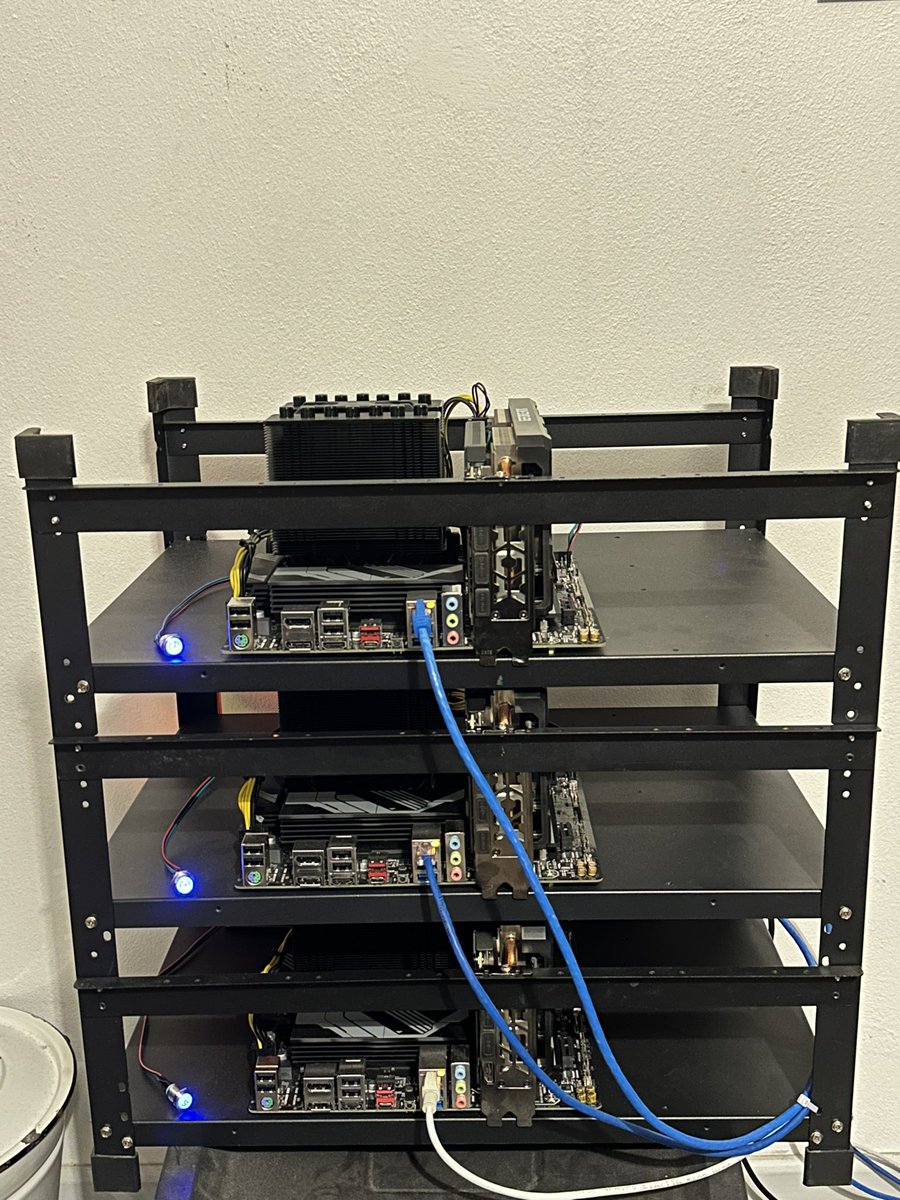
I have converted my 3x7950X CPU rigs into https://t.co/m2Kp9DgUOx machines.
So far it looks to be generating much more attractive revenue per day.
I am currently doing a 1-month trial, to measure the cumulative power consumption, to determine if it will actually be profitable.
We are accepting orders for GPU Hosting starting at .11 cents with a one time deposit! Everything stays stateside! Server case rentals available! #cryptomining#GPUMining#cryptocurrency
Crypto — First Principles
In order to craft good legislation, it is critical to understand some first principles of crypto (Digital Assets). “Crypto” as it is used here, includes #Bitcoin, #Ravencoin, Ethereum Classic, #Litecoin, and similar open-source projects. It does not include centralized entities like exchanges (Kraken, Coinbase, Binance, etc), which hold crypto for others in a custodial relationship along with off-chain credits in a database.
Crypto is a globally distributed ledger.
At its core, crypto is a globally distributed and replicated ledger. The code is able to ensure that the ledger is tamper-proof, and that every copy of the ledger is identical. Private keys are required to transfer items on the ledger.
Private keys are just large random numbers.
An “account” or ledger entry are managed by the holder(s) of a private key. Private keys are not issued by anyone. Private keys are just large random numbers. These random numbers are usually generated by a computer or a mobile phone, but can also be generated with dice or flipping a coin. There is no way to stop account generation, to prevent holding crypto, or to seize specific accounts.
Private Keys can be distributed.
Since a private key is just a very large random number, it can be split and distributed. This allows for shared ownership, or even non-ownership of a ledger entry. There are multiple technologies for this such as addition/subtraction, Shamir Secret Sharing, XOR, and Threshold Signatures.
A public address is just a transformation of a private key (random number).
The public address or “account” that is visible on the ledger is just a one-way transformation of the private key. It does not require registration. There are a near-infinite number of them, and they can be created at 0 cost.
Crypto can be obfuscated, but is generally transparent and fully public.
Bitcoin is fully transparent. The balance of every address is known. This makes it undesirable to have the addresses (“accounts”) publicly associated with personal identifiable information (name, address, etc).
Crypto is not good or bad.
Like a dollar bill, crypto can be used for licit or illicit purposes. The US Dollar bill is used for far more illicit activity and currently provides more privacy than open and transparent ledgers.
Crypto is not encrypted.
Crypto uses cryptographic primitives (code) for issuance, digital signatures, hashing, validation, etc., but generally does not use encryption. In most cases, transactions are fully public, and permanently recorded on a tamper-proof ledger.
Crypto is programmable.
This allows the new economy to be more efficient, automated, and adaptive. This opens the door for new possibilities that did not exist before 2008. DeFi is a generic term which covers using the programmability of crypto to provide financial services through decentralized code execution.
Crypto cannot be stopped.
Because of the design, which was informed by misguided attempts at stopping electronic money systems with centralized double-spend-prevention, the architecture and design is such that it cannot be turned off unless all communications (internet, phone, radio, satellite) are also stopped.
Crypto is trans-jurisdictional.
The nature of code, distributed nodes, and the resultant emergent network is such that crypto does not recognize jurisdictional boundaries. It is currently global. With the addition of interstellar communication networks, it will be universal.
Crypto is permissionless.
Anyone with a network connection may participate. Account setup consists only of creating a large random number and there are no other prerequisites to engage in crypto commerce.
Crypto can adapt.
Crypto can and will adapt to threats. These threats may come from hacks, or potentially from misguided legislation. The various crypto projects will adapt at different rates when threatened. These adaptations could include additional obfuscation, zero-knowledge proofs, ring-signatures, Mimble Wimble, Zk-SNARKs, PrivateSend, integrated CoinJoin, TapRoot, lightning layer, etc.
With a better understanding of these first principles, legislation can acknowledge its limitations, avoid silly and unenforceable language, and make better laws that benefit the specific legal jurisdiction to improve freedom of commerce.
The Audit team is expanding. Myself, @ChumpXd and now ...... @SerpentXTech who's going to start the process of auditing Contracts and deep diving Tokens
New updates to website soon to allow @SerpentXTech to post his findings. We will also open up the Suggestions area too!
After playing baseball all evening yesterday Stella and I came in to a package from @CrypteeClothing!!!
** New England Crypto / Mrs NEC branded merch =
https://t.co/Mn1eEiApOh
AS WELL AS ALL SORTS OF OTHER CRYPTO MERCH
#Crypto#NewEnglandCrypto#Thankful
Just Finished a Brand New Design to show my love for @RunOnFlux
It’s a 3080 Founders Edition with a #Flux Capacitor! My Favorite Design so far! I have it on Shirts and Posters.
Exclusively at https://t.co/9niqBLeM6z
I ship World Wide!!