Been a management consultant for 20 years.
Made Partner in my 30s.
Led teams of 100+ people.
Run 9-figure client portfolios.
Lived and worked in 4 continents.
Typically, corporate IT investment would follow a common script.
Capital spent on software means a shrinking payroll.
As boards map out their strategies for the coming quarters, they are operating under the comfortable assumption that this way of thinking still holds true for AI.
But I think a fiscal reckoning is brewing there, because within the next few quarters, the current prevailing narrative of AI as a headcount killer (which we all know is vastly exaggerated) will give way to a far more punishing reality.
Instead of a clean capital-for-labor swap, executives are about to watch their IT infrastructure costs and their personnel expenses balloon simultaneously 🚀🚀🚀
It may not be fun.
First, this whole idea that generative AI can operate autonomously will shatter as early deployments attempt to scale.
Because LLMs remain inherently prone to hallucination and error, companies cannot simply fire the analysts; they will be forced to retain them (or hire new talent) to serve as high-vigilance editors.
Furthermore, because AI makes it effortless to generate code, reports, marketing collateral, etc etc organizations will soon find themselves drowning in internal output. Managing, auditing, and securing this massive influx of AI-generated material will require an unprecedented wave of human oversight....
This will ultimately EXPAND corporate bureaucracy rather than trimming it (remember the 'Scaled Agile' saga??).
Even in scenarios where entry-level automation does succeed, the math of headcount reduction will fail to balance out on the ledger.
In the coming quarters, the wage differential of the AI era will trigger *severe* skill inflation.
Replacing 5 mid/entry-level programmers does not result in a net savings of 5 salaries. Instead, it requires hiring a premium-tier AI architect whose single salary frequently eclipses the combined wages of the workers they replaced (plus tokens cost).
Companies will trade high-volume/low-cost labor for scarce/ultra-premium talent, driving TCO UPWARD despite a leaner organizational chart on paper.
Jevons' Paradox again...
AI slashes the time and cost required to draft a legal brief, design a graphic, build a software feature, and therefore executive appetite for those outputs will skyrocket.
Management will demand 10x the volume of data analysis or continuous product iterations. Because the corporate demand for output will scale far faster than the technology's efficiency gains, departments will find themselves forced to expand their human teams just to handle the sheer velocity of these new AI-driven initiatives.
Until AI achieves absolute, unmonitored autonomy (if ever), it will function not as a replacement for human labor, but as a hyper-amplifier of it.
If ungoverned, the corporate balance sheets will show that the AI boom made running the business vastly more expensive.
Been a management consultant for 20 years.
Made Partner in my 30s.
Led teams of 100+ people.
Run 9-figure client portfolios.
Lived and worked in 4 continents.
Typically, corporate IT investment would follow a common script.
Capital spent on software means a shrinking payroll.
As boards map out their strategies for the coming quarters, they are operating under the comfortable assumption that this way of thinking still holds true for AI.
But I think a fiscal reckoning is brewing there, because within the next few quarters, the current prevailing narrative of AI as a headcount killer (which we all know is vastly exaggerated) will give way to a far more punishing reality.
Instead of a clean capital-for-labor swap, executives are about to watch their IT infrastructure costs and their personnel expenses balloon simultaneously 🚀🚀🚀
It may not be fun.
First, this whole idea that generative AI can operate autonomously will shatter as early deployments attempt to scale.
Because LLMs remain inherently prone to hallucination and error, companies cannot simply fire the analysts; they will be forced to retain them (or hire new talent) to serve as high-vigilance editors.
Furthermore, because AI makes it effortless to generate code, reports, marketing collateral, etc etc organizations will soon find themselves drowning in internal output. Managing, auditing, and securing this massive influx of AI-generated material will require an unprecedented wave of human oversight....
This will ultimately EXPAND corporate bureaucracy rather than trimming it (remember the 'Scaled Agile' saga??).
Even in scenarios where entry-level automation does succeed, the math of headcount reduction will fail to balance out on the ledger.
In the coming quarters, the wage differential of the AI era will trigger *severe* skill inflation.
Replacing 5 mid/entry-level programmers does not result in a net savings of 5 salaries. Instead, it requires hiring a premium-tier AI architect whose single salary frequently eclipses the combined wages of the workers they replaced (plus tokens cost).
Companies will trade high-volume/low-cost labor for scarce/ultra-premium talent, driving TCO UPWARD despite a leaner organizational chart on paper.
Jevons' Paradox again...
AI slashes the time and cost required to draft a legal brief, design a graphic, build a software feature, and therefore executive appetite for those outputs will skyrocket.
Management will demand 10x the volume of data analysis or continuous product iterations. Because the corporate demand for output will scale far faster than the technology's efficiency gains, departments will find themselves forced to expand their human teams just to handle the sheer velocity of these new AI-driven initiatives.
Until AI achieves absolute, unmonitored autonomy (if ever), it will function not as a replacement for human labor, but as a hyper-amplifier of it.
If ungoverned, the corporate balance sheets will show that the AI boom made running the business vastly more expensive.
A DEVELOPER TAUGHT GIT WITH A BOX OF CHILDREN'S TOYS AND ENGINEERS WITH TEN YEARS IN SAY IT'S THE FIRST TIME THE THING EVER ACTUALLY MADE SENSE
90 minutes, one table, a pile of Tinkertoys. No wall of jargon -- he builds a real Git repo out of plastic rods right in front of you.
-> The moment he snaps the first pieces together, Git stops being scary command-line magic and becomes what it really is: a chain of tiny objects pointing at each other.
Branches, merges, rebase, the staging area -- every concept that's ever burned you at 2am -- he rebuilds with toys until a four year old could follow. He calls Git a two-trick pony. After this you'll see exactly why.
Memorizing commands was never the skill -> holding the graph in your head is. And with an AI agent now committing and rebasing on your machine all day, that mental model is the only thing between you and a history you can't read.
Scroll the comments and you'll see the same thing over and over: this is the talk that finally made Git click and made people the one their whole team comes to when it breaks.
Bookmark & watch it today. It's the 1.5 hours that pays you back for the rest of your career ↓
A DEVELOPER TAUGHT GIT WITH A BOX OF CHILDREN'S TOYS AND ENGINEERS WITH TEN YEARS IN SAY IT'S THE FIRST TIME THE THING EVER ACTUALLY MADE SENSE
90 minutes, one table, a pile of Tinkertoys. No wall of jargon -- he builds a real Git repo out of plastic rods right in front of you.
-> The moment he snaps the first pieces together, Git stops being scary command-line magic and becomes what it really is: a chain of tiny objects pointing at each other.
Branches, merges, rebase, the staging area -- every concept that's ever burned you at 2am -- he rebuilds with toys until a four year old could follow. He calls Git a two-trick pony. After this you'll see exactly why.
Memorizing commands was never the skill -> holding the graph in your head is. And with an AI agent now committing and rebasing on your machine all day, that mental model is the only thing between you and a history you can't read.
Scroll the comments and you'll see the same thing over and over: this is the talk that finally made Git click and made people the one their whole team comes to when it breaks.
Bookmark & watch it today. It's the 1.5 hours that pays you back for the rest of your career ↓
Most people talk about Agentic AI.
Very few can actually design it.
Here’s a simple cheat sheet to design + explain Agentic AI architecture 👇
🎯 Start here ➡️ Define the goal
What exactly should the agent achieve?
1️⃣ Orchestration Layer ➡️ The control panel
Decides flow, logic, and coordination
2️⃣ Agents Layer ➡️ The workforce
Single or multi-agents handling specialized tasks
3️⃣ Tools Layer ➡️ Execution power
APIs, web search, databases, external systems
4️⃣ Memory ➡️ The brain
Short-term + long-term context storage
5️⃣ Monitoring ➡️ The eyes
Track every step, detect issues in real time
6️⃣ Reliability & Failure ➡️ The safety net
Retries, fallbacks, human-in-the-loop
7️⃣ Governance & Security ➡️ The guardrails
Auth, compliance, audit, data protection
💡 Real insight:
Agents alone don’t make systems powerful.
Architecture does.
If you can explain this simply,
you’re already ahead of 90% in AI.
❤️ Like
🔁 Retweet
🔖 Bookmark
Follow @MeenakshiYACS for more such posts
#AI #ArtificialIntelligence #GenerativeAI #CareerGrowth #Upskilling
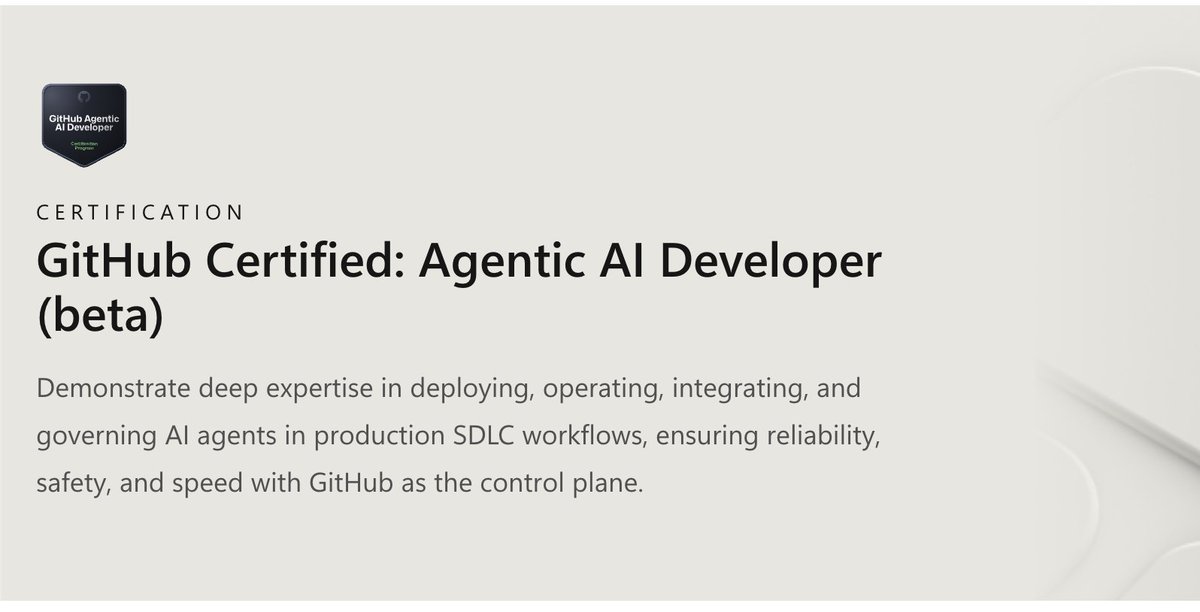
GITHUB JUST CREATED AN OFFICIAL CERTIFICATION FOR THE MOST IN-DEMAND DEVELOPER ROLE OF 2026.
It is called Agentic AI Developer.
GH-600.
And it is the first formal signal that running AI agent teams is now a recognized engineering discipline with a credential behind it.
Not a prompt engineer.
Not a vibe coder.
An Agentic AI Developer.
The person who operates, supervises, and integrates AI agents across the entire software development lifecycle.
The person who knows where agents fail in production.
The person who understands how to build autonomous workflows that do not introduce catastrophic failure modes into CI/CD pipelines.
The person every engineering team is going to need and almost none of them have right now.
GitHub certifying this role changes the hiring conversation permanently.
Before GH-600: "Do you work with AI agents?" is an interview question with no standard answer.
After GH-600: the credential tells the hiring manager exactly what you know and what you can do before the interview starts.
The engineers who get certified in the first wave of GH-600 will have a credential for a role that has more demand than supply for the next 3 to 5 years.
The engineers who wait until it is mainstream will be competing with everyone who moved first.
If you are already working with GitHub Copilot or building agent-driven workflows you are already doing this job.
GH-600 is how you prove it.
Bookmark this.
Follow @cyrilXBT for every AI certification worth your time the moment it drops.
Ali Abdaal just dropped his Claude Code workflow.
And I think this is the most beginner-friendly breakdown anyone has published.
Most Claude Code tutorials are made by engineers for engineers.
Terminal commands.
API keys.
Technical jargon that loses you in the first 60 seconds.
Ali starts from zero.
Ali Abdaal just dropped his Claude Code workflow.
And I think this is the most beginner-friendly breakdown anyone has published.
Most Claude Code tutorials are made by engineers for engineers.
Terminal commands.
API keys.
Technical jargon that loses you in the first 60 seconds.
Ali starts from zero.
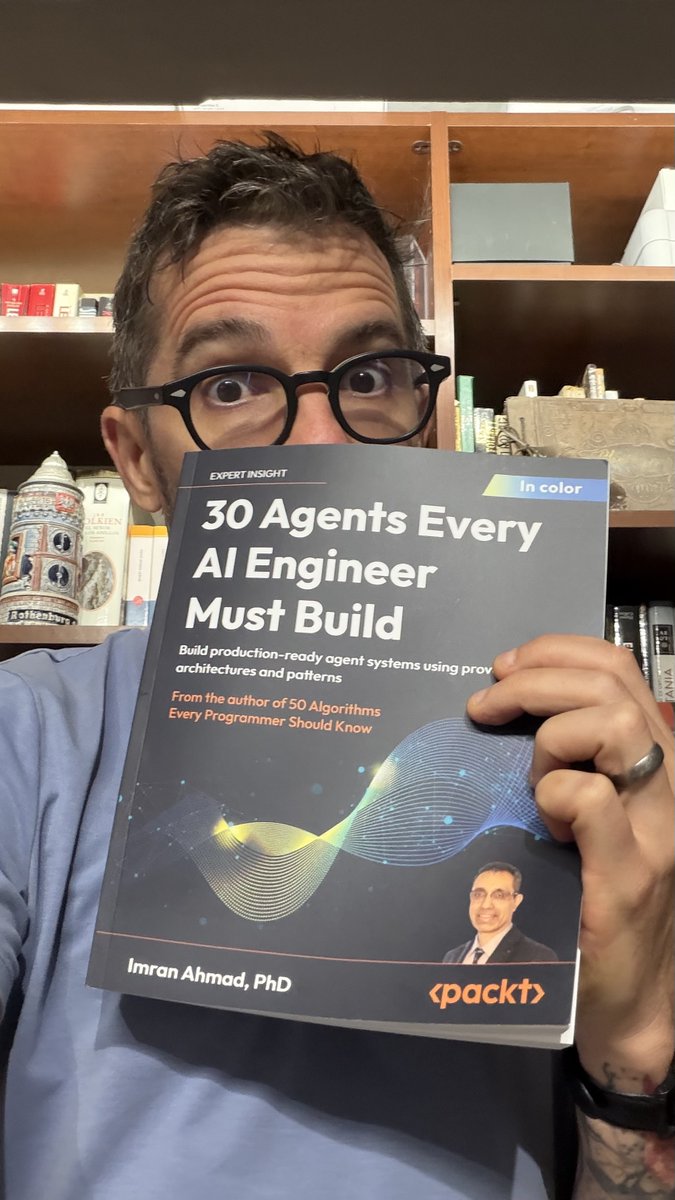
30 agents every AI Engineer must build.
This is the most comprehensive and practical book on AI Engineering that I've ever seen.
I can't think of a single use case that they didn't cover here:
1. The autonomous decision-making agent
2. The planning agent
3. The memory-augmented agent
4. The knowledge retrieval agent
5. The document intelligence agent
6. The scientific research agent
7. The tool-using agent
8. The agentic workflow system
9. The data analysis agent
10. The verification and validation agent
11. The general problem solver agent
12. The code generation agent
13. The security-hardened agent
14. The self-improving agent
15. The conversational agent
16. The content creation agent
17. The recommendation agent
18. The vision language agent
19. The audio processing agent
20. The physical world sensing agent
21. The ethical reasoning agent
22. The explainable agent
23. The healthcare intelligence agent
24. The scientific discovery agent
25. The financial advisory agent
26. The legal intelligence agent
27. The education intelligence agent
28. The collective intelligence agent
29. The embodied intelligence agent
30. The domain-transforming integration agent
I also read 50 Algorithms Every Programmer Should Know by Imran. Same vibe.
Here is the Amazon link: https://t.co/buLPqjToiu
At 26, she was diagnosed with advanced rectal cancer. Four months later, there was no detectable evidence of the disease.
Mrinali Dhembla had begun experiencing clear warning signs: rectal bleeding and persistent constipation. These symptoms led to more in-depth testing and a definitive diagnosis — stage 3 rectal cancer, with the disease already starting to spread beyond its original site.
An underlying genetic condition was also present: Lynch syndrome, which increases the risk of developing several types of cancer.
The standard approach in such cases typically involves surgery and chemotherapy. However, her medical team chose a different path.
And from that point, everything changed.
She was started on an immunotherapy regimen using two drugs: nivolumab and ipilimumab. The goal was to stimulate the immune system, encouraging it to recognize and attack cancer cells.
The treatment lasted four months.
By the end of that period, follow-up scans showed an unexpected outcome: no detectable tumor remained. Blood tests for circulating tumor DNA also came back negative.
The patient was declared to have no evidence of disease.
This case has drawn attention for the potential of immunotherapy in similar situations, particularly in patients with specific genetic profiles.
At 26, she was diagnosed with advanced rectal cancer. Four months later, there was no detectable evidence of the disease.
Mrinali Dhembla had begun experiencing clear warning signs: rectal bleeding and persistent constipation. These symptoms led to more in-depth testing and a definitive diagnosis — stage 3 rectal cancer, with the disease already starting to spread beyond its original site.
An underlying genetic condition was also present: Lynch syndrome, which increases the risk of developing several types of cancer.
The standard approach in such cases typically involves surgery and chemotherapy. However, her medical team chose a different path.
And from that point, everything changed.
She was started on an immunotherapy regimen using two drugs: nivolumab and ipilimumab. The goal was to stimulate the immune system, encouraging it to recognize and attack cancer cells.
The treatment lasted four months.
By the end of that period, follow-up scans showed an unexpected outcome: no detectable tumor remained. Blood tests for circulating tumor DNA also came back negative.
The patient was declared to have no evidence of disease.
This case has drawn attention for the potential of immunotherapy in similar situations, particularly in patients with specific genetic profiles.
ANDREJ KARPATHY COULD HAVE CHARGED $500 FOR THIS WALKTHROUGH.
He put it on YouTube.
Every way he personally uses LLMs in his own life. Thinking models. Deep research. File uploads. Python interpreter. Claude Artifacts.
Not theory. Not benchmarks.
The actual daily workflow of the person who built Tesla Autopilot and co-founded OpenAI.
2 hours walking through his personal LLM workflow.
The gap between people who watch this week and those who save it for later is not 2 hours.
It is everything those 2 hours quietly change about how you work for the rest of your career.
The hottest job for the next five years is going to be the agent operator.
They don't need to be an engineer. They can walk into marketing, legal, or life sciences research and actually make agents work for that function.
Required skills:
> MCPs
> CLIs
> Writing skills (the file kind)
> agents.md fluency
> Business acumen
None of this is in any CS curriculum today.
Soon, enterprises will be pressured to redesign their workflows for agents, not for people. And when that happens, agent operators will be in massive demand.
wake up because this is the GREATEST time in history to start a company with TRILLIONS of dollars up for grabs over the next 10 years
1. consumer mobile is INTERESTING again for the first time since like 2017. apps can actually do things now.
do things. real things. book the flight, draft the contract, follow up with the lead, negotiate the rate, do things. we went from "tap to view" to "tap to deploy." the entire interaction model of software just flipped & most people haven't even registered it yet. OH, and the cost to create these apps is 1/100th of 2017.
2. HARDWARE is back on the table because you can shove Gemma 4 or DeepSeek onto a device that costs less than dinner & it runs locally with zero cloud costs. a year ago that sentence would have sounded insane. you can ship a physical product with a real brain in it now. the last time hardware was this accessible was the early smartphone era & that created a trillion dollar app economy from scratch.
3. literally EVERY category is open to be rebuilt AI-first. the incumbents know it & they're paralyzed. they can't move fast because moving fast because incumbents move slower than you (usually). that paralysis is your opportunity. build the app. build the SaaS. build the AI agent
4. distribution is FREE. you can go from zero audience to 10,000 people who trust you in 90 days on X or YT or IG your first 100 customers are sitting in your replies right now. the old playbook of "raise money, hire sales team, buy ads" is being lapped by a solo founder with a twitter account & a working demo. Oh, and you can use AI to automate a lot of it (ideas, research, AI avatars etc)
5. Idk about you but it feels like companies are doing LAYOFFS like it's the great depression and it's only getting started. No job is secure. So, building a side project that could turn into the main project is more important than ever.
6. the ENTIRE economy is being repriced in real time. the surface area for new companies has never been wider. the tools to build are free. the models are open source. the incumbents are running committees about their "AI strategy" while you could have already shipped.
and somehow the predominant response from most people is to watch youtube videos about it & go back to their 9-5.
not saying this is easy
not saying everyone will win
but im saying right now is a time worth trying
YOU ARE LIVING through a mass reshuffling of who owns what & who builds what. the last time this happened was the internet itself. before that, electricity.
this almost never happens.
& you're sitting there doing nothing about it?
wake up.
There’s $1T up for grabs for agent-first startups and this window is WIDE open. Probably 10,000+ niches.
How it plays out:
1. Every SaaS company follows salesforce and goes headless within 18 months
2. a new category of "agent-native" startups emerges that treat salesforce, HubSpot, workday etc as dumb backends. the startup IS the agent. the SaaS is just the database.
3. the entire consulting/services industry around enterprise SaaS gets compressed into software. the agent replaces the implementation team.
4. outcome-based pricing becomes default. nobody pays per seat when the "seat" is an agent making 10,000 API calls a minute. you pay when revenue hits your account.
5. the winning founders are ex-operators who understand a vertical workflow cold. the code is the easy part. knowing that a property manager spends 14 hours a week on lease renewals? that's the insight worth $100M.
6. distribution becomes the moat. when anyone can wire agents to APIs, the company with the audience and the brand wins. media + agents is the new SaaS. There’s a rush to incubate live/short form shows.
7. Silicon Valley goes all influencer. Roy lee gets this. Pat Walls gets this. Sam Parr gets this.
8. the first $1B agent-native company in each vertical will look nothing like the SaaS it replaced. smaller team, higher margins, no implementation cost, no churn from bad UX because there is no UX.
the fastest path to wealth right now: find an industry that still runs on dashboards, phone calls, and spreadsheets. build the agent-native version. charge per outcome. own the workflow end-to-end.
someone reading this right now is going to build a $100M company off this exact shift. tell me about it on the @startupideaspod when you do. Im rooting for you.
Less reading, less bookmarking, more building.
the last wave rewarded people who built pretty interfaces on top of ugly data.
I think this wave rewards people who build smart agents on top of exposed APIs.
Or who just build the APIs themselves
Here we go
Off topic but consulting firms will be a glorious example of jevons paradox.
As AI makes things cheaper + faster to build…more companies try to adopt it (and struggle/fail).
Twitter fingers claim consulting is toast, but the amount of companies needing ongoing support to implement AI is practically endless with how fast things move + change.
Nobody really has a choice either...companies need to adopt AI for survival. First-movers will need to constantly adapt to stay ahead of competition too.
I see 3 waves:
> "where do we even start with ai?"
> "can you actually implement this?"
> "can you maintain + evolve it?"
specialized skill + ai fluency + speed of adaptation = new consulting moat
I'm genuinely, and with conviction, believe this is true.
I just can't comprehend what should be happening in a person's head who doesn't see this as an obvious outcome of how LLMs work.
Sure, in some utopian AGI world that won't be true. But how are you reading all the research on using LLMs at scale and not seeing that LLMs need frameworks?