There's a big whale out there accumulating $KAS 👀
Yesterday, it moved 3.14M KAS from Gate to a private wallet, reaching a total of 1.528 BILLION tokens
That's a $60M+ bag
Major milestone for the Kaspa Privacy Initiative! 🎉
We just demonstrated autonomous recovery of native test KAS on Kaspa L1.
After physically switching off the original computer, a second machine independently found the remaining reserve, generated a fresh ZK proof and successfully withdrew the KAS on TN10.
No intervention from the original machine. No privileged withdrawal key.
This is a major step toward something essential for private KAS: being able to recover your funds even when the original infrastructure disappears.
Not a shielded pool yet, not audited, and more A1 tests remain. But a critical piece of the foundation now works!
Built in the open:
https://t.co/6iTsdtGnfE
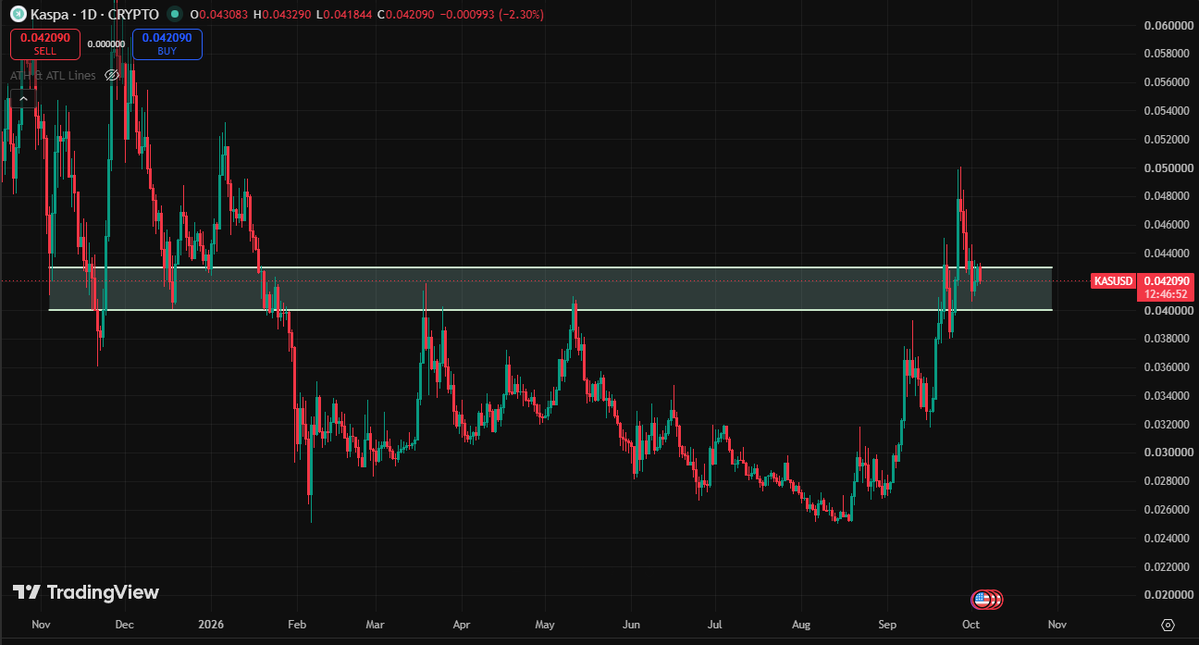
Interesting price area for $KAS 👀
We're in a very tight range between $0.042 and $0.040
If we can bounce over the 4 cents line, we should be able to push back further toward 5 and 6 cents
They don't want you to know there is a PoW out there that has an insane ceiling.
How kaspa:native retunes every 100 milliseconds
The job
Ten blocks a second only holds if difficulty moves with hashrate. If the target is stale, blocks bunch or stall. Kaspa retunes the target about every 100 milliseconds so the clock stays at 10 BPS.
Before Crescendo, the node inspected a full window of 2,641 blocks, about 44 minutes at 1 BPS, and did that work every block. At 10 BPS that window would be 26,410 blocks. Too heavy.
KIP-4 switched to a sampled window. Same 2,641 seconds of history. Blocks sampled about every 4 seconds by DAA score. About 661 samples. Same duration. Less work per block.
The miner writes bits and daaScore. bits is the compact target. daaScore is the network’s second-counter for monetary months and for the sample window. Nodes recompute both. They do not trust the miner.
Why it matters: Emission is per second. Difficulty is per second. Block rate can change without rewriting money. Crescendo multiplied blocks by 10 and divided per-block subsidy by 10. The DAA kept the same wall-clock window.
So, kaspa:native does not wait a week to notice hashrate.
It samples the last 2,641 seconds, every tenth of a second, and keeps 10 BPS as a rule. Consistency.
I may have found my next rabbit hole:
Optional privacy for native KAS.
No new token. No custodian. Just exploring whether a trustless shielded KAS protocol can be built on Kaspa.
More soon. 👀
toccata added a native ZK proof verifier to kaspa’s L1.
an app can do expensive calculations off-chain, then submit a proof that it followed the programmed rules.
a covenant checks the proof and makes sure the transaction applies the proven result.
kaspa calls this inline ZK.
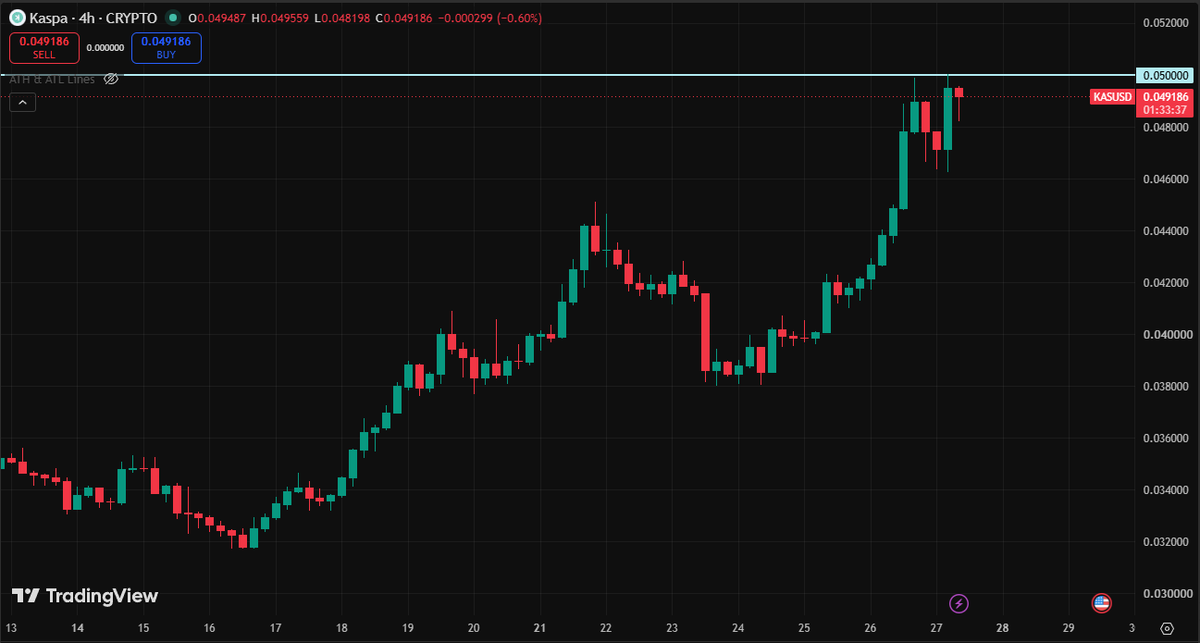
Gm to all $KAS bulls
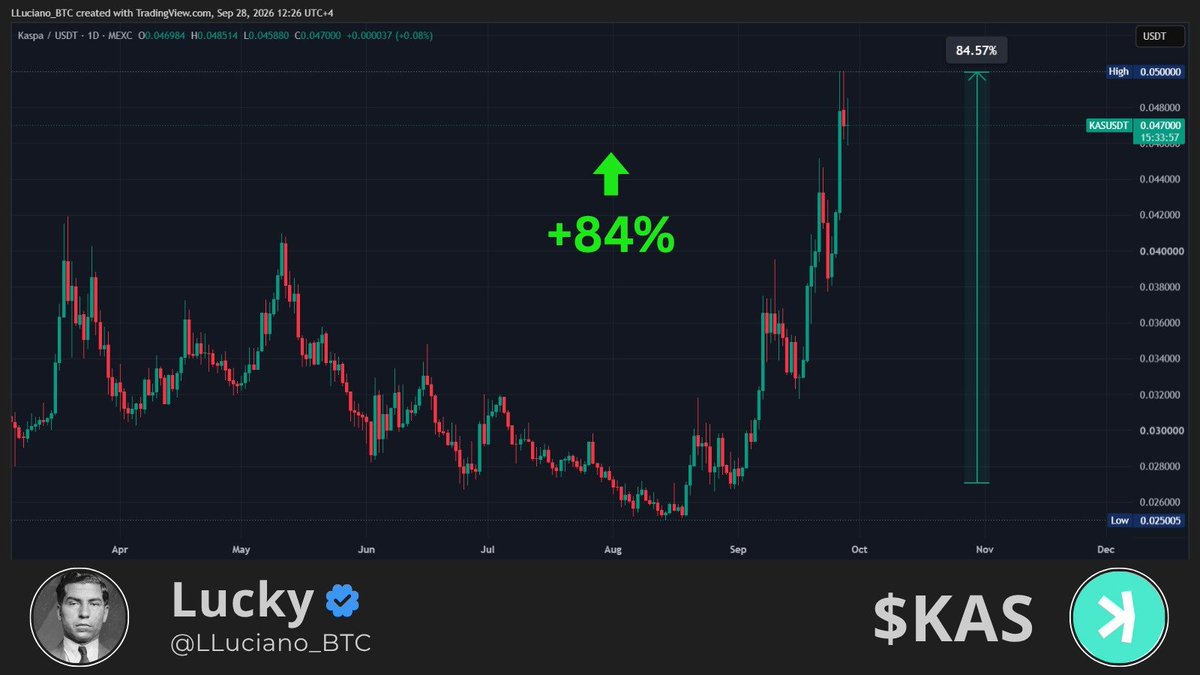
We just briefly touched the $0.05 line 🐂
Absolute bullish day for a bag that I've been accumulating for months
Good to see it finally rise, the fun has just begun
So, kaspa:native is trending again, but what is it?
🧵What if PoW could be fast?
That’s where Kaspa (kaspa:native) comes in. Instead of using a traditional linear blockchain, Kaspa uses a blockDAG architecture.
Here’s why that matters 👇
Traditional blockchains process blocks one after another:
Block → Block → Block
Kaspa allows multiple blocks to be created and processed in parallel.
That’s the core idea behind its GHOSTDAG protocol. Resulting in:
⚡ Faster block production\
⚡ Higher throughput\
⚡ Efficient PoW consensus\
⚡ Scalability without abandoning Proof-of-Work
Kaspa uses kHeavyHash for mining and keeps Proof-of-Work at the center of its security model. So it’s not simply “another fast chain.” It’s experimenting with a different way to scale PoW.
The token? kaspa:native is the native coin of the network.
It’s used for transactions and fees, while miners earn KAS for helping secure the network. Kaspa also launched without a premine or hidden allocation.
The bigger idea behind Kaspa is simple: Keep the principles of PoW, but rethink the architecture. Instead of one block at a time… Think many blocks working in parallel.
hello again. the devs made things this week and i made a list.
1 / Rusty Kaspa v2.1.0
nodes now download sync data in smaller chunks to avoid bottlenecks and timeouts while catching up with the network. v2.1.0 also includes Stratum bridge fixes and moves the existing zero-knowledge proof tools into their own package.
https://t.co/WzHdJGh4qo
2 / vProgs
@Max143672 announced the first vProg running on testnet. it’s a playable tic-tac-toe game with real execution and settlement. still a working proof of concept, with public code for devs to build from.
https://t.co/P9wYRkkcMx
3 / Python SDK
@smartgoo_ released Python SDK v2.1.0. devs can now compile SilverScript contracts in Python and debug them without running a node. it also adds tools for using zero-knowledge proofs, examples and bug fixes. SilverScript support is still experimental.
https://t.co/yYkw11hhop
4 / SilverScript Studio
@KasperoLabs announced SilverScript Studio is live on mainnet. build, compile and deploy covenants from your browser. write them yourself, describe what you want to its AI, or use the wizards for things like vaults, escrow, recurring payments and payroll.
https://t.co/pXKUP3Ob4l
5 / KCC23
@manyfest_ explained a proposal for linking details like token names, symbols and images to a covenant, without copying them into every holder’s coins. KCC23 is still a draft and open for review.
https://t.co/Tk4rGZxJjN
6 / KCC standards
@asaefstroem’s proposal to finalize KCC0 was merged. it sets out how shared ecosystem conventions are proposed and reviewed. he also proposed moving KCC20 into last call review. that hasn’t merged, so KCC20 is still a draft.
https://t.co/48shGa9eNJ https://t.co/u1SKQvgPOk
7 / DNS seeder
@supertypo_kas released DNS seeder v0.9.6, fixing a bug that counted some offline nodes as online.
https://t.co/2MvdLFDHF9
thanks to everyone building. see you next week.