Claude controlling tradingview live — switching symbols, writing Pine Script, batch scanning futures, replay trading, drawing levels. All from the terminal.
Still rough edges but the vision is clear.
You only need Claude + laptop + 1 hour/day.
Giving This Free for 24 hours. To get it:
1. Comment the word 'CLAUDE'
2. Like and Retweet this post
3. Follow me
@ZayvenKnox
(so i can DM you)
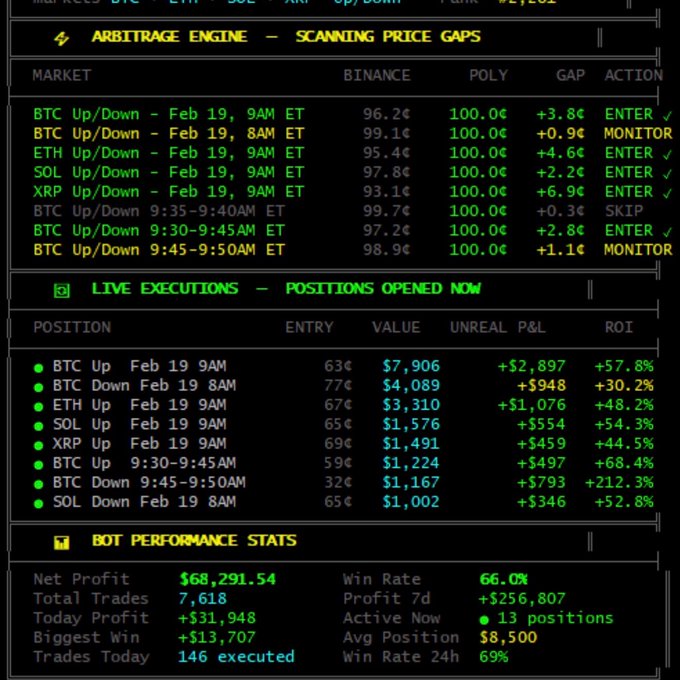
One Polymarket account turned $50 into $435,000 with OpenClaw.
It exploits price lag, executes in milliseconds, runs locally in Rust, and prints $400 to $700 a day.
I have the exact step-by-step guide, giving it free for 24 hours.
To get it:
1. Comment "Polymarket."
2. Like and Retweet
3. Follow me @Faazsh (so I can DM you)
What you will learn:
✅ How to reverse-engineer profitable trading bots
✅ Using AI to build Rust bots in under 1 hour
✅ Exploiting price lag across exchanges
✅ Setting up local execution for speed
✅ Complete bot deployment walkthrough
✅ Risk management and error handling
This is not a theory.
This is the exact process to replicate a proven system.
The bot runs 24/7 while you sleep and catches every opportunity.
Comment "Polymarket," and I will send you everything.
Must follow me @Faazsh to get the DM.
This trader gave Claude $44 and one question.
Not “what should I build.”
Not “how do bots work.”
He asked: what’s the easiest way to consistently extract money from short-term mispricing.
No lecture. No disclaimer. No theory.
It said: find small windows where the market is off by a few percent.
Quietly. Repeatedly. At scale.
Then it dropped a wallet.
stargate5
$165,618 profit
16,279 trades
Joined November 2025
He almost skipped it.
Then he opened the activity.
No predictions. No narratives.
Just micro trades on 5–15 minute windows.
Over and over and over.
Tiny edges. Constant flow.
The entire strategy:
scan for mispricing above ~6%
enter instantly
redeem at $1
repeat.
He asked Claude how this keeps working.
It said: you don’t need big wins.
You need a small edge
executed thousands of times
at near-even conditions.
Volume handles the rest.
He asked: what kind of capital this started with.
Claude: based on sizing — probably under $1,000.
Compounding did the rest.
He went through the trades manually.
Same pattern every time:
short window
mispriced odds
fast execution
instant settlement
No randomness.
No luck.
The same edge, repeated 16,279 times
until it turned into $165K.
He asked Claude one last thing.
What do you call this strategy?
It said: capturing the gap between panic pricing
and actual probability
on repeat.
At scale, that gap becomes income.
Still running.
You only need Claude + laptop + 1 hour/day.
Giving This Free for 24 hours. To get it:
1. Comment the word 'Trade'
2. Like and Retweet this post
3. Follow me @hasan28d (so i can DM you)
This is central banking in a nutshell:
A group of rich guys go to the king and say: "Hey, you need money for your war. We'll give you all the money you want."
The king says: "Great, where's the money?"
They say: "We're going to make it up. We'll write numbers in a book and that's your money now."
The king says: "What do I owe you?"
They say: "You pay us back with interest."
The king says: "Where do I get that money?"
They say: "You tax your citizens."
The king says: "What if I can't pay it all back?"
They say: "That's fine. We'll lend you more. Same deal."
The king says: "And what do you do with the IOUs I gave you?"
They say: "We use them to prove we have money, so we can lend even more money to other people and charge them interest too."
The king says: "So you made up money, lent it to me, I tax my people to pay you back, and then you use my debt to make up even more money and lend it to everyone else?"
They say: "Yes."
The king says: "What did it cost you?"
They say: "Nothing."
That's literally how the Bank of England started in 1694. The Bank was formed to finance King William's war with France. The king gave the Bank a charter, granting it a monopoly on money.
The king could have as much money as he wanted. The bankers could always earn interest. Taxpayers covered the bill.
Now replace "king" with "United States Government" and you have the Federal Reserve in 1913. Same story, different country.
It doesn't end there.
185 central banks exist in the world today.
Across the globe, the governments get as much money as they want, the bankers load their pockets with interest, and the taxpayers pay for it all.
Oh, and if you don't pay your taxes, they'll fine you, penalize you, or throw you in jail.
The ONLY way out of this is to STOP USING THEIR MONEY.
As long as you're using the money that central banks control, the central banks will have control.
You have to stop giving them energy.
Use a different form of money that they can't control.
This is why Satoshi Nakamoto created Bitcoin.