How Do Crypto Projects Actually Create Value for Their Tokens?
A crypto project can generate millions in revenue, attract thousands of users, and grow its ecosystem. But does that automatically make its token valuable?
Not necessarily.
A token needs a mechanism that connects the project's activity to demand or economic value for the token.
Here are four important mechanisms:
1. Fee Sharing & Burns
Some protocols use a portion of their fees to distribute value to eligible holders or burn tokens, reducing circulating supply.
2. Buybacks
Projects may use protocol revenue or treasury funds to purchase their own tokens from the open market.
3. Utility
Tokens can be required for transaction fees, payments, collateral, access to services, or participation within an ecosystem.
4. Staking
Users lock or delegate tokens to help secure a network and may receive rewards in return.
But here's what investors often overlook:
- Not every mechanism creates the same kind of value.
- Token burns do not guarantee price appreciation.
- Buybacks depend on sustainable revenue and execution.
- Utility only matters when there is genuine demand.
- Staking rewards may come from inflation rather than actual revenue.
- Governance rights alone do not guarantee a claim on project earnings.
Before evaluating a token, ask three questions:
1. Where does the project's revenue come from?
2. How does that revenue benefit the token?
3. Is the mechanism sustainable without relying on new buyers?
The real question isn't just whether a project is growing.
It's whether its token captures any of that growth.
Follow @CryptoClashers for research-backed crypto and Web3 insights beyond the hype.
Binance just got hit. Should you panic? Here is what is actually confirmed so far.
• Outflows: on-chain trackers reported up to $5.8B leaving Binance hot wallets on Oct 29. Estimates range from about $2B to $6.3B, and the final loss is not confirmed.
• Frozen: over $2.5B has been frozen, including more than $1.5B of USDT by Tether. Circle also froze USDC.
• Binance's response: withdrawals are paused. Binance says user funds are safe and it will cover losses from its SAFU fund and company funds.
• Timeline: co-CEO Yi He said withdrawals are expected to resume within 48 hours.
• SAFU: reports put the fund at about $1B in bitcoin. CZ said losses might run a bit higher than $1B, but Binance will cover them.
What is still unknown: the cause, the final loss size and whether SAFU plus company funds cover it. There are no audited figures yet.
This is not the FTX story. FTX misused customer funds, while here reports describe an outside attacker draining hot wallets. But "safe" is Binance's claim until the numbers are confirmed.
Verify from official sources, not screenshots, and know how much of your crypto sits on one exchange.
What is your plan if an exchange pauses withdrawals? Reply and tell us.
🤝 Follow @CryptoClashers for crypto news beyond the hype, and repost this to help someone who is panicking.
Educational content, not financial advice. Facts as of Oct 30, 2026.
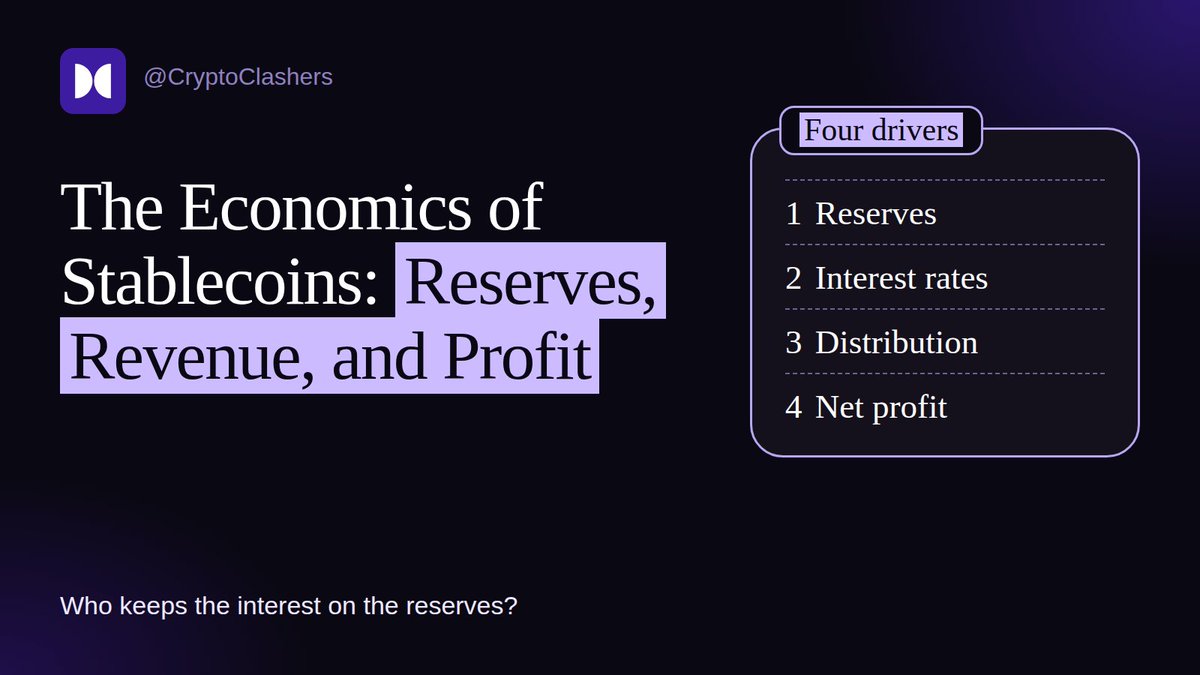
How do stablecoin issuers make money, and who keeps it?
A stablecoin is backed by reserves, and those reserves earn interest. Here is how the economics work.
• Reserves: issuers hold mostly short-term US Treasuries and cash against each token.
• Revenue: that interest is the main income. At Circle, reserve income was 94.6% of first-half 2026 revenue.
• Distribution: about 59¢ of each revenue dollar went to distribution partners and transaction costs.
• Operations: roughly 34¢ more went to infrastructure, compliance and product.
• Profit: about 7¢ per dollar of revenue remained as net profit.
What the data shows: Tether reported about $1.5B in net operating profit in Q2 2026 on roughly $184.6B of USDT, mostly from Treasury interest and repo. Circle's reserve return was 3.5% in Q2, down 66 bps year over year, so lower rates cut income unless supply grows.
Before you trust a stablecoin, check what backs it, who verifies it and who keeps the interest.
Which part of this surprised you most? Reply and tell us.
🤝 Follow @CryptoClashers for crypto education beyond the hype, and repost this to help a friend who is new to stablecoins.
Educational content, not financial advice.