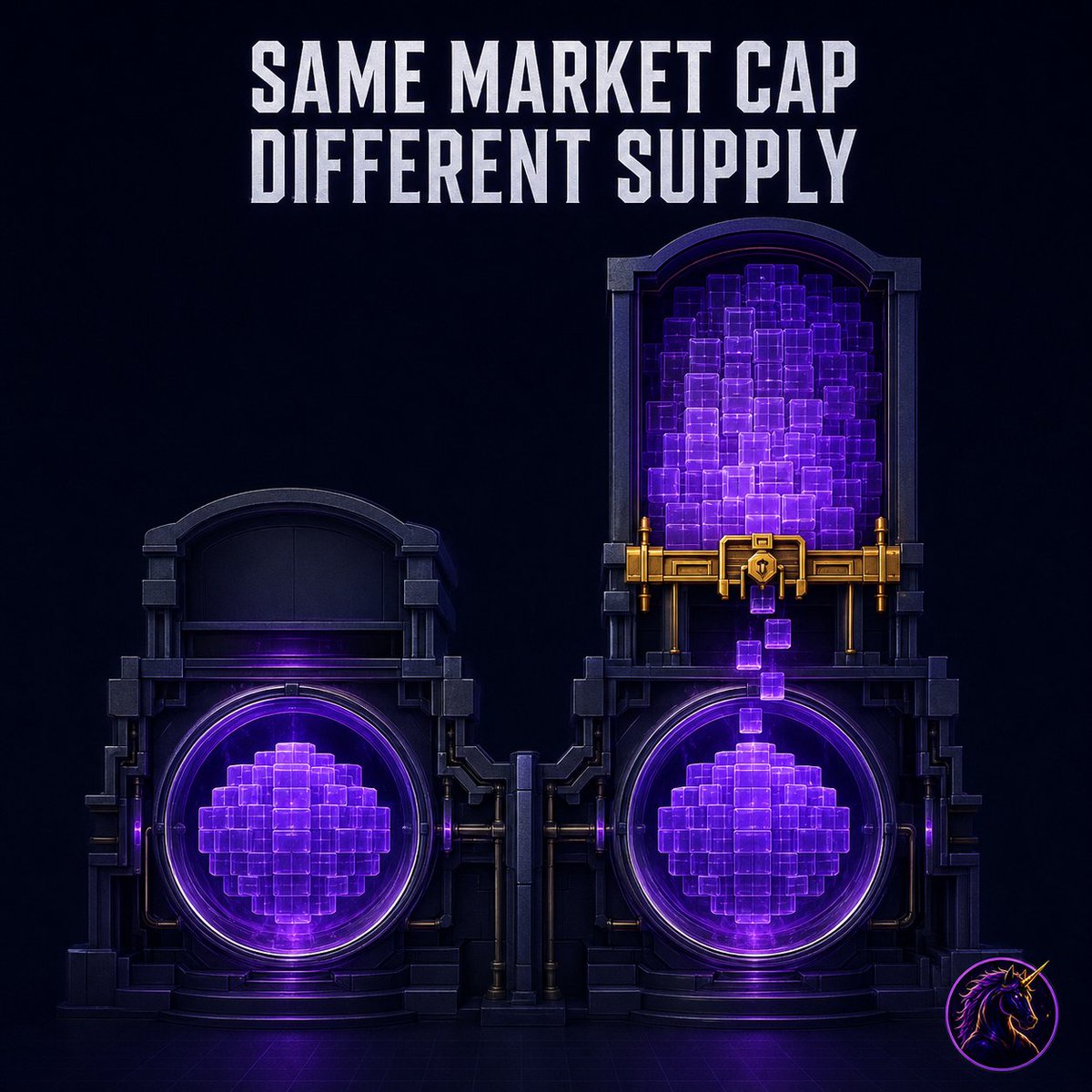
Two tokens can have the same market cap while having very different supply structures.
To see that difference, it helps to look beyond market cap and consider FDV as well.
These questions add more context:
- How much of the total supply is already circulating?
- When will new tokens enter the market?
- Under what conditions will that supply increase happen?
FDV is not a price prediction. It is a framework for understanding supply structure.
Two tokens can have the same market cap while having very different supply structures.
To see that difference, it helps to look beyond market cap and consider FDV as well.
But as more tokens enter circulation, the market needs to absorb that extra supply.
So it is not only about how many tokens will unlock. When they unlock and how liquid the market is at the time also matter.
An initial approval on a draft does not mean it is actually right.
Sometimes a second pair of eyes catches the gap that was invisible at first glance.
I think decisions work the same way.
When a dispute reaches @GenLayer, it is not decided by one AI. The network randomly selects validators, each reasoning with a different model. No one knows in advance who will judge the case, so there is no one to lobby.
When most validators reach the same conclusion, the result is accepted. But that does not make it untouchable.
If someone appeals, the case is reviewed again by a new, larger group of validators. Bad verdicts do not become easier to defend over time. They become harder to defend.
Every validator also has real value at stake. Voting correctly is rewarded, while attempts to game the system are penalized through slashing.
That is the idea behind Optimistic Democracy: decisions can move forward, but they are never beyond scrutiny.
As agents begin making agreements and payments on our behalf, trust cannot come from speed alone. It comes from knowing a decision can be tested again when it needs to be.
What matters more: getting the first decision quickly, or being able to have it reviewed when needed?
That is why “high volume” is not enough on its own.
It also helps to ask:
- Is volume consistent over time?
- How much depth sits near the price?
- How far does a larger trade move the price?
A token can have high trading volume and still be hard to buy or sell at the price you see.
Because trading volume and liquidity are not the same thing.
If there are only a few orders near the current price, even a relatively small market order can consume multiple price levels.
That is where the price on screen and the price you can actually trade at start to diverge.
That’s why asking only “How much money entered?” is not enough.
Better questions are:
• How much of the supply is actually trading?
• How deep is the liquidity?
• Is the move supported by volume?
A token’s market cap rising by $500M does not mean $500M of new money entered the market.
Market cap is calculated by multiplying the latest traded price by the circulating supply. It does not track cash inflows 1:1
This is not a fixed rule or a price prediction.
The size of the effect depends on market conditions, token use, supply structure, and liquidity.
And the same mechanism can also amplify downside moves.