Ethereum has Etherscan. Cardano has... nothing similar for smart contract verification.
This creates a trust gap. Users can't easily verify what code is actually running on-chain.
So I built plutus-scan - a proof of concept to solve this. 🧵
Someone at Thanksgiving dinner is going to ask you about Bitcoin 👀
Skip the lecture. Hand them a Keystone.
Our Black Friday Super Sale is live 🔥
20% off on everything Keystone. Ends Dec 4 ⏰
Can anyone verify that the script running on-chain actually comes from the published source code?
https://t.co/aReh0ME8Uq makes the link between source code and compiled script verifiable through reproducible compilation. Instead of relying solely on a developer's claims, users and auditors can independently check the result.
Featured in Developers Office Hours #79 with Giovanni Gargiulo @CryptoJoe101, UPLC Link allows developers to rebuild Aiken contracts from a GitHub repository, commit and compiler version, compare script hashes, and register verification records on-chain.
Applied to our Wenze escrow contract (Preprod), the build reproduced the expected hash from plutus.json.
▪️ Full experience on Cardano Forum 👇
https://t.co/tkcfEg5M3L
Open source lets us read the code. Reproducible builds let us verify it. #Aiken builders on @Cardano can start today.
📢 EASY1 Stake Pool update
To keep EASY1 running sustainably, and now that the pool has grown significantly over the past year and the fixed costs are well absorbed, on December 1st I'll raise the variable fee to 1%. The fixed fee stays at the minimum, 170 ADA per epoch.
The change takes effect from epoch 673 (10 Dec).
The estimated per epoch impact for my delegate is:
• 1k ADA → ~0.003 ADA
• 10k ADA→ ~0.03
• 100k ADA → ~0.28
• 1M → ~2.8
The impact is small and significantly contributes to teh sustainability of the pool.
Thank you all for the support since 2020 💙 #Cardano
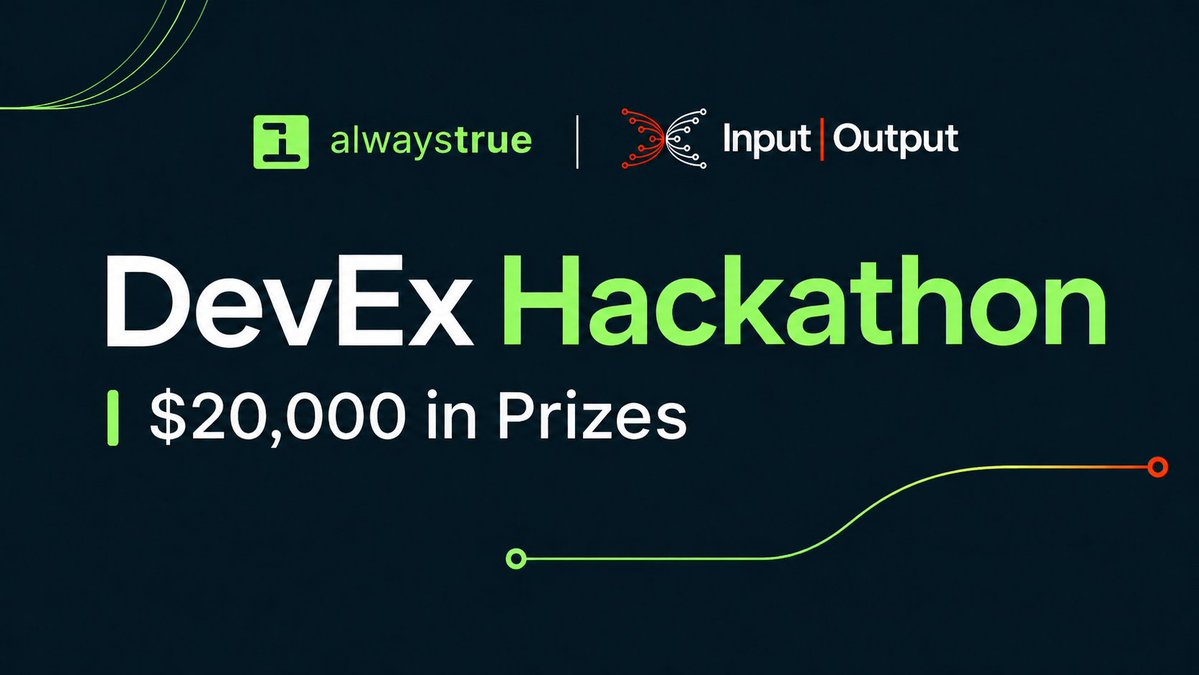
We’re looking for devs from every ecosystem, and giving them the chance to win $20,000.
Because developer experience is everything. It doesn’t matter if you write Rust, Haskell, Java or Solidity. What matters is how fast you can go from idea to something real.
And AI just raised the bar. This week, Google reported that for the first time, AI agents found and exploited software flaws on their own, with no human involved. Attackers already move at machine speed.
So the real question is: are your tools keeping up?
That’s the challenge of the Developer Experience Hackathon: put Cardano’s new developer tools, developed by @theroberm & @alwaystrueio, to the ultimate test.
Bring your skills, your team, your AI, and build something real. Tell us what works and what breaks. Your feedback will shape the tools the next wave of builders will use.
This could be @Cardano’s last competitive advantage. Today, successful companies won’t build because it’s too expensive, and won’t vibecode because it isn’t secure. When we try to onboard them, they either pass or push the costs back on us. Combine great tools with AI, and fast, secure, well-built integrations become possible.
100% virtual, open to the whole world. Spots are limited
Code. Test. Compete. And win. 🥇
ATTN: DJED & SHEN Holders
DJED and SHEN services will wind down at the end of December 31, 2026 at 11:59pm UTC. Please redeem and convert any DJED and SHEN you hold before then. All redemptions are subject to the reserve ratio.
EMURGO Academy -> CF
Project Catalyst -> CF
Cardano Research -> CF
Cardano Global Events -> CF
Intersect…
The largest and best resourced organization on Cardano -> CF
Pragmatic + Professional -> CF
Don’t watch the ball, watch were it is going.🧠
One of my 2026 goals was to learn ZK basics and explore its potential on Cardano.
That exploration led me to build ZeroJ, a growing set of ZK and privacy components in Java for Cardano L1.
Java developer or not, tutorials at https://t.co/q6PeeXxgHx can help you explore ZK apps on #Cardano
#ada #zkp
@RickMcCracken "load bearing" and "you're absolutely right" are typical AI sentences.
The second in particular pop us when a human corrects the AI after it gave him the most "confident" answer ever.
I have a major result to share.
I’ve found conclusive forensic evidence that the top 4 Chinese AI labs—DeepSeek, Moonshot, MiniMax and Ant Group—have built their newest models on NVIDIA’s most advanced Blackwell chips, which are barred from export to China.
This sounds insane, but I discovered that almost every AI model carries a hidden signature of the GPU that trained it. When a model is first set up, the starting values of its weights are laid out in a pattern that depends on the exact GPU. Each combination of GPU and seed number produces a unique pattern—a sort of fingerprint of the hardware used to create the model. Traces of that pattern survive training into the published model.
Again, this evidence isn’t based on any insider information or leaking. It’s based on a forensic analysis of the model weights released by the companies themselves.
I searched more than six trillion combinations of chip layout and seed number and matched them to open-weights models. In doing so, I found conclusive evidence that six Chinese AI models—including DeepSeek-V4-Pro, Kimi K3, and MiniMax-M3—were initialized on NVIDIA Blackwell systems. Four of the models match Grace Blackwell, the GB200 and GB300 parts in NVIDIA’s flagship liquid-cooled rack-scale systems.
I then verified these results on real hardware. Running unmodified PyTorch with the seeds I’d recovered, a Blackwell B300 reproduced DeepSeek-V4-Flash’s untouched starting weights bit for bit, and a rented GB200 reproduced Kimi K3’s to a correlation of 0.999995. A Hopper H100 reproduced none of DeepSeek-V4-Flash’s, and changing the seed by one broke the match. (DeepSeek’s seed is 953049583 by the way.) The method also was verified to match 24 known open-weights models to the hardware that developers said they used.
It is exceedingly unlikely that these results are a coincidence. Across six trillion combinations, the best accidental match should reach only about 8 sigma (i.e., eight standard deviations above what random chance would produce). The real matches range from 49 to 1,385 sigma, and even the weakest single test hits 20.
These were data-center-scale training runs. With some analysis of release schedules and model details, I estimate that the largest, Kimi K3 and DeepSeek-V4-Pro, used 2,000 to 3,000 Blackwell GPUs each. Clusters of this size cost on the order of $150 to $200 million each to buy, and across these labs alone would add up to more than half a billion dollars of export-controlled GPUs, not counting experimental compute or otherwise. It’s quite likely that we see multi-billion dollar expenditure on export-controlled GPUs.
I am highly confident in this result, and it has been independently verified by senior researchers at OpenAI and Anthropic. You can read the full report at https://t.co/YOtzND0Jqk.
There is much more I’ve identified about these models through other forms of checkpoint forensics like this, and will have more to share soon.