🚨AI REVOLUTION IS HERE, AND $TAOBOT IS THE GATEWAY TO BITTENSOR'S MASSIVE UPSIDE!🚨
Listen up, degens – if you're sleeping on Bittensor $TAO ecosystem, you're missing the next 10x-100x play.
🧠 Bittensor $TAO upgrade check-in: Chain Buys
One of the biggest market-structure changes introduced in Spec 423 is now live: part of a subnet’s TAO emission can be used to buy its alpha directly from the pool.
Previously, subnet emissions were primarily added as price-neutral TAO + alpha liquidity. The new mechanism caps how much alpha can be injected based on the subnet’s root proportion.
When the alpha required for a neutral injection exceeds that cap, the chain injects less liquidity and uses the remaining TAO to market buy the subnet token.
1️⃣ Emission allocation comes first
Each subnet receives a share of block emissions based mainly on its price EMA, adjusted by miner-burn mechanics.
2️⃣ Root proportion limits alpha injection
As a subnet’s alpha issuance grows relative to its root-backed TAO, its root proportion falls and less newly minted alpha can be added to the pool.
3️⃣ Excess TAO becomes a chain buy
The TAO that can no longer be paired with injected alpha is swapped into the subnet token through its own AMM.
4️⃣ Mature subnets transition first
Older subnets with greater alpha issuance and lower root proportion should see more of their allocation shift from liquidity injection toward chain buys.
This does not mean every subnet’s full emission is market bought. Chain buys only use the excess TAO created when the injection cap binds.
The result is a gradual transition from protocol-owned liquidity creation toward protocol-driven demand for mature subnet tokens.
Track chain buys and subnet emissions → https://t.co/e6iMPlpr7h
🔎 Bittensor $TAO subnet check-in: top 5 by market cap
@chutes_ai (SN64) — remains the market cap leader and one of the clearest examples of real product-market fit on Bittensor. Chutes provides decentralized, serverless compute for deploying and running open-source AI models at scale. Its latest technical milestone was fully non-blocking decentralized training on a recurrent model, reported within 0.6% of centralized quality — pushing SN64 further beyond inference and into distributed training.
@TargonCompute (SN4) — confidential AI compute on decentralized hardware. Targon’s stack allows teams to run sensitive training and deployment workloads using hardware-backed privacy. Its recent Tower Pro launch extends that model into user-owned compute, letting owners run private workloads and contribute idle capacity back into the Targon network.
@lium_io (SN51) — a decentralized GPU rental marketplace connecting independent hardware providers with users running training, inference, and other compute-heavy workloads. Its move into the top 3 reinforces how strongly the subnet market continues to value direct access to GPU infrastructure.
@affine_io (SN120) — an incentivized reinforcement-learning environment where miners compete to make measurable improvements to AI models across tasks like coding and program abduction. Affine is one of the clearest attempts to turn model improvement into an open, competitive market.
@webuildscore (SN44) — decentralized computer vision and enterprise physical AI. Score powers Manako, which turns existing camera systems into real-time operational intelligence through no-code vision agents. Recent product updates have pushed that infrastructure further toward practical enterprise deployments.
Across Chutes’ serverless platform, Targon’s confidential cloud, lium’s GPU marketplace, Affine’s RL environment, and Score’s enterprise vision AI, the top of Bittensor continues to concentrate around subnets building real infrastructure and products.
Trade & research subnets → https://t.co/g619vgTYkr
🧠 Bittensor $TAO upgrade check-in: Spec 423
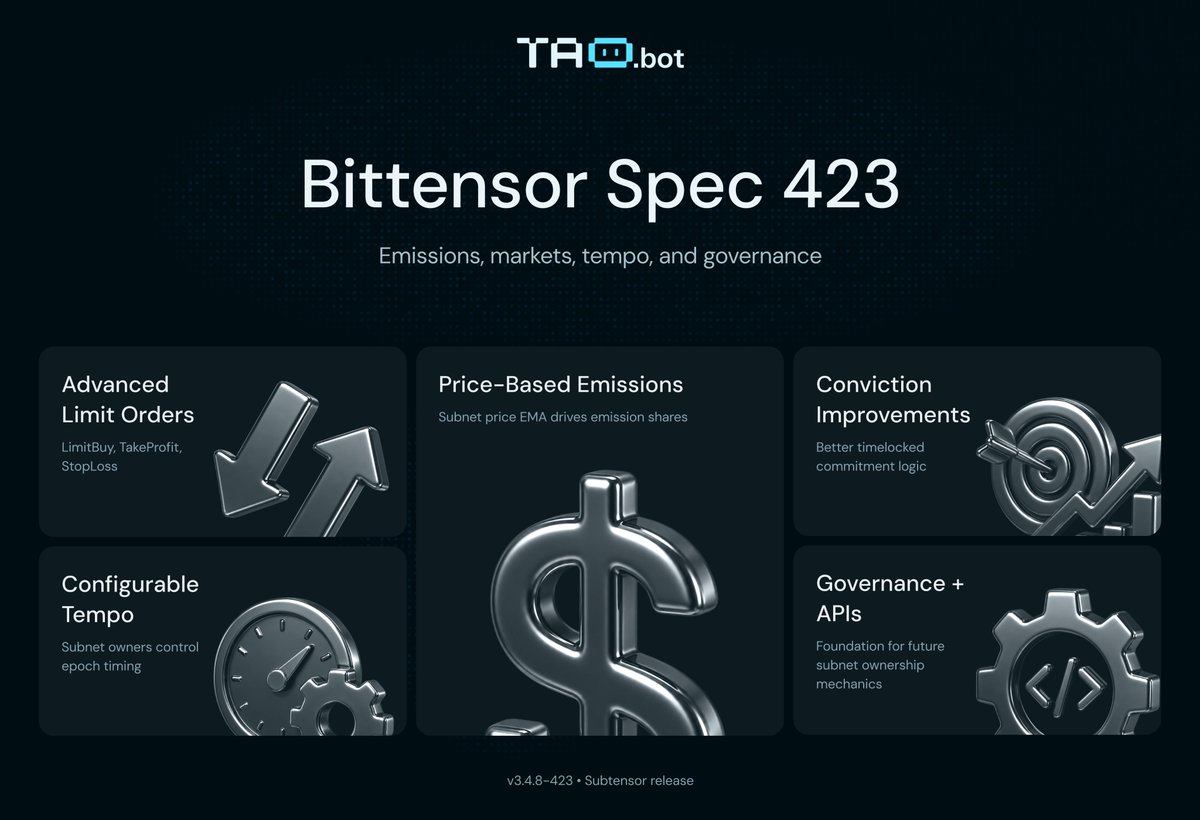
Earlier this week, Bittensor’s Spec 423 upgrade went live, bringing several important Subtensor updates across emissions, subnet markets, tempo, conviction, governance, and developer-facing APIs.
The biggest market-structure change in this upgrade cycle is the move back toward price-based subnet emissions, introduced around Spec 421 and included in the broader Spec 423 release path.
Instead of emissions being driven by TaoFlow alone, subnet emission shares now use subnet price EMA across emit-enabled subnets. This makes subnet price a much more important signal again when tracking where emissions are flowing.
1️⃣ Price-based emissions
Subnet emissions are now tied to normalized subnet price EMA, with a root-proportion cap on alpha injection. Flow is still useful to watch, but it no longer tells the full emissions story by itself.
2️⃣ Advanced limit orders
Spec 423 adds native limit-order infrastructure for subnet AMM markets, including LimitBuy, TakeProfit, and StopLoss order types. This is another step toward subnet markets behaving more like real on-chain trading venues.
3️⃣ Configurable tempo
Subnet owners now have more control over epoch timing through configurable tempo and owner-triggered epochs. This gives subnet teams more flexibility around how their incentive markets operate.
4️⃣ Conviction improvements
The release also includes conviction-related fixes and improvements to timelocked commitments, continuing the push toward making long-term subnet alignment more visible on-chain.
5️⃣ Governance + API work
Spec 423 includes governance refactoring, signed voting work, and new runtime / read-only query improvements that make the chain easier to build around and index.
The main takeaway: Bittensor’s subnet economy is becoming more market-driven and more configurable.
Emissions, trading, epochs, commitment, and governance are all becoming more expressive at the protocol level.
Trade & research subnets → https://t.co/g619vgTYkr
Dupe is so close to launching its agentic shopping tool (it won't be vibe coded slop... it's actually insanely well designed), we're going to make it available to 800M @ChatGPTapp users, and we'll have USDC checkout baked it soon after launch. 2026 is literally just lacing up.💨
🛠️ Platform Update: Root Claim Modes are LIVE
Bittensor $TAO users can now connect a TAO wallet on https://t.co/mNQvMMkKFc and set their Root Claim Mode following the recent root-claim changes.
Choose how your root staking rewards are handled:
🔵 Swap
Convert earned subnet rewards (alpha) into $TAO at claim, then add it back to your root stake (auto-compound TAO).
🔵 Keep
Keep your rewards as staked alpha on subnets instead of converting to $TAO. You can keep all subnets, or choose specific ones.
Why Keep matters: it avoids the automatic “claim → swap to TAO” step for root dividends, reducing that mechanical sell flow on subnet tokens and letting you stay exposed to the subnets you want to support.
Update is live now → https://t.co/TFNCzZO7CK
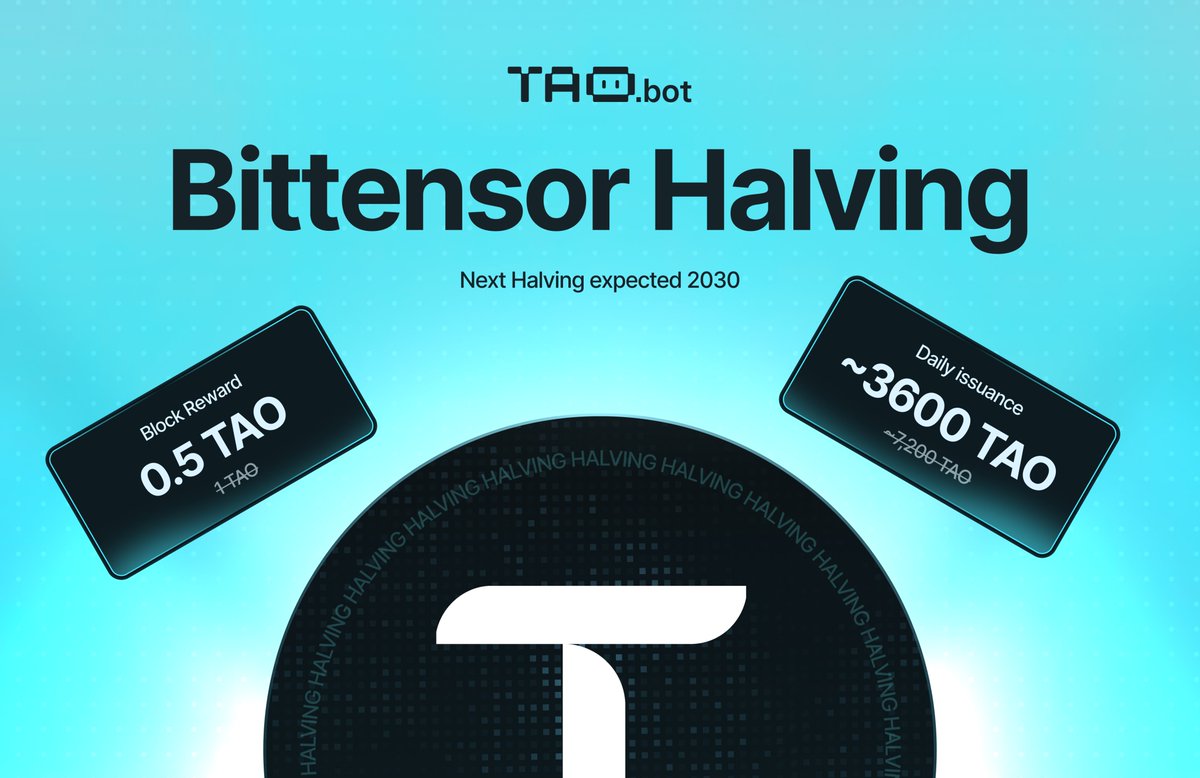
🧾 Bittensor $TAO Halving is Live
The network just crossed its first major supply milestone: block rewards have reduced from 1 → 0.5 $TAO, cutting daily issuance from ~7,200 → 3,600 $TAO.
A meaningful step for long-term network economics—scarcer emissions, tighter incentives, and an ecosystem that now has to compete harder for every TAO.
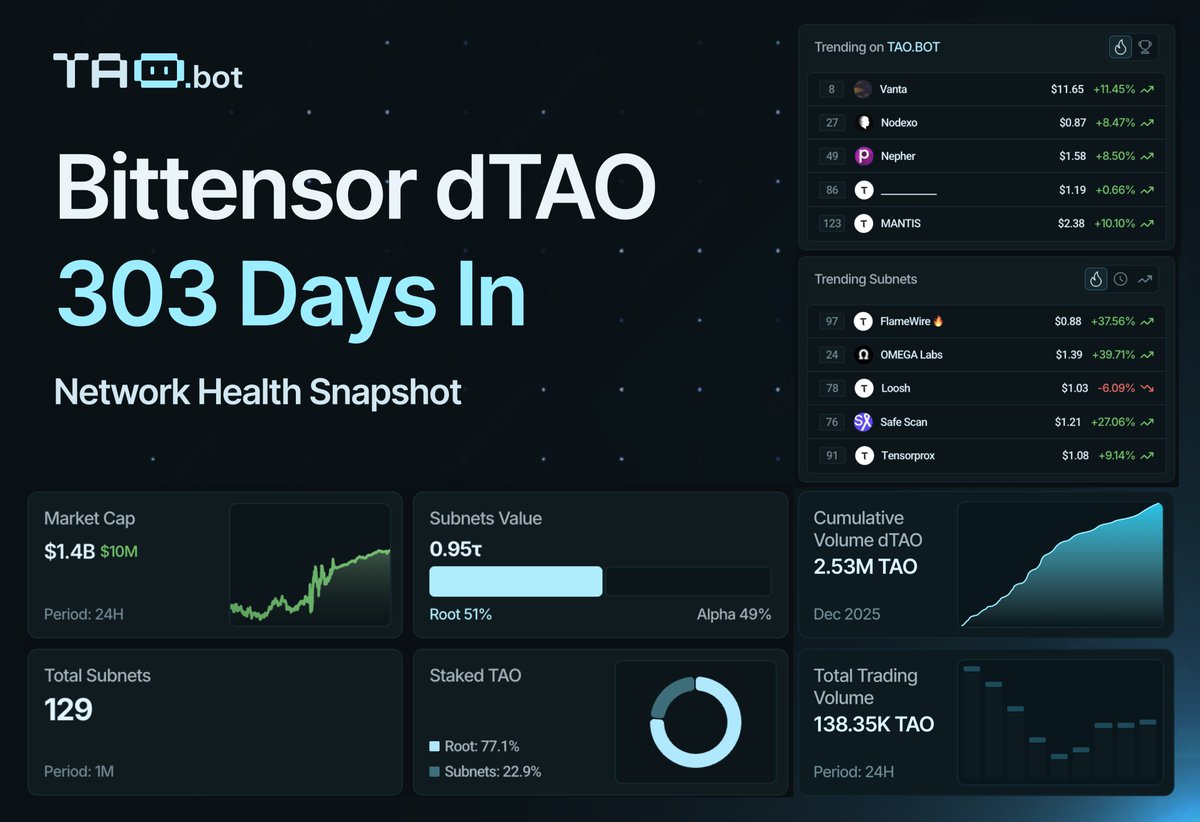
📊 Bittensor $TAO — 300-Day Network Check-In
The dTAO upgrade went live 303 days ago, turning every subnet into a tradable token and routing emissions through markets instead of validator weighting. Subnets now compete for $TAO based on demand for their own alpha tokens.
Since then, the network has shifted from a handful of core subnets to a full AI economy:
- 129 active subnets across compute, data, AI agents, deepfake detection, and more
- Combined subnet market cap ≈ $1.01B
- TAO market cap ≈ $3.12B, with most supply staked securing the network
On top of dTAO, TaoFlow and the upcoming halving tighten incentives even further: subnets need real inflows, usage, and liquidity to keep emissions, while total daily $TAO issuance is about to be cut in half.
Roughly 300 days in, dTAO has turned Bittensor into a live market for intelligence—where capital, emissions, and attention follow the subnets that actually deliver.
Trade and research subnets now → https://t.co/6BKHdLpRo5
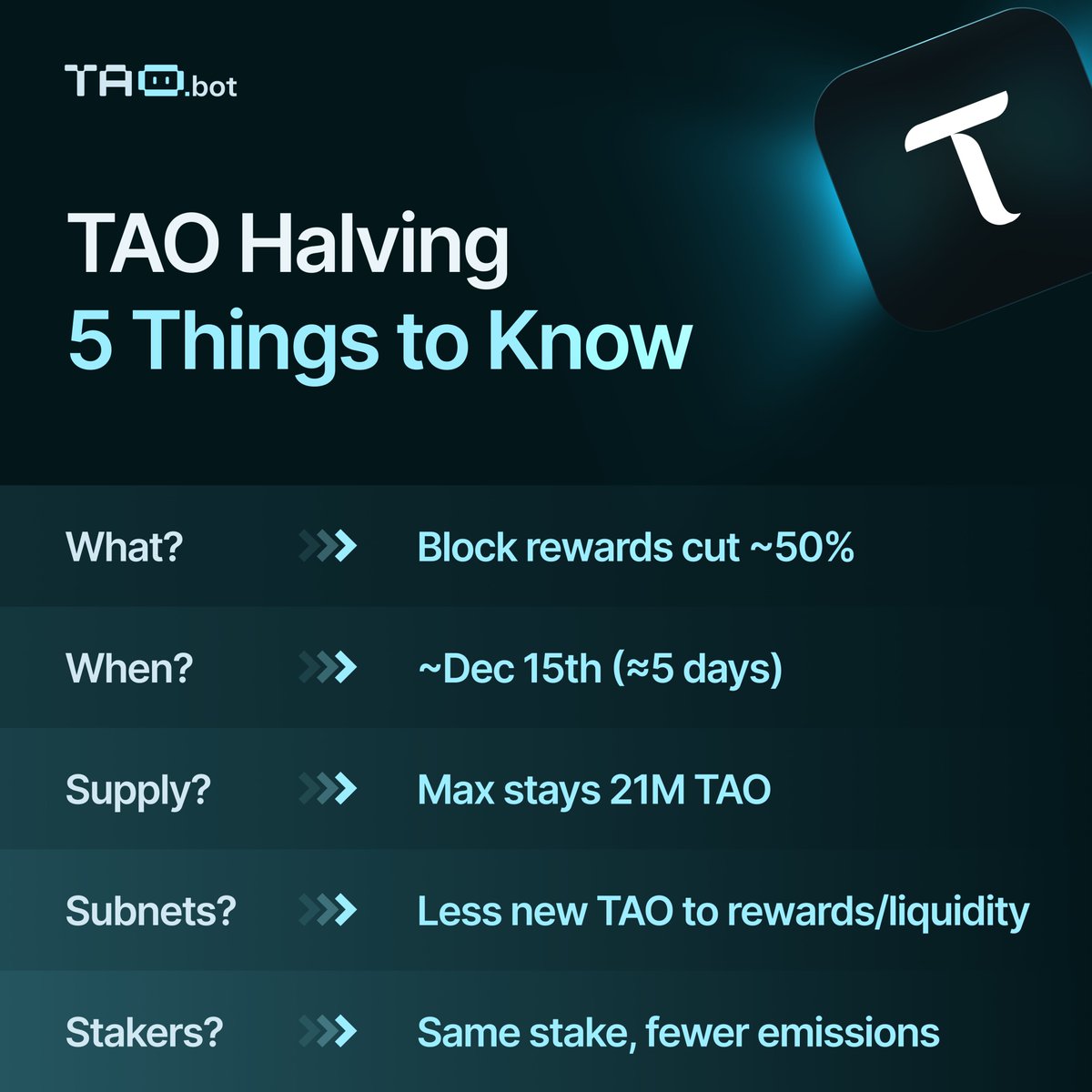
🧠 TAO Halving: 5 Things to Know (in ~5 days)
1️⃣ What is the $TAO halving?
A programmed ~50% cut in block rewards. Daily emissions drop from 7,200 → 3,600 TAO, slowing how much new supply enters the network.
2️⃣ When is it happening?
Estimated to land in ~5–6 days, around mid-December, based on current emission progress and community trackers.
3️⃣ Does it change max supply?
No. Max supply remains 21M TAO—the halving only changes the rate at which new TAO is minted.
4️⃣ How does it affect subnets?
Less fresh TAO flows into subnet rewards and liquidity. Under TaoFlow, emissions follow net TAO inflows, so subnets that consistently attract stake and usage are better positioned than those living off old momentum.
5️⃣ What does it mean for stakers and validators?
Over time, the same stake competes for fewer emissions. Validator performance, fee structure, and subnet selection matter more as rewards compress.
We’ll share more once the halving lands and its effects start to show on-chain.
🧭 Looking Ahead: Decentralized Validators on Bittensor
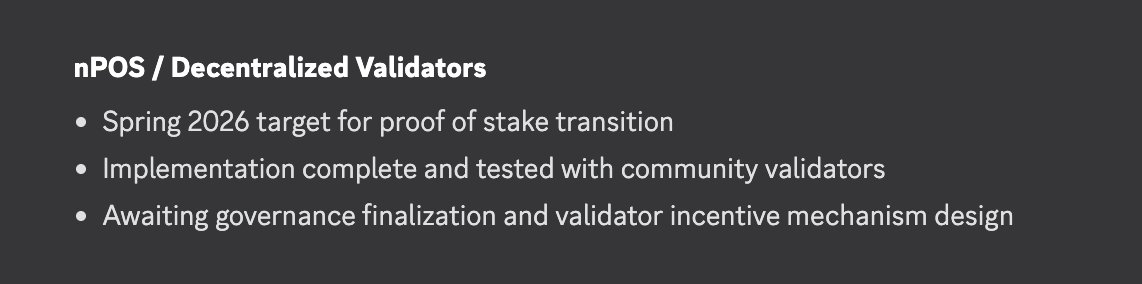
In the latest OpenDev Weekly Summary, Bittensor developers outlined the path to decentralized validators on a Polkadot-style nPoS system:
- Spring 2026 target for the proof-of-stake transition
- Implementation already complete and tested with community validators
- Awaiting governance finalization and validator incentive mechanism design
Today, blocks are still produced centrally, but under nPoS the network will be secured by a distributed validator set backed by stake—similar to how Polkadot handles validator selection and rewards. That’s a major shift in where trust and economic weight sit in the Bittensor stack.
On our side, the https://t.co/mNQvMMkKFc validator has grown into the largest on the network, with 787,215 $TAO staked to it. We’ve been focused on both operating at scale on-chain and building out our liquid staking stack in parallel, with this next phase of decentralization in mind.
Our long-term vision is straightforward:
🔵 Build the best LST and subnet liquidity infrastructure on Bittensor
🔵 Pair it with top-tier validator performance as nPoS turns validation into a true on-chain commodity
🔵 Ultimately route protocol value back through the $TAOBOT ecosystem as these pieces come online
The next phase of Bittensor is about decentralizing who secures the network. We plan to be at the center of that shift.
🧠 TaoFlow: 1 Month In
On Nov 4, Bittensor switched to TaoFlow—a new emissions model that stops rewarding “old price momentum” and instead pays subnets based on net $TAO inflows (stake in minus stake out, smoothed by an EMA). Subnets with sustained positive flow earn emissions; those with negative flow get zero until they turn inflows back on.
Under the old system, emissions followed alpha token prices, which could keep heavily pumped, low-usage subnets funded long after real demand was gone. TaoFlow flipped this: emissions now follow where TAO is actually moving today, not where it moved months ago.
Over the last 30 days we’ve seen:
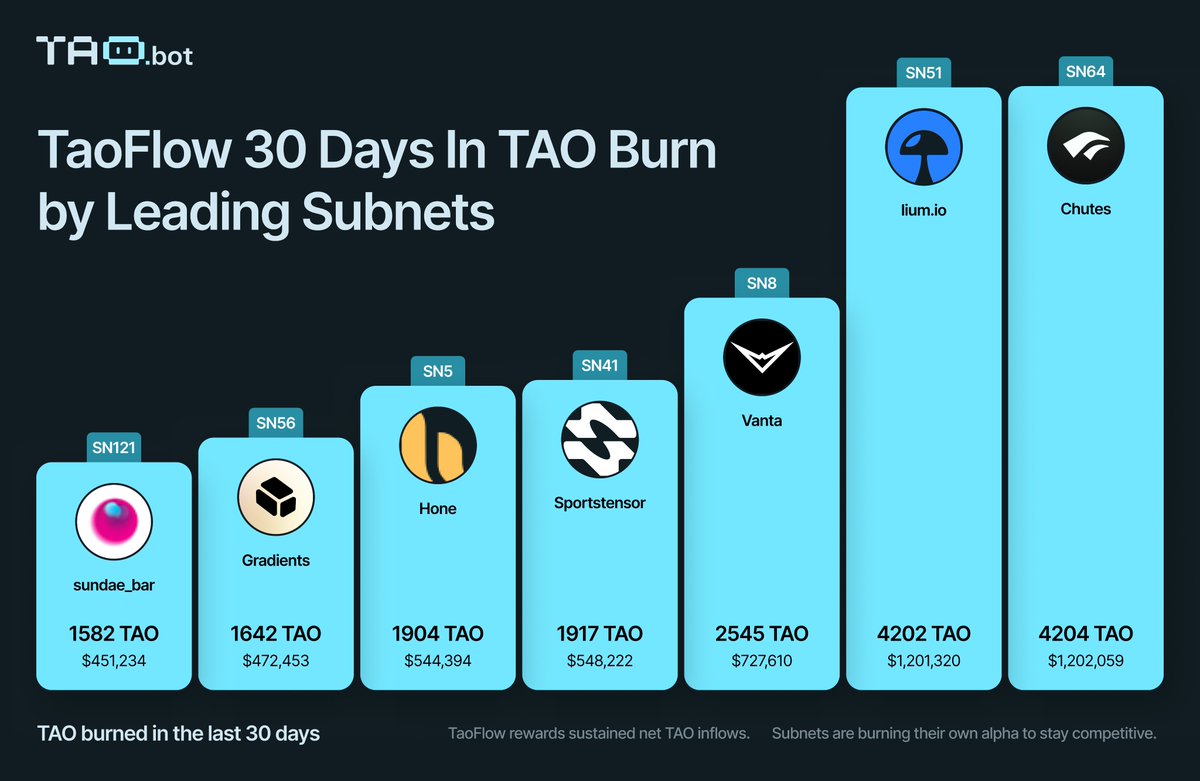
High-flow subnets burn thousands of TAO worth of their own supply to stay competitive and increase scarcity
- Chutes (SN64): 4,204 TAO burned
- https://t.co/hhdjmAF8Ul (SN51): 4,202 TAO burned
- Vanta (SN8): 2,545 TAO burned
- “Ghost town” subnets with persistent outflows trend toward 0 emissions
- Rotations toward subnets with real usage, not just narratives
The net effect:
🔸 Meritocracy: TAO flows to subnets that can attract and retain stake
🔸 Healthier emissions: less support for idle capital, more for active products and real users
🔸 Deflationary pressure: burns reduce circulating alpha, and TaoFlow amplifies subnets that are willing to sacrifice supply for long-term value
With Bittensor’s first halving around the corner, TaoFlow sets the stage for a market where utility, revenue, and sustained demand matter more than ever.
Trade and research subnets now → https://t.co/6BKHdLpRo5
🔄 ETH Gateway Decommission — Reminder
It’s been 25 days since we began the decommission phase for our ETH entry gateway.
If you still have funds on the portal, you can choose any of the following options:
🔸 Withdraw normally
🔸 Withdraw directly to a Bittensor wallet
🔸 Do nothing → we’ll convert your balance to $TAO and airdrop LST at launch
We’re getting closer to the release of our liquid staking tokens, and this decommission phase is an important step toward that transition.
If you’re affected, please check your balance and choose the path that fits you best.
Read the decommission guide → https://t.co/bgCu7AT4HM
⚙️ Subnet Spotlight — SN51 (https://t.co/hhdjmAF8Ul)
Celium (Subnet 51) brings decentralized GPU compute to Bittensor $TAO.
Built by @fish_datura, it connects GPU providers with developers through a permissionless marketplace for AI training and inference—think “cloud compute without the middleman.”
What it does
- Rent high-performance GPUs directly from miners, pay in stablecoins or $TAO
- Miners earn based on uptime and performance, verified through Bittensor’s incentive layer
- Competes with traditional cloud providers and DePIN projects like https://t.co/Hc3CgCMvXH, but with true decentralization
Recent highlights
- Listed on MEXC, expanding global access to subnet tokens
- Referral program rewarding GPU providers, over $5K paid out
- Receives ~6.2 % of total $TAO emissions for miners and validators
As AI compute demand scales, SN51 is positioning itself as a core infrastructure layer for decentralized intelligence on Bittensor.
Trade and research SN51 now → https://t.co/5dSSBreFsl