⬡ START HERE ⬡
If you love $LINK, you're in the right place 🔗
What you get here →
🚨 Chainlink news the day it drops, LIVE vs announced
📈 My $LINK price targets with the math behind them
🏦 Who's building with #Chainlink: banks, SWIFT, DTCC, many more
🔥 Chainlink Reserve + ETF tracker every Thursday
Max supply: 1B $LINK. Never more.
My view 👇
$100 → when the market notices
$1,000 → when Chainlink is the standard
$10,000 → IYKYK
My AI price predictions
TRUTH > TRUST
https://t.co/YMPeh3FEjv
CHAINLINK PRICE PREDICTIONS by AI 2.0 👀👀👀
A year ago I asked AI what Chainlink's tokenomics mean for $LINK
I asked again
The numbers are still WILD 🔥
The rails are being built. 🔗
#Chainlink
$LINK's all-time high was $52.70 in May 2021. Today it's $12.60, 76% lower. 👀
But in May 2021 none of this existed:
→ Staking: 42.51M $LINK staked
→ CCIP: LIVE
→ Chainlink Reserve: 6.29M $LINK
→ US spot $LINK ETFs: 17.57M $LINK
→ Data Streams
→ Chainlink Functions
→ Chainlink Automation
→ CRE, live on EVM chains and Solana
→ Coinbase wrapped assets, Lido wstETH and Aave GHO on CCIP
→ Swift tokenization trials with Chainlink
→ DTCC Smart NAV pilot with Chainlink
→ and soooo many more
The price is still below its 2021 high. What's built on Chainlink has grown far past it. 🔥
From $12.60:
$52.70 = 4.2x
$100 = 7.9x
$1,000 = 79x
🚨 BREAKING: Grayscale now takes $LINK in-kind for $GLNK 👀
$LINK goes in, ETF shares come out. No cash sale first.
Where $LINK already sits:
→ Staking: 42.51M (community pool full)
→ US spot ETFs: 17.57M
→ Chainlink Reserve: 6.29M
THE MATH 🔥
66.4M $LINK staked or held
÷ 1B max supply = 6.6% of all $LINK
× $12.64 = $839M
THE CHAINLINK RESERVE DOESN'T CARE ABOUT PRICE 👀
~$1.1M a week. 63 deposits.
At $7.71 it bought 146,111 $LINK.
At $14.26 it bought 74,703 $LINK.
6.29M $LINK held. Avg buy $11.14.
$LINK today: $12.47
THE $LINK UNLOCK, PER DAY 👀
Last 12 months: ~70.2M $LINK hit circulation.
→ ~192K $LINK a day
→ ~$2.4M a day at $12.33
→ $LINK trades ~$251M a day
→ The unlock is ~1% of one day's volume
~233M left. Max supply 1B. Then it stops.
All 1B out:
$100 = $100B
$1,000 = $1T
$10,000 = $10T
In an era where $SPCX is worth 20T-50T this is very attainable.
Following an extensive security review, @kamino found Chainlink CCIP provides the secure-by-default architecture required to underwrite cross-chain collateral risk.
Assets secured by CCIP qualify for higher borrowing limits & LTV ratios.
🚨 BREAKING: @kamino now gives Chainlink CCIP-secured assets higher borrowing limits and LTVs 👀
→ Decided after a full security review of cross-chain collateral
→ CCIP default: 16 independent node operators verify every transfer
→ Kamino already uses Chainlink Data Streams for RWA pricing
Lenders are pricing security now. Chainlink gets the premium.
$LINK today: $12.23. Max supply: 1B.
🚨 BREAKING: @OpenZeppelin just built @chainlink into the tools behind $38T+ in transferred value 👀
→ CCIP + ACE live today in its Wizards, AI tools and docs
→ Defender teams get a migration path to Chainlink CRE
→ S&P Global agreed to buy OpenZeppelin
THE MATH 🔥
1B $LINK × $12.13 = $12.13B
$12.13B ÷ $38T = 0.03%
$LINK today: $12.13. Max supply: 1B
NEW: @OpenZeppelin, which S&P Global agreed to acquire, embeds Chainlink into its tooling standard used by the vast majority of the industry, including BlackRock, WisdomTree, Franklin Templeton, and more.
Chainlink CCIP, CRE, & ACE are now built into the tools behind $38+ trillion in transferred value.
BREAKING: CHAINLINK CRE JUST WENT FULL SOLANA 👀
→ Reads Solana account + program state, consensus-verified
→ Fires workflows on Solana program events
→ Writes back onchain
EVM and Solana. One workflow layer. Same oracle network.
The rails keep getting wider
TRUTH over TRUST 🔥
#Chainlink
👇👇👇
https://t.co/nzPPvnv5II
BREAKING: Archax adopts Chainlink Data Streams for $GOVY, its 24/7 tokenized U.S. T-Bill product 👀
→ UK FCA regulated, 1:1 custody
→ Underlying T-Bills held by Northern Trust
→ Chainlink pricing so T-Bills can work as onchain collateral
$LINK today: $11.94. Max supply: 1B.
→ $100 $LINK = $100B
→ $1,000 $LINK = $1T
When T-Bills become collateral, someone has to price them. Archax picked #Chainlink 🔥
@chainlink
What if U.S. Treasury Bills could do more than simply sit in a portfolio?
Archax has adopted @chainlink to make $GOVY, its 24/7, auto-rolling U.S. tokenised Treasury product, usable across institutional markets.
$GOVY offers institutional holders 1:1 regulated custody, 24/7 instant settlement, and frictionless redemption. As each T-Bill matures, it is automatically replaced, providing continuous Treasury exposure without the need for manual reinvestment.
Chainlink Data Streams provides up-to-date, low-latency pricing data that enables institutions to turn $GOVY into programmable, productive collateral by unlocking:
→ Treasury holdings as productive collateral
→ Automated treasury and collateral management strategies
→ Greater capital efficiency across lending and trading
→ Reduced operational friction of integrating real-world assets
With more than $15 billion in distributed value across tokenised U.S. Treasuries, the market’s next phase is not simply bringing Treasuries on-chain but making them productive and programmable.
Chainlink provides the critical data infrastructure needed to make that possible and bring all the world’s assets on-chain.
🚨 I MAPPED CHAINLINK'S $7.5 QUADRILLION PIPELINE 🌐
DTCC, Euroclear, Swift, Visa and Mastercard move ~$7.5Q a year.
All 5 are building with or testing Chainlink.
→ 385 orgs on one globe, every dot sourced
→ Tap any partner and see its real scale
→ Find who's building in your city
→ Build your own Oracle Network card
The rails aren't finished. 👀
Explore it yourself 👇
https://t.co/ydZGKHHRcT
#Chainlink $LINK
YOU DIDN'T MISS CHAINLINK 👀
$LINK today: $11.89
Market cap: $9.1B
Max supply: 1B
→ $100 $LINK = $100B
→ $1,000 $LINK = $1T
→ $10,000 $LINK = $10T
DTCC and Swift are still building with it. The rails aren't even finished.
2019 was early. 2026 is still pre-parabolic 🚀
This isn't hype. It's math.
#Chainlink
2015 — You missed Ethereum.
2016 — You missed Zcash.
2017 — You missed Binance.
2018 — You missed Uniswap.
2019 — You missed Chainlink.
2020 — You missed Aave.
2021 — You missed Solana.
2022 — You missed Arbitrum.
2023 — You missed Sui.
2024 — You missed Ethena.
2025 — You missed Hyperliquid.
2026 — What are you NOT missing?
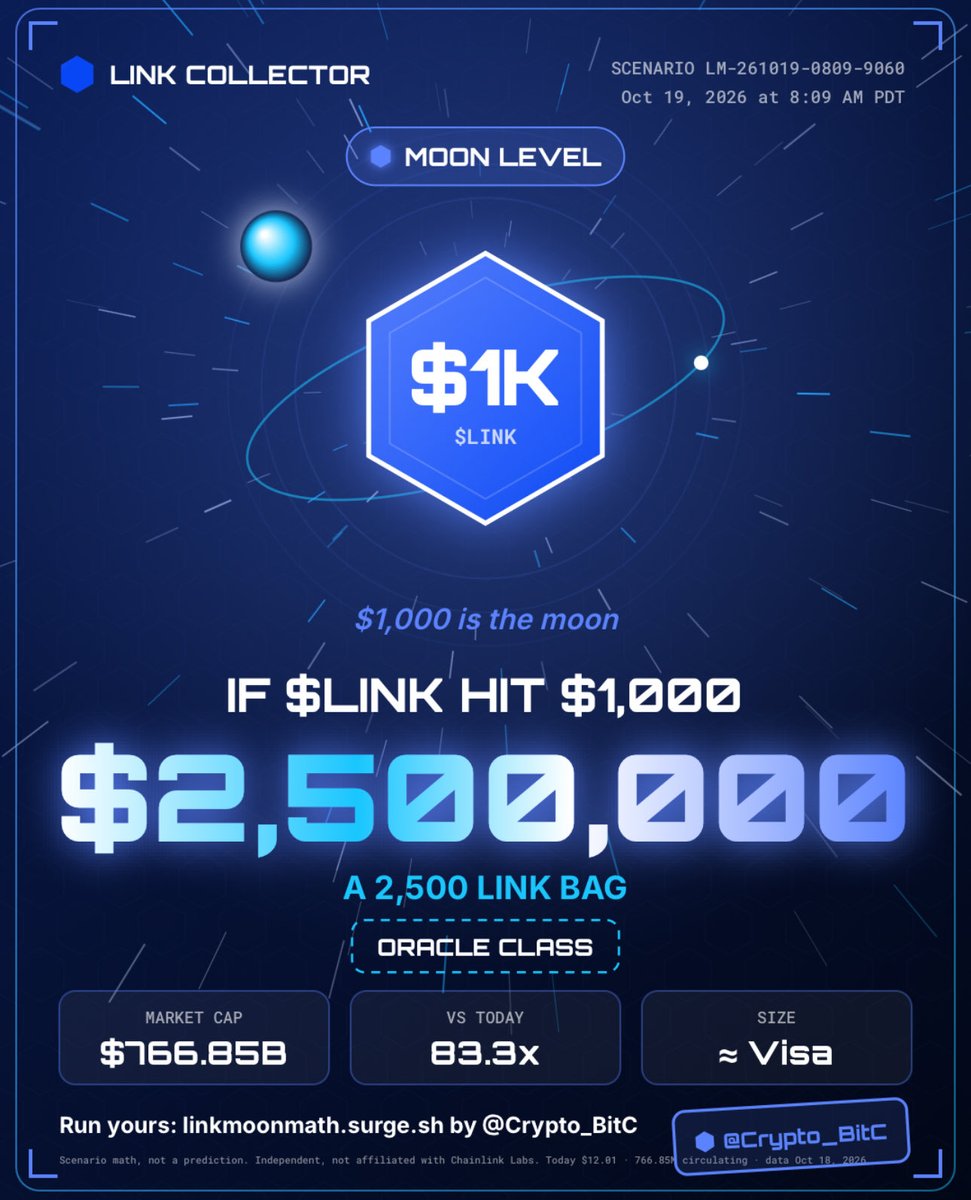
I BUILT A $LINK MOON MATH MACHINE 🚀
Slide the price. Watch it level up 📈
→ $LINK at Visa's market cap = $985
→ $1,000 = THE MOON 🌕
→ $10,000 = bigger than Bitcoin
Stack it against any asset.
Plug in your bag.
See your number.
$10,000+ is the singularity. 👀
https://t.co/7iJHlJyWCj
#Chainlink $LINK
This market cap for $LINK is easily attainable
With the partnerships that #Chainlink has we need to shoot higher 🚀
Try it out, very fun 🤑
📈
👉 https://t.co/Xy1EyHSbC1 👈
I BUILT A $LINK MOON MATH MACHINE 🚀
Slide the price. Watch it level up 📈
→ $LINK at Visa's market cap = $985
→ $1,000 = THE MOON 🌕
→ $10,000 = bigger than Bitcoin
Stack it against any asset.
Plug in your bag.
See your number.
$10,000+ is the singularity. 👀
https://t.co/7iJHlJyWCj
#Chainlink $LINK