(1/7) Keeta Personal is live!
Built to bring everyday banking, payments, and digital asset management into one application.
Users can now hold, manage, and move crypto, fiat, and other investments from a single platform.
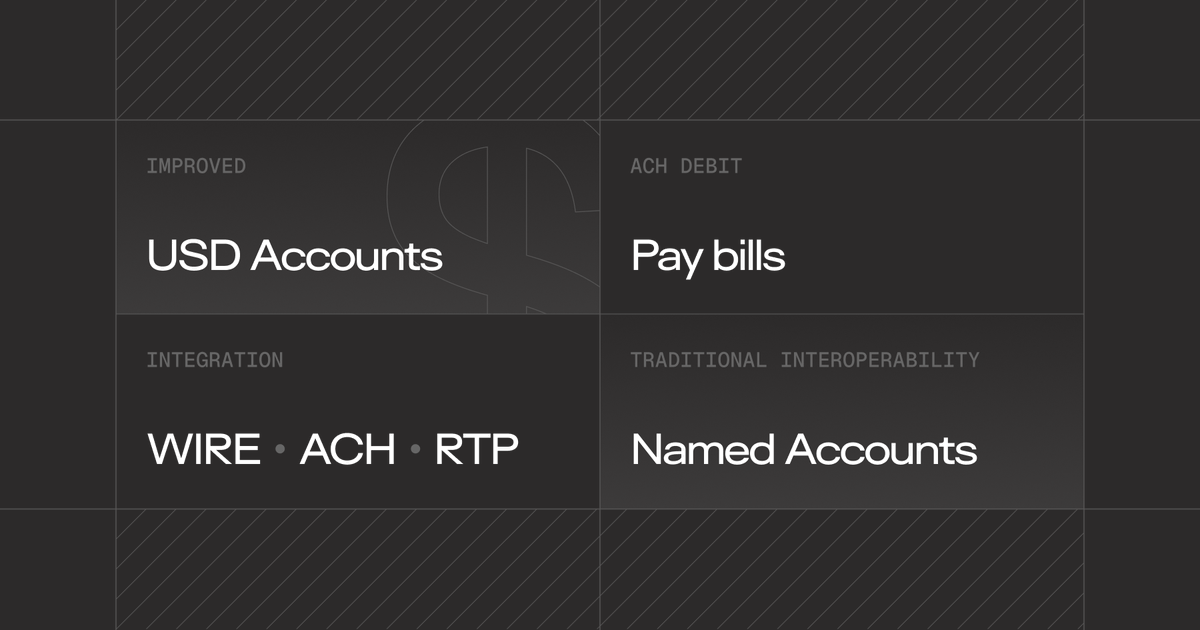
(1/6) As mentioned in last week's announcement, Keeta Network will soon support full ACH and wire functionality with named USD accounts.
New capabilities include:
• Named USD accounts
• ACH debit (pull payments)
Below is a breakdown of what this enables for end users.
(1/8) Over the past few months, the team has been building and expanding Keeta's infrastructure across payments, FX, investments, and digital assets.
We’re now rolling out a series of major releases that significantly expand what Keeta Network can do.
See our new releases below.
Join us on X Spaces tomorrow, where the CEO of Keeta will provide an update on the team’s recent progress and discuss upcoming releases.
We look forward to seeing you there.
https://t.co/XzMRPQgmxA
We’re about to turn a corner with Keeta
Just asked Ty in the VC:
The upcoming “big partner” announcement
is NOT the same partner providing liquidity for the 26 stablecoins.
Then I asked if this ties into the anchor connected to 4 banks…
He said indirectly because those banks are the ones providing the liquidity.
Let that sink in.
This isn’t one piece.
It’s multiple parts coming together at once.
The rails.
The liquidity.
The anchors.
Most people are still asking when.
They’re about to start asking who’s building on top of it.
DYOR
@KeetaNetwork $KTA
Swap KTA, USDC, EURC, and other tokens directly in Keeta Web Wallet.
No traditional exchanges. No delays.
Fund your wallet from your bank, make purchases, and move funds back out quickly.
As more tokens and rails are added, this only gets better.
10M TPS isn’t hype.
It’s preparation for the next generation of finance.
As global payments, markets, and day-to-day finance move on-chain, transaction volume will reach levels most networks were never built to handle.
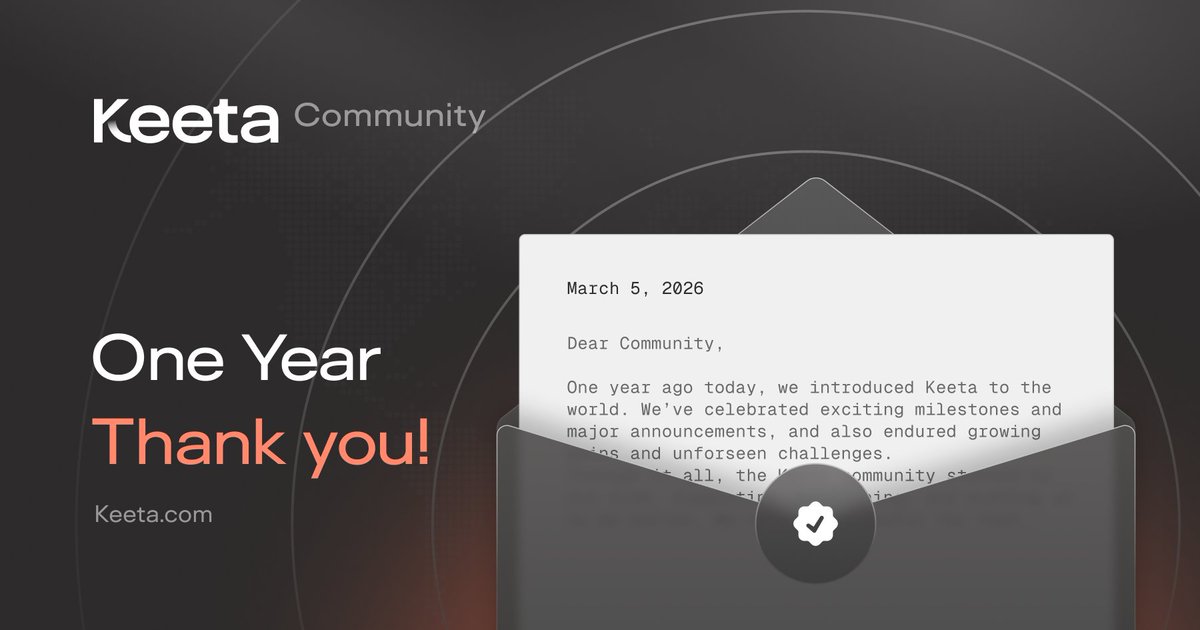
One year ago today, we introduced Keeta to the world.
We've celebrated exciting milestones and major announcements, and also endured growing pains and unforeseen challenges.
Through it all, the Keeta community stood by our side, supporting, questioning, and pushing us to be better. We’re truly grateful for that.
What excites us isn’t what we’ve already accomplished. It’s what comes next.
The groundwork is laid, the pieces are coming together, and the year ahead is set to deliver far more than the one behind us.
Thank you for supporting the vision.
Let's get to work.
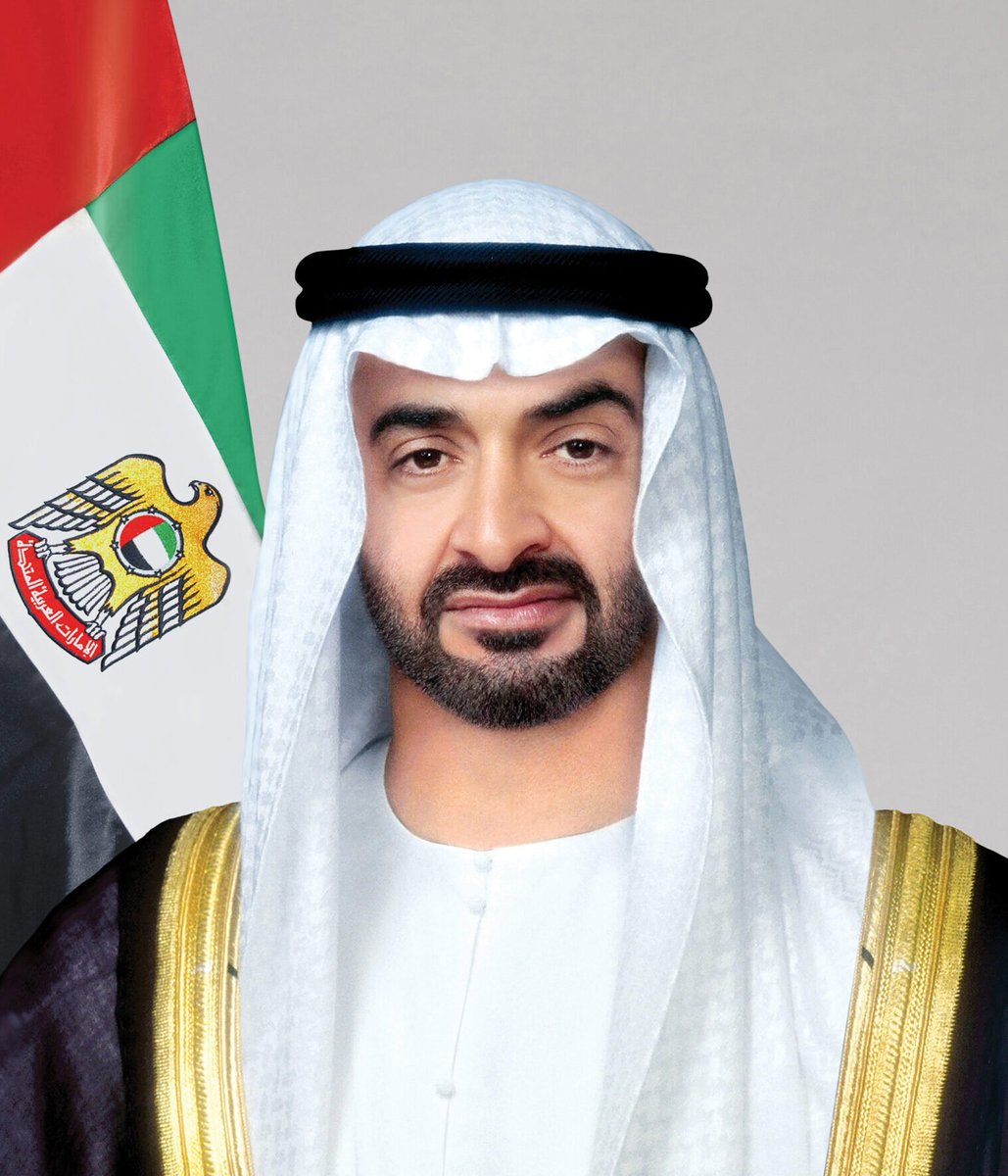
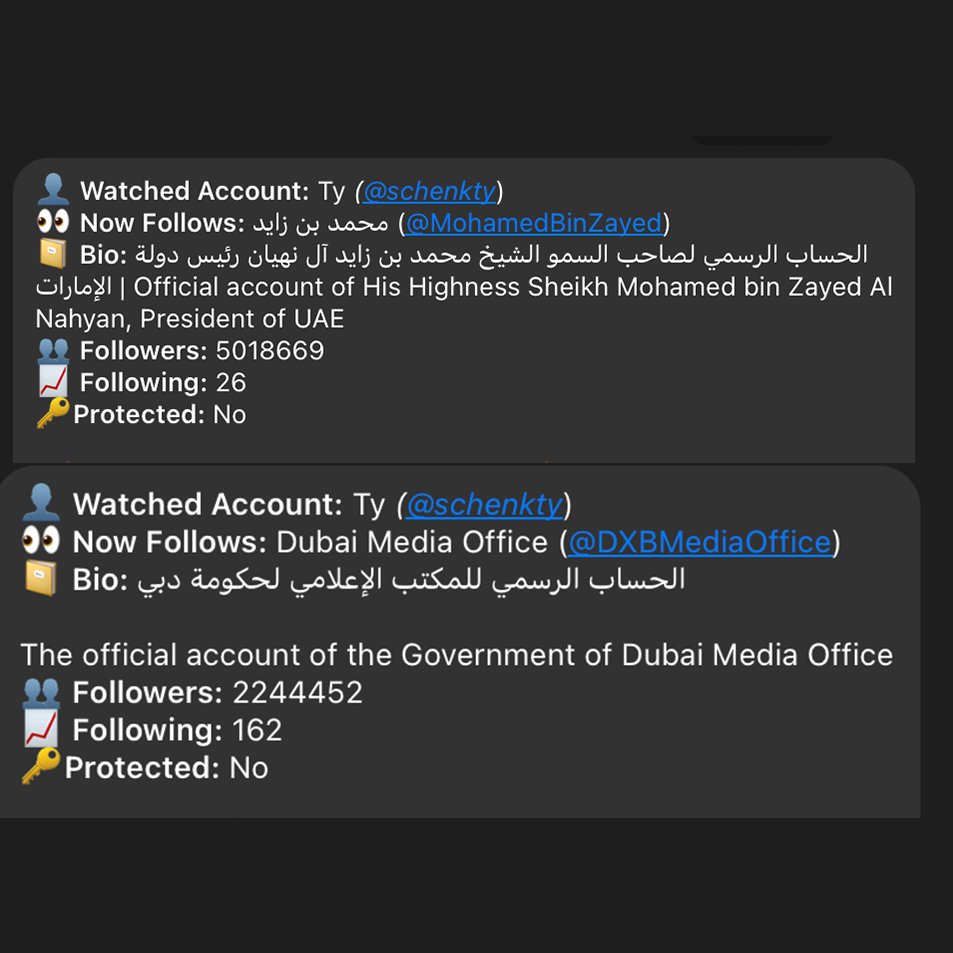
Keeta $KTA Founder Ty recently followed the president of UAE and ruler of Abu Dhabi Sheikh Mohamed bin Zayed Al Nahyan on X alongside Government Dubai Media Office @DXBMediaOffice
There have been lots of talks and rumors of governmental involvement and collaboration with @KeetaNetwork and if one country stands out the most as an early adopter of blockchain it is UAE.
The UAE has positioned blockchain not as a speculative technology like other countries have but as core national infrastructure. Even as early as 2018, the Emirates Blockchain Strategy 2021 set a federal goal to move 50% of government transactions onto blockchain, projecting savings of AED 11 billion in costs and 77 million work hours annually.
For various reasons however this project largely ''fell out''. The government didn’t move “50 % of all transactions on blockchain,” but blockchain and digital systems did get heavily implemented and integrated within the country for example UAE pass.
Sheikh Mohamed bin Zayed Al Nahyan and his brothers Tahnoun bin Zayed and Mansour bin Zayed are also publicly very deeply involved within the blockchain industry.
Tahnoun bin Zayed - Has emerged as the most aggressive crypto dealmaker. Through MGX, the Abu Dhabi based AI and tech investment firm he chairs, he led the largest single institutional crypto investment in history in March 2025 a $2 billion stablecoin funded stake in Binance. In January 2026, it was revealed that Tahnoun had also quietly acquired a 49% stake in World Liberty Financial, the Trump family’s crypto venture, for roughly $500 million.
Mansour bin Zayed - As Chairman of the Central Bank of the UAE (CBUAE), Sheikh Mansour has led the country’s regulatory push into digital finance. In June 2024, he chaired the board meeting that approved the UAE’s stablecoin licensing framework, establishing rules for AED backed and foreign currency backed stablecoins. He also authorized the first issuance of the Digital Dirham CBDC in January 2024.
As we remember, @KeetaNetwork previously received major investment offers from the Middle East. However, Keeta founder Ty Schenk was forced to decline them in 2023.
There are also public records showing Ty’s connections with highly influential figures in the region, and he recently took a trip to the UAE.
A few months ago, Ty also highlighted in a Twitter Space that governmental entities are and may be in talks/working with Keeta and hinted that certain collaborations may already be in progress.
He added that the current focus is on regions and countries that are open to adopting blockchain based solutions and infrastructure, rather than prioritizing jurisdictions that are slower to embrace the technology.
Ty has also declined to comment further on any governmental ties with Keeta when members of the community recently asked him about it on his live streaming platform.
Probably nothing.
The code doesn't lie.
On March 1st, two days ago, the Anchor SDK shipped version 0.0.40. That's not a major announcement. There was no marketing push. It just shipped.
The changelog includes:
- username anchor
- Storage Anchor
- generic block listener utility
- listPersistentAddresses method for asset movement
- queue runner configuration updates
If that sounds like plumbing, it is. It's the kind of infrastructure you build when you're getting ready to run real financial operations on a network. Not testnet demos. Real operations.
Now here's where it gets interesting. The open pull requests in the Anchor repository tell you exactly where the engineering team's heads are at.
There is a work-in-progress PR titled "Add ISO20022 fragment emitter."
If you don't know what ISO 20022 is, it's the global financial messaging standard that banks use to talk to each other. SWIFT is migrating to it. Every major financial institution on the planet either already uses it or is transitioning to it.
For context, most crypto projects that claim ISO 20022 compatibility are talking about messaging layers built on top of their protocol. It's a wrapper, not a native implementation. Even XRP itself is NOT ISO 20022 compliant. Ripple's CTO David Schwartz even confirmed XRP has nothing to do with ISO 20022. RippleNet, the enterprise software layer, supports ISO 20022 messaging but the token and the ledger itself don't natively implement it.
This PR is different. This is ISO 20022 being built directly into the anchor infrastructure at the protocol level. That's not a marketing bullet point. That's an engineering decision about how this network talks to banks.
There is another open PR titled "Add order matcher anchor service."
Read that again. Order matcher. That is decentralized exchange infrastructure.
The roadmap says "launch a high-frequency decentralized exchange." The GitHub says "here's the order matching engine we're building." That's not a promise on a landing page. That's a service being constructed in a public repository right now.
There is a third PR titled "Feature: PII Encapsulation."
This maps directly to how Keeta handles compliance. The protocol uses X.509 certificates for identity and KYC without embedding personally identifiable information in the certificate itself.
This PR is the engineering work that makes that possible at scale. Compliance without doxxing. That's not a tagline. It's a design decision being implemented in code.
And it doesn't stop at pull requests. There's an entire demo repository called demo-fx-anchor that implements a fully functional foreign exchange anchor.
It handles:
- conversion requests between tokens
- deployment to Google Cloud Run through Docker and Pulumi
- zero-fee demo mode for testing
- precision between tokens with different decimal structures
This isn't a whitepaper diagram. It's a working reference implementation that anyone can clone and deploy.
All of this connects back to the same architectural pattern. Anchors are the connective tissue across the entire roadmap.
Fiat on and off ramps. Foreign exchange. The debit card. Identity verification. Even parts of the DEX infrastructure.
Every major roadmap milestone runs through the anchor layer, and that anchor layer is where the heaviest engineering activity is happening right now.
The Anchor repo is verified under the KeetaNetwork organization which controls the https://t.co/7vBbXqkxR0 domain. This isn't a third-party fork or a community experiment. This is the core team pushing code in public where anyone can read it.
Most projects in crypto want you to trust the roadmap. Keeta is giving you the receipts.
The Fastest Universal L1. $KTA
$KTA ecosystem quietly dropped something on February 28th that almost nobody noticed.
They released a Model Context Protocol server.
If you don't know what that is, pay attention because this is the kind of infrastructure move that separates projects that talk about AI from projects that actually build for it.
MCP is a standard that lets AI assistants interact directly with technical documentation, APIs, and codebases. Think of it like giving an AI agent a master key to everything Keeta has ever built.
And before I go any further, Keeta is not the first project to do this. Injective launched one on February 25th for AI-driven perpetual futures trading. Trust Wallet dropped one on February 27th with a Claude Code skills marketplace. Phantom built one so AI agents can swap tokens and sign transactions across chains. deBridge went live across 24 networks.
This is an industry-wide shift happening right now in real time.
But here's the differentiator.
Most of these MCP servers are built for execution. Trading. Swapping. Bridging. Signing transactions. They turn AI agents into operators on existing infrastructure.
Keeta's MCP server is built for understanding. It gives AI agents structured access to the full technical architecture. The official documentation at https://t.co/RF8mZKjCUP. The API references for the KeetaNet client and anchor packages. The complete technical whitepaper. Unified search across every Keeta knowledge base. All of it readable and queryable by any AI assistant that supports the protocol.
Why does this matter? Because the next wave of blockchain development isn't just humans writing code. It's AI agents generating code, debugging integrations, and building applications autonomously.
Every major protocol is going to need this eventually. Keeta built it now.
Think about what this unlocks. A developer wants to build on Keeta but doesn't know the architecture. Instead of spending days reading documentation, they point Claude or ChatGPT at the MCP server and the AI already understands the hybrid DAG design, client-directed validation, anchor operations, and the entire SDK.
The barrier to entry for building on Keeta just collapsed.
This is what "AI-native" infrastructure looks like. Not slapping an AI token on a chain. Not launching an AI chatbot. Building the actual plumbing so that AI systems can read, understand, and build on your protocol natively.
Stripe said publicly that current blockchains can't handle an agentic economy. Keeta isn't just handling it. They're making their protocol the one that AI agents can actually work with at the deepest technical level.
The MCP server sits alongside everything else shipping right now. Pulumi components for cloud-native node orchestration updated within the last 24 hours. The anchor repo actively maintained. The Rust-based node implementation. The Swift client for native iOS payments. All of it moving simultaneously.
While most projects in crypto are releasing roadmaps full of promises, Keeta is pushing code that makes their entire ecosystem machine-readable.
That's not a marketing play. That's an engineering decision about where this industry is going.
The developers who build the next generation of financial applications aren't going to pick the chain with the best logo. They're going to pick the chain their AI tools already understand.
While most of crypto is building AI tools to trade faster, Keeta is building AI tools to understand deeper. That's not the same thing and it's not a small distinction.
The Fastest Universal L1. $KTA
It’s officially March, and we’re coming up on one year of $KTA
As I mentioned in my last tweet, March is rumored to be shaping up as a very exciting and potentially big month for Keeta
It might be worth giving this a read before it’s too late :)