The #FusionRollup is live on mainnet.
The world's first multi-ledger rollup, purpose-built for institutions operating across multiple blockchains at once.
Learn more about the launch here: https://t.co/jAY6Y0KLF5
#QuantFusion#EnterpriseBlockchain#MultiLedger
The UK is rebuilding the infrastructure of money in real time.
At City Week, the Bank of England outlined what's happening: a #digitalgilt, #stablecoin rules this year, 16 firms going live in the Digital Securities Sandbox, and a synchronisation service settling tokenised transactions in central bank money by 2028.
As Sarah Breeden put it, RT2 is a "parked Ferrari", and it's now out on a test drive.
When every asset is tokenised, the question of who is authorised to move value, and under what conditions, becomes foundational.
That's the design question we've been building for.
https://t.co/oe24PbPst1
#DigitalFinance #Tokenisation #FinancialInfrastructure
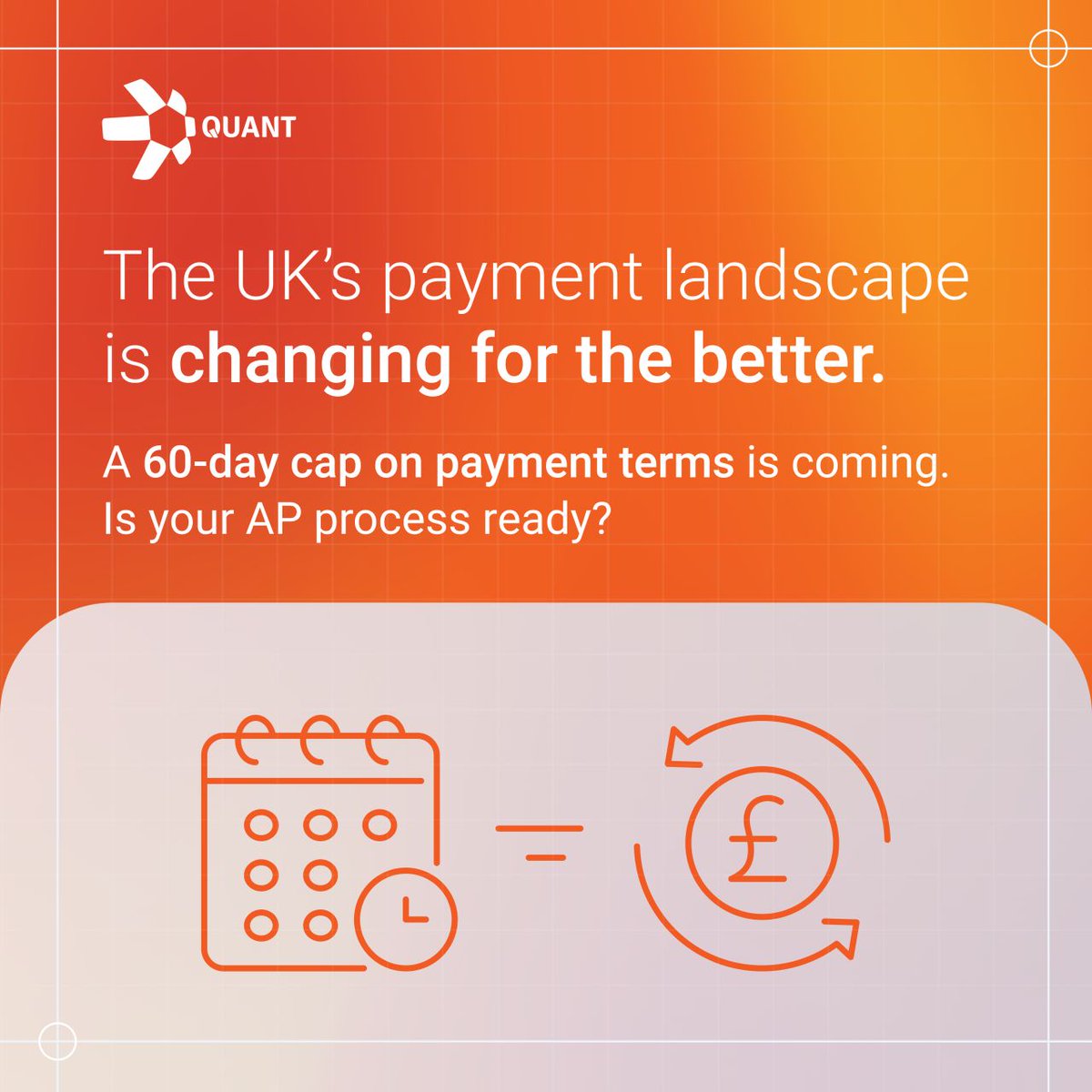
The UK's mandatory 60-day payment cap removes the mutual consent exemption that previously let businesses agree to longer terms, closing a loophole that had undermined earlier reforms.
With implementation expected in 2027, there's time to prepare properly. That means auditing every contract with terms beyond 60 days, mapping real payment performance against stated terms, and making sure your #APprocess is ready.
Learn more: https://t.co/FR2VZP1u0U
#QuantFlow #AccountsPayable #CFOs
As #programmablemoney and #tokenisedassets move from experimental to operational, the infrastructure enabling #interoperability across disparate networks becomes increasingly valuable.
Quant’s patent portfolio protects the innovations making this transition possible, ensuring that enterprises can build on proven, protected technology as they modernise their financial operations.
Learn more in this article: https://t.co/1oQ0sL3mYn
#QuantFusion
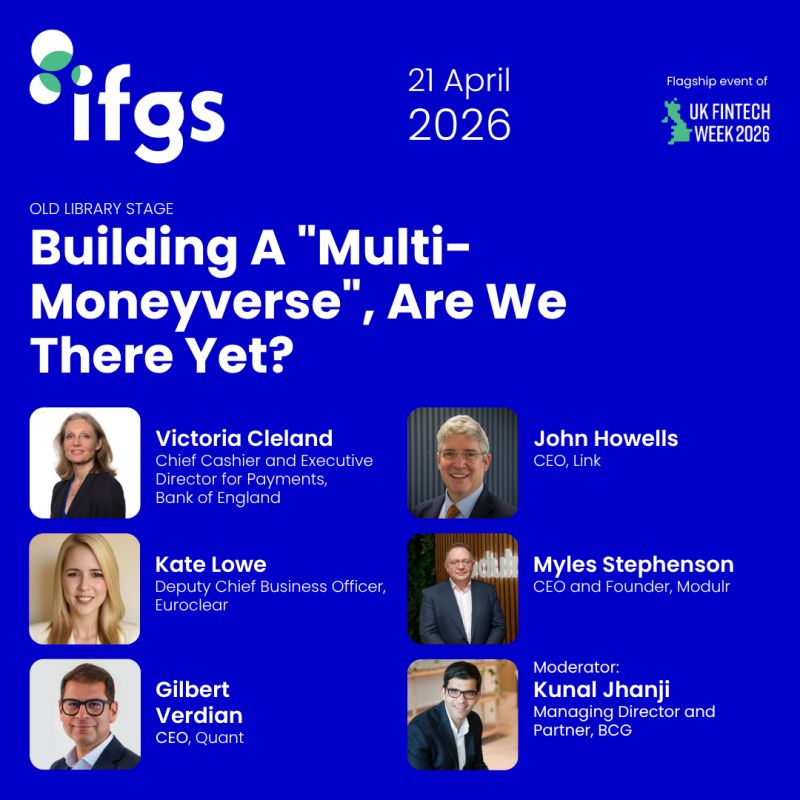
There's just over one week to go until @InnFin's Global Summit where our Founder and CEO, @gverdian, will be joining a panel session on the Old Library Stage titled: 'Building A "Multi-Moneyverse", Are We There Yet?'
Panellists will explore what a multi-money UK might look like, and how we can foster a mixed ecosystem. It'll also cover progress since the National Payments Vision, what remains to be done, and how #interoperability can unlock a truly connected financial landscape.
Secure your ticket here: https://t.co/PPLdVaYyBl
#IFGS #Payments
Tokenised deposits are becoming significant infrastructure for #financialinstitutions. A succession of central bank programmes, commercial deployments, and regulatory frameworks across 2025–26 has removed the uncertainty.
The question now is positioning. When network effects begin to compound, institutions with interoperable infrastructure will be ahead. Those holding proprietary #tokenisation stacks that cannot communicate with the majority of their counterparties will be left behind.
The architecture is taking shape. Read the full guide to understand where #tokeniseddeposits, wholesale #CBDCs, and #interoperability infrastructure fit together, and what that means for your institution: https://t.co/9aQbw8KTtA
@RachelReevesMP You are stealing tax from productive Britain and handing it to lazy foreigners and the healthy indolent.
If anyone ran a company like you ran the economy, they’d be in prison.
Murex built the systems capital markets trust. Quant is making those same systems programmable.
Today, we’re announcing a strategic partnership that brings institutional-grade digital asset capabilities directly into MX.3, one of the most widely deployed capital markets platforms in the world.
Banks and capital markets firms can now issue, settle and manage tokenised deposits and digital bonds within the systems already operational across their trading, risk and post-trade workflows. No rip and replace, no parallel infrastructure. The same platforms made ready for the next era of settlement, automation and liquidity.
This partnership comes as tokenised infrastructure moves from pilot to production across the world’s largest markets. Tokenised real-world assets have crossed $100 billion. DTCC has SEC approval to tokenise US Treasuries from mid-2026. Major UK banks are already working with Quant through the Great Britain Tokenised Deposit initiative.
The infrastructure moment is here, and now it runs on MX.3.
Read the full announcement: https://t.co/EcnAa3kiKv
#Tokenisation #DigitalAssets #CapitalMarkets #Programmability
I’m delighted to announce that @quantnetwork and Murex are partnering to bring tokenised deposits and digital bond settlement into MX.3.
Institutions have been asking the same question. How do we move forward with tokenisation without disrupting the trading, risk and post-trade operations we depend on?
The answer is now inside the platform they already use.
Tokenised RWAs just crossed $100 billion. DTCC has SEC approval to tokenise real-world assets from mid-2026 and major UK banks are already working with Quant through the Great Britain Tokenised Deposit initiative - all of which signals that the market is moving.
Users in banks, asset managers, insurance companies, pension funds, hedge funds, corporations and energy utilities in over 65 countries now have a production-ready path into tokenisation through the systems they already run.
The future of capital markets infrastructure is programmable: https://t.co/RmT2yVJ4SH
#Tokenisation #DigitalAssets #CapitalMarkets #Programmability
Tokenised deposits promise to transform #bankinginfrastructure, but fragmentation could undermine the entire project.
Every major institution is building its own protocols and compliance controls in isolation, reproducing the very inefficiencies they were supposed to solve. History is clear: every payment innovation that achieved scale got there through neutral clearing infrastructure, not proprietary networks.
The technology is not the bottleneck. The collective will to prioritise #interoperability over proprietary advantage is. Learn more: https://t.co/ArSH9Naz6p
#TokenisedDeposits #Blockchain
A decade in the making, we have published an ISO standard for blockchain interoperability.
This is a milestone I've been working towards since 2015, Remitt was founded with the conviction that blockchains could transform financial services but only if the industry solved interoperability and harmonised around global standards. Without that, blockchain would remain fragmented, siloed, and locked out of mainstream institutional adoption.
In April 2016, we published what was the world's first proposal for a blockchain standard (https://t.co/SL83Yl4Ejr) a bold move at a time when the industry was still largely focused on proofs of concept and competing protocol narratives, not standardisation.
The idea was simple but ambitious: if blockchains were going to serve global markets, they needed a common framework that transcended any single protocol or vendor.
Central to this thinking from the very beginning was the concept of a multi-gateway architecture, leveraging the know-how of 20 years of experience in cybersecurity to frame the principle that interoperability shouldn't depend on a single bridge or point-to-point connection, but on a layered gateway model that could abstract away the differences between underlying DLTs and connect them through a common interface. This was the architectural foundation of what would become Overledger, and it was also the design philosophy we brought to the standards process.
The belief was that a viable international standard for blockchain interoperability had to be protocol-agnostic and gateway-driven, enabling any DLT to communicate with any other DLT (any-to-any) and with existing networks, without requiring those ledgers to change how they operate. The standard and the technology were born from the same insight.
That same year, I worked closely with the team from @standardsaus (Standards Australia), who had the foresight in 2015 to champion the initiative at the international level. Together, we pushed for ISO to establish a dedicated Technical Committee for blockchain and not to be absorbed into an existing committee, but to stand on its own as a recognition that this technology warranted its own global standards programme. The industry demand was there, the use cases were multiplying, and the fragmentation was becoming a real barrier.
In September 2016, the New Work Item Proposal (NWIP) received global approval, and ISO formally gave the green light to establish a new Technical Committee (https://t.co/7biJjvHRk9). TC 307 — Blockchain and Electronic Distributed Ledger Technologies — was born (https://t.co/5SsFPIw0HH). The inaugural meeting was held in Sydney in April 2017, and from that moment the real work began.
As the standards work progressed internationally, the mission at Remitt was evolving too. What started as an effort to use blockchains for financial services and solve interoperability grew into something far larger, a full enterprise infrastructure platform for connecting any blockchain to any network. Remitt became Quant, and we built Overledger, the world's first blockchain operating system to deliver on that original vision. The multi-gateway architecture that informed the standards thinking became the core of Overledger's design: a technology layer that sits above all blockchains, providing institutions with a single integration point to access any DLT, any network, and any existing system. The interoperability challenge that drove the standards work was the same challenge we set out to solve commercially and the two efforts reinforced each other throughout.
For close to a decade since TC 307's formation, subject matter experts across the world have contributed their time and expertise to Working Group 7 — Interoperability is the committee I chair.
International standards are not built quickly they are built through consensus, technical debate, and relentless refinement. The same methodology and rigour that created the Internet, through publishing standards. The result is a published international standard for blockchain interoperability.
🔗 https://t.co/GRoR7fXNLQ
A huge thank you to @isostandards as the international standards developing organisation, to the team at @standardsaus who started the initiative in 2015 and worked tirelessly to get TC 307 approved and established globally, and to every subject matter expert who contributed to Working Group 7 over the years. This would not exist without that collective effort.
From a blog post proposing the world's first blockchain standard in 2016, to a published ISO standard in 2026 and from Remitt to Quant, from an architectural concept of multi-gateway interoperability to Overledger and a global standard, this has been a decade-long journey of building both the standards and the technology to make blockchain interoperability a reality for institutions worldwide.
There is still much more work ahead. More standards to develop, more to evolve, and more to build. But today, we mark a significant milestone.
#Blockchain #ISO #Interoperability #Standards #TC307 #DLT #Quant #Overledger
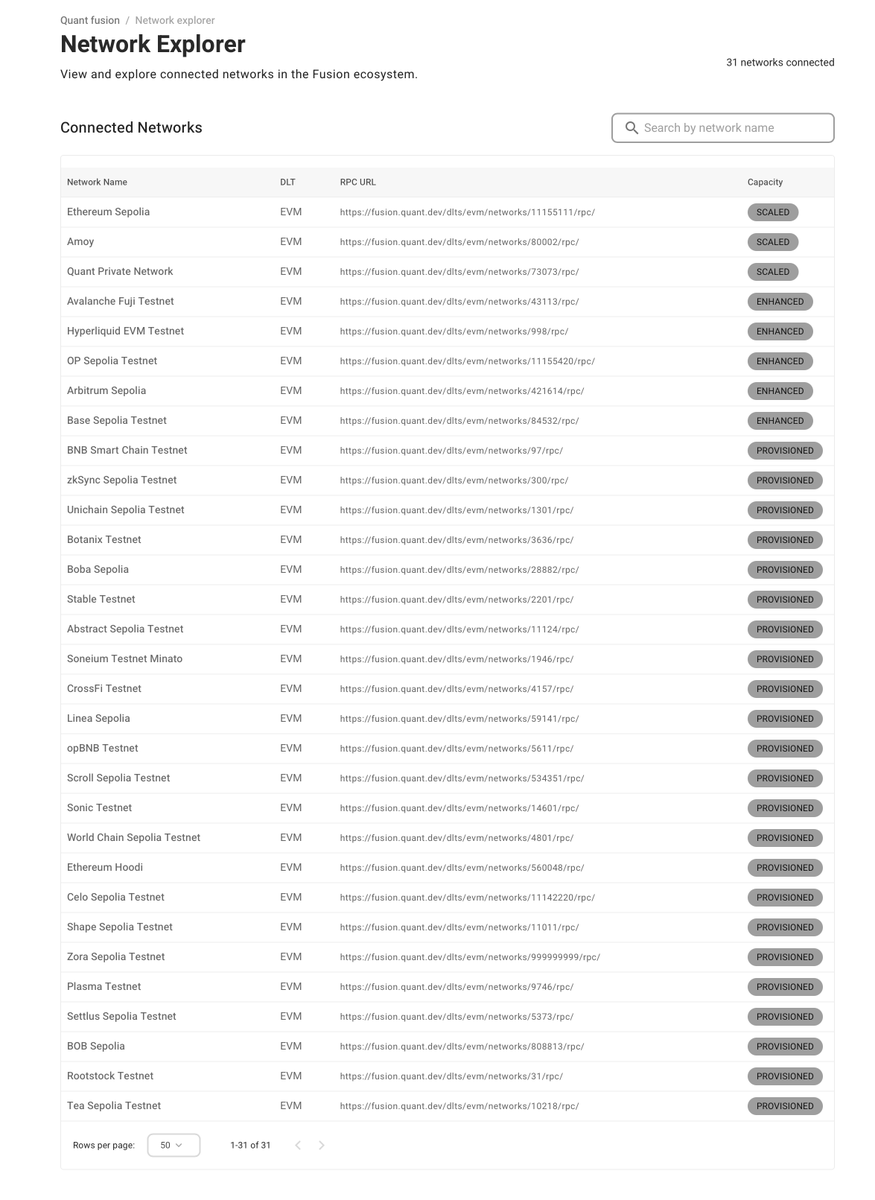
The Layer 2.5 Network of Networks @FusionLayer25 is coming together nicely!
31 Networks connected in the first hour! 🚀
Sign up and interoperate: https://t.co/N3rDK9bOYd
Yet technology alone is not enough. For this transformation to benefit everyone, it must be built on foundations of trust, interoperability, and governance. Without these, scale creates silos, and innovation outpaces coordination.
This is where the next phase of the journey leads. As AI becomes a core layer of digital infrastructure, interoperability becomes the mechanism that allows intelligence to move seamlessly across networks, organisations, and jurisdictions. Trust becomes programmable, embedded directly into systems rather than enforced after the fact.
At @quantnetwork, our focus has always been on enabling systems to work together across technologies, markets, and borders. In an AI-driven world, this capability becomes essential. It ensures that as productivity accelerates, participation broadens; as systems become more powerful, they also become more accessible.
It is a future where growth is not limited by legacy infrastructure or fragmented systems, but enabled by connected, trusted digital foundations.
The @FT highlights how Lloyds Banking Group and other lenders such as Natwest, Barclays & HSBC are leading UK banking into a new era through tokenised deposits and programmable money, a shift that could fundamentally reshape how money moves, settles, and is used across the economy.
Tokenised deposits bring real cash onto blockchain infrastructure, enabling automation, real-time settlement, and smarter financial products from mortgages to payments and capital markets.
At Quant, we’re proud to be working with leading banks on this transformation. As our CEO @gverdian notes in the article, tokenised deposits represent the evolution of electronic money into digital, programmable money - unlocking efficiency, liquidity, and interoperability across the financial system.
This is about more than innovation. It’s about building the next generation of money and the infrastructure that underpins it securely, at scale, and connected across institutions.
Article: https://t.co/BPitmvYPDB
#TokenisedDeposits #ProgrammableMoney #Tokenisation #DigitalAssets #FinancialInfrastructure #Blockchain #FutureOfFinance
Major milestone for UK #digitalassets: @hmtreasury just laid legislation creating a comprehensive #cryptoasset regulatory regime coming into force in 2027.
This framework provides the clarity innovative firms need while protecting consumers. At Quant, we welcome technology-neutral regulation that enables responsible innovation.
The UK is leading the way in balancing innovation with protection, exactly what's needed to unlock the sector's full potential.
Learn more: https://t.co/TpKgiTziY2
#Regulation #Blockchain #Interoperability
Fusion's second core component enables users to integrate their own #nodes and #blockchainnetworks into the ecosystem.
Key features:
• Fine-grained access control (define who sees what)
• Native privacy preservation
• Modular, extensible design
• Form an interconnected mesh of ledgers
Coming soon:
📍 BYON (Bring Your Own Node) with QNT staking incentives
📍 Open source connector specification
📍 BYOC (Bring Your Own Connector) for any network.
Turn your private infrastructure into part of the multi-chain ecosystem.
Learn more: https://t.co/5EHhTdb0At
#Web3Infrastructure #BlockchainNodes #QuantFusion
📣 Attention UK @Xero users!
This #BlackFriday, we’re giving you a one-day-only offer you won’t want to miss.
Still processing #payments by hand, moving #taxfunds manually, or juggling multiple bank accounts? There’s a smarter way.
Quant Flow connects directly with #Xero to automate the finance tasks that eat up your time.
Get the full #QuantFlow experience for 60 days at just £1/month.
Setup takes under an hour. No new software. Bank-grade security.
Whether you’re a business owner or an accountant managing multiple clients, this is your chance to reclaim hours every week.
Grab the offer before midnight: https://t.co/lbtUm7eSj1
#FinanceAutomation #CashFlow #Accounting #UKBusiness
The #tokeniseddeposit revolution faces a critical challenge that could determine its success or failure: the absence of universal standards for how #banks and #wallets communicate and operate.
Achieving scale requires the industry to prioritise narrow, specific standards in critical areas while accepting diversity in others.
The focus should be on #interoperability standards that enable different tokenised deposits to work together, rather than prescribing how each institution must implement its solution.
➡️ Learn more in our latest article: https://t.co/ArSH9Naz6p
#Tokenisation #Blockchain #Interoperability #DigitalAssets
When you establish TC307 to develop ISO Standards for blockchain in 2016 basing it on #ISO20022 for mainstream adoption by financial institutions:
https://t.co/we67ion5Tz
You’ve built everything since then with ISO 20022.