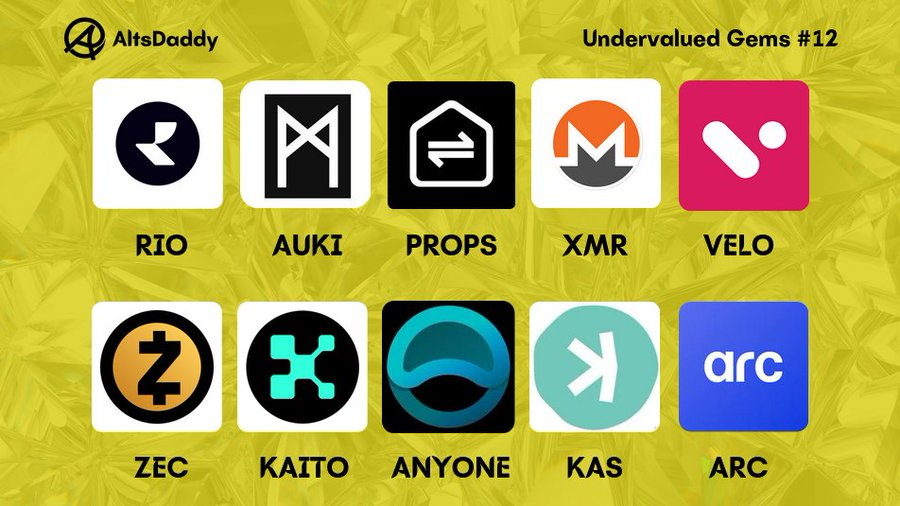
#Utilitytokens are fast becoming one of the most popular sectors in the #crypto space.
We expect another big push for #Utility tokens as $BTC looks to reclaim $70,000
1️⃣ $RIO
2️⃣ $AUKI
3️⃣ $PROPS
4️⃣ $XMR
5️⃣ $VELO
6️⃣ $ZEC
7️⃣ $KAITO
8️⃣ $ANYONE
9️⃣ $KAS
🔟 $ARC
#Altseason2026 $DDY
Excited to see the Velo Card integrating PayFi infrastructure with @Zebec_HQ’s card technology. This collaboration offers users a seamless bridge from crypto to everyday payments and further strengthens the broader ecosystem. Looking forward to the upcoming details.
A great week at Rio Innovation Week networking and catching up with partners.
Now, our focus shifts to bringing privacy on Hathor to the masses.
We’ll keep building, pushing forward and taking the steps needed for long-term success.
Thank you Hathorians $HTR
🧵 Velo is moving PayFi closer to everyday payments.
The recently announced Velo Card is more than another crypto card integration.
Velo is combining its PayFi infrastructure with Zebec’s card technology to create another bridge between digital assets and everyday spending.
Here’s what is taking shape. 👇
The architecture is straightforward:
Velo → PayFi infrastructure
Zebec → Card technology
Velo Card → Real-world payment access
The objective is simple:
Make digital assets easier to move from on-chain environments into everyday financial activity.
And the planned functionality already goes beyond a simple branded card.
According to the announcement from @Zebec_HQ, the integration is expected to support:
• USDT and USDC funding
• BNB Chain, Ethereum and TRON
• USD, EUR and GBP balances
• Apple Pay and Google Pay
• Silver and Carbon card tiers
And importantly:
$VELO can be used to top up the card.
That introduces a direct consumer-facing utility for the ecosystem token.
This distinction matters.
Crypto infrastructure becomes considerably more useful when users don’t have to think about the infrastructure underneath it.
Fund digitally.
Convert when necessary.
Spend through familiar payment rails.
That is where PayFi begins moving from infrastructure into an actual financial experience.
@veloprotocol itself describes the strategy clearly:
“One ecosystem. One more way to use digital assets.”
And that broader ecosystem has been expanding.
Velo is developing infrastructure around:
payments → settlement → stablecoins → RWA → wallets → cards
The Velo Card adds another consumer-facing layer to that stack.
But Velo doesn’t exist in isolation.
Its wider ecosystem includes Lightnet, which has spent years building regulated cross-border payment infrastructure across Asia.
@lightnetgroup has worked with institutions including Siam Commercial Bank (SCB) and TransferMate on international payment and remittance infrastructure.
That institutional side is important when looking at what Velo is trying to build.
Then there is USDV.
Velo has also connected its ecosystem to institutional real-world assets through BlackRock’s tokenized USD Institutional Digital Liquidity Fund, BUIDL, via Securitize.
That creates another layer:
Traditional financial assets → tokenized liquidity → digital payment infrastructure.
The card expands the opposite end of the stack:
Digital assets → real-world spending.
Put those pieces together and the strategy becomes easier to see.
Institutional infrastructure
Cross-border payments
Stablecoins
Tokenized RWAs
Self-custodial wallet infrastructure
Card payments
Everyday spending
Velo is gradually connecting different parts of the financial lifecycle.
And that is why the @Zebec_HQ partnership matters.
Not because another crypto card suddenly changes everything.
It doesn’t.
What matters is whether infrastructure eventually becomes usable infrastructure.
Products that people and businesses can actually use are what turn blockchain networks from technology stacks into financial ecosystems.
There is still plenty to prove.
Adoption, transaction volumes, merchant usage and regulatory execution will ultimately determine how significant this becomes.
But the direction is increasingly clear:
@veloprotocol is building PayFi infrastructure designed to connect digital assets with real-world financial activity.
And with the Velo Card, another piece of that infrastructure is moving closer to the user.
PayFi for everyday life.
Build on Hathor, locally. 🛠️
Hathor Forge gives developers a complete local environment with everything needed to build and test on Hathor.
It even includes an MCP server, letting AI assistants create wallets, fund them, send transactions, inspect blocks, and more.
Learn more ⬇️
Our team had managed to save her sight.
Because we have the little hospital and recovery only 10 yards away she could walk right back to her suite where she will recover for days.
Her little growths have been sent to the lab (6/7)
Imagine living with they for a year and the all of a sudden it’s gone.
I think her little smile says it all.
That’s why our little hospital is so so important. (7/7)
🔥 벨로 프로토콜: 벨로 카드 결제
벨로 카드는 PayFi(결제 금융) 인프라와 Zebec의 카드 기술을 결합해, 디지털 자산을 일상 결제에 더 자연스럽게 활용할 수 있도록 지원합니다!
: https://t.co/rRNy1DBenb
하나의 생태계 안에서 암호화폐를 사용하는 새로운 결제 수단이 더해지는것으로 자산 관리부터 실생활 결제까지 이어지는 벨로의 PayFi 경험을 확인하실 수 있습니다.
벨로 카드에 관한 자세한 내용은 곧 공개됩니다!
https://t.co/hqBDOdGiLs
The Velo Card combines PayFi infrastructure with @Zebec_HQ's card technology, giving users another way to move seamlessly from crypto to everyday payments.
One ecosystem. One more way to use digital assets.
More details coming soon.
#VELO#PayFi#Zebec
@Zebec_HQ@veloprotocol 8/10 What would make this huge?
✅Velo Card live in multiple countries ✅ Real volume
✅ Transactions routed through Velo’s engine
✅ VELO fees/buybacks live
✅ LP staking and institutional collateral active.
Announcements matter; production data matters more. 👀 #Adoption
@Zebec_HQ@veloprotocol 4/10 Velo’s roadmap describes $VELO as the network coordination asset:
Settlement fees funding buybacks, liquidity providers staking VELO for routing fees/spreads, and institutions locking VELO as net-settlement collateral. That is the long-term value-capture thesis. #Tokenomics
@Zebec_HQ@veloprotocol 3/10 Why this matters for $VELO:
$VELO does not need to build a global card stack from zero. Zebec gives it a last-mile product users can actually spend with, while Velo can focus on settlement, liquidity, compliance, RWAs and cross-border finance. 🔥 #RWA#PayFi#Fintech#Web3
@Zebec_HQ@veloprotocol 2/10 Think in layers:
Zebec = card program, funding UX and access to existing merchant rails. Velo = compliant cross-border liquidity, FX routing, stablecoin settlement and treasury infrastructure. One is the spending endpoint; the other aims to move value behind it. #PayFi#FX
@Zebec_HQ@veloprotocol 1/10 The confirmed partnership:
@Zebec_HQ is @veloprotocol exclusive card partner. The Velo Card is planned to support $USDT/ $USDC, $BNB, $LINK, $ETH, $TRX, $USD/ $EUR/ $GBP, Apple Pay, Google Pay and $VELO top-ups. 💳🌐 Onchain value meets daily spending. #ZBCN#VELO
🚨 $VELO x $ZBCN is bigger than a co-branded crypto card—but not because one replaces the other. @Zebec_HQ brings the spending layer. @veloprotocol is building the #PayFi liquidity + settlement engine.
👀 Here’s how both fit—and what $VELO holders should watch. 🧵👇🏻