Here you will meet a number of folks on our team and understand the motivations behind their amazing work. Pleased to bring you our Wow Moments at #AVCT#NextGenLoading#LetsDoThis
That was one hell of an R&D Spotlight episode published this week by @avacta #AVCT. A must-watch for holders.
I thought I’d provide a recap of the investment case on here, as the Company sits on the cusp of a major news period that could prove transformational.
The pre | CISION platform has evolved at a dazzling pace over the past couple of years, opening up almost limitless possibilities for improving the delivery of potent therapeutics intended to target FAP-rich solid tumours (which is to say, approximately three quarters of all cancer cases worldwide).
The foundation of the platform, and which lies at the heart of the IP suite, is the peptide sequence (or ‘substrate’), “D-Ala-Pro” (highlighted in red on the slide at 2:40 in the video). In the simplest of terms, the substrate “blocks” any molecule that it is a component of, from entering into cells; and is cleaved away from the molecule to which it is attached, by the enzyme FAP (which is only found in abundance in most solid tumour micro-environments). With the peptide having been removed, the warhead component of the molecule becomes ‘active’ at the site of the tumour – and can start killing cancer cells.
The pre | CISION substrate was created by the renowned William Bachovchin of Tufts University: Avacta obtained the worldwide exclusive license to the technology in 2018 (as well as co-inventing and co-patenting with Tufts, the 1st generation of pre | CISION-powered affimer or antibody-drug conjugates). With the license in place, Avacta developed the first pre | CISION prodrug – which is now known as a “peptide-drug conjugate”.
This 1st generation pre | CISION-powered PDC is the doxorubicin-based #AVA6000. Everyone knows the story there. The Phase 1a trial has obliterated all prior expectations. It has been running for 37 months now, with approximately 50 patients (spanning 10 cohorts) having been dosed.
The results have been spectacular. Active doxorubicin in the tumour micro-environment compared to in the bloodstream is trending at a ratio of around 100:1. This has enabled the trial clinicians to drastically increase the cumulative lifetime dose (compared to standard doxorubicin) for patients in the trial. They have done so in three interlinked ways:
- increasing the size of the individual dose of AVA6000, compared to the recommended dose of standard doxorubicin;
- increasing the frequency of dosing of AVA6000, compared to standard doxorubicin (currently from three weeks down to two weeks);
- increasing the total number of treatment cycles of AVA6000 for the patient (going well beyond the usual maximum number of six cycles for doxorubicin).
These dramatically increased cumulative doses are resulting in very encouraging efficacy data already – which is in itself very unusual for a Phase 1a trial. For example, one heavily pre-treated patient with a type of sarcoma has experienced a near-complete response.
That was several months ago, and that patient is still on drug. I’m expecting a bit more new data this weekend (Avacta is presenting at major cancer conference ESMO tomorrow – so I expect there’ll be an RNS on Monday), with a much more comprehensive data release before Christmas (hopefully the entirety of Phase 1a data).
To reiterate: AVA6000 is only a 1st generation pre | CISION PDC. Yet by the looks of things, it already appears (highly) probable that it will, in time, steadily displace doxorubicin across the board (well, at least for treating tumours that are high in FAP – which accounts for well over 60% of global doxorubicin sales (currently at circa $1.2bn pa)).
……
The 2nd generation PDC platform that Avacta has developed (watch video from 6:36 to 8:37) enables the pre | CISION peptide to be linked to a massively expanded range of warheads, that it would not have otherwise been able to be linked to under the 1st generation format. This has been made possible by the in-house development of a range of linkers (circa 20 of them), as well as the in-house development of range of capping groups (over 40 of them).
Together, not only do they substantially expand the range of payloads that can be linked to the pre | CISION peptide, but they also enable the fine-tuning of the molecule, i.e. modulating the speed of warhead release; altering plasma protein binding; altering half-life of drug, etc.
As an educated guess on my part, I believe that this may have generated significant new IP for the platform, that Avacta may now wholly own (i.e. separate from the license with Tufts / Bach Biosciences (William Bachovchin’s vehicle)). Whilst that in itself would be a significant positive on the commercial front, an even more important result of this would be that the clock counting down the patent protection over the platform would have just been reset.
So, whilst in 2033/34 (approximately when the family of patents expire for the D-Ala-Pro substrate), other companies may start to use the 1stgeneration format for developing PDCs, they could not develop 2nd generation PDCs (unless under license from Avacta or whoever owns the technology then). And why bother attempting to develop a 1st generation PDC in the mid-2030s, when the owner of the 2nd generation technology (which would be on-patent for another decade at that point) could simply develop a superior molecule?
To reiterate – the prospect of new IP is all conjecture, purely on my part. But to me, it makes sense – especially as the Company itself has alluded to filing important new IP over the past year (which to date it has refused to provide any detail on).
……
I explained in an thread earlier this week how there's a reasonable possibility (in my view, probability) that one of Avacta's new pre | CISION peptide-drug conjugates, #AVA6103, could be armed with one of the novel TOP1 inhibitor warheads, SN-38 or deruxtecan (the latter being owned by Japan's Daiichi Sankyo and used in the world's best-selling antibody-drug conjugate, Enhertu).
Now in this latest video, we see that the Company uses MMAE as the example warhead incorporated into pre | CISION PDCs and BDCs, across all of the deck's slides.
For those unfamiliar with it, MMAE is a synthetic antineoplastic agent that acts as a microtubule inhibitor (in short, a class of chemotherapy agent that disrupts the microtubule dynamics required for cell division). To put its potency into context: MMAE is 100-1,000 more potent than doxorubicin. It is far too potent to be used as a free drug, as a monotherapy; rather, to date is has only been used as a warhead in ADCs.
Now: it may be that Avacta decided to use MMAE as the example warhead in its slides in the video this week, for the simple reason that it is probably the most well-known of the novel cytotoxins – it is the warhead used in 4 of the 14 ADCs that are currently approved and marketed across the world.
That said, management will have been acutely aware that many hundreds of pairs of eyes from both the investment community, and from the pharma industry, will be very keenly scrutinizing every scrap of info that the Company puts out into the public domain.
To me at least, it would seem rather daft for Avacta to use MMAE as the example warhead in a presentation that is designed to demonstrate the versatility of the 2nd generation PDC platform – only to later on inform investors (and much more importantly, potential licensees / partners / acquirors) that MMAE could not in fact be linked to the pre | CISION peptide.
This is one of the key reasons why I personally believe that a pre | CISION-powered MMAE-PDC has already been created by Avacta, and put through successful pre-clinical testing.
It is important to note that MMAE as a standalone compound is no longer under patent. Of the four marketed ADCs that do use it as their warhead, three are owned by Seagen (itself acquired by Pfizer last year); and the fourth by Genentech/Roche (which licensed linker technology from Seagen in order to develop its ADC). Seagen itself does not own patents over MMAE as a standalone compound, but rather specific linker technologies that attach it to an antibody.
Now, I’ve got absolutely no experience in patent law(!) – but with regards to Avacta’s 2nd generation pre | CISION PDCs, my reading of the situation is that it would not require a license from Pfizer to use MMAE. My rationale? Avacta is not linking MMAE to a biologic (a monoclonal antibody); but rather to an inert peptide.
To go even further: we learn in this week’s video that the 2nd generation PDC platform also places a (proprietary?) self-immolative linker between the MMAE warhead and the pre | CISION peptide. Given that Avacta’s scientists state that they have developed a range of ~20 of these linkers, and given that the Company is openly portraying them in public material, it would seem inconceivable that these are Seagen’s proprietary linkers.
In short, Avacta could own 100% of a pre | CISION-powered, MMAE-based PDC.
An MMAE-based PDC compared to the existing MMAE-based ADCs might enjoy the same advantages as I described in my Tweet earlier this week, with regards to a pre | CISION TOP1 inhibitor-based PDC versus the existing TOP1 inhibitor-based ADCs:
- much cheaper to manufacture (as no biologic);
- superior efficiency (extracellular release via FAP-cleavage is a much faster process than internalisation – the mechanism of action employed by the ADCs);
- superior tissue penetration (monoclonal antibodies are substantially larger than the pre | CISION peptide);
- superior targeting?! (TBD!)
…���
The video also touches briefly on the 3rd generation of molecules derived from the pre | CISION platform: biologic drug conjugates (‘BDC’). This is essentially an extension of the 2ndgeneration PDC molecule, but with the capping group replaced by a second type of linker that joins a biologic to the overall molecule. The biologic could be a monoclonal antibody; an affimer; an Fc region., etc.
The key differences between pre | CISION BDCs and existing ADCs on the market are:
1) extracellular release of warhead by BDCs, versus the necessary internalization (prior to warhead release) for standard ADCs;
2) BDCs have a “double lock” versus the “single lock” of ADCs. Explanation: the warheads of pre | CISION BDCs would only (generally) activate once the biologic component of the molecule has bound to its target antigen on the cancer cell, and once FAP has cleaved the warhead from the D-Ala-Pro peptide. The warheads of standard ADCs are only kept in check by the “biologic lock”, as it were.
This should result in (likely significantly) superior targeting by pre | CISION BDCs compared to existing ADCs.
There is also the possibility of utilizing the biologic component of the pre | CISION BDC to generate an immunotherapeutic effect (given that the primary targeting mechanism is the peptide, thus freeing up the role of the biologic / enabling it to do other things besides just being a secondary targeting mechanism). In short, a pre | CISION BDC could have the potential to be an immunotherapy and chemotherapy in a single molecule. Beyond a gamechanger.
[Again, note that MMAE is once more used as the warhead in the example pre | CISION biologic-drug conjugate. And again, I would suggest it would be bizarre for Avacta to portray this in public documents, without having successfully developed and tested the molecule in the lab first.]
……
Pre | CISION is a highly diverse, highly tuneable delivery platform – both for next-generation, uber-potent cytotoxins, and for well-known, long-used drugs on the market such as doxorubicin. It is a toolbox that has the real potential to one day be licensed out to dozens of biotech / pharma companies, to be used in dozens of cancer therapeutics.
[On that note, the video and slide between 4:05 and 5:25 contain extremely important info: Avacta has developed a pre | CISION computational design algorithm – which of course will be hugely useful to anyone looking to license the platform to enhance their own in-house drug development programmes.]
The improvements to the platform over the past few years – as evidenced by this video – have been dramatic; but the heart of the pre | CISION platform remains the D-Ala-Pro peptide sequence, that no one the world over has come close to replicating. FAP is upregulated in ~80% of solid tumours. Solid tumours comprise ~90% of global cancer cases. The D-Ala-Pro peptide sequence can prevent incredibly toxic warheads from entering into healthy cells of a patient, and then enable those warheads to activate only at the site of the tumour(s). And this is achieved without the need for a bulky (and expensive) biologic.
The AVA6000 Phase 1a trialhas proved just how targeted the delivery platform is; and in this week’s video, the Company has explained how it has drastically expanded the range of potential molecules (both synthetic small molecules, as well biologics) to which the pre | CISION substrate can be conjugated. Indeed – in the video, Avacta states that it has created ten new molecules in the 2nd and 3rd generation formats.
I’ve come to the realization that attempting to calculate a fair valuation range for Avacta is practically impossible. I also now think putting out pie-in-the-sky numbers on social media does more harm than good, at least in management’s eyes.
What I am more than happy to state over and over is my strong belief – after doing more than a little research into the Company and the oncology industry(!) – that pre | CISION has very real potential to revolutionise the treatability of solid tumours.
And those also just happen to be Avacta’s very own words…!
The pre | CISION platform – both its 2nd generation peptide-drug conjugates, and its 3rd generation biologic-drug conjugates – represents a direct challenge to the ADC class, which happens to be the drug class in oncology that has received by far the most funding and attention in recent years from Big Pharma.
I don’t think it’s too tricky to work out where Avacta is headed.
[As always: do your own research, arrive at your own conclusions... and take responsibility of your own buying and selling of shares!]
@BigBiteNow 100% @BigBiteNow the worst political change to our government 🤦
Labour didn't actually win many more seats, most of the lost conservative seats went to other parties.
Our only hope is that reform will become stronger in the next 5 years and boot them out.
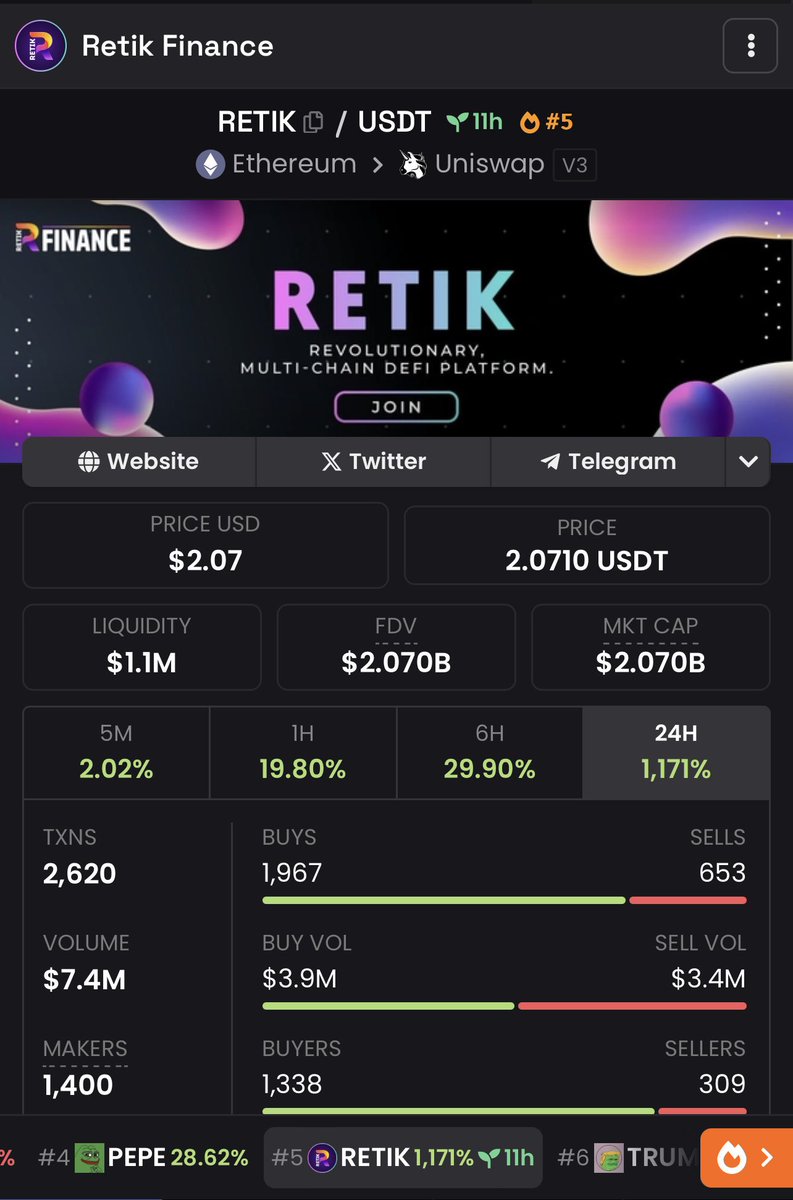
Retik Finance ($RETIK) growth has been phenomenal after its launch!😍
$RETIK climbing like a roller coaster 🎢since listing on multiple exchanges. Let's continue to reach new heights together! 🚀
Stay tuned for more updates as we continue to innovate and grow.
#RETIK #retikfinance
Retik Finance skyrockets 1171% since launch 🚀🔥 With over $10M in volume, we're just getting started! ❤️
Buy Now: https://t.co/YNGH1jcKwm
#Crypto#Retik#RetikFinance#ETH
📈@RetikFinance is skyrocketing!!
$RETIK has climbed over 1000% since its launch on #Uniswap and multiple exchanges! 🚀
With trading volume over $10M! ❤️
Read more: https://t.co/wrgU1J9cCG
#Retik#RetikFinance
Retik Finance (Retik) Launches on Uniswap and Major Exchanges on May 21😍✨
With the listing price set at $0.15 and major exchange listings and Uniswap launch scheduled for May 21, Retik Finance (RETIK) is poised for exponential growth in the cryptocurrency market.
Read more: https://t.co/C3ZIFTSPBm
Get ready for the launch of Retik Finance (RETIK) on May 21st, 2024, at 12pm UTC! 😍🚀
Don't miss your chance to be part of this milestone event as RETIK goes live on multiple exchanges and Uniswap.
Stay tuned for updates!
#RetikFinance#RETIK
🌐 🌟Introducing Retik's Multi-Chain Swap! 🚀
Experience the ultimate in decentralized trading with Retik Swap! 💸
Discover the best prices, lowest fees, and maximum liquidity across 22 chains and 46 DEXes! 💰 💡
Join the decentralized revolution now: https://t.co/Ta6XRVMj9L
#RetikSwap #DeFi #DEX