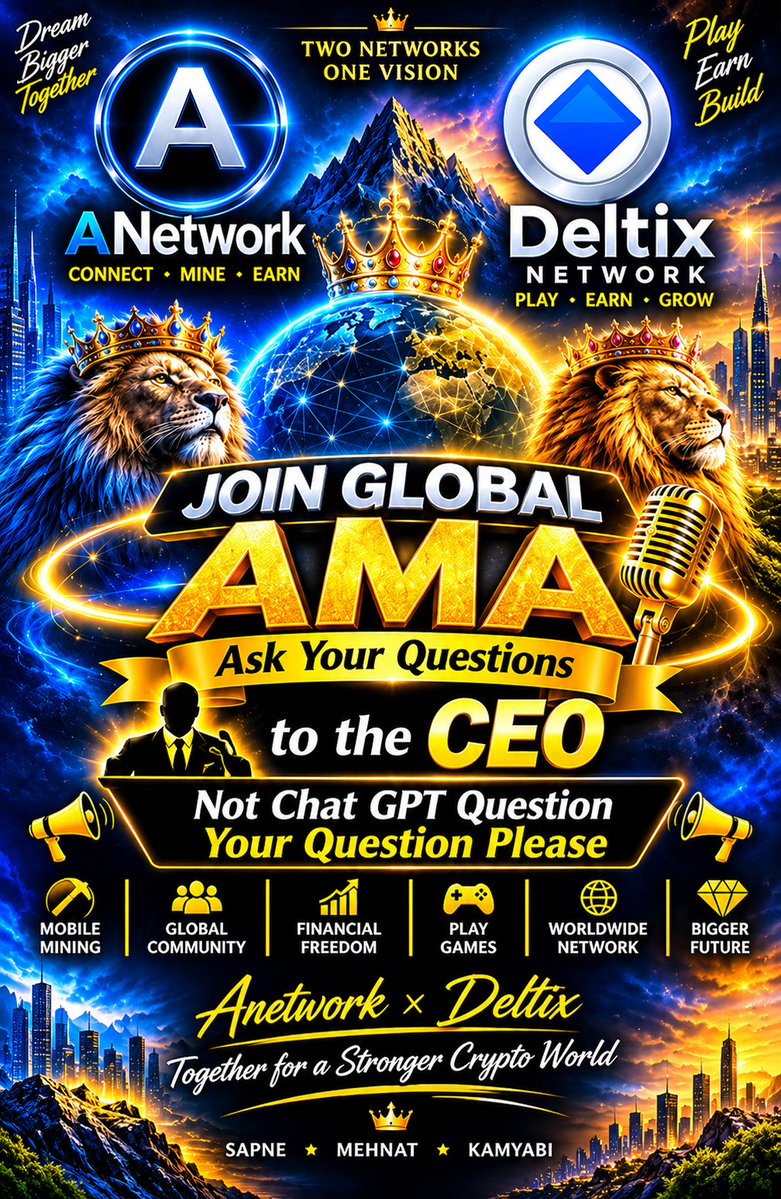
👑 **TWO NETWORKS. ONE VISION. ONE GLOBAL FUTURE!** 🌍🔥
🔷 ANetwork × Deltix 🚀
Great partnerships create greater opportunities. Two communities, two powerful visions, and one dream of building a stronger crypto future. 💎
#ANetwork#Deltix#deltixnetwork#joinama
🚨 CAA, YOU SPENT MONTHS BEGGING PROJECTS FOR ATTENTION. NOW YOU DON’T KNOW WHAT TO DO WHEN A BUILDER ACTUALLY RESPONDS.
I’ve been watching your performance on X.
For months, you’ve been jumping from one crypto project to another.
Shouting. Accusing. Complaining. Demanding answers.
Day after day, arguing with community members as though winning an argument with a random miner makes you a blockchain auditor.
But here’s the funny part.
YOU WANTED ATTENTION FROM PROJECT LEADERSHIP.
THEN A NETWORK ACTUALLY GAVE YOU A RESPONSE.
Not once.
Not twice.
Three or four times.
And instead of demonstrating the maturity of a serious researcher, you started producing sequels to your own essays.
CAA AUDIT — PART 1.
CAA COUNTER-AUDIT — PART 2.
CAA OFFICIAL WATCHDOG — PART 3.
At this rate, Netflix might offer you a documentary series before you finish auditing our GitHub. 😂
Let’s remember your performance.
You demanded ownership information.
WE PROVIDED IT.
You demanded developer information.
WE PROVIDED IT.
You questioned our US legal entity.
WE PROVIDED THE COMPANY INFORMATION AND ADDRESS.
You questioned our legal standing.
WE EXPLAINED OUR US REGISTRATION AND FEDERAL TAX STATUS.
You questioned our trademark.
WE POINTED TO OUR USPTO REGISTRATION.
You questioned our blockchain.
WE PROVIDED THE EXPLORER.
You questioned mining records.
WE PROVIDED THE RECORDS AND WHERE TO CHECK THEM.
You questioned development.
WE EXPLAINED THE DEVELOPMENT.
You questioned GitHub.
WE POINTED YOU TO THE SOURCE CODE.
And suddenly your next discovery was:
🚨 “SOURCE CODE ONLY PROVES CODE WAS WRITTEN!”
Outstanding research, Sherlock.
What’s next?
🚨 “EXCLUSIVE: WATER IS WET!”
YOU KEEP ASKING QUESTIONS, BUT EVERY TIME YOU RECEIVE AN ANSWER, YOU CHANGE THE SUBJECT.
That’s not how serious research works.
That’s how someone keeps an argument alive after running out of new material.
And now you’ve announced that A Network is under your “OFFICIAL WATCHDOG MONITORING.”
Congratulations on your promotion.
Who appointed you?
Yourself?
Did you hold a meeting with your keyboard and unanimously elect yourself Chief Blockchain Inspector? 😂
PUTTING “OFFICIAL” IN CAPITAL LETTERS DOESN’T GIVE YOU OFFICIAL AUTHORITY.
And since you enjoy putting A Network’s registered branding in your posts, remember that a trademark registration is a real legal record, not something you get to redefine through an X headline.
You can criticize us.
You can examine us.
But don’t confuse your personal commentary with a regulatory investigation.
NOW HERE’S THE PART THAT SHOULD EMBARRASS YOU.
Think about the mobile mining industry since 2019.
Millions of users across different projects.
Years of unanswered questions.
Communities demanding clarity about ownership, unlocks, development, and token distribution.
And here you are, receiving repeated public responses from someone actually involved in building the infrastructure.
YOU FINALLY GOT THE CONVERSATION YOU’VE BEEN CHASING.
And what did you do?
You turned it into another engagement campaign.
Imagine spending months knocking on doors, demanding someone answer you.
One day, the owner opens the door.
You ask ten questions.
He answers ten questions.
You go home and publish:
🚨 “BREAKING: OWNER CONFIRMS HE LIVES IN THE HOUSE!”
That’s your audit methodology in one sentence.
HERE’S A LESSON YOU WON’T FIND IN YOUR NEXT AI-GENERATED ESSAY.
A serious researcher doesn’t lose credibility by acknowledging a response.
He gains credibility by reporting it fairly.
You could have told your followers:
“I challenged A Network. Its leadership responded publicly, provided company information, pointed to its blockchain explorer and GitHub, and addressed my questions. I still have concerns.”
That would have been a credible statement.
But apparently, acknowledging anything positive would ruin the next episode of your investigation.
YOU DON’T HAVE TO LIKE A NETWORK.
YOU DON’T HAVE TO LIKE ITS BUILDERS.
AND YOU CERTAINLY DON’T HAVE TO AGREE WITH US.
But if your entire identity depends on never acknowledging an answer, perhaps you’re more interested in arguments than audits.
“A RESEARCHER FOLLOWS THE EVIDENCE. A PERFORMER FOLLOWS THE APPLAUSE.”
And let’s make one more thing clear.
I didn’t respond because your account has authority over A Network.
I responded because public accountability matters.
YOU MISTOOK PROFESSIONAL COURTESY FOR AN OBLIGATION TO ENTERTAIN YOU INDEFINITELY.
That’s your mistake.
This is my final response.
I welcome genuine audits.
I welcome healthy criticism.
I welcome technically grounded challenges.
But I am not employed to write daily responses to your essays.
YOU HAVE AN X ACCOUNT TO MANAGE.
I HAVE A NETWORK TO BUILD.
YOU CAN KEEP COUNTING MY REPLIES.
I’LL KEEP COUNTING OUR PROGRESS.
— A Network Builder
BUILD FIRST. DELIVER SECOND. TALK LAST.
@Crypto_A_A@Dr_ANET1@LateshShetty13@yasirabbasi300@Joel_Dupalco@Queen_ANet
🚨 CAA, YOU DIDN’T EXPOSE A NETWORK. YOU EXPOSED HOW LITTLE YOU UNDERSTAND ABOUT BUILDING ONE.
THIS IS NOT AN AUDIT , IT’S AN ESSAY THAT A 2nd GRADE STUDENT CAN WRITE FROM AI ,
REMEMBER ONE MORE THING I AM JUST GIVING YOU THIS ATTENTION BECAUSE OF OUR COMMUNITIES TRUST IN US , THAT WE DON’T HIDE FROM CRITICISM, BUT ITS NOT REALLY WORTH MY TIME TO ANSWER AN ATTENTION SEEKER.
I answered your 15 allegations with facts. You returned with another essay, recycled the same arguments, and announced that you had won.
Let me make something clear.
You are not auditing my excuses. You are auditing infrastructure that our team actually built.
You say our application uses Web2 servers.
BREAKING NEWS: So do thousands of Web3 applications.
You think a blockchain cannot exist because its mobile application uses centralized authentication and anti-farming systems?
Then you need to learn the difference between an application backend and a blockchain.
We deliberately validate mining sessions to prevent people from manipulating the system.
That’s engineering, not a confession.
By your logic, if a bank installs security cameras, the money inside its vault must be fake.
A SECURITY SYSTEM DOESN’T INVALIDATE THE SYSTEM IT PROTECTS.
YOU FOUND ZERO CLAIMED ANET?
Genesis Unlock hasn’t happened yet!
We announced December 2026 long before you decided to become our watchdog.
You are standing outside a building under construction, screaming that nobody has moved in.
And you call that an audit?
Imagine walking into a restaurant at 8 AM, being told it opens at noon, and publishing an investigation at 9 AM:
🚨 “BREAKING: RESTAURANT HAS SERVED ZERO LUNCHES!”
That’s basically your 86,266 ANET discovery.
YOU DISCOVERED ADVERTISEMENTS?
We literally disclosed them in our whitepaper, app listings, and release notes.
We even publicly documented changes to our advertising providers.
You didn’t uncover a secret.
You read our documentation and repackaged it as an investigation.
Imagine opening a newspaper, reading the weather forecast, and announcing:
🚨 “EXCLUSIVE INVESTIGATION: TOMORROW MAY RAIN!”
Congratulations, detective. The information was already public.
And your argument that operators earn advertising revenue while miners wait for Genesis?
Does a construction company stop paying its engineers until the building opens?
Does a software company wait until its final product launches before generating revenue?
REVENUE DURING DEVELOPMENT IS NOT AUTOMATICALLY EVIDENCE OF DECEPTION.
YOU DISCOVERED THAT OUR RPC IS STILL UNDER DEVELOPMENT?
Another extraordinary discovery.
Something we already told everyone is under development is, apparently, still under development.
What exactly did you expose?
Imagine Apple announcing a future iPhone feature, and someone publishing an emergency audit six months before its release:
🚨 “EXPOSED: APPLE’S UPCOMING FEATURE IS NOT AVAILABLE TODAY!”
That’s not an investigation.
That’s reading a roadmap and pretending you discovered a conspiracy.
YOU FOUND OUR GITHUB BUT NOW CODE ISN’T ENOUGH?
Now this is my favorite part.
In your previous post, you raised questions about our GitHub and publicly available code.
We responded by pointing you toward our repository.
And suddenly, in your new essay, the conversation changes.
Now you acknowledge that source code exists, but apparently code is no longer what you wanted.
First, you question the code.
We show you where to examine it.
Then you announce:
“Uploading Rust files and backend API code proves code was written.”
BRILLIANT DISCOVERY. SOURCE CODE PROVES SOMEONE WROTE SOURCE CODE.
What’s next?
🚨 “EXCLUSIVE AUDIT: A CAR ENGINE PROVES SOMEONE BUILT AN ENGINE, NOT THAT THE CAR CAN DRIVE!”
Then inspect the engine.
Test the implementation.
Examine the architecture.
But don’t ask where the engine is, receive the location, and immediately change the subject to the tires.
Now you want independent validators, unrestricted RPC, and every future infrastructure component completed immediately.
That’s not a technical finding.
That’s moving the goalposts.
And let’s be clear: GitHub source code alone does not prove that every component of a production network is decentralized.
But if your original criticism concerns the absence of accessible code, and we provide a repository, acknowledge that response instead of pretending nothing changed.
AN AUDIT SHOULD FOLLOW THE EVIDENCE, NOT RUN AWAY FROM IT.
YOU KEEP TALKING ABOUT wANET PRICES.
We never guaranteed that native ANET would trade at the same market price as wANET.
Our bridge eligibility rules are clear.
Complete 1,000 sessions.
Become eligible.
Bridge according to the ecosystem rules.
Buying wANET externally does not purchase your way into native ANET eligibility.
You keep presenting our published rules as though you discovered hidden restrictions.
Imagine an airline publishing its baggage policy, and someone buying a ticket without reading it.
Then an auditor announces:
🚨 “AIRLINE EXPOSED! BAGGAGE RESTRICTIONS DISCOVERED!”
The restrictions were published.
Not reading them doesn’t make them secret.
And since you mentioned the external wANET market price, here’s another basic lesson.
A MARKET PRICE IS NOT A GUARANTEED REDEMPTION PRICE.
A 1:1 token bridge ratio does not mean two separate markets must trade at identical prices.
You are criticizing a guarantee we never made.
AND NOW YOU WANT TO TEACH US ABOUT BITCOIN?
You proudly claim Bitcoin was decentralized from Day 1.
NOT SO FAST. LET’S OPEN THE HISTORY BOOK.
Bitcoin launched in January 2009 with open-source software and a permissionless design.
But was it decentralized on Day 1 to the degree it is today?
Absolutely not.
In its earliest days, Bitcoin had only a handful of participants.
Satoshi Nakamoto was the principal developer and one of its earliest miners.
The network had nowhere near today’s distribution of miners, developers, and infrastructure.
BITCOIN WAS DESIGNED FOR DECENTRALIZATION FROM DAY ONE. THAT DOESN’T MEAN IT ACHIEVED TODAY’S LEVEL OF DECENTRALIZATION ON DAY ONE.
And since you’re so interested in Bitcoin’s early history, let’s discuss something else.
AUGUST 15, 2010.
184,467,440,737 BTC.
Yes, you read that correctly.
More than 184 BILLION BITCOIN were created in a single transaction because of a critical software vulnerability.
A network designed around a maximum supply of 21 million BTC temporarily accepted the creation of more than 184 billion BTC.
Developers had to identify the vulnerability, release corrected software, and coordinate adoption of a corrected blockchain history.
The invalid transaction was eventually excluded from the accepted chain.
Now tell us, CAA.
DID THAT MAKE BITCOIN A SCAM?
DID THAT MAKE BITCOIN A FAKE BLOCKCHAIN?
DID THAT MAKE ITS DEVELOPERS FRAUDSTERS?
NO.
It meant that even groundbreaking technology could have serious vulnerabilities during its early development.
Bitcoin survived because developers identified the problem, fixed it, and continued building.
That incident did not prove Bitcoin was centralized. It proved that decentralized systems can still experience critical bugs and require coordinated software upgrades.
And that’s exactly what you keep missing.
Imagine someone auditing Bitcoin in August 2010 and announcing:
🚨 “184 BILLION BTC CREATED! BITCOIN IS FINISHED!”
Imagine if every developer had stopped building because an X account declared the technology a failure.
THANKFULLY, SOFTWARE ENGINEERS DON’T BUILD TECHNOLOGY BY FOLLOWING SOCIAL MEDIA HEADLINES.
YOU CANNOT JUDGE EVERY BLOCKCHAIN BY PRETENDING THAT BITCOIN WAS BORN WITH THE SAME INFRASTRUCTURE, PARTICIPATION, AND MATURITY IT HAS TODAY.
Bitcoin had its architecture.
A Network has its architecture.
Bitcoin had its development challenges.
A Network has its development challenges.
Nobody appointed you the authority who gets to decide that every blockchain must follow Bitcoin’s exact launch model.
NOW LET’S TALK ABOUT YOUR DECEMBER WATCHDOG.
You announced that A Network is officially under CAA monitoring.
And?
Did you think that announcement would stop our developers?
Did you think we needed your permission to launch Genesis?
Did you think putting the word “OFFICIAL” in your headline gave you authority over our roadmap?
Imagine standing outside a construction site wearing a homemade inspector badge and announcing:
🚨 “THIS BUILDING IS NOW OFFICIALLY UNDER MY WATCH!”
The engineers would probably ask you to move away from the entrance so the trucks could get through.
You are free to watch.
You are free to criticize.
You are free to publish another 15 essays.
But understand one thing:
YOUR POSTS DO NOT BUILD BLOCKCHAINS.
Our developers write code.
Our infrastructure processes network activity.
Our team works on the systems that you sit online criticizing.
And while you keep counting the features we haven’t released yet, we keep working to release them.
HERE IS MY CHALLENGE.
Stop recycling our own disclosures as investigative discoveries.
Show us an actual exploit.
Show us fabricated transactions.
Show us manipulated supply.
Show us evidence that our published code contradicts our claimed implementation.
Bring technical evidence, not dramatic headlines.
And if you cannot establish those allegations, stop pretending that repeating them makes them true.
You call yourself an auditor.
Then audit.
I DIDN’T BUILD A NETWORK TO WIN ARGUMENTS WITH AN X ACCOUNT.
I built it to deliver infrastructure.
December is approaching.
Genesis is approaching.
And our work will continue long after your next headline disappears from the timeline.
YOU KEEP WRITING ABOUT WHAT WE HAVEN’T BUILT YET.
WE’LL KEEP BUILDING WHAT YOU’LL HAVE TO WRITE ABOUT NEXT.
AND ONE FINAL THING, CAA.
This is my last response to you.
Not because I am afraid of your questions.
Not because I cannot answer them.
And certainly not because I object to scrutiny.
I WELCOME HEALTHY CRITICISM.
I WELCOME GENUINE TECHNICAL AUDITS.
I WELCOME PEOPLE WHO CHALLENGE OUR WORK WITH VERIFIABLE EVIDENCE.
But I am a builder.
I am not here to spend my days answering your essays, especially when each new essay repackages the same publicly disclosed information.
You have made your arguments.
We have provided our responses.
The community can examine both.
From this point forward, my time belongs to development, not endless debates.
YOU CAN KEEP WRITING ESSAYS ABOUT A NETWORK.
I HAVE A NETWORK TO BUILD.
And remember:
A HEADLINE TAKES FIVE MINUTES TO WRITE.
INFRASTRUCTURE TAKES YEARS TO BUILD.
— A Network Builder
BUILD FIRST. DELIVER SECOND. TALK LAST.
@Crypto_A_A@Joel_Dupalco@Dr_ANET1@LateshShetty13@Queen_ANet@BuildOnAnet@ANetworkLLC
#ANetwork #ANet #ANTS #wANet #ANRC20
Some things are better left unsaid.
Some moves are better left unseen.
And some games are already won before the world realizes they’ve begun.
♠️ GAME ON.
@Joel_Dupalco#ANetwork#ANRC
👑 **TWO NETWORKS. ONE VISION. ONE GLOBAL FUTURE!** 🌍🔥
🔷 ANetwork × Deltix 🚀
Great partnerships create greater opportunities. Two communities, two powerful visions, and one dream of building a stronger crypto future. 💎
#ANetwork#Deltix#deltixnetwork#joinama
MY OFFICIAL RESPONSE TO THE A NETWORK AUDIT
Dear Mr. CAA,
This is our third interaction.
And once again, I am here personally to answer your allegations about A Network.
Before we begin, understand one thing.
I am not one of those project CEOs who hides behind curtains when difficult questions are asked.
I am here. I am accessible. And I am willing to answer every legitimate question.
But if you are going to publish something and call it a technical audit, you have a responsibility to understand the technology, read the documentation, and verify your conclusions.
Let’s go through your allegations one by one.
1. “A NETWORK ACCIDENTALLY DOCUMENTED ITS ADVERTISING SYSTEM.”
Accidentally? Seriously?
Mr. CAA, we documented those changes intentionally.
We published those release notes ourselves because we believe users should know what changes inside their application.
Our whitepaper explains our advertising model.
Our Google Play Store and Apple App Store disclosures identify advertising within the application.
We have never hidden that A Network uses advertisements.
Running servers, maintaining infrastructure, developing applications, and supporting a global ecosystem require resources.
Advertising is one of the ways we support those operations.
And an advertising trigger does not automatically mean every interaction results in a displayed advertisement or a payment.
You presented information we voluntarily disclosed as though you had uncovered a secret.
There is nothing accidental about transparency.
2. “A NETWORK IS A CENTRALIZED AD MONETIZATION ENGINE.”
An application using advertisements does not make its blockchain fictional.
Advertising infrastructure and blockchain infrastructure are separate components.
A Network has an application, a mining participation system, a Layer 1 settlement architecture, and an external wANET market.
You are entitled to question our monetization model.
But describing the entire project as an advertising operation requires evidence beyond the existence of advertising SDKs.
And regarding revenue, we have already discussed our advertising revenue publicly during a live YouTube presentation with our community.
We did not hide the subject.
We discussed it openly.
3. “MINING SESSIONS ARE VALIDATED CENTRALLY ON WEB2.”
YES. AND WE DESIGNED IT THAT WAY.
Why?
To prevent automated farming, duplicate accounts, manipulated sessions, and other abuse.
A Network does not claim that pressing a mining button performs Bitcoin-style computational mining.
Our participation system validates six-hour Ant Work sessions.
The backend checks participation and eligibility.
Our Layer 1 architecture separately handles blockchain records and settlement.
The public source code documents the relationship between the Web2 mining ledger and the Layer 1 settlement system.
Our Miner Directory and explorer provide additional ways to inspect available records.
MINER DIRECTORY:
https://t.co/wbRlqt0P5x
LAYER 1 EXPLORER:
https://t.co/E54xKpXzof
A centralized participation-validation system and a blockchain settlement system are not the same thing.
We have also never claimed that every component of our validator architecture is already fully permissionless.
Our decentralization roadmap is being developed in phases.
Centralized mining-session validation does not prove that a blockchain does not exist.
4. “86,266 ANET MINED, BUT ZERO ANET CLAIMED.”
Mr. CAA, this is one of the most misleading conclusions in your entire audit.
A NETWORK HAS NOT REACHED ITS GENESIS UNLOCK YET.
Our Genesis Unlock is targeted for December 2026.
Users must complete 1,000 verified sessions to become eligible.
Mining accumulation and claiming are two different stages.
If you examine a pre-unlock system and find that users have not yet claimed their balances, that is not automatically evidence of a failed distribution mechanism.
The correct test is whether eligible participants can claim and use their balances when the applicable unlock conditions are satisfied.
You cannot declare a future unlock mechanism a failure simply because its scheduled activation has not occurred.
5. “THE MINED ANET IS JUST DATABASE POINTS.”
Then examine the publicly available architecture.
We have provided a Miner Directory.
We have provided a Layer 1 explorer.
And we have published Layer 1 source code.
Our technical documentation describes how Web2 mining balances are tracked and how eligible balances can be activated or settled into the Layer 1 environment.
The backend mining ledger and on-chain balances are not identical records.
That distinction is part of the architecture, not something we are concealing.
A proper audit should distinguish between completed mining sessions, pending activation, on-chain settlement, and transferable balances.
Read the source code. Examine the records. Then present your technical findings.
6. “THE 1,000-SESSION REQUIREMENT IS A BOTTLENECK.”
Yes, A Network requires 1,000 verified sessions.
And where did you find this supposedly hidden requirement?
IN OUR OWN WHITEPAPER.
Four sessions are available daily.
Each session lasts six hours.
The theoretical minimum to complete 1,000 sessions is 250 days.
This requirement has been part of our participation model since the beginning.
It is intended to reward sustained participation and discourage automated account farming.
You can disagree with our model.
But a publicly documented participation requirement is not evidence of fraud.
And completing 1,000 sessions does not require purchasing expensive mining equipment.
Our system is designed around participation rather than computational mining power.
7. “USERS MUST WAIT SIX MONTHS BEFORE THEY CAN SELL.”
YOU ARE CONFUSING NATIVE P2P TRANSFERS WITH EXTERNAL BRIDGING.
Our Genesis Unlock and native P2P mechanism are separate from the external-market vesting schedule.
After Genesis, eligible participants are intended to be able to transfer and sell unlocked native ANET through the supported P2P mechanism.
The external-market release schedule governs how eligible native ANET becomes available for export into the external wANET environment.
These are two different mechanisms.
The purpose of the external release schedule is to prevent the entire eligible supply from entering external markets simultaneously.
This is a supply-management policy.
It is not staking.
It is not a mechanism that pays users additional rewards for locking coins.
And it is not a guarantee of future token prices.
Remember something important.
Bitcoin was introduced as a peer-to-peer electronic cash system.
It did not begin with centralized exchanges.
A Network’s native economy is also designed around peer-to-peer participation and transfers.
P2P AND EXTERNAL BRIDGING ARE NOT THE SAME THING.
8. “A NETWORK DISPLAYS THE wANET PRICE TO MISLEAD MINERS.”
Who guaranteed that every mined ANET would immediately be worth the external wANET market price?
Show me where we made that promise.
Native ANET and wANET operate in separate environments.
Native ANET belongs to our Layer 1 ecosystem.
wANET operates on BNB Smart Chain.
The external market price reflects trading activity and available liquidity.
It does not guarantee the immediate cash-out value of locked or unclaimed native ANET.
For eligible participants, external bridging is an additional option governed by the applicable rules.
WE HAVE NEVER GUARANTEED A MARKET PRICE OR INVESTMENT RETURN.
An external quotation is not a promise of redemption value.
9. “THE CEO MANIPULATED APP STORE RATINGS.”
You identified one five-star review allegedly associated with me.
And from that, you concluded that A Network operates a ratings manipulation campaign?
One review does not establish an organized campaign.
If you have evidence of purchased reviews or coordinated manipulation, present it.
We do not rely on buying thousands of artificial reviews to manufacture credibility.
Any review associated with a developer or executive should, of course, comply with the applicable platform rules.
But an allegation about a review should be assessed using evidence, not assumptions about someone’s motives.
10. “A NETWORK ADDED GAMES INSTEAD OF BUILDING DEVELOPER TOOLS.”
When we introduced those games, A Network was approximately two and a half months old.
At that stage, our application primarily offered mining.
We added games so participants would have something else to enjoy inside the application.
That is all.
Users can mine, participate in the community, and use additional features while infrastructure development continues.
Adding Chess, Ludo, Sudoku, or other games does not invalidate blockchain development.
A BLOCKCHAIN ECOSYSTEM CAN HAVE MORE THAN ONE FEATURE.
11. “A NETWORK SHARES PERSONAL INFORMATION WITH THIRD PARTIES.”
Let’s clarify something.
A Network does not require miners to provide their real names to participate.
Our mining system relies on account verification, wallet identities, and participation records.
We do not operate a business selling miners’ personal identities.
However, applications using advertising, authentication, and security providers may transmit technical information such as device identifiers or IP addresses to those service providers.
That is different from selling a database of users’ names.
Privacy disclosures should accurately reflect what our application and its integrated services process.
We welcome specific, evidence-based questions about data collection and third-party processing.
But please distinguish technical service-provider processing from allegations that we are selling users’ personal identities.
12. “WHERE IS YOUR PUBLIC GITHUB?”
MR. CAA, THIS ONE IS PARTICULARLY INTERESTING.
You asked where our GitHub is.
Here it is.
A NETWORK PUBLIC GITHUB:
https://t.co/FhfvfN9hRJ
LAYER 1 BLOCKCHAIN SOURCE CODE:
https://t.co/yTwJa9BtLi
MOBILE APPLICATION SOURCE CODE:
https://t.co/zMwOCVPUfW
Our Layer 1 repository includes Rust source code, node configuration, transaction APIs, and validator-related documentation.
The repository describes the Web2 mining synchronization mechanism, eligible balance activation, and signed transaction processing.
It also documents API routes for blockchain accounts, blocks, transactions, DEX operations, and ANRC-20 functionality.
These are actual technical resources available for examination.
Public source code does not automatically establish full decentralization.
We understand that.
But you specifically asked where our code was.
HERE IT IS.
Now examine it and identify any actual technical inconsistencies.
That would be a far more useful audit than simply claiming the code is unavailable.
13. “WHERE IS YOUR PUBLIC RPC?”
Our broader RPC and external Web3 wallet connectivity remain part of our development roadmap.
Our Layer 1 explorer is available.
Our DEX interface is also live.
A NETWORK DEX:
https://t.co/UsnvODhcpI
We are working toward broader wallet connectivity and developer access.
These developments are part of our next infrastructure phase.
An RPC endpoint is an interface that allows external applications to communicate with a blockchain.
It does not create the blockchain itself.
And an explorer does not automatically establish a fully permissionless network.
We recognize those distinctions.
We will not claim that unfinished RPC integrations are already complete.
14. “WHEN WILL PUBLIC VALIDATORS BE AVAILABLE?”
Again, read our roadmap.
Independent validator participation is part of the next development phase.
Our current architecture includes operator-managed infrastructure.
We have not claimed that every aspect of our network is already permissionless.
Moving toward independently operated validators and broader public verification is part of the work ahead.
We are building toward that goal.
And when those capabilities are available, they should be evaluated through independent technical verification.
15. “WHY DOESN’T A NETWORK OFFER UNRESTRICTED TWO-WAY BRIDGE PARITY?”
Because A Network is designed around eligibility.
Participants must complete 1,000 verified sessions before becoming eligible for native ecosystem transfers and supported bridge operations.
Buying wANET externally does not automatically make someone an eligible native ANET participant.
It does not bypass the mining requirement.
Our published bridge policy restricts the movement of externally purchased assets into the native mining economy.
The distinction between eligible miners, native balances, and external token holders is intentional.
BUYING AN EXTERNAL TOKEN DOES NOT MEAN YOU HAVE COMPLETED 1,000 MINING SESSIONS.
And it does not grant unrestricted access to the native economy.
⸻
NOW LET ME SPEAK DIRECTLY TO YOU, MR. CAA.
This is our third interaction.
And once again, I have personally responded.
I am not hiding behind a public relations team.
I am not disappearing because someone has asked difficult questions.
I am here.
You want to discuss advertising?
Let’s discuss it.
You want to discuss centralized session validation?
Let’s discuss the architecture.
You want to examine the blockchain?
Here is the explorer.
You want to inspect mining records?
Here is the Miner Directory.
You want to inspect the source code?
Here is our GitHub.
You want to ask about RPC, validators, P2P, or bridging?
I am available to discuss those as well.
BUT THERE IS A DIFFERENCE BETWEEN ASKING QUESTIONS AND PRESENTING INCOMPLETE RESEARCH AS A DEFINITIVE VERDICT.
A Network is a developing ecosystem.
We have operational infrastructure.
We have published economic rules.
We have centralized components.
And we have development milestones that are not yet complete.
We have never needed to pretend otherwise.
I welcome legitimate technical criticism.
But I expect researchers to distinguish between a feature that is operational, a feature that is restricted, and a feature that is scheduled for a future phase.
You are welcome to join our public AMA.
Bring your questions.
Bring your evidence.
Bring your technical findings.
I will answer what I can, and where additional engineering verification is needed, we will identify it.
I AM NOT AFRAID OF QUESTIONS.
But I will challenge conclusions that misrepresent our published rules or confuse separate technical mechanisms.
Our community deserves accurate information.
Our critics deserve factual answers.
And our technology deserves to be judged by what can actually be verified.
BUILD FIRST. DELIVER SECOND. TALK LAST.
— Digital Gold
A Network
OFFICIAL RESOURCES
Website: https://t.co/DsNAXjqyej
Whitepaper: https://t.co/HCwpcjgdEe
Miner Directory: https://t.co/wbRlqt0P5x
Layer 1 Explorer: https://t.co/E54xKpXzof
DEX: https://t.co/UsnvODhcpI
GitHub: https://t.co/FhfvfN9hRJ
Layer 1 Source: https://t.co/yTwJa9BtLi
Mobile App Source: https://t.co/zMwOCVPUfW
@Crypto_A_A@Queen_ANet@LateshShetty13@Dr_ANET1@BuildOnAnet
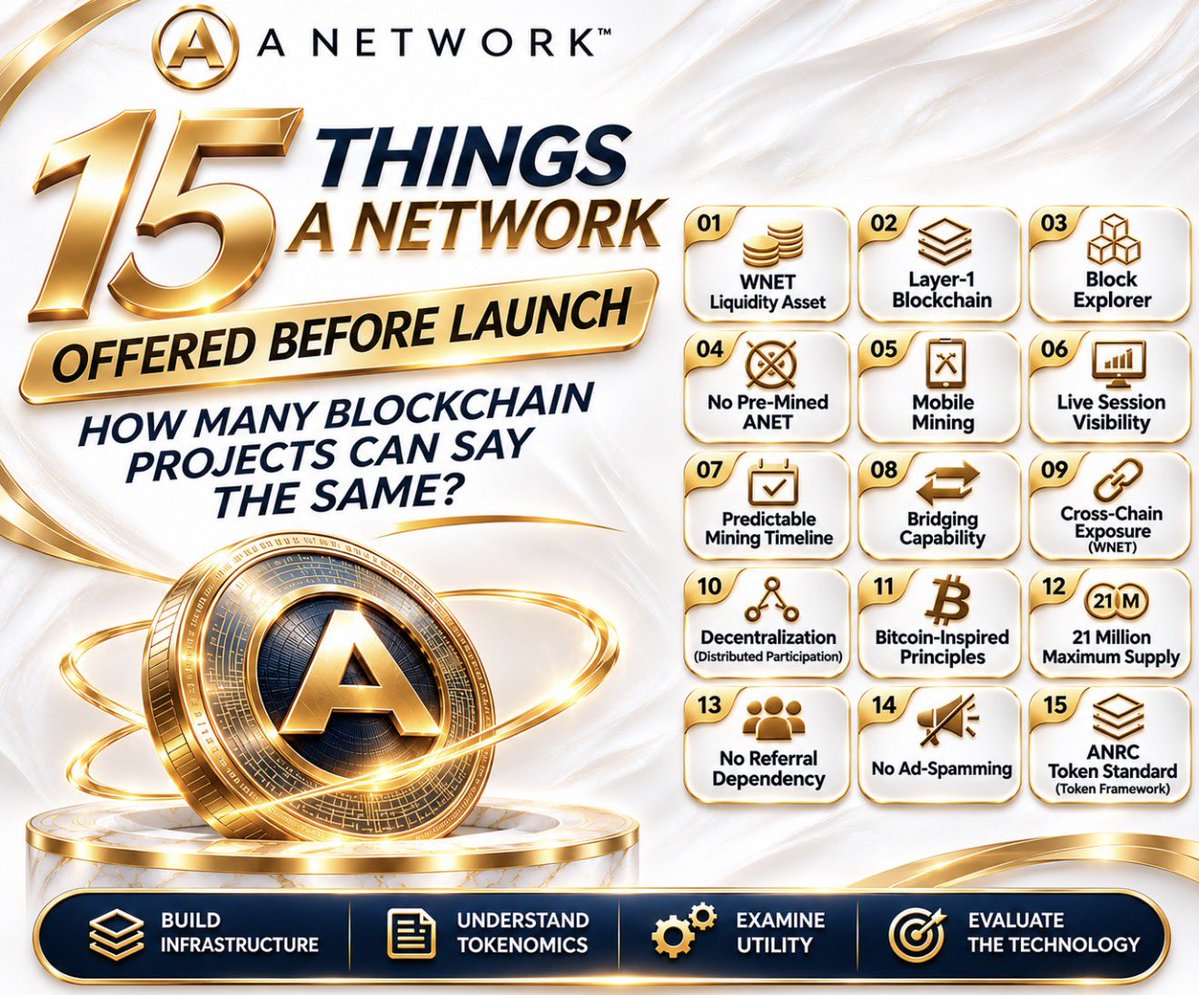
15 THINGS A NETWORK OFFERED BEFORE LAUNCH. HOW MANY BLOCKCHAIN PROJECTS CAN SAY THE SAME?
Before asking about the price of $ANET, take a closer look at what was built BEFORE launch.
Most projects launch a token first and promise to build the ecosystem later.
A Network took a different approach.
15 key features worth examining:
WNET — A liquidity-related asset introduced before launch.
Layer-1 Blockchain — Its own blockchain infrastructure.
Block Explorer — On-chain transparency from the beginning.
No Pre-Mined Native ANET — No special pre-mined founder allocation.
Mobile Mining — Mining participation directly through a mobile application.
Live Session Visibility — Mining sessions visible through the explorer.
Predictable Mining Timeline — Calculate expected coin release based on predefined rules.
Bridging Capability — Connectivity beyond a single blockchain.
Cross-Chain Exposure — WNET as a pathway to other blockchain ecosystems.
Decentralization — A focus on distributed participation.
Bitcoin-Inspired Principles — Scarcity and predefined monetary rules.
21 Million Maximum Supply — A limited native ANET supply.
No Referral Dependency — No referral recruitment requirement for mining.
No Ad-Spamming — No endless advertisements to earn.
ANRC Token Standard — A framework for creating tokens within the A Network ecosystem.
But here is what really matters:
A blockchain is not valuable simply because it has a token.
Its long-term potential comes from what people can build on it, what businesses can do with it, how transactions are processed, and whether real economic activity develops.
That’s why the conversation around A Network should go beyond price predictions.
Look at the infrastructure.
Understand the tokenomics.
Examine the utility.
Evaluate the technology.
Don’t just ask what $ANET could be worth. Ask what the A Network ecosystem could make possible.
No price is guaranteed. Real adoption and execution will ultimately matter.
#ANET #ANetwork #WNET #ANRC #Blockchain #Web3 #MobileMining
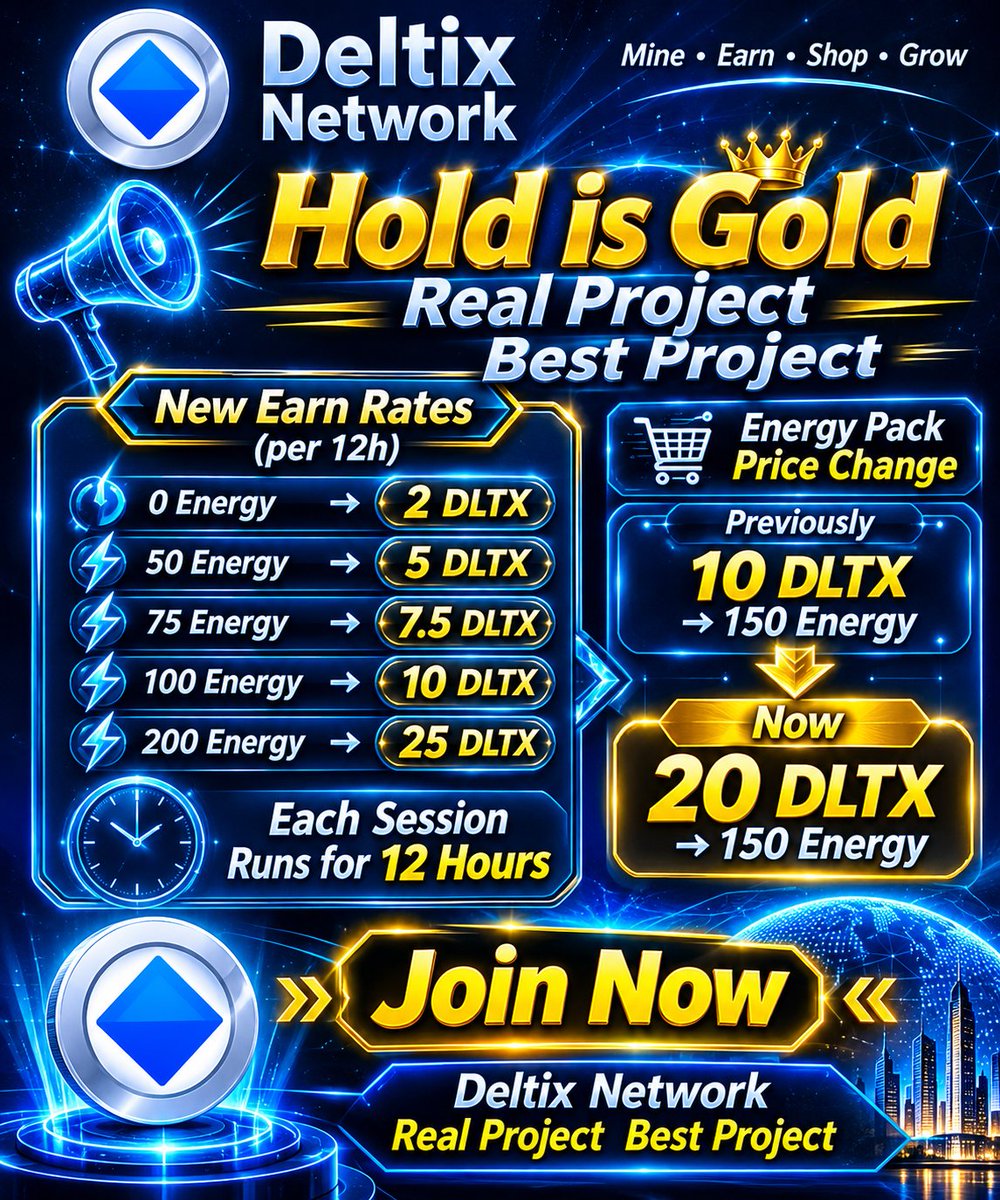
💎 **Deltix Network – A New Era of Earning!** 🚀
Every update brings new possibilities, new opportunities, and a stronger ecosystem. ⚡
⛏️ Mine • 💰 Earn • 🛒 Shop • 🌍 Grow
🔥 More earning options, exciting updates, and a growing community!
#Deltix#newupdate#new
🚀 **ANETWORK – A New Journey Begins!** 💎
Every big revolution starts with a small beginning. The future of blockchain is built by a strong and united community. 🌍
🔥 Real Project, Big Dreams
🚀 Building the Future Together
🤝 Join the Anetwork Family!
🚀 **ANETWORK – A New Journey Begins!** 💎
Every big revolution starts with a small beginning. The future of blockchain is built by a strong and united community. 🌍
🔥 Real Project, Big Dreams
🚀 Building the Future Together
🤝 Join the Anetwork Family!
#deltix#ANetwork