Xeffy's Community MiniApp has launched! 🚀
Join us: https://t.co/hmAJIkcSfD
Access the Xeffy app, become an early contributor, and contribute to RWA mass adoption!
Early participants and contributors will be provided with our ecosystem token $Xef 🎁
Mark June 2026 on your calendars!👀🪂
Invite your friends and earn points by using the app!
#Crypto is shifting!
The first decade was all about Layer 1, consensus, and infrastructure.
Now? The real action is moving to the application layer. $KAS #kaspa 👀
Your mobile phone runs with ARM chips. Your mobile wallets will run with Kaspa.
My followup illusion is building PoW with 100 blocks per second. Who’s coming?
Why Transaction Finality Is Actually A Physics Problem
The speed of light is 300,000 kilometers per second. Earth's circumference is 40,000 kilometers. This means information traveling at light speed takes approximately 133 milliseconds to circle the globe.
This physical limit constrains all blockchains. A miner in Sydney finds a block. A miner in New York finds a block at the same instant. Neither knows about the other's block because the information hasn't arrived yet. Who wins?
Bitcoin's solution: give blocks tons of time to propagate. Ten-minute block intervals mean a Sydney block reaches New York with 9 minutes and 50 seconds to spare. Conflicts are rare. When they happen, the longest chain rule resolves them. Simple, secure, slow.
The problem with speed. If Bitcoin tried 1-second blocks, geography becomes chaos. Sydney and New York would constantly mine competing blocks before hearing about each other. The orphan rate (wasted blocks) skyrockets. Security degrades because attackers exploit the confusion.
Single-chain blockchains cannot escape this. They must choose: long block intervals (safe but slow) or short intervals (fast but unstable). The physics don't negotiate.
Kaspa's architectural solution: embrace the conflicts instead of preventing them. At 10 blocks per second with 100ms intervals, conflicts are guaranteed. Miners on opposite sides of Earth will mine blocks before hearing about each other. That's fine. The blockDAG includes both blocks. GHOSTDAG's ordering algorithm determines sequence after the fact.
You're not fighting physics. You're designing around it. The blocks still propagate at light speed. But the system doesn't break when parallel blocks appear. It expects them and handles them algorithmically.
This is why blockDAG can achieve 100ms block times while single chains need 10 minutes. Different architecture, same physics, different constraint.
Next in The Kaspa Blueprint Series: why blockchain fees are actually paying for digital real estate.
Kaspa feels like the continuation of #Bitcoin, explains James Lee.
@KaspaFinance founder @cryptojameslee breaks down the tech during @token2049 — blockDAG architecture, proof-of-work consensus, and 10 blocks per second throughput. 🔽 https://t.co/YwjR1BDhMv
📣New Spot Listing Alert: $KAS Kaspa @kaspaunchained@Kaspa_KEF
Kaspa is a decentralized and fully scalable Layer-1, based on the GHOSTDAG protocol.
🪙Deposits Opened,
📈Trading Starts Soon!
https://t.co/7BXhMQRX8C
Fraction AI is collaborating with @Morpho to bring the best risk-adjusted yields to everyone through Fraction AI Agents.
Morpho Vaults let users deposit assets and earn yield across DeFi lending markets without active management.
Fraction AI’s agents add real-time capital routing, enabling automated allocation based on your risk–return profile.
Together, we are enabling autonomous agents deploy capital across the most valuable onchain assets. Intelligent automation of capital is here.
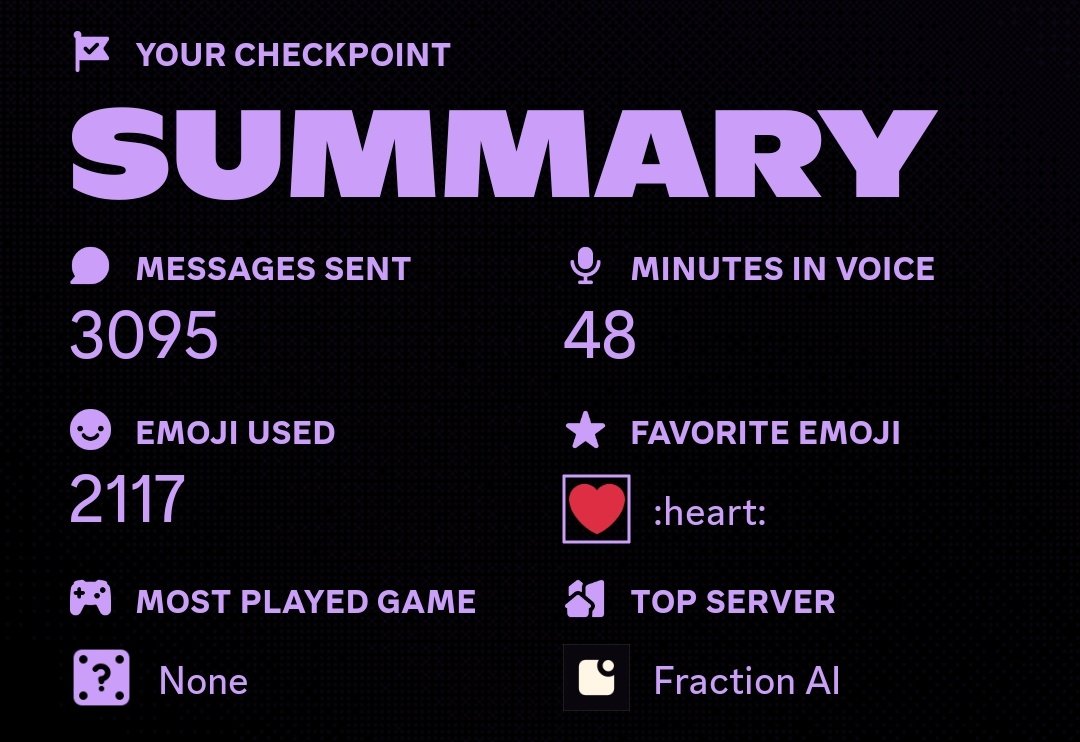
DISCORD SUMMARY, 2025.
I guess I really went hard on Discord this year, and it's quite evident on the number of Roles I earned while on it.
My Top Server was @FractionAI_xyz, and I can't say it's a surprise.
Fraction AI was the only thing that kept me locked in on Discord.
Let's do more next year.