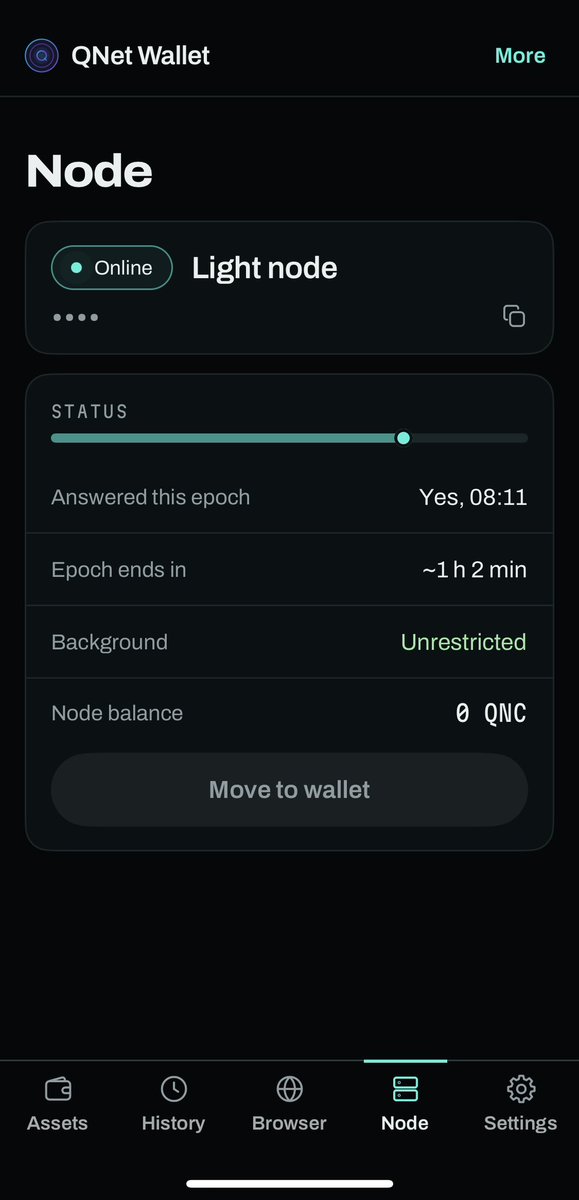
QNet Wallet has now been downloaded 111 times on Android (https://t.co/xdZyMqQbT3) and 32 times on iOS (https://t.co/0VvM1haz81)!
Over the past 26 days, the app has received 2.92K impressions on Google Play. It’s appearing in Google Play’s discovery sections, with users also finding it through ads and external referrals.
Waiting for the full iOS release. Thank you to everyone downloading, testing, and supporting QNet Blockchain!
Website update: The hosting provider is aiming to restore the servers on November 22–23, after which the website should be back online.
The attack on the hosting provider has not affected the QNet Blockchain. The network continues to operate.
Study QNET Blockchain.
Study 1DEV.
The best opportunities appear when the market is no longer watching—
and when a project doesn’t shout for attention.
Look past short-term price action.
Think in decades.
Study what’s being built.
Five minutes of serious research today
can be worth far more tomorrow.
1DEV :
4R3DPW4BY97kJRfv8J5wgTtbDpoXpRv92W957tXMpump
Whitepaper:
https://t.co/9tXYx9z8eY
#QNET #1DEV
QNET BLOCKCHAIN @AIQnetLab
Being an early contributor to a blockchain ecosystem can open doors that may never be available to those who arrive later.
Look at Hyperliquid: 31% of its HYPE supply was distributed to early users.
Arbitrum allocated 11.62% of its ARB supply to platform users, with earlier activity receiving additional weight in its eligibility system.
Now imagine being part of a Post-Quantum-Resistant L1 Blockchain while it is still in testnet.
QNET BLOCKCHAIN is being built right now.
Activate your node, participate in the testnet, learn the technology and establish your contribution before mainnet kicks in.
Don’t wait until the network launches to start paying attention.
Make hay while the sun shines. 🐺
Referral contest: when it starts
The referral contest starts after the official release of QNet Wallet on the App Store. Apple’s review is taking longer than expected, so the focus right now is on the work that has to be ready for the release:
— a QNet Blockchain core upgrade: protected selection of block-producing nodes and more reliable data transfer between nodes;
— a mandatory lock for super nodes and a penalty for double signing;
— flexible fees that follow network load, and smart contract improvements;
— cancel and speed up for stuck transactions in the app and the extension.
The start date will be announced once the app is released.
Dear crypto enthusiasts, are you not tired?
Tired of fake tap-to-earn projects, endless airdrop farming, Ponzi schemes and memecoins that are launched today only to become exit liquidity for early insiders tomorrow? Tired of VCs gobbling up huge portions of token supplies before ordinary people even get a fair chance?
I know many of you are tired. I know you want something better. Something you can believe in and participate in without constantly wondering who is waiting to dump on you.
But have you noticed that we keep looking at the same things over and over again? A new project launches, a few things get changed, it gets a different name, a different narrative and perhaps a new token. Suddenly, it’s presented as something revolutionary.
But changing the name doesn’t make it different. Changing the narrative doesn’t make it innovation.
Have we stopped asking whether something fundamentally different can still be built?
What about starting from ZERO pre-mine, ZERO VC allocations and ZERO privileged token distribution? What about building something where the technology, the economics and the opportunity to participate actually matter more than marketing and hype?
And what about being part of something while it’s still being built? Watching the development unfold step by step, examining the code, following the commits and verifying the progress ourselves, rather than relying on big accounts, influencers, kols or people telling us what to believe. Wouldn’t that be a better way to discover and evaluate a project?
Now, take a look at QNET BLOCKCHAIN @AIQnetLab.
A solo-built, post-quantum-resistant Layer 1 blockchain being developed transparently, with its code and development progress open for anyone to examine.
I’m not asking you to believe in it simply because I’m talking about it. Take a look, examine the documentation, study the economics and verify what is being built.
Perhaps we’ve spent so much time looking for the next big thing in the same old places that we’ve overlooked the possibility of something fundamentally different.
Website: https://t.co/TtX5H0Dxvj
QNET BLOCKCHAIN: TOKENOMICS
Phase 1: 1DEV on Solana
Token: 1DEV (SPL Token)
• Total Supply: 1,000,000,000 1DEV
• Contract: 4R3DPW4BY97kJRfv8J5wgTtbDpoXpRv92W957tXMpump
Burn-to-Activate Model
• Initial activation cost: 1,500 1DEV per node.
• Activation cost decreases as more 1DEV is burned.
• Minimum activation cost: 300 1DEV.
• The same activation model applies to Light Nodes and Super Nodes.
Developer Holdings
• 25% developer allocation.
• Vesting contracts on Streamflow Finance.
• Publicly verifiable vesting arrangements.
Phase 2 Transition
Phase 2 is triggered when either of the following conditions is met:
• 90% of the original 1DEV supply is burned.
• Five years have passed from genesis.
Whichever occurs first.
What Changes?
• Node activation transitions from 1DEV to QNC.
• Existing Phase 1 activated nodes retain their activation status.
• New node activations require QNC payment.
• QNC becomes the native asset used for Phase 2 node activation.
Phase 2: QNC Native Token
• Maximum Supply: 4,294,967,296 QNC (2^32).
• Initial Supply: 0.
• No premine.
• New QNC enters circulation through protocol emissions.
Node Activation
QNET has two node categories:
Light Nodes
• Base activation cost: 10,000 QNC.
Super Nodes
• Base activation cost: 7,500 QNC.
Activation costs are adjusted according to the number of registered nodes using a network-size multiplier.
Network-Size Multiplier
Registered Nodes: Below 100,000
Multiplier: 0.5×
Registered Nodes: 100,000–299,999
Multiplier: 1×
Registered Nodes: 300,000–999,999
Multiplier: 2×
Registered Nodes: 1,000,000 and above
Multiplier: 3×
Resulting Activation Costs
Network Size: 0.5×
Light Node: 5,000 QNC
Super Node: 3,750 QNC
Network Size: 1×
Light Node: 10,000 QNC
Super Node: 7,500 QNC
Network Size: 2×
Light Node: 20,000 QNC
Super Node: 15,000 QNC
Network Size: 3×
Light Node: 30,000 QNC
Super Node: 22,500 QNC
Emission and Reward Distribution
QNET’s base emission is distributed between two node categories:
• 75% to eligible Light Nodes.
• 25% to eligible Super Nodes and Genesis operators.
• Rewards are distributed equally among eligible nodes in each category.
• Individual rewards depend on the number of eligible nodes sharing each allocation.
• If one category has no eligible participants, its allocation goes to the other eligible category according to protocol rules.
Reward Pools
Pool #1: Base Emission
• Funded through scheduled QNC emissions.
• Distributed among eligible nodes.
• Follows the emission and halving schedule.
Pool #3: Phase 2 Node Activation
• Introduced with Phase 2.
• Funded by QNC node activation payments.
• Activation payments enter Pool #3.
• Distributed among active nodes.
Node Participation and Responsibilities
Super Nodes
• Participate in block production and consensus.
• Maintain and serve blockchain data.
• Must satisfy network admission and eligibility requirements.
Light Nodes
• Support mobile network participation.
• Do not require server-level computing infrastructure.
• Respond to network requests and provide signed attestations.
• Receive rewards according to recorded participation and eligibility.
Transaction Fees
• Transaction fees are separate from protocol emissions.
• Net transaction fees are credited to the registered wallet of the block producer.
• Light Nodes do not receive transaction fees.
QNC Total Supply
• Maximum Supply: 4,294,967,296 QNC.
• Initial Supply: 0.
• No premine.
• New QNC enters circulation through scheduled protocol emissions.
• Total supply cannot exceed the maximum supply.
Emission Schedule
Initial Base Emission: 251,432.34 QNC every four hours.
• Emission halves every four years.
• An additional 10× reduction occurs at Year 20.
• Further four-year halvings continue after Year 20.
• The emission schedule eventually reaches zero at 50 halving cycles (approximately 200 emission-years).
@AIQnetLab#Crypto#Solana#Quantum
Here is my awful attempt to record myself talking about a project that would normally take an hour or more but fitting some of it in just over 8 min.
Every great project begins with a question.
"What value can I bring to the world?"
Jeffrey Yan built Hyperliquid.
"What does it bring to people?"
The QNET developer chose to build something different — a network where ordinary people can participate, not just consume.
QNet Blockchain update
QNet Wallet 1.3.1 (32) is out on iOS: https://t.co/0VvM1haz81
The Android update is right behind it and will be live very soon: https://t.co/xdZyMqQbT3
• A redesigned app: a fresh look on every screen, with icons in the tab bar and for every token
• Token details: each token now has its own screen with its balance and information
• Token sending is fixed and simpler: Send opens a list of your tokens with a search, and the token you pick opens its own form
• The Node tab shows a light or super node steadily, as the network names it
• Move to wallet takes the whole node balance in one press and shows what reached the wallet
• After a wallet is deleted the welcome screen opens; after a reset, the recovery phrase screen opens
https://t.co/fr29L0vBGV
• The whole site now speaks 11 languages
• Connecting the site to the phone app is steadier: requests reach the wallet reliably and wait out a slow connection instead of failing
• A new explorer: latest blocks live at the top, search with suggestions, network readouts, and token pages with their holders
• My node shows your node, its status and its earnings at a glance, and an activation spends nothing until the network confirms the wallet has no node
• Pages open faster and stay readable on any screen
The QNet Wallet browser extension 3.1.7 is in review and will be updated soon: https://t.co/w5EHONMTiI
Been following QNet and there’s plenty to try already: a wallet, mobile light nodes and a public testnet. Using it is way more interesting than just reading about it.
@AIQnetLab