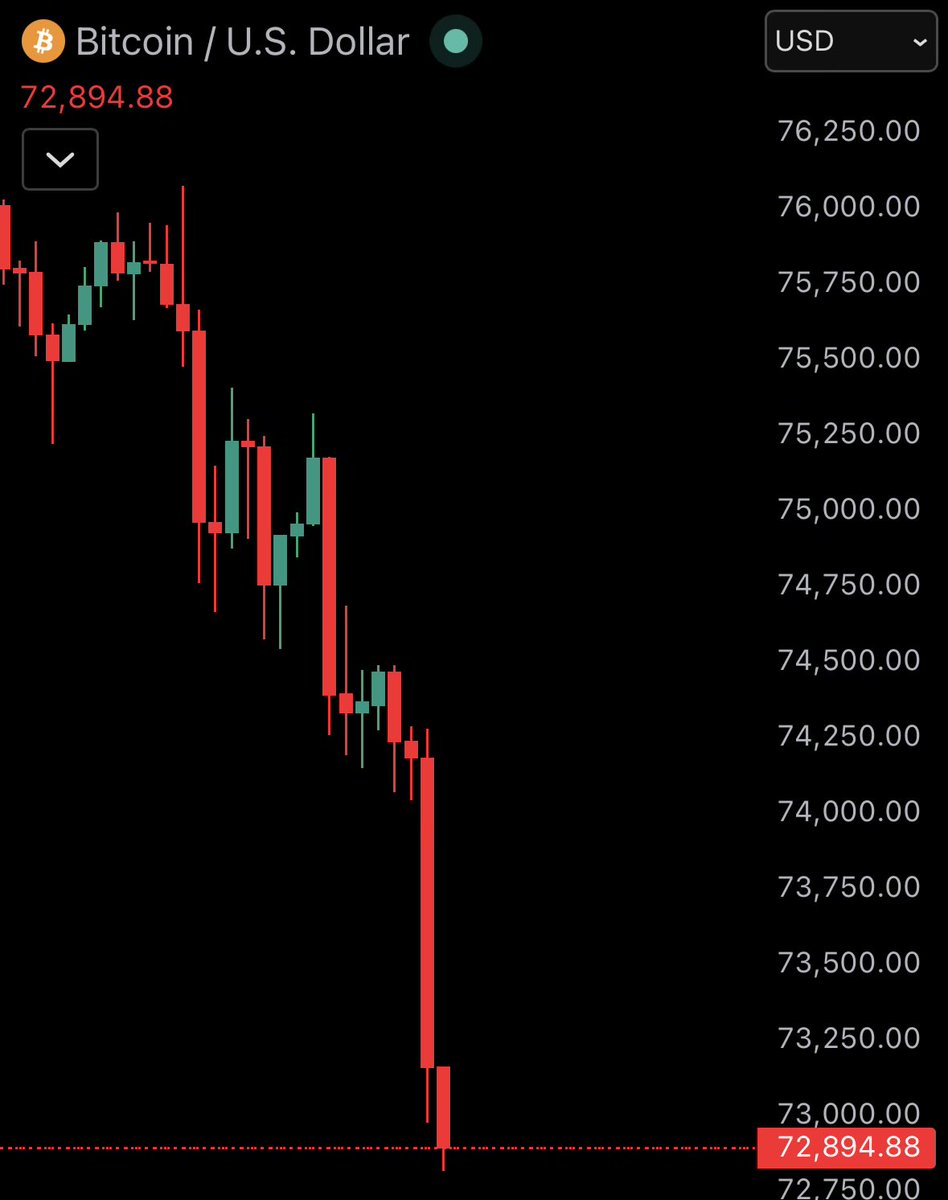
$Bitcoin look very ugly with this bearish breakout.
Will it Bear Trap??
First RSI is showing Hidden Bullish divergence but no confirmation till Bitcoin bounce back above $74,000.
Bitcoin/ nasdaq ratio also dropped to 29 months low, means bitcoin not able to outperform Nasdaq from last 29 months.
🚨NY’s strict regulators giving Mastercard green light for crypto and stablecoin payments is HUGE. 🚀🚀🚀
Billions of users about to spend #crypto like cash.
Stable coins becoming the real winner here.
#Circle, #Tether volumes about to explode.
Banks without crypto rails losing customers fast.
This is mainstream adoption finally hitting Main Street. 🚀
Crypto payments going mainstream or just hype cycle?
Source: Mastercard, NYDFS
#Mastercard #Crypto
There have been a few key changes in crypto market structure.
I've written about this topic before but I found myself carrying some stale epistemological baggage about how the market used to be versus what it is at the moment, so thought I'd share.
1. More coins than ever before and the barrier to creating new coins has never been lower.
2. More competition for the hot ball of money (AI, semis, tech, even commodities) and instruments like 0DTE options - all of which are very attractive to normies.
3. Change in participant type and sophistication - ETFs, more tradfi shops, suits etc.
4. Normie flows that used to concentrate around a few CEXes and a limited token set have been fragmented by the infinite listings and existence of the trenches.
There are fewer normie flows, they're spread too thin, and it's difficult to come back to the casino if you get dumped on for holding longer than 15 seconds.
The main attractor to crypto used to be outsized, long-lasting, and well-distributed trend and momentum effects that were easy to access because there weren't that many venues or coins.
That's basically up only/alt season i.e. multi-month periods that were responsible for a disproportionate amount of a crypto trader's lifetime P&L.
A rising tide lifting all boats is an overused but appropriate analogy - it didn't really matter what coins you bought.
If you got the broader market conditions right, you'd enjoy significant uplift and basically get bailed out even if you made bad picks.
In the current paradigm you can't afford to make bad picks.
To be precise: in previous cycles if you got the conditions right but the assets wrong, you'd still make money but underperform. In the current cycle (even from the most recent BTC run) if you got conditions right but the assets wrong, you got shafted.
So asset selection went from a nice-to-have enhancer to one of the main drivers of returns, even if BTC is going up.
That's a pretty significant departure from what we've dealt with in the past
This type of dispersion is a symptom of the market maturing.
I think that's a net good thing and is likely to incentivise more intelligent token design, less ghost chain VC slop etc.
But that's a forward-looking view, and at the moment we're trapped in this awkward transition phase where the old rules don't really apply but we haven't figured out a new framework yet e.g. top N coins by market cap are still mostly shit vs quality.
Maybe I'm wrong and everything changes and we go back to the market-wide altseason paradigm when conditions are right. This could all be cyclical, but I think that's less compelling than before given the dispersion we saw on the way up too vs just to the downside.
I think it's a good time (especially with other markets and asset classes going crazy) to revisit where crypto sits in the speculative stack and how to approach it as the market is changing.
Cheers.
It is really hard to be optimistic on anything denominated in Bitcoin.
A single stock (Micron) grew by $200 billion today alone.
A single stock (Nvidia) is worth $5.2 trillion.
SpaceX will IPO close to $2 trillion.
NASDAQ is now higher against money supply than it was in the dot-com bubble.
S&P 500 in gold is rolling over. Only three times since 1900. One was the Great Depression, one was the Great Financial Crisis of 2008, third was the crash in the 1980s.
Close to 40% of the S&P 500 is in 10 companies.
If Bitcoin becomes 1% of the world by 2040 (and the world inflates at 7% per year) that is $1,405,000 per Bitcoin.
Long term Bitcoin should eclipse everything else, just as the internet eclipsed everything else.
🚨Breaking:Samsung paying chip workers $400K BONUS each - AI boom finally reaching workers!
78,000 #Samsung semiconductor employees just won 10.5% of operating profit which equals $22 BILLION bonus pool.
Stock jumped 7% on the news because investors realized happy workers equals less talent poaching from TSMC and Micron.
This is the smartest move Samsung made in years.
Memory chip war between Korea, Taiwan, US is really a TALENT war.
Whoever keeps engineers wins.
Expect Micron, TSMC, SK Hynix to announce similar profit sharing soon or lose top talent.
Game theory in action.
REST:#DYOR
#Samsung
#AI
The best thing about being comfortable with trading is, I don't own anything.
I have no stress, no liability, no bank or wordly obligations.
Just one laptop, travelling and stopping wherever I want and a few T shirts because I don't have dress for office.
Live wherever I want. Eventually I'll settle down but nothing else could give me this freedom.
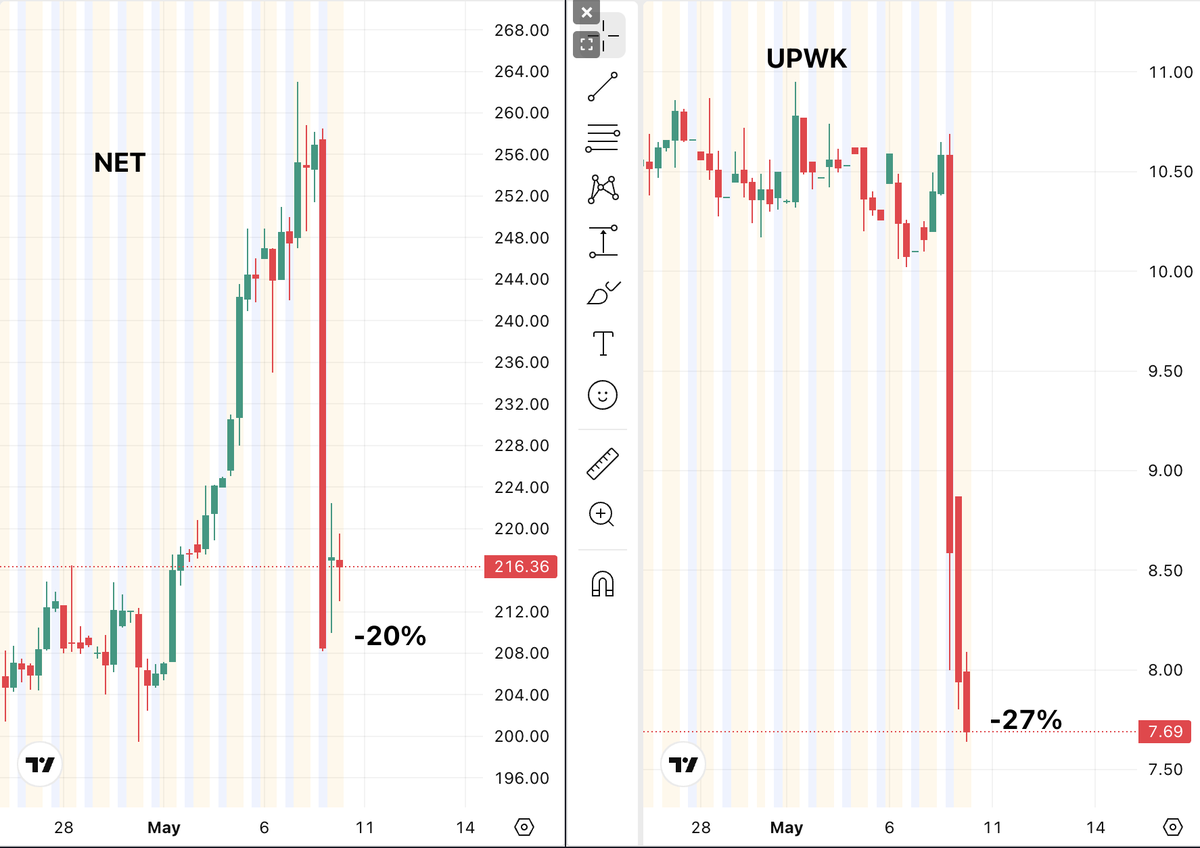
$NET Cloudflare down 17% , $UPWK down 28% in pre market after earning.
Cloudflare beat earnings. Revenue up 34%. Then fired 1,100 humans. AI took their jobs.
Upwork connects businesses with freelance workers. Revenue grew just 1.4%. Fewer companies are hiring humans now.
Both dropped the same night. Both blamed AI.
One is the tool replacing workers. The other is the marketplace losing them.
Memory stocks continue printing money.
$MU up 8% today — hit a new all-time high of $588, nearly 10x in the last 13 months.
$SNDK up 5% today — hit a new all-time high of $1,257, nearly 45x in the last 13 months.
No FOMO, but I spoke with a senior executive — all supply is completely sold out and demand is already booked till 2027.
#DYOR Both stocks will highly volatile in coming weeks.
Clear lesson from the last 12 months:
Real AI stocks (both large and small cap) like $NVDA $MU $SNDR delivered multi-x returns.
Meanwhile, most AI crypto coins are sitting at multi-year lows, down 70% to 99%.
Why the massive difference?
Most AI tokens launched at ridiculously high valuations with massive hype, then got dumped on retail. Big exchanges helped facilitate the liquidity for exits.
Now we’re seeing the reality:
- SAFT unlocks every month → continuous selling pressure
- Developers raise money, build hype, then move to the next project
- Most of these coins will slowly die
Only a tiny fraction (0.001 level) will actually survive and perform.
Key takeaway for next cycle:
- Valuation matters more than narrative.
- If a project starts with insane FDV and no real product, it’s usually just a sophisticated exit liquidity play.
It not a sale call, But don't forget to sale or switch when these coin give another fake pump for 3x-5x after 90%+ correction.
Be very selective.
$ICP $NEAR $RNDR $FET $INJ $IP $AKT $GRT
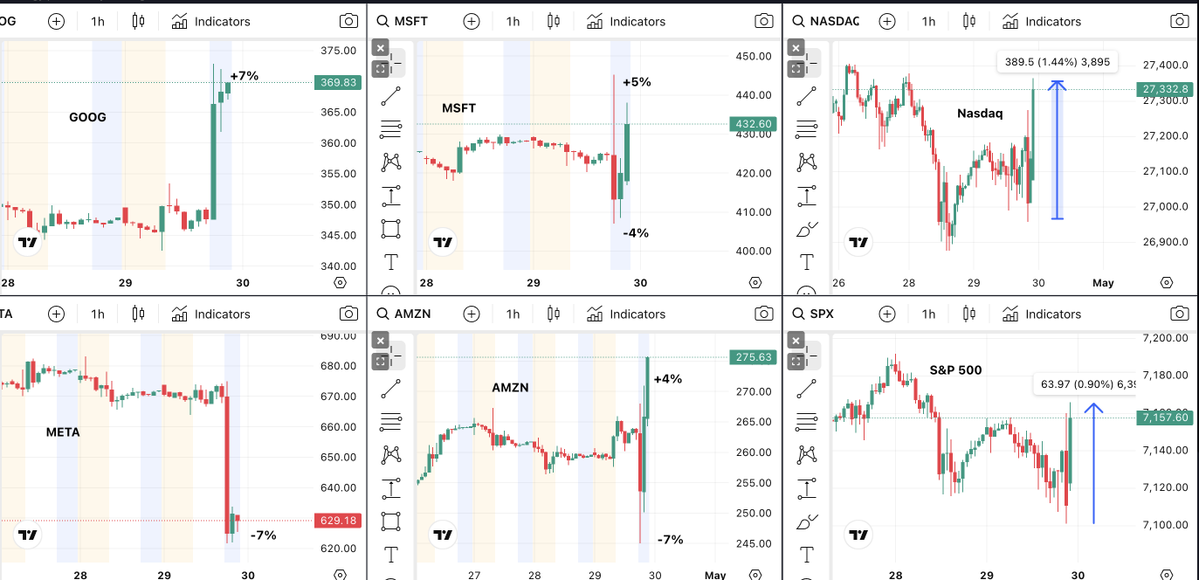
After 2.30 hrs of eanings
$GOOG up 7% at record ATH
$MSFT back to 2%
$AMZN Big swing, First dropped -7% , but now 4% up
$META still -7% down
Nasdaq F up 0.55%, less than 100 from new High.
Israel’s economy is showing remarkable resilience despite nearly 3 years of war.
The Bank of Israel expects 3.8% GDP growth in 2026.
The IMF is even more optimistic — forecasting 3.5% this year and 4.4% in 2027, outperforming all G7 countries.
Key strengths:
• Unemployment at just 3.2% (lower than US & Eurozone)
• Debt-to-GDP ratio of 69.8% (much healthier than G7 average of 123.7%)
• High-tech, defense, and gas exports remain strong
If ceasefires hold, growth could accelerate to 5.5% next year.
War has hurt tourism and some sectors, but Israel’s private sector, skilled workforce, and demographics continue to support a solid rebound.
Are you surprised?
Trump to sign executive order expanding retirement access.
The order aims to boost the “Saver’s Match” program, providing up to $1,000 annual matching contributions for workers earning under $35,000 who don’t have employer-sponsored retirement plans.
This targets roughly 54 million Americans currently without access to such plans.
A notable push to increase retirement savings participation among lower and middle-income workers.
Is the US economy moving towards Stagflation?
The Good News:
- Initial Jobless Claims: 189K (massive beat vs 213K forecast) , lowest in months. Labor market remains strong.
The Bad News:
- Q1 GDP: 2.0% (missed 2.2% forecast), economy slowed.
- Core PCE (Fed’s favorite): 4.3%, QoQ (much hotter than 4.1% expected). Biggest quarterly jump in years.
Simple Summary:
Strong jobs.
Slowing growth.
Rising inflation.
This is stagflation lite— the worst combination for the Fed.
They can’t cut rates to support growth (because jobs are strong), and they can’t cut to fight inflation (because prices are accelerating). They’re boxed in.
The Iran war oil shock is now clearly feeding into the numbers — exactly as expected.
Follow @NeelMacro. The next move is already in the data.
Rest. #DYOR