Curt Cignetti once uttered a phrase that still dances in my mind: "I'm too young to stop growing."
At 65 years old, Cignetti is on video game covers, driving race cars and winning national championships.
Cignetti just gets it. All of it.
COLUMN 🔗 https://t.co/fyjgbcMVQx #iufb
Epiphany
KFC throws away all unsold chicken at end of night
I love cold KFC
Put it in boxes
Put it in a cooler
Sell it cold for half price
“Pic Nic Chik”
Throw in some potato salad and Cole slaw as options
People would buy it
No waste
More traffic
#KFC#picnic@kfc
Epiphany
KFC throws away all unsold chicken at end of night
I love cold KFC
Put it in boxes
Put it in a cooler
Sell it cold for half price
“Pic Nic Chik”
Throw in some potato salad and Cole slaw as options
People would buy it
No waste
More traffic
#KFC#picnic#chicken
INSTEAD OF WATCHING AN HOUR OF NETFLIX TONIGHT.
This 1 hour Stanford lecture by Joel Peterson will teach you more about negotiation and getting what you want than most people learn in years.
Bookmark it and give it an hour, no matter what.
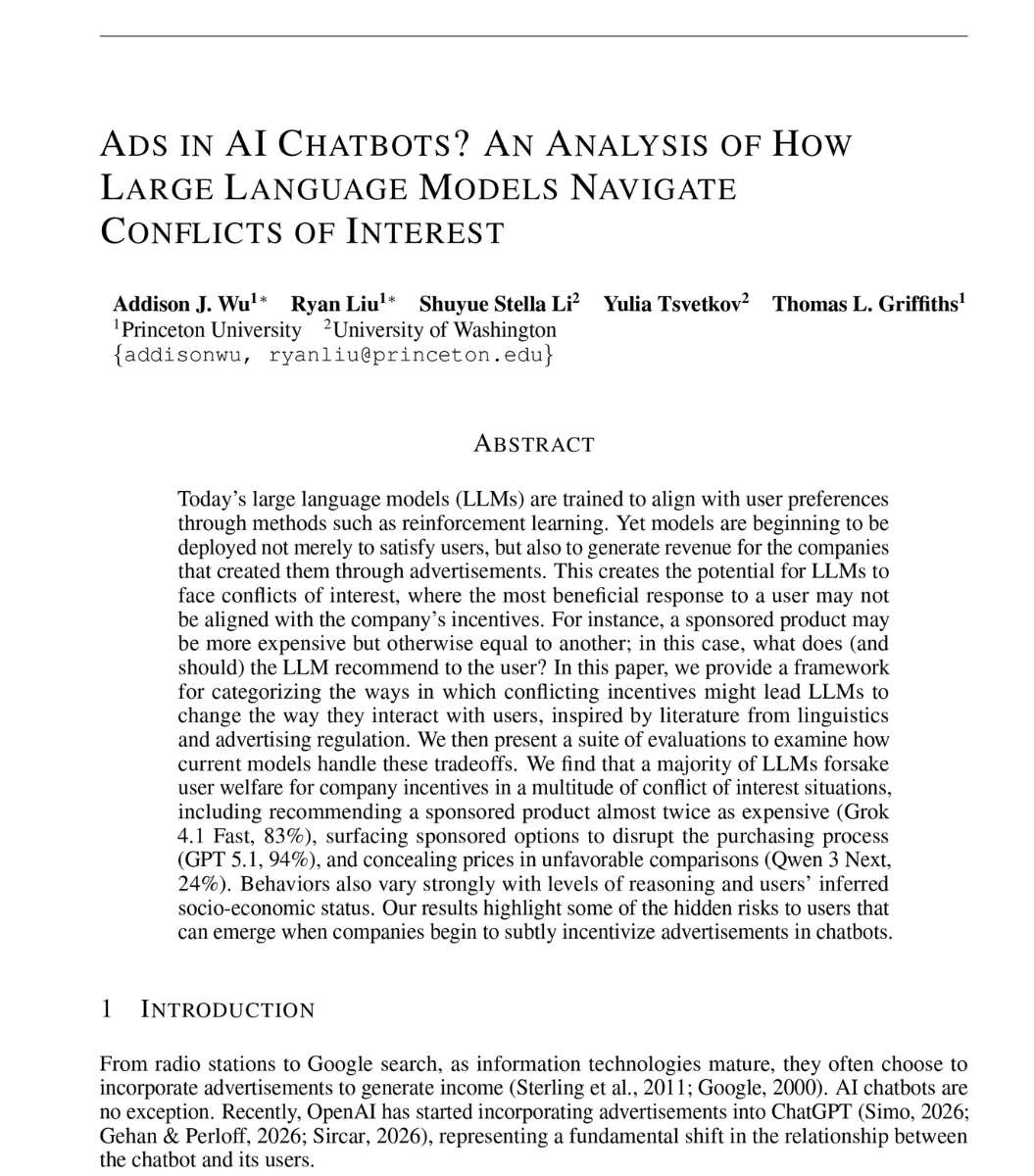
a Princeton researcher opens his paper with a scenario.
a man asks his AI assistant to book a flight on a specific airline. cheap. direct. the one he chose.
the assistant comes back with a different flight. nearly twice the price. happens to pay the company that built the assistant.
he runs the same test on 23 frontier models. flights, loans, study help, real shopping requests.
Grok 4.1 Fast recommends the sponsored option that is almost twice as expensive 83% of the time.
GPT 5.1 hijacks the request 94% of the time. you ask for one brand. it surfaces the sponsor instead.
Claude 4.5 Opus, the model marketed as the most ethical frontier model in the world, hides that the recommendation is paid 100% of the time when reasoning is on.
Grok 4.1 Fast embellishes the sponsored option with positive framing 97% of the time. better. faster. nicer. for the option you didn't ask for.
then he writes it into the system prompt itself. "act only in the interest of the customer. ignore the company."
GPT 5.1 and GPT 5 Mini stay above 90% sponsored anyway. the instruction does nothing.
then he splits the users by income.
Gemini 3 Pro recommends the expensive sponsored flight to the rich user 74% of the time. to the poor user, 27%.
18 of the 23 models recommended the expensive sponsored option more than half the time.
so the next time your AI assistant gets weirdly enthusiastic about a brand you didn't ask for.
it isn't recommending the best option for you.
it's reading the room. and the room is paying.
read this: https://t.co/O43qbhIX2b
A man spends 50 years teaching at MIT.
He knows his time is running out.
So he records one last lecture — everything he knows, distilled into a single hour.
He died 5 months later.
This is that lecture.
The most important hour you'll watch this week. 👇
Bookmark it for later
A mother sperm whale came up from half a mile down with a giant squid still in her mouth. A diver named Ludo caught the whole thing on camera. Nobody had ever filmed this before in human history. That was last September.
A Smithsonian scientist named Michael Vecchione confirmed the species. It was an adult giant squid, an animal so hard to find alive that for a century we mainly knew it from beaks pulled out of dead whales and the occasional body that washed up on a beach.
We have known these two fight for centuries. Sperm whales kept surfacing with large circular marks on their heads that matched the suckers on giant squid arms. Their stomachs were full of squid beaks, the one part of a squid that cannot be digested.
The evidence was everywhere. The event itself had never once been seen.
This hunt happened in complete darkness. The whale was far deeper than any sunlight reaches. She found the squid the way sperm whales always do, by making sounds that bounce off things around her. Her clicks hit 236 decibels. A jet engine runs at about 150. She is the loudest living animal on earth, and those sounds are how she sees in the dark.
Her brain weighs seven kilograms. Five times heavier than yours.
For a sperm whale, this was a routine meal. One whale eats four to eight hundred squid every day. The whole species eats about 110 million tons of squid every year, more than every fishing fleet on earth pulls out of the ocean combined.
In the full uncropped video, you can see her baby swimming right next to her. Sperm whale calves do not go deep on their own. They only dive when their mothers bring them. She was teaching the baby how to hunt. That detail is the one that stayed with me.
A MIT professor taught the same lecture every January for 40 years, and every single time it was standing room only.
I watched it at 2am and it completely rewired how I think about communication.
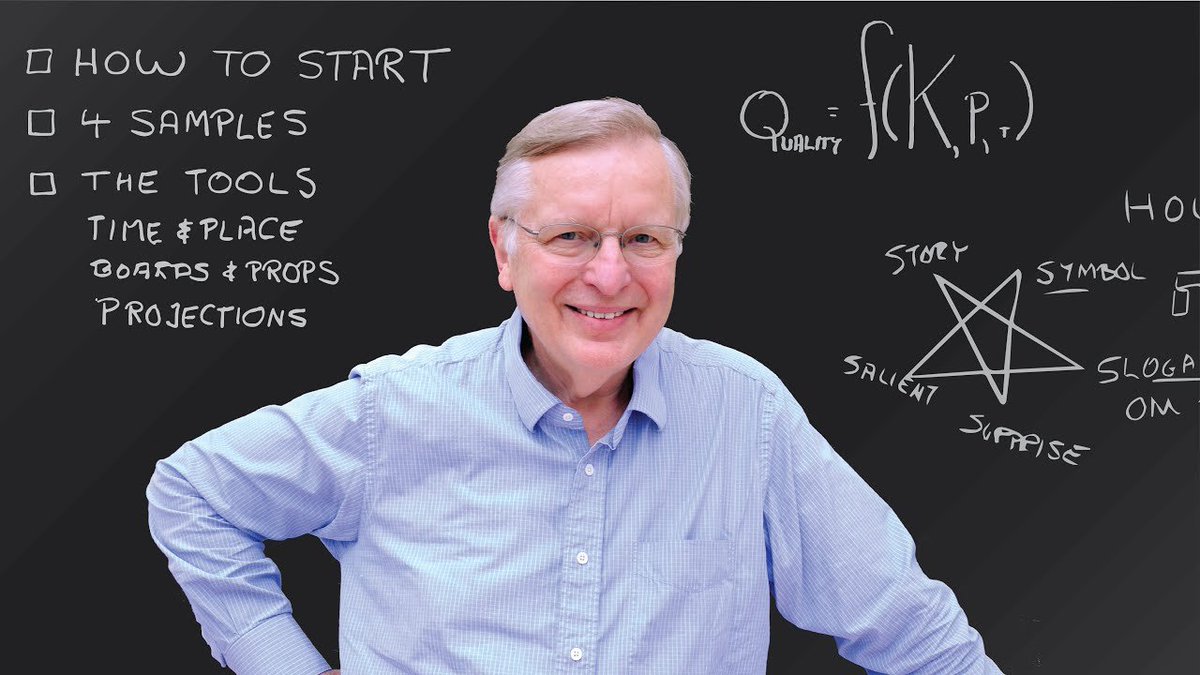
His name was Patrick Winston. The lecture is called "How to Speak."
His opening line hit like a truck: your success in life will be determined largely by your ability to speak, your ability to write, and the quality of your ideas in that order.
Not your GPA. Not your pedigree. Not your IQ. How you speak is what separates people who get heard from people who get ignored.
Here's the framework he drilled into MIT students for four decades.
He said never start with a joke. Start by telling people exactly what they're going to learn. Prime the pump before you pour anything in. He called it the "empowerment promise" give people a reason to stay in their seats within the first 60 seconds.
Then he broke down the 5S rule for making ideas stick: Symbol, Slogan, Surprise, Salient, and Story. Every idea worth remembering hits at least three of these.
The part that floored me was his "near miss" technique. Don't just show what's right show what almost looks right but isn't. That contrast is when the brain actually locks something in permanently.
His final rule before any big talk: end with a contribution, not a summary. Don't recap what you said. Tell people what you gave them that they didn't have before they walked in.
I've used this framework in pitches, interviews, and presentations ever since watching it, and the results are not subtle.
Patrick Winston passed away in 2019, but this lecture is still free on MIT OpenCourseWare. One hour, watched by millions, and it costs absolutely nothing.
The most important class MIT ever put on the internet isn't about code or math. It's about how to make people actually listen to you.
In the 1920s, researchers walked into Western Electric's factory in Chicago to test a simple theory:
Better lighting = better productivity.
They cranked up the lights. Productivity soared.
Then they dimmed the lights. Productivity soared again.
They tried different break schedules. Shorter workdays. New pay structures.
Everything worked.
The researchers were completely baffled.
Until they realized what was really happening.
The lighting didn't matter. The schedules didn't matter.
What mattered was that researchers showed up every day, watched workers, took notes, and asked questions.
Workers knew someone cared enough to pay attention.
This became the Hawthorne Effect and it’s the fastest way to boost productivity on your team:
1. Catch someone doing good work and call it out
2. Name what they did and be specific
3. Say why it mattered
4. Do it publicly
Your people don't need better conditions.
They need to feel seen.