CUBIT has a launchpad and almost nobody noticed.
The Forge is live at https://t.co/rBWfEngJvm.
Anyone can launch a token for 0.005 ETH. You pick a name, a symbol, and the wallet that receives your team taxes. One transaction deploys your token, its Uniswap v4 hook, and its pool.
Every launched token runs the same machine as CUBIT: 21M fixed supply, 100% into one band at launch, 3% buy tax, 15% sell tax — 12% of every sale builds ETH walls under your price automatically. Your hook has no admin. Nobody can pull your liquidity.
Child markets are fully isolated. Your token gets its own band and its own walls. If it dies tomorrow, CUBIT's pool doesn't notice.
The launch fee goes to the governance vault — not refunded, not yours. When your walls get crossed, the CUBIT they absorb goes there too.
This isn't a launchpad that prints a token and wishes you luck. It's CUBIT's market maker, copy-pasted into its own pool.
This is what a wall looks like when it works.
Price dumped. Hit the top wall support. Stopped.
The green line isn't a chart indicator, it's ETH sitting under the market, placed by prior sells. The blue line didn't bounce because someone bought the dip. It hit a bid that already existed.
https://t.co/vuSk2EJAiZ
There are no LP tokens to lock. CUBIT's liquidity sits inside the Uniswap v4 hook, the protocol is the only LP. 80% of supply went into the band at launch. No withdraw on the band, no admin on the hook, no way to pull wall ETH. A v2/v3 locker solves dev-held LP. We don't have that problem, it's locked in the bytecode.
Verify : https://t.co/BHcCL2mcVe · 📷https://t.co/1PWnrvVTR2
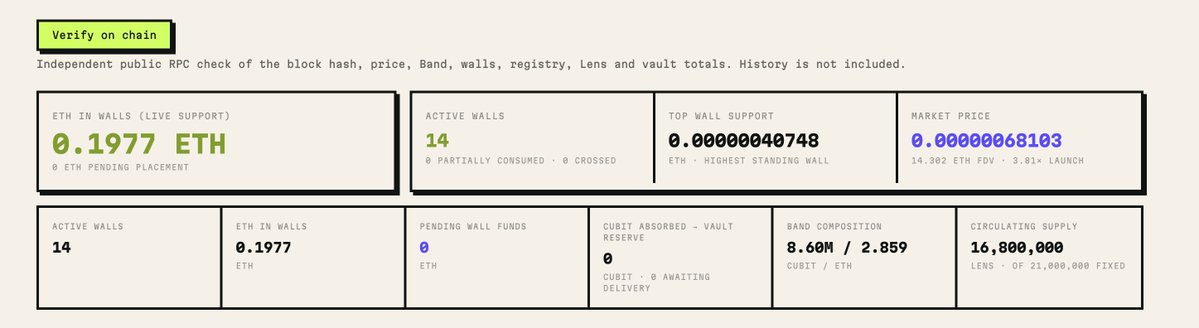
New page: the state of the market, read straight from the Lens.
The band's current composition, each active wall and its remaining depth, pending funds, and where the next target sits.
It's a lens, not a lever. It cannot withdraw ETH from a wall, cannot move the band, cannot change a single rule. The geometry it displays is the hook's geometry, a frontend can't invent one.
https://t.co/32wyW8BeX6
What currently sits under the CUBIT market:
· 0.36 ETH across 34 active walls
· 0 ETH pending, waiting for a placeable target
· 1.49 ETH in the band — exactly what buyers put there
· 201,824 CUBIT taken off the market by walls, heading to the Vault reserve
Four balances. Four different jobs. A single "floor" number would be a lie, so we don't publish one.
When does a wall absorb again? When price hits the next one. No schedule. Just trades.
Live data: https://t.co/1PWnrvVTR2
@Korasu88888 When the market crosses the next active wall.
12% of every sell keeps stacking ETH under the price until one gets hit, u can check the proof here : https://t.co/yiyFgq2XVP
A wall just did its job.
Wall #12 spent 0.0305 ETH buying 79,690 CUBIT from a seller.
The sale emptied it. Those CUBIT are on their way to the Vault reward reserve.
Absorption isn't a promise in a pinned tweet. It's an event with a transaction hash.
Proof: https://t.co/CZ8eNciTC9
Soon you'll be able to deploy a market that runs on CUBIT's machine.
A launchpad, but not the kind that prints you a token and wishes you luck.
What you deploy: your own Uniswap v4 hook where the protocol is the only liquidity provider, where 12% of every sale places an ETH wall under your price automatically, and where no address can pause your market or pull your liquidity. Because those functions don't exist.
Your launch fee goes into CUBIT's pending wall funds. Nobody launches here without adding to the wall.
The Forge. Soon
In 2022, $GIZA invented protocol-owned walls and ran 100x before it died.
The idea was right. The trust model killed it. Their rebalance was a manual call from the dev's wallet, and when the market turned, their v2 quietly pulled the buy-side liquidity, the exact liquidity the floor was made of.
CUBIT is that idea rebuilt on a Uniswap v4 hook, with the operator removed from the loop entirely.
Walls are placed by the sale that funds them. The band is never withdrawn. There is no admin key, no pause, no guardian, nothing to call and nobody to trust with calling it.
GIZA needed someone to show up. CUBIT needs nothing.
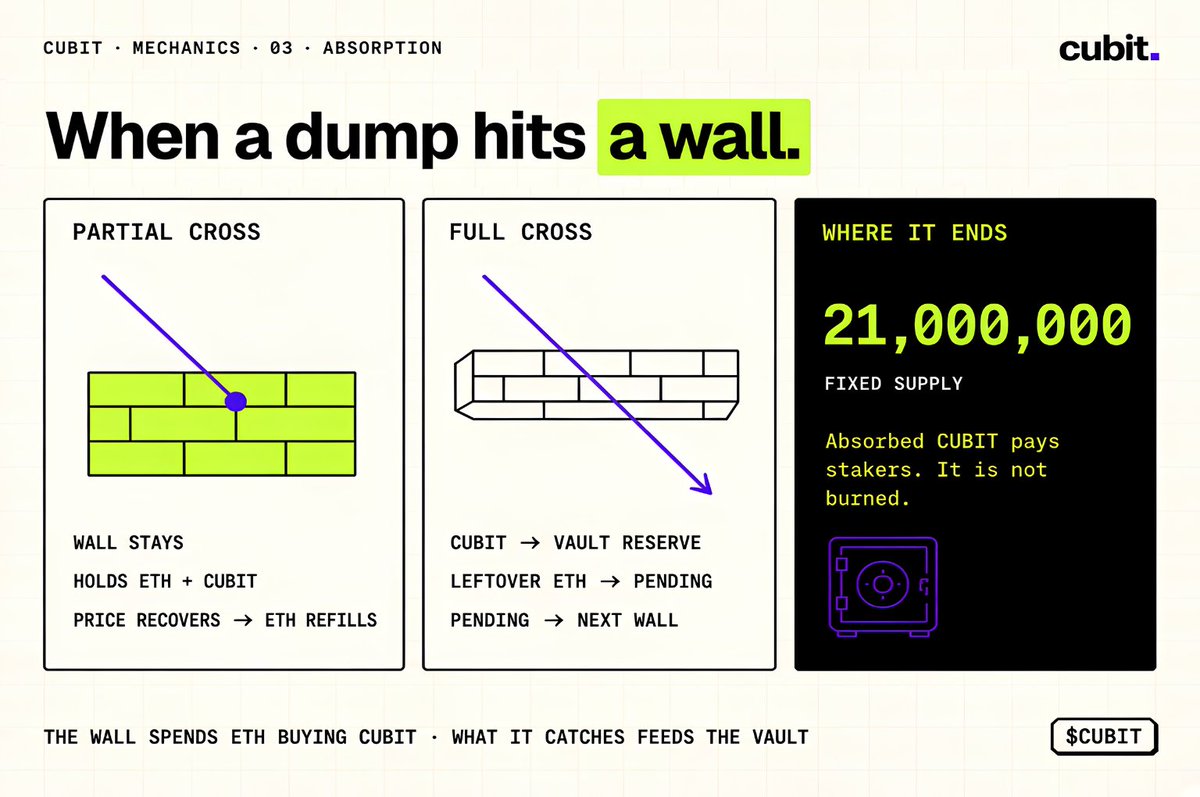
What happens when a dump reaches a wall.
The wall spends its ETH buying CUBIT. If the price stops inside the wall, the wall stays in place, holding both, and refills with ETH if the price comes back up.
If the price goes all the way through, the sale empties that wall. Its CUBIT goes to the Vault reward reserve. Its leftover ETH goes back into pending funds and gets placed in the next wall.
To be explicit, because the old version worked differently: absorbed CUBIT is not burned. Supply stays at 21M. CUBIT is not a deflationary token.
The tokens the walls take off the market go to the people who stayed staked.
You've probably seen a holder sitting on 20% of the supply. That's a contract, not a wallet.
It's 4.2M CUBIT set aside at launch for the staking rewards. The team holds zero tokens. No allocation, no vesting, nothing to dump. We get paid from the tax, in ETH.
That reserve is what stakers will earn from, paid in CUBIT. It's finite: when it's empty, rewards stop, and nothing mints more. Fully crossed walls refill it with the CUBIT they take off the market.
Staking goes live very soon. Until then the tokens just sit there, and the contract is public.
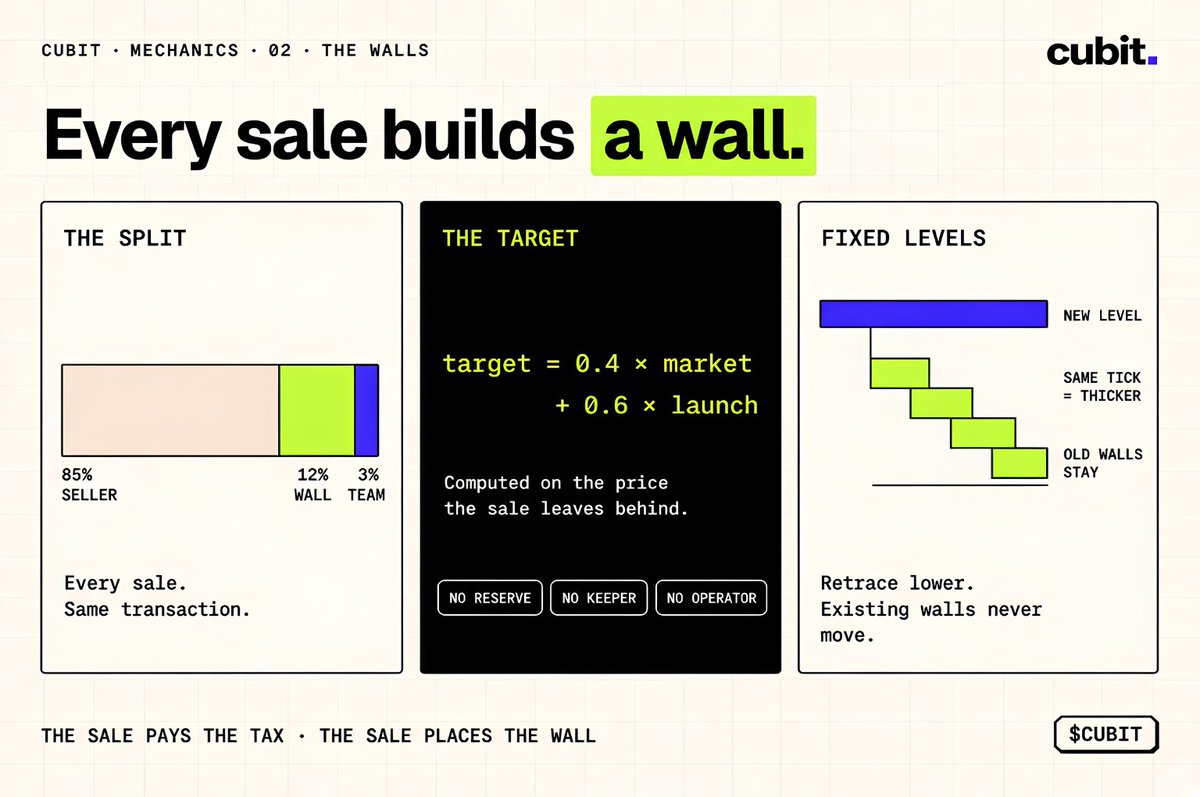
Every sale builds a wall. The sale places it itself.
12% of the ETH from every sale funds an ETH-only buy position under the market, at a level set by one fixed formula:
target = 0.4 × current price + 0.6 × launch price
Calculated on the price the sale left behind. No reserve waiting for a maintenance call. No keeper. No operator. The transaction that pays the tax is the transaction that places the wall.
Once placed, a wall never moves from its tick. New money builds new levels. Two fundings landing on the same tick thicken the same wall.
There is no all-time-high ratchet. If the market retraces, the next wall is placed lower, and every older wall stays exactly where it was built, holding whatever ETH it has left.
Quick update: there’s currently a routing issue on the Uniswap interface preventing some CUBIT sells.
The token, pool and hook are working normally. Sells are going through on trading bots and other compatible routers.
This is a frontend routing issue, not a problem with the contract. We’re working on resolving it.
The first wall is funded.
CUBIT is trading around $41K market cap. The first wall under the price sits near $23.5K, and twelve more are stacked below it, down to about $17K.
Every level is live at https://t.co/yiyFgq2q6h.