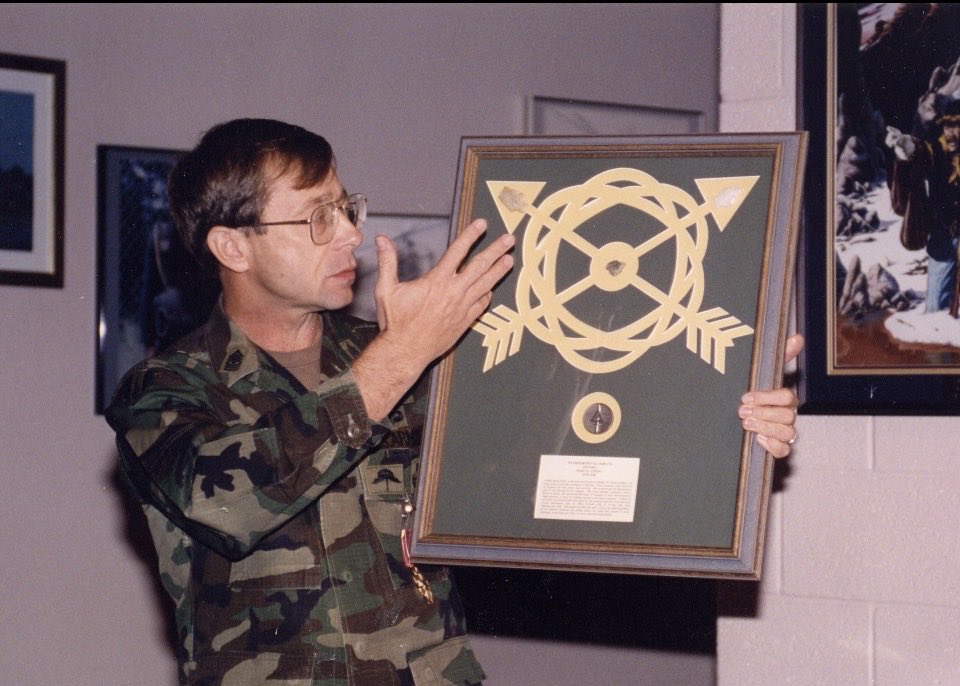
I gave this plaque to the Unit upon my retirement. It hangs in Delta.
This is what I wrote on it:
TO FREEDOM'S GUARDIANS
THANKS
MIKE R. VINING
1989-1999
I found these Native American arrowheads on Range 19, which testifies to its long history of use that continues to this day. They symbolize man's first use of weapons for war, peace, and survival. The arrowheads are displayed as part of the Special Forces insignia. The atom emblem symbolizes today's threat to peace, the counterproliferation of weapons of mass destruction by rogue nations. A piece of trinitite represents the atom's nucleus. Trinitite is sand that was transformed into glass by the pressure and heat from the first atomic detonation, July 16, 1945, 5:29:49 A.M. at Trinity Site, near Alamogordo, NM. The plaque signifies the unit's role as the quiet guardians of our nation's freedom and public safety, for which this country is truly indebted. It has been my honor to serve with this organization.
Somebody has to be the richest person on the planet.
The fact that it’s the guy who popularized electric cars, made rockets reusable, and is working on curing blindness and paraplegia as a side quest seems fair to me.
I’ve never watched to a @jockowillink podcast before. So I dove into his episode 192 recently.
He started off going into this powerful monologue. Spitting absolutely warrior poet fire. Frankly I was taken aback. I mean this was POWERFUL stuff.
Then he says one line that hit me hardest:
“Eventually you and the men by your side have lived lifetimes worth of life in a matter of months. And those men, the ones that survive, become your brothers. And the ones that don’t survive, become your heroes.”
After reading a little more from the paper he was looking at, he reveals those are the words of Sean Parnell @SeanParnellASW from the book ‘Outlaw Platoon’.
Absolutely epic warrior prose.
And given the current environment where we are arguing over how to remember the GWOT, it hits harder than ever.
The ones that didn’t survive became our heroes.
We would do well to remember that and act accordingly.
All we ask from our countrymen is to be Americans worth giving the last full measure of devotion for. So that if there is no choice for us but to charge into the abyss, we do so knowing it isn’t all in vain.
And that we do it for more than because the law tells us to.
The law can compel obedience. Only love of country compels righteous sacrifice.
You could feel the tension from people today during the run up to the Anthony verdict.
"Are we gonna get fucked over again"
Well Texas Jurors said "No you aren't"
And it was like relief washing over people in real time. Society has become very unjust and it was nice to see
I want to tell you a story about a “journalist.”
I’m pretty sure the journalist in question was Scott Pelley, but for reasons I am about to explain I can’t be 100% sure—I just know it was a major US TV reporter.
August, 2003.
I was the G-4 of the 82nd Airborne Division. The IED threat had just become a real thing in Iraq and the 82nd—having just returned from Iraq—was sent back to the fight.
The “Division Support Area” was earmarked for a place called al Taqaddum, or “TQ.” I led the advance party to occupy the site (we drove from Kuwait). TQ was a huge area on a high bluff, west of Fallujah, and had a cratered Iraqi Air Force airfield. Later in the war it was a plush site with a PX and restaurants, but when I occupied it, it was nothing but a bunch of abandoned buildings, hulks of old Iraqi fighting vehicles blocking the runway, nightly rocket and mortar attacks, and constant probing of the huge perimeter by insurgents.
The IED threat was happening because insurgents were pulling artillery rounds out of abandoned Iraqi army ammunition supply points and turning them into roadside bombs.
We had been on TQ about one full day when the front gate called me on the radio: “All American 4, we have some TV reporters here, they want to come in, what should I do, over?”
After telling the gate to check IDs and do a sweep of their vehicle, I said: “Send them to me, over.”
A few minutes later an armored Mercedes pulls up to our TOC. The “talent” is in the very back where I could barely see him, but I’m pretty sure it was Scott Pelley. (Pelley was definitely in Iraq at the time, I checked.)
His producer gets out from the air-conditioned Mercedes plushness and pulls out a map. He arrogantly points to an Iraqi ammo supply point between TQ and Ramadi and demands: “I need you to escort us to this location.”
(They wanted to do a story with reporter speaking against a backdrop of an ammo supply point, because that’s where the IEDs were coming from.)
“NEED? I’m sorry sir, that site is not secured and I am not putting my paratroopers at risk for your story.”
Big disappointment and head shaking. I’m thinking: “The NERVE of this guy. Does he think I work for him?”
He then asks: “Well what will happen if we go by ourselves?”
My response: “You’ll probably die.”
(Important background: TQ also had a giant Iraqi ammo supply point that was inside the wire but we had not cleared it yet—it could have been booby-trapped, we just did not know at the time.)
He points at the map again: “Well how about the ammunition right here? We can just drive over there, right?”
“No sir, you cannot. We have not cleared that site.”
By this time he was visibly angry, he had a chat with the talent in the back, and then they all got back in and left without even saying thank you or good bye.
(Important point: the ammo on TQ he wanted to use as a backdrop for his “story" was SECURED from Iraqis grabbing any of it, yet they wanted to use that as a backdrop for a story on Iraqis grabbing ammo.)
The point of this story is this: those “journalists” were incredibly arrogant, incredibly dismissive of anyone in uniform with dirty boots, and basically oozed a sense of entitlement as if they were on some sort of noble mission, when in reality their mission was to smear the effectiveness of our operations because Bushitler.
When you hear Scott Pelley talk, oozing with arrogance over his “combat” experience, remember that he is of a breed that all think and act alike. To those "journalists," we were not American fighting men and women in combat. No, we were there for their convenience. It sickened me, and still does.
You think you hate journalists enough...
The period from 2006 to 2009 in Iraq was a strategic and operational mess.
Higher headquarters and civilian leadership in DC often had unclear or shifting objectives, and assessments were frequently written to satisfy whatever narrative the academics, colonels and above, or political masters wanted to hear that quarter. We were handed impossible tasks and regularly accomplished them anyway. To hindsight second-guess the people on the ground who were actually dealing with that soup sandwich is beyond the pale.
@infantrydort recently shared one such account on X: a detailed first-person description of a 2008 firefight near Sadr City, in which his small element was attacked from multiple directions during a dust storm, took sniper fire and mortar rounds, called for artillery and air support on the buildings the fire was coming from, and held their ground.
@HicksCBER, a retired military academic responded by implying the officer had never thought through the implications of calling for fire in an urban setting and didn't know anything worth knowing. The veteran's reply was raw and unfiltered, the kind of response you get from a man who actually carried the weight of those decisions. Both reactions make sense. This post is about the context that was missing from that exchange.
Fights matching that pattern occurred across eastern Baghdad and the surrounding belt in April 2008. On April 17 and 18, a heavy dust storm engulfed the city. Mahdi Army gunmen used the cover to attack coalition front lines and checkpoints. Iraqi units at police stations and positions came under pressure, with some companies deserting or being overrun before American forces reinforced. Fighting continued through the night and into the next day while aviation and drones were grounded by the storm. Official reports recorded 17 Iraqi soldiers and 22 militiamen killed in that span, along with civilian casualties.
A second wave hit around April 27 and 28 during another dust storm. Mahdi Army fighters again attacked blockades and positions around Sadr City and in eastern and northeastern Baghdad. In one documented clash, a large group assaulted a joint Iraqi and US checkpoint in northeastern Baghdad with small-arms fire. Twenty-two Mahdi Army fighters were killed in that single engagement. Additional fighting in eastern Baghdad that same period left another 16 militants dead. Broader reporting from the same days noted that most of the roughly 41 Mahdi fighters killed in recent clashes had been attacking checkpoints and patrols while using the sandstorm to offset the lack of air cover. US and Iraqi forces responded with ground counterattacks, armor support where available, and fires into urban areas.
These actions were part of the militia response that followed Prime Minister Maliki's launch of Operation Charge of the Knights in Basra in late March 2008. The Iraqi government was moving against Jaish al-Mahdi strongholds and criminal networks in the south. Tehran enabled pushback through its proxy networks, producing coordinated pressure in both the south and the Baghdad belt. Dust storms became a recurring tactical factor that allowed militia groups to mass against checkpoints, bridges, and canal crossings while degrading Coalition ISR and aviation. The consistent pattern across these fights included use of captured equipment, indirect fire, and deliberate operation in dense urban terrain where civilian presence complicated targeting. That was terrain the enemy chose precisely because it created that complication.
That last point is the one the armchair critics consistently miss.
Michael's charge, that the officer never thought through the implications of calling for fire in an urban setting, gets the causality backwards.
The enemy engineered that dilemma deliberately.
They amassed in dense neighborhoods, used civilians as tactical cover, and timed attacks to dust storms that grounded air assets and degraded ISR. The choice was not between a clean option and a messy one. It was between accepting friendly casualties and accepting the risk of civilian harm inside an urban environment the enemy had deliberately occupied. That is not an ethical failure. That is the enemy's strategy, successfully imposed.
At higher levels the picture remained muddled. The Surge had produced tactical gains, but the broader strategy was shifting toward transition with unclear and sometimes competing priorities between Washington, MNF-I, and an increasingly assertive Iraqi government.
Assessments often emphasized metrics that looked good in briefings rather than the harder ground truth small units were facing. The result was the same soup sandwich across sectors: adaptive enemies executing a recognizable pattern while ground forces handled the immediate friction with limited resources and guidance.
Iranian Qods Force facilitation of weapons, training, and direction gave militia groups the capacity to sustain these surges and impose real friction on Coalition and Iraqi forces. Small units on the ground were dealing with the effects of that proxy system in real time, without the luxury of the strategic clarity their critics now claim to possess.
The veteran's raw response, that he didn't stop for an ethics huddle, that he would level an entire neighborhood to protect one of his men, will strike some as troubling. It shouldn't.
Not caring in the moment is not the same as not carrying the weight afterward.
The men who executed these missions lived with the uncertainty about who was truly in the fight versus caught in the middle. Some of that weight is spiritual. Every person involved still bore the image of God, even when the necessities of the moment did not allow for perfect distinctions. That burden is real, and it is one reason why honest processing of what actually happened matters more than lectures from people who were never in it.
This is where detached ethics criticism falls short.
Comments that reduce these decisions to individual moral failures ignore both the documented pattern and the enemy's deliberate tactics. When small elements faced coordinated assaults on checkpoints and key terrain during dust storms, with effective enemy fires and civilians in the same dense areas, the immediate requirement was to break contact, protect their people, and hold ground. Reducing that to an ethical lapse from a safe distance isn't serious moral reasoning. It's the projection of classroom standards onto conditions the classroom cannot replicate.
The men who did this work in 2006 to 2009 do not need to be turned into case studies for someone else's virtue. They need the space to describe the actual pattern of fights they faced: small units accomplishing impossible tasks inside a strategically confused war against adaptive, Iranian-enabled proxies, without being second-guessed by people operating from safety and hindsight. The ground truth of that period deserves more respect than armchair ethics.
Respect to the men who carried it.
You know what? Fuck this. I’m so sick of the retired military academic class and their smug bitch made criticism.
Hopefully this ape gets community noted. But it’s fine.
You know what? I actually did the things you say I haven’t. Many witnesses to this.
You’re right though, I wasn’t thinking about ethics in the heat of battle. You got me Mike. GUILTY.
When I was watching the green tracers streaming from the neighborhood in front of me near Sadr City, shooting at my boys and I, I wasn’t thinking of the law of war. GUILTY.
I didn’t stop to have an ethics huddle with the boys. I didn’t move forward to ask if there were civilians in the buildings.
No, I called for a linear artillery target to level the entire fucking neighborhood because the hair on the head of even one of my men is worth more than every person in Iraq to me.
Then I called for jets to bomb the shit out of those same buildings until the firing stopped. No friendly casualties. Massive enemy BDA.
The next days the local cemetery had a massive stream of corpses from that engagement. Were some civilians? Were they all enemy? I don’t know. I don’t care.
I would siege Constantinople to save the life of an American son or daughter. Ruthlessly.
Go to hell you smug bastard.